Illuyanka: The Hittite Serpent Who Defeated the Storm God
Illuyanka was a powerful serpent that defeated the Storm God in one of the best-known myths of the ancient Hittites. In the first surviving version, the goddess Inara arranges a feast to lure the creature from its hiding place, allowing a mortal man named Hupasiya to bind it. In the second, Illuyanka steals the Storm God’s heart and eyes. Recovering them requires a marriage alliance that ultimately costs the god’s son his life.
Both accounts survive in the Hittite composition CTH 321, each followed by ritual passages associated with the purulli festival. Their preservation alongside these rituals places the stories within the religious practices of the Hittites, rather than leaving them as isolated tales of divine combat.
Who Was Illuyanka in Hittite Mythology?
Although Illuyanka is commonly called a dragon, the Hittite word illuyanka-, also written elliyanka-, was a common noun rather than a personal name. Hittitologist Harry A. Hoffner Jr. preferred the broader translation “serpent” or “reptile,” since the word “dragon” can suggest features not described in the ancient text. Its linguistic origin remains disputed. Some scholars favor a non-Indo-European Anatolian origin, while others have proposed Indo-European derivations.
The surviving narratives provide almost no physical description of Illuyanka. The creature emerges from an underground hiding place with its offspring in the first account, but neither version describes wings, multiple heads, or the ability to breathe fire. Such features in modern illustrations are imaginative reconstructions rather than details preserved in the Hittite tablets.
Illuyanka appears as a supernatural opponent powerful enough to defeat the Storm God. The texts offer no account of its origins or explain what caused their conflict. No independent cult devoted to Illuyanka is securely documented, and CTH 321 portrays it as an adversary of the Storm God rather than a deity receiving worship.
Where Does the Illuyanka Myth Come From?
The Illuyanka myth survives in cuneiform tablets discovered at Hattusa, the capital of the Hittite Empire. Classified as CTH 321 in the Catalogue des Textes Hittites, the composition is preserved principally on a tablet known as KBo 3.7, alongside seven additional fragmentary manuscripts.
The opening attributes the account to Kella, a priest of the Storm God of Nerik, in connection with the purulli festival. A colophon at the end identifies the text as the first tablet of Kella’s words and names Piḫaziti as its scribe. It also mentions Walwaziti, the chief scribe. These details provide rare information about the people associated with the preservation of a Hittite myth.
None of the surviving manuscripts dates to the Old Hittite period. Nevertheless, the composition contains archaic grammatical forms that led Hittitologist Harry A. Hoffner Jr. to identify an Old Hittite origin for the text. The surviving tablets are therefore later copies of material that was probably composed centuries earlier.
The linguistic evidence supports an early origin, but it cannot establish when the two narratives were first combined or whether the accompanying ritual sections developed during the same period.
The First Version of the Illuyanka Myth
The first account begins at Kiškilušša, where the Storm God fights Illuyanka and suffers a defeat. He calls upon the other deities for help, and the goddess Inara responds by preparing a feast.
She fills large vessels with wine and two kinds of beer, marnuwant and walhi. She then travels to Ziggaratta, where she approaches a man named Hupasiya and asks for his help.
Hupasiya agrees, but only if Inara sleeps with him. She accepts his condition and conceals him near the place where she intends to trap the serpent.
Inara adorns herself and calls Illuyanka out of its underground lair, inviting it to eat and drink. The serpent emerges with its offspring, and together they consume the feast and drink from the vessels. When they do not return to their holes, Hupasiya comes out of hiding and binds Illuyanka with a rope.
The Storm God then arrives and kills the restrained serpent, with the other gods standing beside him.
Inara builds a house for herself on a rocky outcrop in Tarukka and settles Hupasiya there. She warns him not to look through the window while she is away in the countryside, explaining that he would see his wife and children.
Twenty days later, Hupasiya looks outside and sees his family. When Inara returns, he begs her to let him go home. The text becomes damaged at this point, leaving her response uncertain. Some scholars have reconstructed a violent ending in which she kills him, but the surviving words do not establish his death.
A damaged passage then refers to Inara placing her house and the river of the watery abyss into the king’s hands at Kiškilušša, connecting the narrative with the first purulli festival.
The Second Version of the Illuyanka Myth
In the second version, Illuyanka defeats the Storm God and takes his heart and eyes. Although the god survives, he cannot regain his former strength without them.
The Storm God marries the daughter of a poor man, and they have a son. When the boy reaches adulthood, he marries Illuyanka’s daughter.
The Storm God instructs his son to ask his wife’s family for the stolen heart and eyes. The young man first requests the heart, which they give him. Later, he asks for the eyes and receives them as well. He returns both organs to his father, restoring the Storm God’s strength.
Scholars have connected this marriage with the Anatolian custom of antiyanza, in which a husband joined his wife’s family. This arrangement helps explain how the son gained access to Illuyanka’s household, although the myth does not describe the marriage agreement in detail.
With his strength restored, the Storm God goes to the sea to confront Illuyanka. As he begins to overcome the serpent, his son stands beside his father-in-law and calls out to his father in heaven, asking to be included in the attack and not spared.
The Storm God kills both Illuyanka and his own son. The text does not explain why the young man asks to share the serpent’s fate.
Why Are There Two Versions of Illuyanka?
The two Illuyanka narratives describe alternative versions of the Storm God’s conflict with the serpent, rather than successive episodes. Both were preserved in CTH 321, despite their differences in setting, plot, and associated rituals.
The first version contains geographical references that place its setting in northern Anatolia, within the religious sphere of Nerik. Its serpent lives underground, while the second account places the final confrontation near an unnamed sea. Harry A. Hoffner Jr. described this as a contrast between a terrestrial and a marine serpent, although it remains uncertain whether the stories originated in different regions.
Their methods of defeating Illuyanka also differ. The first relies on Inara’s trap, while the second develops a plan involving marriage that takes an entire generation to succeed. Both require human participation, but the consequences for the helpers are not the same.
An earlier interpretation suggested that the second version replaced the first. Gary Beckman rejected this view, tracing it partly to an older mistranslation of the passage introducing the purulli festival. He considered the two narratives complementary rather than mutually exclusive.
The accompanying ritual passages also differ, and Hoffner noted that some of their religious details are not entirely consistent. These differences may reflect traditions brought together in a single composition, but the surviving tablets do not establish when or why they developed separately.
Illuyanka and the Purulli Festival
The Illuyanka myth was preserved in connection with purulli, an important Hittite religious festival with roots in older Anatolian traditions. The opening of CTH 321 associates its celebration with the prosperity and protection of the land. Although generally considered a spring festival, purulli has no securely established date. Some scholars have identified it as a New Year celebration, but the surviving texts do not explicitly describe it as one.
The reference to the first purulli celebration at the end of Inara’s story connects the narrative with a local cult foundation at Kiškilušša, although the damaged passage leaves its precise significance uncertain.
The accompanying ritual material also concerns Mount Zaliyanu, a deified mountain associated with rainfall near Nerik. When rain falls in the city, a herald brings thick bread as an offering. Another passage records a request for rain addressed to the mountain.
The material following the second Illuyanka narrative describes the relative standing of local deities and the duties of priests. Zaliyanu’s cult offerings are described as substantial, while his wife Zašḫapuna is ranked above the Storm God of Nerik. Another goddess, Tazzuwašši, is identified as Zaliyanu’s concubine.
Priests cast lots to determine precedence, with a stone seat located above a spring. The closing passages record the royal restoration of land at Tanipiya, including a field, garden, houses, and threshing floor associated with the local cult.
The relationship between the myth and the festival’s actual ceremonies remains debated. Some scholars have interpreted Illuyanka’s defeat as part of a seasonal ritual celebrating the restoration of divine power. Amir Gilan offered another explanation, arguing that Kella, the priest associated with the composition, used the first narrative to explain the origins and importance of a particular purulli cult and justify its support by the authorities at Hattusa.
The tablets establish a connection between the serpent myth and Hittite religious institutions, but they do not demonstrate that Illuyanka’s defeat was reenacted annually during the festival.
What Does the Illuyanka Myth Represent?
The Illuyanka myth is often interpreted as a struggle between order and chaos. The serpent’s defeat restores the Storm God’s authority, but CTH 321 never identifies Illuyanka as a personification of chaos or describes the world falling into disorder. This reading draws partly on comparisons with other ancient serpent-combat myths rather than an explanation given by the Hittite text itself.
Another interpretation connects the conflict with water and agricultural fertility. The Storm God’s association with rainfall and Illuyanka’s underground dwelling have led some scholars to interpret their struggle as a contest over rain and subterranean water sources. Harry A. Hoffner Jr. questioned this division, noting that the accompanying ritual invokes Mount Zaliyanu as a giver of rain. The myth also describes no drought resulting from the Storm God’s defeat.
Gary Beckman emphasized cooperation between gods and mortals, connecting the myth’s ritual setting with the renewal of the land. He also interpreted the fate of the human helpers as a warning against crossing the boundaries between humanity and divinity. However, his reading assumes that Hupasiya was punished with death, which the damaged text does not establish. Hoffner challenged this assumption, suggesting that Inara may instead have dismissed Hupasiya and allowed him to return home. This uncertainty limits interpretations that depend on his supposed execution.
Was Illuyanka Depicted in Hittite Art?
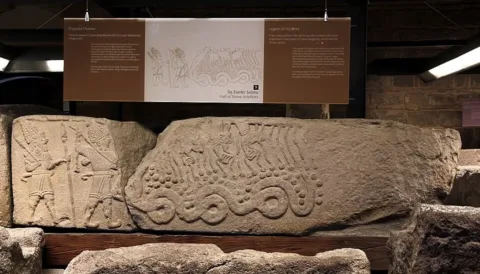
One of the best-known proposed depictions of Illuyanka is Relief H (AMM 12250), a Neo-Hittite stone relief from Malatya-Arslantepe in southeastern Anatolia, dated to the second half of the twelfth century BCE. It shows a large, coiling serpent confronted by two figures dressed like the Storm God. Both carry spears, while one also holds a mace. Scholars disagree over whether they represent separate individuals or the same figure shown at successive moments of combat.
The identification remains uncertain. In the first Illuyanka narrative, Hupasiya binds the serpent before the Storm God kills it, while the second describes a battle without specifying the weapons used. Neither version provides a physical description matching the relief. In a 2023 study, Vladimir Shelestin, Alexandre Nemirovsky, and Anastasia Iasenovskaia argued that the damaged carving probably depicts a two-headed creature with claw-like forelimbs.
The researchers compared the relief with an Old Assyrian seal impression from Kültepe, ancient Kanesh, dating to around the eighteenth century BCE. Preserved on a clay tablet envelope fragment in Moscow’s Pushkin State Museum of Fine Arts, it depicts an armed figure attacking a serpent-like monster. The two images share features that may include multiple heads and projecting forelimbs. However, the figure on the seal could represent the god Aššur rather than the Anatolian Storm God.
These objects demonstrate that serpent-combat imagery existed in Anatolia across several centuries, but neither can be securely identified as an illustration of the Illuyanka myth.
Illuyanka and Other Ancient Serpent Myths
The Illuyanka myth has parallels with other ancient traditions, particularly the Hurrian story of Hedammu and Greek accounts of Zeus fighting Typhon. These similarities involve deception, outside assistance, and the recovery of divine power after defeat.
Hedammu was a sea serpent in the Hurrian Kumarbi Cycle, preserved in Hittite texts as CTH 348. Born from the union of Kumarbi and the daughter of the Sea God, he becomes a threat to the Storm God Teshub. The goddess Shaushka, the Hurrian counterpart of Ishtar, uses music, seduction, and drink to overcome the creature. Her intervention resembles Inara’s strategy against Illuyanka, although the surviving Hedammu narrative does not establish precisely how the monster met its end.
A closer parallel to the second Illuyanka version appears in the Greek Bibliotheca, attributed to Apollodorus. Typhon overpowers Zeus, removes the sinews from his hands and feet, and hides them in the Corycian Cave in Cilicia. Hermes and Aegipan recover the sinews, allowing Zeus to regain his strength and defeat his enemy. Both stories make the god’s recovery depend on retrieving something taken by his opponent.
Read Also
Other Greek accounts resemble the first version. In Halieutica, Oppian describes Pan luring Typhon from his hiding place by promising him a feast of fish. In Nonnus’s Dionysiaca, the mortal Cadmus disguises himself as a herdsman and uses music to persuade Typhon to surrender Zeus’s stolen sinews, claiming he needs them to string a lyre. Both episodes recall the use of cunning in the Illuyanka myth, although neither reproduces the Hittite narrative exactly.
Calvert Watkins examined these parallels as evidence of connections between Anatolian and Greek serpent-combat traditions. Ian Rutherford approached the relationship more cautiously, noting that the closest Greek parallels survive in relatively late sources. Hesiod’s earlier account of Typhon contains no episode involving stolen sinews. Rutherford considered transmission through Cilicia and other regions of cultural contact possible, but the surviving evidence does not establish when or how these particular stories influenced one another.
Conclusion
Neither version presents the Storm God’s victory as a simple triumph of strength. Inara and Hupasiya make the first possible, while the second requires a marriage alliance and ends with the death of the god’s son.
Preserved alongside rituals associated with the purulli festival, the narratives belonged to a wider Hittite religious tradition. Their precise ritual function remains uncertain, as does Illuyanka’s symbolic meaning. The surviving tablets tell us how the serpent was defeated, but not everything the conflict meant to those who preserved the stories.
Academic Sources & Primary Texts
This article draws on the surviving Hittite text of the Illuyanka myth (CTH 321), scholarly translations, philological commentary, and studies of ancient Anatolian religion, archaeology, and comparative mythology.
Primary Hittite Text
- CTH 321: The Illuyanka Myth.
TITUS, Goethe University Frankfurt. Scholarly German translation of both surviving narratives and their accompanying purulli ritual passages.
Read the primary text
Academic Studies
- Hoffner, Harry A., Jr. (2007).
“A Brief Commentary on the Hittite Illuyanka Myth (CTH 321).” In Studies Presented to Robert D. Biggs, Assyriological Studies 27, pp. 119–140. Oriental Institute, University of Chicago.
Detailed analysis of the manuscripts, linguistic evidence, mythological narratives, and ritual passages.
Read the academic study (PDF) - Beckman, Gary (1982).
“The Anatolian Myth of Illuyanka.” Journal of the Ancient Near Eastern Society, 14, pp. 11–25.
Critical edition and interpretation of CTH 321, including the relationship between its two narratives and the role of human participants.
Read the academic study (PDF) - Gilan, Amir (2013).
“Once upon a Time in Kiškiluša: The Dragon-Slayer Myth in Central Anatolia.”
Examines the relationship between the Illuyanka narrative, the purulli festival, and the religious institutions associated with Kiškilušša and Nerik.
View university publication record - Shelestin, Vladimir, Alexandre Nemirovsky, and Anastasia Iasenovskaia (2023).
“The Serpent-Fighting Imagery of Anatolia in the 2nd Millennium BC and Malatya Serpentine Monster in the Light of Newly Published Old Assyrian Seal Impression from Kültepe.” Belleten, 87(308), pp. 1–22.
Archaeological comparison of Malatya Relief H and the Old Assyrian seal impression from Kültepe.
Read the research article - Watkins, Calvert (1995).
How to Kill a Dragon: Aspects of Indo-European Poetics. Oxford University Press, especially “Typhoeus and the Illuyankas,” pp. 448–459.
Comparative linguistic and mythological analysis of Anatolian and Greek serpent-combat traditions.
View book record - Rutherford, Ian (2018).
“Kingship in Heaven in Anatolia, Syria and Greece.”
Comparative study of Anatolian and Greek mythological traditions, including possible routes of cultural transmission.
View university research record
Research Note: The Illuyanka narratives survive in later copies of an older composition, and several passages are damaged. Interpretations of Hupasiya’s fate, the myth’s ritual function, and its possible artistic representations remain disputed.