Samuha: The Hittite Royal City and Cuneiform Archive Found in 2026
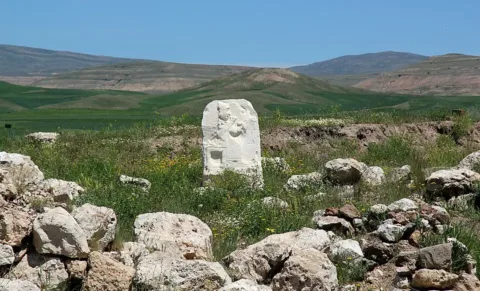
Samuha was one of the major cities of the Hittite kingdom, identified with the archaeological site of Kayalıpınar near modern Sivas in central Türkiye. During periods of political crisis, it served as a royal base and military center while also holding major religious importance.
In 2026, archaeologists announced the discovery of 131 cuneiform tablets and fragments at Kayalıpınar. Together with 53 pieces found in 2025, the newly identified royal archive contains 184 tablets and fragments written in Hittite and Hurrian. The texts deal with warfare, court administration, illness, funerary rites, and divination.
Earlier cuneiform finds had already helped confirm Kayalıpınar as ancient Samuha. The new archive adds a substantial body of written evidence for the city’s role within the Hittite state during the Late Bronze Age.
What Was Samuha?
Samuha was a major city of the Hittite Upper Land, a strategically important region on the eastern side of the kingdom. Its position on the upper Kızılırmak River placed it along an important route through central Anatolia.
The city had political and administrative functions that went beyond those of an ordinary provincial settlement. Excavations at Kayalıpınar have revealed monumental public buildings, including a complex interpreted as palatial in character, suggesting a close connection with royal authority.
Samuha was also a major cult center shaped by both Hittite and Hurrian traditions.
Where Was Samuha?
Ancient Samuha is identified with Kayalıpınar in the Yıldızeli district of Sivas Province, central Türkiye. The archaeological mound lies about 1.5 kilometers northeast of the modern village, on the northern bank of the Kızılırmak River, known to the Hittites as the Maraššantiya.
Its position in the river valley gave the settlement access to an important corridor through central Anatolia. That location supported trade and communication while also giving Samuha strategic value for administration and military movement across the region.
How Kayalıpınar Was Identified as Ancient Samuha
For decades, Samuha was known from Hittite texts but its exact location remained uncertain. Kayalıpınar became a serious candidate after a Hittite tablet fragment was found there in 1999, encouraging systematic excavation of the site.
The decisive evidence came from cuneiform tablets recovered during those excavations. The texts named Samuha itself, allowing Elisabeth Rieken and the Marburg team to identify Kayalıpınar securely with the long-sought Hittite city. The identification was publicly announced in 2014.
The discovery was especially important because many Hittite place names remain known only from written sources. At Kayalıpınar, archaeology and the written record could finally be tied to the same city.
Samuha Before the Hittite Empire
Samuha was important centuries before it became a major Hittite center. Old Assyrian texts from Kültepe, ancient Kaneš, show that the city was already part of the commercial network linking central Anatolia with Assur during the early second millennium BCE.
The earliest references describe Samuha as a wabartum, a smaller Assyrian trading station. Later texts refer to it as a karum, indicating that the settlement had grown into a more substantial commercial center.
Merchants moved tin and textiles through this network in exchange for Anatolian silver and gold. Samuha’s participation placed it within a wider system of caravan routes and regional markets long before the rise of the Hittite Empire.
Samuha as a Royal and Military Center
By the fourteenth century BCE, Samuha had become a strategically important Hittite stronghold in the Upper Land. Its position made it useful for military operations in a region frequently threatened by enemies from the north and east.
Hittite texts connect the city with the movement of troops, royal personnel, and war booty, showing that it played an active role in the kingdom’s military administration rather than serving only as a local center.
During periods of crisis, Samuha also became closely tied to the royal court. The details of that role become clearer under Tudhaliya, when the city appears to have served as a temporary base during the recovery of lost Hittite territory.
Tudhaliya and the Crisis of the Hittite Kingdom
Samuha rose to particular importance during one of the most dangerous periods in Hittite history. In the early fourteenth century BCE, the kingdom faced pressure from several directions, including the Kaška in the north and Arzawa in the west. Later Hittite accounts describe a time when large territories were lost and Hattusa itself came under attack.
During the crisis, King Tudhaliya appears to have used Samuha as a temporary royal and military base while campaigns were organized to recover lost territory. The surviving evidence is fragmentary, but the Deeds of Suppiluliuma supports the city’s close connection with the royal court during this period. Samuha was therefore an operational center, not a permanent replacement for Hattusa.
The king’s numbering varies in modern scholarship. The ruler associated with this crisis is often called Tudhaliya III, while other chronological systems identify him as Tudhaliya II. The difference reflects competing reconstructions of the Hittite royal succession.
Suppiluliuma and the Reconquest
Suppiluliuma I played a major role in the campaigns that restored Hittite control after the crisis. Before becoming king, he was already an experienced military commander and took part in years of warfare across Anatolia.
The Deeds of Suppiluliuma, composed during the reign of his son Mursili II, preserves part of this campaign history. Although the text survives only in fragments, it shows that the recovery of lost territory was central to Suppiluliuma’s rise before his later expansion into Syria.
Samuha remained part of this military network during the recovery, linking the city directly with the period in which the Hittite kingdom regained its strength and moved toward imperial expansion.
Samuha as a Religious Center
Samuha was one of the major cult centers of the Hittite Upper Land. Hittite texts describe it as a “city of gods,” reflecting the prominent place of religion in the life of the city.
Female deities were especially important in its pantheon. The best known was Šauška, the Hurrian goddess associated with love, war, and divine power. Apara and Pirinkir were also worshipped there, showing that Samuha’s religious traditions drew on both local Anatolian and Hurrian elements.
The city’s pantheon changed over time. Scholars have suggested that Apara may have been an older principal goddess before Hurrian influence became stronger and the cult of Šauška gained greater prominence. Later Hittite rulers, including Hattusili III, maintained a particularly close connection with Šauška of Samuha.
What Archaeology Has Revealed at Kayalıpınar
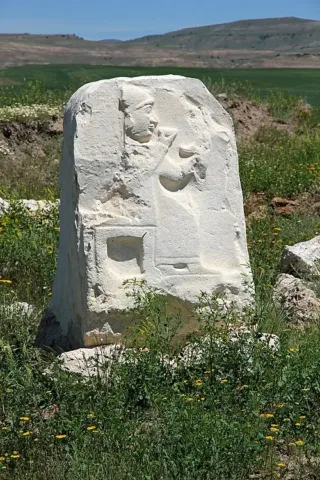
Excavations at Kayalıpınar have uncovered several phases of Hittite occupation and substantial public architecture. Among the most important remains are two large structures known as Buildings A and B, which dominated part of the settlement during the Middle Hittite period.
Building A was monumental in scale, with massive foundations and architectural decoration unlike ordinary domestic buildings. A doorway carried a relief of a seated goddess holding a drinking vessel and a bird, while additional limestone fragments suggest that other parts of the facade were also decorated. Excavators consider a palatial function more likely than that of a conventional Hittite temple.
Building B stood nearby and contained long, narrow rooms better suited to storage than residential use. Its layout suggests that it functioned in support of the larger complex, possibly as part of the city’s administrative infrastructure.
The buildings also preserve evidence of destruction and rebuilding. One phase appears to have been damaged by an earthquake followed by fire, while a later destruction was preceded by looting and may belong to the period of invasions that affected the Hittite kingdom in the early fourteenth century BCE. Construction continued afterward, showing that Samuha remained occupied and important despite repeated disruption.
The Earlier Cuneiform Archives of Samuha
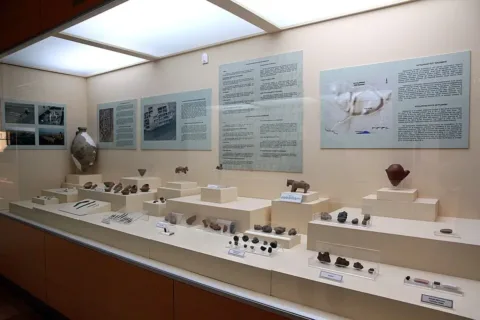
Kayalıpınar had already produced important written evidence before the discoveries of 2025 and 2026. Finds began appearing from 1999 onward, including the tablet that helped confirm the site as ancient Samuha.
A major breakthrough came in 2015, when excavators uncovered a closed temple archive containing more than 100 cuneiform fragments. The texts included letters, cult inventories, oracle inquiries, and festival rituals, providing evidence for the city’s temples, local pantheon, religious administration, and links with Hattusa.
The archive also records several forms of divination, including extispicy, token-based oracles, augury, and bird observation. Some inquiries sought the cause of divine anger, including that of Šauška of Samuha, showing how ritual consultation formed part of official decision-making.
These texts were published in 2019 by Elisabeth Rieken and other specialists in Keilschrifttafeln aus Kayalıpınar 1, covering material found between 1999 and 2017. The royal archive announced in 2026 is therefore a separate discovery, not Samuha’s first body of written records.
The 2025–2026 Royal Archive
The latest excavations at Kayalıpınar revealed a separate royal archive dating to the reign of King Tudhaliya II. Excavators found 53 tablets and fragments in 2025 and another 131 in 2026, bringing the total to 184 pieces. The excavation team describes it as the most extensive Hittite-language archive discovered in the twenty-first century.
The documents were written in Hittite and Hurrian and include letters, ritual texts, prayers, divination records, and administrative material. Unlike the earlier temple archive, this collection is closely connected with royal government and events affecting the court and army.
What Do the New Tablets Reveal?
The new archive records problems faced directly by the Hittite court, including disease, military pressure, and the use of divination in decision-making. Since the complete scholarly editions have not yet been published, the details currently available come from the official excavation announcement.
A High-Fever Epidemic
One group of texts records a high-fever illness spreading between cities and affecting children and infants. The royal court monitored the condition of young princes and princesses as well as children of high-ranking officials during the outbreak.
The published information is not sufficient to identify the disease in modern medical terms. The tablets nevertheless show that the outbreak was serious enough to become a matter of concern at the royal court.
The Death of an Infant Princess
One of the records concerns an infant princess who became seriously ill while still being breastfed. Diviners were consulted about her condition, linking the child’s illness with the religious practices used by the court in times of uncertainty.
Another tablet records her death and the funeral ritual performed afterward. A separate message states that she had fallen ill at Ziulila, a city whose location has not yet been identified.
The surviving information does not reveal her identity or the full circumstances of her death, but it preserves an unusually personal record of illness and mourning within the Hittite royal household.
A Military Emergency in Western Anatolia
One of the newly discovered letters was sent by Hittite commanders in western Anatolia to the king at Samuha. They described a deteriorating military situation in which Hittite territory was under pressure from several enemies and the forces already in the field were considered insufficient.
The commanders requested additional soldiers, horses, and chariots. Their warning was direct: without reinforcements, the army risked destruction, and they did not want responsibility for the outcome if their request was ignored.
The letter places the king at Samuha while senior officers in the west reported directly to him, providing clear evidence of the city’s role in royal military command during a period of crisis.
Bird Divination and Royal Decision-Making
Several tablets record divination through the observation of birds, a practice used by the Hittites when seeking divine guidance. The texts document the movements of specialist diviners, the places they visited, and the birds observed along their routes.
These records show that divination could be documented in precise administrative detail rather than treated as an informal ritual. Observations, routes, and results were recorded as part of the decision-making process at the royal court.
Government, Language and Scribal Culture
The archive also sheds light on Hittite administration. Letters, reports, ritual texts, and other records show that Samuha was connected directly with the royal court and with officials operating across the kingdom.
The tablets were written in both Hittite and Hurrian, reflecting the mixed cultural environment of the city and the strong Hurrian influence on its religious and intellectual life.
The official announcement also notes that the archive contains material relevant to the development of the Hittite language and to scribal practice during the reign of Tudhaliya II. The full significance of those texts will remain uncertain until the archive is published in detail.
What Is Confirmed and What Is Still Preliminary?
The basic facts of the discovery are well established: the 2025 and 2026 excavations produced 184 tablets and fragments, identified by the excavation team as a royal archive from the reign of Tudhaliya II. The texts are written in Hittite and Hurrian and cover subjects including military correspondence, illness, funerary ritual, divination, administration, language, and scribal practice.
The detailed interpretation remains preliminary. Complete transliterations, translations, and philological commentary have not yet appeared in a full scholarly edition. Questions about the epidemic, the infant princess, the western military crisis, and the wider historical context should therefore remain tied to what the excavation team has actually published.
Why Samuha Matters to Hittite History
Samuha occupied an unusual position in Hittite history. It began as part of the Old Assyrian trading network and later became a royal, military, administrative, and religious center in the Upper Land.
Its importance is especially clear during periods of political crisis, when the city supported royal authority beyond Hattusa. The archaeology and archives from Kayalıpınar now provide direct evidence for how that regional center functioned within the wider Hittite state.
Conclusion
The identification of Kayalıpınar as Samuha has given one of the Hittite kingdom’s most important regional centers a firm archaeological setting. The newly discovered royal archive now adds voices from the city itself, and its full publication may significantly deepen what we know about Hittite government and court life.
Academic Sources
- Elisabeth Rieken (ed.), Keilschrifttafeln aus Kayalıpınar 1: Textfunde aus den Jahren 1999–2017, Documenta Antiqua Asiae Minoris 1, Harrassowitz Verlag, 2019. The principal scholarly publication of the cuneiform texts discovered at Kayalıpınar before the 2025–2026 archive, including the evidence that securely identified the site with ancient Šamuḫa.
JSTOR - Çiğdem Maner, A. Emre Kuruçayırlı, Rula Shafiq, Hasan Peker and Gökçe Öztürk, “A New Start at Kayalıpınar: 2022 Field Season,” Anatolia Antiqua 31, pp. 179–204. A recent archaeological study of the site, its occupation history, architecture, and identification with Šamuḫa.
Anatolia Antiqua - Andreas Müller-Karpe, “Hittite Rituals at Samuha: The Archaeological Record,” in It All Began with Stratigraphy and Chronology: Archaeology in Central Anatolia. A focused study connecting the archaeological remains at Kayalıpınar with the ritual and religious history of Šamuḫa.
JSTOR - René Lebrun, Samuha, foyer religieux de l’empire hittite, Publications de l’Institut orientaliste de Louvain 11, 1976. A foundational monograph on Šamuḫa as a religious center, including its pantheon, cults, and relationship with Hittite kings.
Google Books - René Lebrun, “Présence des Hourrites à Samuha et dans le Haut-Pays hittite,” Revue Hittite et Asianique 36, 1978, pp. 135–140. Useful for the Hurrian presence at Šamuḫa and the development of its religious traditions.
Persée - Trevor Bryce, The Kingdom of the Hittites, 2nd ed., Oxford University Press, 2005. A major modern synthesis for the political history of the Hittite kingdom, including the crises of the fourteenth century BCE, Tudhaliya, Suppiluliuma I, and the wider imperial context in which Šamuḫa operated.
Oxford Academic
Note: Details of the 2025–2026 royal archive are currently based on the official excavation announcement. A complete scholarly edition of the newly discovered tablets has not yet been published.
