Rhiannon: The Story of a Mysterious Woman in Welsh Mythology
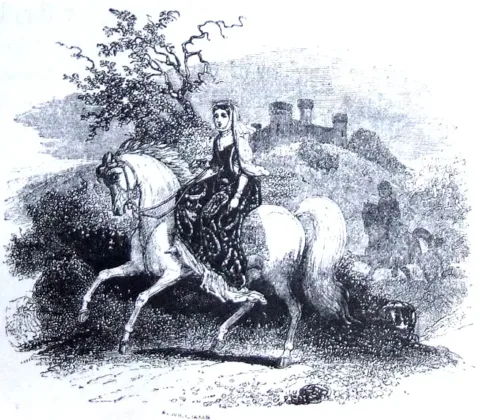
Rhiannon first appears in the First Branch of the Mabinogi, riding a pale white horse that no one can overtake. She has come to marry Pwyll, prince of Dyfed, rather than the man chosen for her. Their marriage leads to the disappearance of their son, Pryderi, and a false accusation that leaves Rhiannon facing years of punishment.
Her story continues in the Third Branch, where a mysterious enchantment threatens Dyfed and places her in danger once more.
Although often described as a Celtic horse goddess, Rhiannon is never explicitly identified as a deity in the surviving medieval Welsh tales. Her possible divine origins remain a subject of scholarly debate.
Who Is Rhiannon in Welsh Mythology?
Rhiannon is a noblewoman in medieval Welsh literature, identified in the Mabinogi as the daughter of Hyfaidd Hen (Hyfaidd the Old). The First Branch provides little information about her family or earlier life. Her noble status is evident from her father’s court and the marriage arrangements surrounding her.
After Pwyll’s death, their son Pryderi succeeds him as ruler of Dyfed. In the Third Branch, Pryderi proposes a marriage between Rhiannon and Manawydan, son of Llŷr, offering them the use of his territory while retaining sovereignty himself. Rhiannon accepts the marriage after meeting Manawydan at a feast.
Rhiannon and Pwyll: The Woman on the White Horse
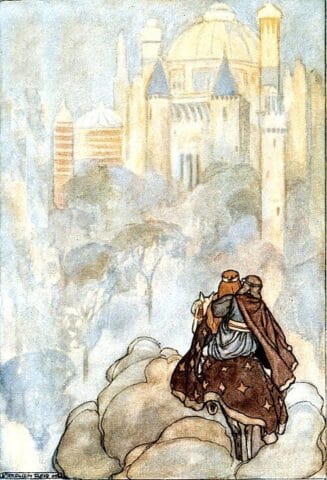
During a feast at Arberth, Pwyll climbs a nearby mound known as Gorsedd Arberth. According to his courtiers, any nobleman who sits there will either suffer a blow or witness something extraordinary. Pwyll hopes for the latter.
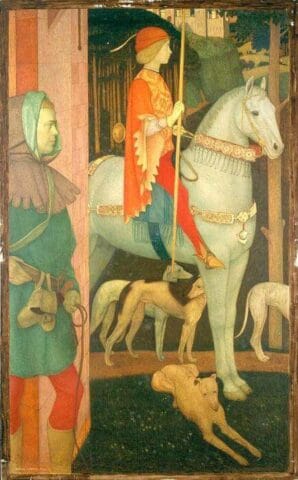
He sees a woman dressed in golden silk riding a pale white horse. Although the animal moves at a leisurely pace, his servants cannot catch it, even on their fastest horses. She appears on three successive days, and on the third, Pwyll pursues her himself.
When he finally calls out, she stops. She tells him that asking sooner would have spared his horse considerable effort.
The rider tells Pwyll that she is being given in marriage to Gwawl, son of Clud, against her wishes. She has come to find Pwyll because she would rather marry him. He agrees, and they arrange to meet at her father’s court one year later.
Gwawl and the Marriage Deception
At the wedding feast, a young nobleman approaches Pwyll and asks for a favor. Without knowing what he wants, Pwyll promises to grant anything within his power.
The visitor is Gwawl, who demands Rhiannon and the feast prepared for her marriage.
Rhiannon immediately recognizes the danger. Pwyll has made his promise before the assembled nobles, and breaking it would bring dishonor. She advises him to honor his word while pointing out that the feast is not his to give away, since she has already provided it for the guests.
She then offers Gwawl another wedding celebration in one year’s time. Before Pwyll leaves, she gives him a small enchanted bag and explains how he can use it to recover her.
At Gwawl’s feast the following year, Pwyll arrives disguised as a poor man, with a hundred companions waiting nearby. He asks Gwawl for enough food to fill his bag. Gwawl agrees, but no amount of food makes it any fuller.
When Gwawl asks whether the bag will ever fill, Pwyll says that a powerful landowner must step inside and press down its contents with both feet. Rhiannon encourages Gwawl to do so.
As soon as Gwawl steps inside, Pwyll pulls the bag over him, ties it shut, and signals his companions. They seize Gwawl’s men and strike the captive through the bag in a game called Badger in the Bag.
Gwawl eventually begs to be released. Following Rhiannon’s advice, Pwyll agrees on condition that Gwawl provide guarantees against future claims or revenge and satisfy the petitioners and entertainers at the feast.
Gwawl accepts the terms, and Rhiannon and Pwyll are finally married.
The Disappearance of Pryderi and Rhiannon’s Punishment
After two years without a child, the nobles of Dyfed urged Pwyll to take another wife so that he might have an heir. Pwyll persuaded them to wait another year, and before it ended, Rhiannon gave birth to a son.
On the night of his birth, six women assigned to watch over mother and child fell asleep. When they awoke, the baby was gone. Fearing punishment, they killed a puppy, smeared its blood on Rhiannon’s face and hands, and placed its bones beside her. They then accused her of killing her own child.
Rhiannon denied the accusation and offered to protect the women if they told the truth, but they maintained their story. Pwyll refused to abandon his wife, although he agreed that she should undergo penance. After consulting her advisers, Rhiannon accepted a punishment intended to last seven years.
She was required to sit beside the mounting block at Arberth, tell arriving strangers about her supposed crime, and offer to carry them on her back to the court. Few accepted.
The Return of Pryderi
Meanwhile, Teyrnon Twryf Liant, lord of Gwent Is Coed, faced a mystery of his own. Every year, his finest mare gave birth to a foal that disappeared without explanation.
Determined to discover what was happening, Teyrnon kept watch one night. When an enormous claw reached through the window and seized the newborn foal, he struck it with his sword, severing the arm. After pursuing the unseen creature into the darkness, he returned to find a baby wrapped in silk near his doorway.
Teyrnon and his wife raised the child as their own, naming him Gwri Golden Hair. The boy grew with extraordinary speed, and his resemblance to Pwyll eventually convinced Teyrnon that he had found the missing prince.
He brought the child to Arberth, where Rhiannon was still serving her punishment. She offered to carry the visitors to the court, but Teyrnon and his companions refused.
During the feast, Teyrnon explained how he had found and raised the boy. The assembled nobles recognized him as Pwyll’s son, clearing Rhiannon of the accusation.
When Rhiannon spoke of being freed from her anxiety, Pendaran Dyfed proposed the name Pryderi, derived from the Welsh word pryder, meaning care or anxiety. Although she pointed out that the boy already had a name, Pwyll approved the new one.
The mystery of the abduction itself remains unresolved. The First Branch never identifies the creature responsible for taking Pryderi or explains its motive.
Rhiannon and Manawydan: Her Second Marriage and Enchantment
Rhiannon’s second marriage begins peacefully. She and Manawydan live in Dyfed alongside Pryderi and his wife, Cigfa, until a strange event disrupts their lives.
While the four are gathered at Gorsedd Arberth, a thunderclap brings a thick mist over the land. When it clears, the people and domestic animals of Dyfed have vanished. Only the four remain.
They survive by hunting before travelling to England, where Manawydan and Pryderi become successful craftsmen. Threatened by rival tradesmen, they eventually return to the deserted kingdom.
Rhiannon’s Disappearance
During a hunt, Pryderi and Manawydan follow a white boar to a fortress that has appeared where no building stood before. Their dogs enter the fortress and disappear. Ignoring Manawydan’s warning, Pryderi goes inside to find them.
In the courtyard, he discovers a marble fountain beside a golden bowl suspended by four chains. When he touches the bowl, his hands become fixed to it, his feet stick to the stone beneath him, and he loses the ability to speak.
Manawydan eventually returns to court without him. Rhiannon reproaches him for abandoning Pryderi and goes to the fortress herself.
Finding her son motionless beside the bowl, she approaches and touches it. She too becomes trapped and unable to speak. That night, thunder and mist return, and the fortress disappears with both mother and son inside.
The Enchantment Is Broken
Manawydan eventually discovers that mice are destroying the wheat he has grown in Dyfed. He catches one unusually large mouse and prepares to hang it.
A scholar and a priest first try to persuade Manawydan to release the mouse. When a bishop arrives with more generous offers, Manawydan demands the return of Rhiannon and Pryderi instead. The bishop then reveals himself as Llwyd ap Cil Coed, the magician responsible for the enchantment.
Llwyd explains that he cursed Dyfed to avenge Gwawl, whom Pwyll had humiliated during the struggle to marry Rhiannon. The captured mouse is Llwyd’s pregnant wife, transformed by magic.
Manawydan agrees to release her only after Llwyd promises to free Rhiannon and Pryderi, restore Dyfed, prevent further enchantments, and abandon any future revenge.
Llwyd accepts, and Rhiannon and Pryderi return. The kingdom’s inhabitants and livestock are restored.
Before the tale ends, Manawydan asks how the captives were treated. Llwyd reveals that Pryderi had been forced to wear the gate-hammers of his court around his neck, while Rhiannon had worn the collars of donkeys used for carrying hay.
Read Also
- The Mabinogion Explained: The Great Stories of Welsh Mythology
, Explore the wider collection of Welsh tales containing Rhiannon’s story. - The Celtic Otherworld: Tír na nÓg, Sídhe and Annwn Explained
, Discover Annwn and the supernatural traditions of Welsh and Irish literature. - Manannán mac Lir: Irish God of the Sea and the Otherworld
, Examine the relationship between Manannán and Rhiannon’s second husband, Manawydan.
The Birds of Rhiannon
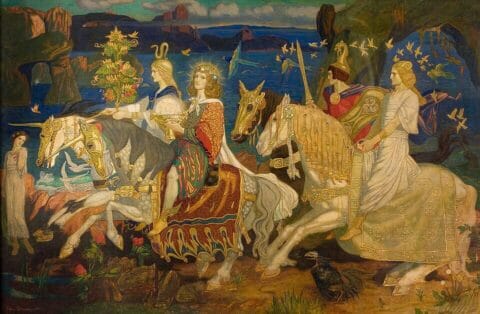
Rhiannon is also associated with three magical birds known in Welsh as Adar Rhiannon. Although they never appear alongside her, their extraordinary singing features in the Second Branch of the Mabinogi and the Arthurian tale Culhwch and Olwen.
In the Second Branch, seven survivors of the war in Ireland reach Harlech carrying the severed head of Bendigeidfrân, which can still speak. As they feast, three birds begin singing. Their song makes every other tune seem unpleasant by comparison. Though the birds appear far out at sea, their voices sound as clear as if they were nearby.
The survivors remain at Harlech for seven years before spending another eighty years at Gwales. The birds are associated with the feast at Harlech, not the later stay at Gwales.
In Culhwch and Olwen, the giant Ysbaddaden demands the birds as one of the tasks Culhwch must complete before marrying his daughter. He wants them to entertain him on the wedding night, describing their ability to awaken the dead and lull the living to sleep. The story does not show them exercising these powers.
Neither account explains the birds’ origins or how they became associated with Rhiannon. Their name establishes the connection, but the surviving texts never show her summoning or commanding them.
Was Rhiannon a Celtic Goddess?
Rhiannon is often called a Celtic horse goddess, although the surviving Welsh texts never explicitly identify her as a deity. The theory rests chiefly on her name and similarities between her story and earlier Celtic religious traditions.
Her name is generally derived from the reconstructed Celtic Rigantonā, meaning “Great Queen” or “Divine Queen.” The linguistic connection is widely accepted, but no surviving ancient inscription identifies a goddess by that exact name.
Rhiannon and Epona
Rhiannon is frequently compared with Epona, the Gaulish horse goddess whose worship is documented by Roman-period inscriptions and sculptures.
The comparison draws on several details in Rhiannon’s story: her appearance on an extraordinary horse, her punishment of carrying visitors on her back, and the animal-related servitude imposed on her in the Third Branch.
In his 1953 study, W. J. Gruffydd proposed that Rhiannon’s story preserved elements of older traditions associated with Epona and Matrona, a Celtic mother goddess. His reconstruction remains an interpretation rather than an account preserved in the medieval text.
Some scholars interpret Rhiannon as a figure of sovereignty whose marriage carries political significance. Yet Pwyll already rules Dyfed when they meet, and the story never explicitly presents her as granting him kingship. Any connection between their marriage and an older sovereignty cult therefore remains a scholarly interpretation.
Rhiannon’s story may preserve features of pre-Christian mythology, but the available evidence cannot establish that she and Epona were the same deity or that Rhiannon herself was worshipped as a goddess.
Academic Sources & Primary Texts
This article draws on medieval Welsh narratives, annotated translations, and academic research into Rhiannon’s literary character and possible mythological origins.
Primary Texts and Translations
- Pwyll Pendeuic Dyfed, First Branch of the Mabinogi
Will Parker’s annotated translation. Primary account of Rhiannon’s marriage, the disappearance of Pryderi, and her punishment. - Manawydan fab Llŷr, Third Branch of the Mabinogi
Will Parker’s annotated translation. Rhiannon’s second marriage, the enchantment of Dyfed, and her captivity. - Branwen ferch Llŷr, Second Branch of the Mabinogi
Will Parker’s annotated translation. Contains the episode of the Birds of Rhiannon at Harlech. - Culhwch and Olwen, Annotated Translation
Medieval Welsh Arthurian tale describing the extraordinary powers attributed to Rhiannon’s birds.
Academic Studies
- Davies, Sioned. The Mabinogion.
Oxford University Press, Oxford World’s Classics. Scholarly translation with introductions and explanatory notes on medieval Welsh storytelling. - Williams, Patricia. “Rhiannon” (2017).
The Encyclopedia of Medieval Literature in Britain, Wiley. Academic reference on Rhiannon’s identity, name, and mythological associations. - Rodway, Simon. “The Mabinogi and the Shadow of Celtic Mythology” (2018).
Studia Celtica, 52(1), 67-85. Critical examination of attempts to reconstruct pre-Christian mythology from medieval Welsh literature. - Gruffydd, W. J. Rhiannon: An Inquiry into the Origin of the First and Third Branches of the Mabinogi (1953).
University of Wales Press. Influential historical study proposing mythological origins for Rhiannon’s narrative. - Morgain, Shân. Mabinogi Rhiannon: Woman of Power & Her Kindred (2025).
PhD thesis, Swansea University. Extensive study of Rhiannon through literary, political, and mythological interpretations.
Note: Proposed connections between Rhiannon and earlier Celtic deities remain scholarly interpretations, not established evidence of her worship.
Copyright & Content Rights
© 2026 History & Myths.
All rights reserved.
The original writing, analysis, and editorial presentation of this article are protected by copyright. Reproduction or republication without prior permission is not authorized.
Historical and mythological narratives discussed in this article are drawn from traditional sources and scholarly research. No ownership is claimed over the original medieval texts or the ideas and findings of cited scholars.