Taranis: The Celtic Thunder God and His Sacred Wheel
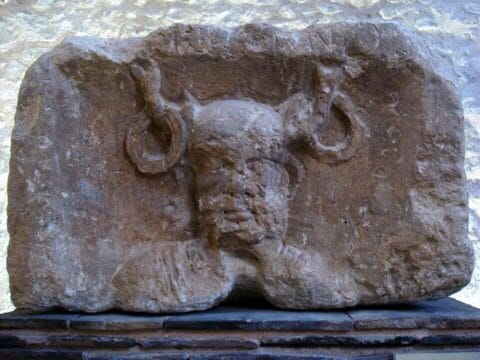
Taranis was a Celtic god of thunder worshipped in ancient Gaul. His name comes from a Celtic root meaning “thunder,” and Roman-era inscriptions associate related divine names with Jupiter. He is also widely linked to the wheel in Gallo-Roman religious art, although no surviving inscription explicitly identifies a wheel-bearing figure as Taranis.
No surviving Celtic myth tells Taranis’s story or describes his relationships with other gods. Evidence for his worship comes instead from Roman writers, religious dedications, and archaeological finds. These sources confirm that he and deities bearing related names received worship, but leave the meaning of the wheel and the rituals associated with him uncertain.
Taranis: Name, Origins and Identity
The Celtic root taran-, meaning “thunder,” survives in the Welsh and Breton word taran. This linguistic connection explains Taranis’s association with thunder, but tells us little about his other religious functions.
Roman-period inscriptions preserve related divine names, including Taranus, Taranucus, and Taranucnus. Scholars have interpreted Taranucus as meaning “associated with Taranus,” while Taranucnus has been explained as “son of Taranus.” The latter is a linguistic interpretation, not evidence of a surviving myth about a divine son.
Dedications involving these names have been found in southern Gaul, the Rhineland, and Dalmatia. An inscription from Roman Britain also names Jupiter Tanarus, although its relationship to Taranis remains debated. These finds suggest that related divine names were known across several regions, but do not establish that their worshippers shared identical beliefs or rituals.
When the worship of Taranis first emerged is unknown. His name belongs to the Celtic linguistic tradition, but most surviving written evidence dates to the Roman period. No earlier account identifies the community in which his cult originated.
Taranis in Ancient Roman Sources
The clearest surviving literary reference to Taranis comes from the Roman poet Lucan’s Pharsalia (Bellum Civile), written in the first century CE. In Book I, lines 444–446, he names Taranis alongside two other Gallic gods, Teutates and Esus. Lucan compares Taranis’s altar to that of the Scythian Diana, a goddess associated in classical literature with human sacrifice.
Lucan introduces these gods while describing the peoples of Gaul after Caesar withdrew troops for his civil war. He was writing epic poetry, not documenting Gallic religious practices. Naming three gods together does not establish that Celtic worshippers regarded them as a fixed triad or honoured them in the same sanctuaries.
The Commenta Bernensia, a collection of commentaries on Lucan preserved in a ninth-century manuscript, offers two different identifications of Taranis with Roman deities: Jupiter and Dis Pater. These explanations show how later commentators interpreted an unfamiliar Gallic god through Roman religious traditions, but they are not direct accounts from his worshippers.
Lucan gives no description of Taranis’s appearance, mentions no wheel, and does not explicitly identify him as a thunder god. His passage confirms that the name was known in Roman literature, while the later commentaries introduce claims about his worship that require separate examination.
Inscriptions and Evidence of Taranis Worship
Religious inscriptions provide evidence of Taranis’s worship beyond Lucan’s literary account. One of the earliest known examples comes from Orgon in southern Gaul, where a dedication written in Gaulish using Greek letters names the deity as Taranou. The inscription records an offering made by Vebroumaros, providing direct evidence of a dedication to a god bearing a form of Taranis’s name.
Two further dedications come from Böckingen and Godramstein, in the Roman province of Germania Superior (present-day Germany). Both name Taranucnus, a deity generally associated with Taranis. The Böckingen altar was erected by Veratius Primus ex iussu, meaning “by command,” apparently in response to a divine instruction. The sandstone altar, discovered in 1765, is now held by the Landesmuseum Württemberg in Stuttgart.
Other inscriptions reveal connections with Jupiter. At Scardona in Roman Dalmatia (present-day Croatia), a woman named Arria Successa fulfilled a vow to Jupiter Taranucus. In Roman Britain, a sandstone altar discovered at Chester was dedicated to Jupiter Tanarus in 154 CE by Lucius Elufrius Praesens, a senior officer (princeps) of the Twentieth Legion. The inscription survives through early transcriptions, although parts of the dedicant’s name remain uncertain. Whether Tanarus represents a form of the Celtic divine name or a reference to thunder remains debated.
Taranis and the Roman God Jupiter
Under Roman rule, local gods were sometimes identified with Roman deities through a practice known as interpretatio Romana. Inscriptions combining Jupiter with names such as Taranucus and Tanarus suggest such an association for Taranis. Jupiter’s connection with thunder offers a natural point of comparison, although his wider roles in Roman religion cannot automatically be attributed to the Celtic god.
A particularly revealing monument comes from Noricum, in present-day Austria. A votive altar dating to the middle of the first century CE bears a dedication to Jupiter, while a relief on its side depicts a wheel-bearing deity. Archaeologist Peter Scherrer considers the figure most likely to represent Taranis. The inscription itself, however, names only Jupiter, leaving the identification dependent on the imagery.
The altar illustrates how Roman divine names could coexist with religious symbols associated with local Celtic traditions. It cannot establish whether worshippers regarded Jupiter and Taranis as identical in every respect, or whether the Celtic god shared Jupiter’s mythology and authority within Roman state religion.
The Wheel Symbol and Its Meaning
In Gallo-Roman religious art, a spoked wheel sometimes accompanies a male deity carrying Jupiter’s thunderbolt. This combination has led scholars to associate the wheel-bearing god with Taranis, although the imagery alone cannot establish the identity of every figure or explain what the wheel represented.
Some scholars interpreted the wheel as a solar symbol, associated with the sun’s movement across the sky. Others connected it with thunder, comparing the rolling of a wheel to the sound of a storm. These competing interpretations led some earlier researchers to distinguish the wheel-bearing deity from Taranis, whose name means “thunder.”
Daniel Gricourt and Dominique Hollard argued that the solar and thunder associations need not be mutually exclusive. They proposed that the wheel could carry several meanings, including lightning, solar power, and a broader cosmic order. Their interpretation draws partly on comparisons with Indo-European religious traditions, where celestial phenomena sometimes share overlapping symbolism.
These explanations remain scholarly interpretations rather than meanings documented by ancient Celtic worshippers. The wheel’s association with thunderbolt-bearing deities suggests a celestial connection, but its precise significance and whether it carried the same meaning across Celtic communities remain uncertain.
Taranis in Celtic Religious Art
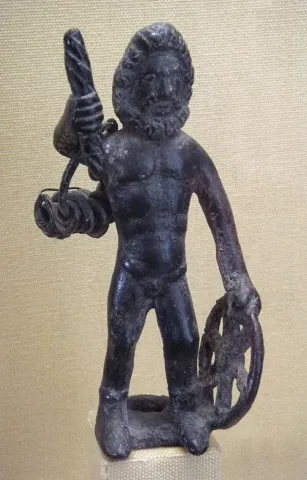
One of the clearest representations of the Celtic wheel-bearing god is a bronze statuette discovered at Le Châtelet de Gourzon in northeastern France. Measuring 10.2 centimetres tall, the bearded figure holds a six-spoked wheel in his left hand and a thunderbolt in his right. A separate ring carrying S-shaped bronze ornaments hangs from his right arm. The statuette dates to the Gallo-Roman period and is catalogued by the Louvre as a representation of Taranis.
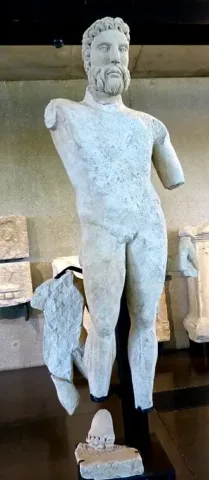
A larger sculpture from Eymet in southwestern France offers another example. Surviving fragments of a limestone statue include a bearded head, a male torso, and part of a wheel. Archaeologist Nathalie de Chaisemartin reconstructed the figure as a standing Jupiter-Taranis, with the god’s left hand resting on the wheel. A smaller figure of a child has also been associated with the group, although the child’s identity remains uncertain. The sculpture shows how Celtic religious symbols could be incorporated into Roman-style representations of divinity.
An earlier possible representation appears on the Gundestrup Cauldron, an elaborately decorated silver vessel discovered in a Danish bog in 1891. One of its panels depicts a large spoked wheel held between two figures, a scene sometimes interpreted as showing Taranis. However, the cauldron bears no inscriptions identifying its deities, and both its place of manufacture and the meaning of its imagery remain debated.
Offerings and Ritual Practices
The inscription from Orgon provides a rare clue about offerings to Taranis. Its dedication to Taranou includes the Gaulish formula bratou dekantem, commonly interpreted as an offering made in gratitude, possibly a tithe.
The wording suggests a religious gift, but does not identify what Vebroumaros offered or describe the ceremony.
Small metal wheels provide further evidence of Celtic votive practices. At the sanctuary of La Villeneuve-au-Châtelot in northeastern France, archaeologists discovered thousands of miniature wheels made from lead, bronze, and silver. Many of the lead examples have four spokes, and archaeological studies indicate that large numbers were produced specifically as offerings rather than everyday objects.
These finds show that miniature wheels played a role in religious dedication, but their connection with Taranis remains uncertain. None bears his name, and the symbol may have belonged to more than one local cult.
No surviving source identifies a festival dedicated specifically to Taranis or describes a regular ceremony conducted by his priests. The inscriptions and votive objects preserve traces of religious activity, but reveal little about the prayers or rituals performed by his worshippers.
Human Sacrifice and the Accounts of Roman Writers
Taranis has long been associated with human sacrifice, but the surviving evidence comes from ancient literary accounts and later commentaries rather than inscriptions or archaeological remains securely linked to his cult.
In Pharsalia, Lucan compares Taranis’s altar to that of the Scythian Diana, a goddess associated with human sacrifice, but gives no details of the rituals performed. The later Commenta Bernensia offers two different explanations. One identifies Taranis with Dis Pater and claims that several people were burned in a wooden trough. Another identifies him with Jupiter, describes him as a powerful god of war and the heavens, and claims that offerings of animal heads had replaced earlier sacrifices of human heads.
Julius Caesar describes a separate practice in The Gallic War (Book VI, chapter 16). According to his account, some Gauls filled enormous wicker figures with living victims and set them on fire. Caesar does not name Taranis as the recipient, however. The familiar association between the god and these wicker figures comes from combining separate accounts, not from an explicit statement by Caesar.
Human sacrifice in ancient Gaul remains a subject of historical and archaeological investigation. Yet no securely identified sanctuary or inscription connects Taranis with the specific practices described in these texts. The possibility of human sacrifice cannot be dismissed, but the surviving accounts do not establish how, or even whether, it formed part of his worship.
Taranis in Celtic Mythological Tradition
No surviving Celtic narrative can be securely identified as a myth about Taranis. Unlike figures such as Lugh and the Dagda, whose stories appear in medieval Irish literature, the Gaulish thunder god has no preserved account of his deeds or relationships with other deities.
A possible trace of a related name appears in medieval Welsh literature. In the Second Branch of the Mabinogi, Gluneu Eil Taran is named among the seven survivors of the war between Britain and Ireland. The figure, also known as Glinneu or Glifieu, appears in Culhwch and Olwen as a warrior captured by Gwyn ap Nudd and later freed by Arthur. His name is commonly interpreted as “Gluneu son of Taran,” with taran meaning “thunder” in Welsh. Neither tale, however, identifies Taran as a god or establishes a connection with the Gaulish Taranis.
Irish mythology preserves another figure sometimes compared with Taranis: Tuireann, father of Brian, Iuchar, and Iucharba in The Fate of the Children of Tuireann. The suggested connection remains speculative. The Irish narrative does not portray Tuireann as a thunder god or identify him with the deity worshipped in ancient Gaul.
Comparisons with other thunder gods, including the Norse Thor, may help scholars examine broader religious traditions. They cannot, however, reconstruct myths that have not survived. Taranis’s worship is historically attested, but the stories once told about him, if any, remain unknown.
Read Also
- Cernunnos: The Horned God of the Celtic World
, another Gaulish deity known mainly through inscriptions and religious imagery. - Epona: Celtic Goddess of Horses and Protection
, explore how a Celtic goddess was worshipped across the Roman Empire. - Tarhunna: The Storm God of the Hittites
, discover the evidence and myths surrounding a thunder god from ancient Anatolia.
Conclusion
Taranis was worshipped in ancient Gaul, but the surviving evidence reveals more about his name and possible representations than about the beliefs of his followers. Inscriptions establish that he and deities bearing related names received dedications, while the wheel-bearing figures of Gallo-Roman art offer possible clues to his appearance and symbolism.
Roman writers preserve claims about his worship, including human sacrifice, but these accounts cannot establish the rituals actually performed in his honour. His connection with thunder is clear; the stories, ceremonies, and wider religious significance associated with him remain largely unknown.
Academic Sources & Primary Texts
This article draws on ancient literary sources, Roman inscriptions, archaeological collections, and modern scholarship. Literary descriptions of religious practices are distinguished from material evidence and scholarly interpretations.
Ancient Literary Sources
- Lucan, Pharsalia (Bellum Civile), Book I, lines 444–446.
The principal surviving literary reference naming Taranis alongside Teutates and Esus.
Latin Text, University of Oxford - Commenta Bernensia, commentary on Lucan, Book I.
Preserves later interpretations identifying Taranis with Jupiter or Dis Pater, including claims about sacrificial practices.
Historical Edition, Bavarian State Library - Julius Caesar, De Bello Gallico, VI.16.
Describes human sacrifice among the Gauls without identifying Taranis as the recipient.
Latin Text and Commentary, Dickinson College
Epigraphic and Archaeological Evidence
- Roman Inscriptions of Britain, RIB 452.
The altar dedicated to Jupiter Tanarus at Chester, dated to 154 CE, with transcription, translation, and archaeological details.
Read the Inscription - Musée du Louvre, Bronze Figurine of Taranis, Inventory ED 4435.
Catalogue record of the wheel-bearing bronze deity discovered at Le Châtelet de Gourzon.
Louvre Collections Database
Academic Studies
- Gricourt, Daniel, and Dominique Hollard. (1990). “Taranis, le dieu celtique à la roue. Remarques préliminaires.” Dialogues d’histoire ancienne, 16(2), 275–320.
Major study of the wheel-bearing deity and its identification with Taranis.
Read the Study - Gricourt, Daniel, and Dominique Hollard. (1991). “Taranis, caelestiorum deorum maximus.” Dialogues d’histoire ancienne, 17(1), 343–400.
Develops interpretations of Taranis’s celestial and religious symbolism.
Read the Study - Scherrer, Peter. (2017). “Gallic Romans or Roman Gauls? Humans and Deities in Selected Image-Script Monuments of the Northern Provinces in the 1st Century AD.” Palaeohispanica, 17, 425–436.
Examines religious identities and the Jupiter-Taranis altar from Noricum.
Read the Study - de Chaisemartin, Nathalie. (2006). “Le groupe de Taranis à l’enfant d’Eymet.” Bulletin de la Société nationale des Antiquaires de France, 162–173.
Archaeological analysis and reconstruction of the fragmented wheel-bearing sculpture from Eymet.
Read the Study - Goussard, Elisabeth. “L’offrande par destination en Gaule : reflet des classes sociales les plus modestes et les plus nombreuses ?”
Discusses objects manufactured for religious dedication, including miniature wheels in Gallic sanctuaries.
Read the Study, Ausonius Éditions
Research note: The identification of wheel-bearing figures with Taranis and the interpretation of sacrificial practices remain subjects of scholarly debate. Literary testimony, inscriptions, and iconographic interpretations are therefore treated separately.
Copyright & Content Notice
© 2026 History & Myths. All rights reserved.
The original editorial content of this article is published by History & Myths. Reproduction or redistribution of substantial portions requires permission, except where permitted by applicable copyright law. Brief quotations should include clear attribution and a link to the original article.
Ancient texts, archaeological objects, scholarly publications, and third-party images remain subject to their respective rights and licenses. Image credits and licensing information are provided separately where applicable.