Istanu: The Hittite Sun God of Heaven and Justice
In Hittite religion, Istanu (Ištanu) was a name for the sun that could refer to more than one solar deity. Derived from the Hattic name Eštan, associated with a female solar deity, it was also used for the male Sun God of Heaven. Hittite texts distinguished this god from the Sun Goddess of Arinna and the Sun Goddess of the Earth, although their religious traditions sometimes overlapped.
Hittite prayers portray the Sun God of Heaven as a divine judge and an intermediary who carried human appeals to other gods. Some hymns also drew on traditions surrounding the Mesopotamian sun god Šamaš, particularly his authority over justice. These influences shaped the Hittite portrayal of the heavenly Sun God without erasing his Anatolian religious background.
Who Was Istanu in Hittite Religion?
In the Hittite kingdom of the second millennium BCE, the Sun God of Heaven held an established place in state religion, although the Storm God of Hatti and the Sun Goddess of Arinna occupied more prominent positions in the royal cult.
His religious standing is particularly evident in Muwatalli II’s model prayer to the assembly of gods (CTH 381). The text invokes the Sun God of Heaven separately from the Sun Goddess of Arinna and assigns him a role in approaching other deities on the king’s behalf. This distinction had practical significance within the prescribed royal ritual, even though the surviving text does not establish whether the ceremony was actually performed.
Most evidence for his worship comes from the archives of Hattusa, which preserve royal prayers, festival texts, and ritual instructions. These records document his place in official religion but reveal considerably less about his worship among ordinary Hittites.
The Name Istanu: Hattic Eštan and the Cuneiform dUTU
The Hittite name Ištanu was borrowed from Hattic Eštan, the name of a solar deity worshipped in central Anatolia before the rise of the Hittite kingdom. In Hattic tradition, Eštan was female, as indicated by the epithet kattaḫ, meaning “queen.” The name entered Hittite with variant forms including Aštanu and Eštanu.
Hittite scribes rarely wrote the name phonetically, instead using the Sumerian logogram dUTU. The sign UTU represented the sun, while the preceding d identified the name as divine. The same logogram could stand for Ištanu in Hittite or Šamaš in Akkadian. Syllabic spellings and parallel passages confirm its Hittite reading.
The difficulty is that dUTU did not always designate the same deity. Depending on the context, it could refer to the Sun God of Heaven, the Sun Goddess of Arinna, or another solar figure. Scribes sometimes distinguished these deities through geographical names or descriptive titles, but not consistently. Identifying the intended deity therefore requires examining the language, religious setting, and surrounding text rather than relying on the logogram alone.
Istanu and the Other Hittite Sun Deities
The Sun God of Heaven (nepišaš dUTU) was a male deity associated with the celestial realm and divine judgment. Muwatalli II’s prayer to the assembly of gods (CTH 381) names him separately from the Sun Goddess of Arinna, showing that the two could be treated as distinct deities in royal worship.
The Sun Goddess of Arinna held a more prominent position in the Hittite state cult. She was a principal protector of the kingdom and its rulers, closely associated with royal authority. Hittite prayers addressed her as Queen of Heaven and Earth, a title reflecting her influence beyond the celestial sphere.
The Sun Goddess of the Earth (taknaš dUTU) was associated with the underworld and appeared prominently in magical rituals. She also received worship in local cults at Nerik and Zippalanda. Her origins remain disputed. Charles Steitler argues that her tradition probably developed in a Luwian religious setting rather than the Hattian milieu proposed by earlier scholars. Her relationship to the Sun Goddess of Arinna is likewise not securely established.
The Sun God as Divine Judge
In a hymn preserved in CTH 372, the Sun God of Heaven is addressed as the lord of judgment, entrusted with establishing law and maintaining justice across the lands. His authority extends even to disputes involving dogs, pigs, and animals unable to speak for themselves.
The hymn also portrays him as a protector of the oppressed, the lonely, and the bereaved, restoring the claims of those without support. At dawn, his radiance reaches the upper and lower lands, an image that connects his daily movement across the sky with the reach of his divine authority.
These descriptions express a religious ideal rather than evidence that the Sun God presided over Hittite courts. Although his judicial role recalls the Mesopotamian Šamaš, the concern with animals appears to be a distinctive element of the Hittite tradition.
Prayers to Istanu: Kantuzzili and Muwatalli II
In the prayer of Kantuzzili (CTH 373), a Hittite prince suffering from illness fears that his personal god has turned against him for an offense he cannot identify. He appeals to Istanu to seek out the offended deity, whether in heaven or on earth, and carry his words to him.
Kantuzzili insists that he has neither broken a sacred oath nor violated food prohibitions. He asks his god to reveal any unknown offense through a dream, a seeress, or a diviner of the Sun God reading an animal’s liver. The prayer belongs to a group of related compositions that also includes versions attributed to an unnamed king (CTH 374) and a figure identified simply as “a mortal” (CTH 372).
In Muwatalli II’s model prayer to the assembly of gods (CTH 381), the Sun God of Heaven receives a different task. After invoking deities from across the Hittite kingdom, the king asks him to summon them from heaven and earth, mountains and rivers, temples and thrones. Muwatalli then appeals to the Storm God of Lightning, his personal deity, to deliver the royal petition before the assembled gods. The composition provides a framework for royal supplication rather than a record of a particular request being presented.
How Did Mesopotamian Šamaš Influence Istanu?
Although Istanu’s name had Anatolian origins, Hittite hymns to the Sun God incorporated religious imagery from Mesopotamian traditions surrounding Utu, known in Akkadian as Šamaš. This influence is particularly evident in the hymnic passages preserved in CTH 372–374.
The hymns describe the Sun God as a son of Ningal and refer to Enlil as his father, drawing on Mesopotamian divine relationships rather than a consistent Hittite genealogy. They give him a beard of lapis lazuli and place the divine attendants Bunene and Mēšaru at his side. Another passage describes a team of four harnessed animals receiving barley, apparently referring to the horses of his celestial chariot. The origin of this chariot imagery remains uncertain.
Direct evidence of literary transmission comes from an Akkadian solar hymn found at Šapinuwa and published by Daniel Schwemer and Aygül Süel in 2021. Known as DAAM 2.6, the fragmentary text provides an intermediary between the Old Babylonian Sumerian hymn Utu N and the Hittite prayers CTH 372–374. Comparison of the three versions reveals how Hittite scribes translated and adapted passages from an established Mesopotamian composition.
These borrowed passages became part of prayers addressed to the Hittites’ own solar deity, rather than remaining confined to scribal study. Their use in royal religious practice shows that Mesopotamian traditions influenced how Istanu was praised and approached in worship.
The Sun God in Hittite Myths
In The Disappearance of Telipinu (CTH 324), the agricultural god’s angry departure brings famine and disrupts fertility throughout the land. The Sun God sends an eagle to search the mountains and valleys, but it returns without finding him. The Storm God also fails in his search, and Telipinu is eventually discovered by a bee sent by the goddess Hannahanna. Here, the Sun God participates in the effort to recover the missing deity rather than resolving the crisis himself.
In The Tale of Appu and His Two Sons (CTH 360), the Sun God intervenes directly in human affairs. Appu, a wealthy but childless man, receives the god’s help and eventually has two sons named Evil and Good. When Evil cheats his brother during the division of their inheritance, he Sun God looks down from heaven and calls for Good’s sickly cow to recover and give birth. The brothers later bring their dispute before him at Sippar, a major center of Šamaš worship. In a fragmentary continuation, the Sun God appears to rule in Good’s favor, but Evil rejects the judgment, prompting him to refer the case to Ištar of Nineveh. The damaged ending leaves the final outcome uncertain.
The two narratives preserve different roles for a solar deity, but neither establishes that its Sun God was necessarily identical with the male Sun God of Heaven known from Hittite royal prayers.
Read Also
Worship, Images, and Royal Solar Symbolism
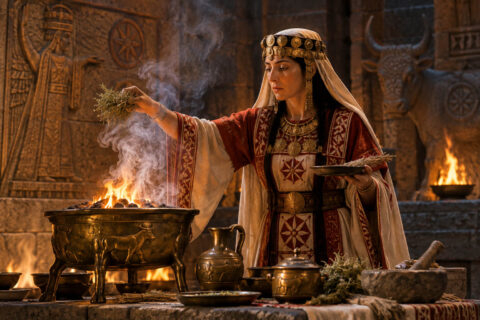
Muwatalli II’s model prayer (CTH 381) prescribes a royal ceremony to be conducted on a rooftop facing the sun. Two offering tables were to be prepared, one for the Sun Goddess of Arinna and another for the male gods, with bread, honey, oil, grain, and wine among the offerings. The king was then to ascend the roof and bow before the Sun God of Heaven. The instructions document an established form of royal worship, although they do not confirm that Muwatalli personally performed the ceremony.
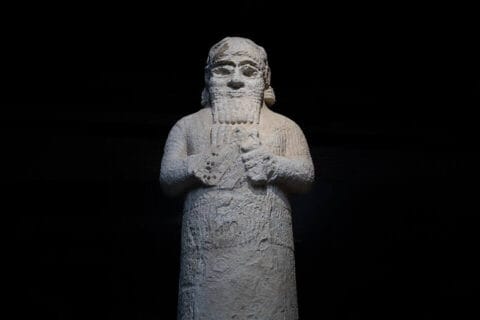
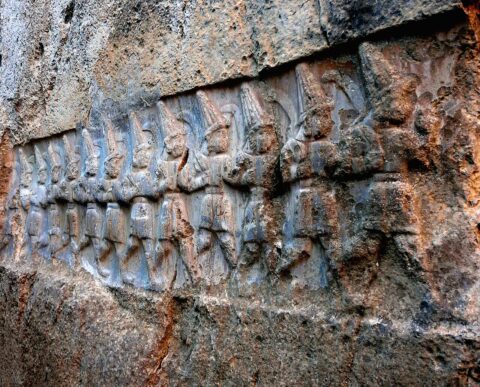
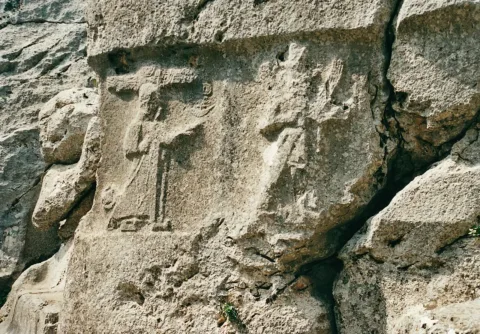
Relief 34 in Chamber A at Yazılıkaya, near Hattusa, is generally identified as a representation of the Sun God of Heaven. He wears a long robe and rounded headdress, holds a curved staff known as the kalmuš, and stands beneath a winged solar disk. Hieroglyphic signs identify him as the heavenly Sun God. The relief forms part of a divine procession influenced by Hurrian traditions, in which the corresponding solar deity was known as Šimegi.
Solar symbolism also appeared in Hittite kingship. The royal title dUTUŠI, meaning “My Sun” and conventionally rendered “My Majesty,” expressed the elevated status of the ruler. On royal seals, including that of Šuppiluliuma I, the winged sun disk appears above the king’s name and titles. The resemblance extended to ceremonial dress, as kings and the Sun God could be depicted wearing similar robes and carrying the kalmuš. These shared attributes connected royal authority with solar divinity without establishing that the king and the god were identical.
Conclusion
Royal prayers and ritual texts establish the Sun God of Heaven as an important figure in Hittite religion, particularly in matters of justice, divine intercession, and royal worship. Yet the shared use of Ištanu and the cuneiform sign dUTU makes it difficult to identify individual solar deities without examining the context of each text.
The evidence also reveals how Hittite religion absorbed Mesopotamian traditions without abandoning its Anatolian foundations. Istanu’s portrayal drew on characteristics of Šamaš, while the Sun Goddess of Arinna and other solar deities retained distinct roles. Their coexistence reflects the diversity of religious traditions within the Hittite kingdom.
Academic Sources & Primary Texts
Primary Hittite Texts
- CTH 372–374: Hymns and prayers to the Sun God, including the prayers of Kantuzzili, an unnamed king, and a mortal. Translated in Itamar Singer, Hittite Prayers (2002), pp. 30–39.
- CTH 381: Muwatalli II’s prayer to the assembly of gods, including the invocation of the Sun God of Heaven and instructions for royal offerings. Translated in Singer, Hittite Prayers, pp. 85–94.
- CTH 324 and CTH 360: The Disappearance of Telipinu and The Tale of Appu and His Two Sons. Translated in Harry A. Hoffner Jr., Hittite Myths, 2nd ed. (1998).
Catalogue des Textes Hittites (CTH), maintained by the Hethitologie-Portal Mainz, provides the standard text classifications.
Academic Studies
- Steitler, Charles W. The Solar Deities of Bronze Age Anatolia: Studies in Texts of the Early Hittite Kingdom. Studien zu den Boğazköy-Texten 62. Wiesbaden: Harrassowitz Verlag, 2017.
Publisher. - Beckman, Gary. “Šamaš among the Hittites.” In Theory and Practice of Knowledge Transfer: Studies in School Education in the Ancient Near East and Beyond, edited by W. S. van Egmond and W. H. van Soldt, 129–135. Leiden: Nederlands Instituut voor het Nabije Oosten, 2012.
Academic PDF. - Singer, Itamar. Hittite Prayers. Edited by Harry A. Hoffner Jr. Writings from the Ancient World 11. Atlanta: Society of Biblical Literature, 2002.
Read Text. - Steitler, Charles W. “Solar and Chthonic Deities in Ancient Anatolia: The Evolution of the Chthonic Solar Deity in Hittite Religion.” In Theonyms, Panthea and Syncretisms in Hittite Anatolia and Northern Syria, edited by Livio Warbinek and Federico Giusfredi, 149–179. Firenze: Firenze University Press, 2023.
Open Access. - Metcalf, Christopher. “The New Akkadian Solar Hymn and Prayer from Ortaköy/Šapinuwa (DAAM 2.6): An Interpretation and Trilingual Commentary.” Die Welt des Orients 53, no. 1 (2023): 46–75.
Oxford Research Archive. - Hoffner, Harry A., Jr. Hittite Myths. 2nd ed. Edited by Gary M. Beckman. Writings from the Ancient World 2. Atlanta: Scholars Press, 1998.
Academic Edition. - Cammarosano, Michele. Hittite Local Cults. Writings from the Ancient World 40. Atlanta: SBL Press, 2018.
JSTOR.
Copyright & Content Rights
© 2026 History & Myths. All rights reserved. Written by H. Moses. This article contains original historical analysis based on cited primary texts and academic research. Third-party images and source materials remain subject to their respective copyrights and licenses.