Wurunkatte: The Hattian War God in Hittite Religion
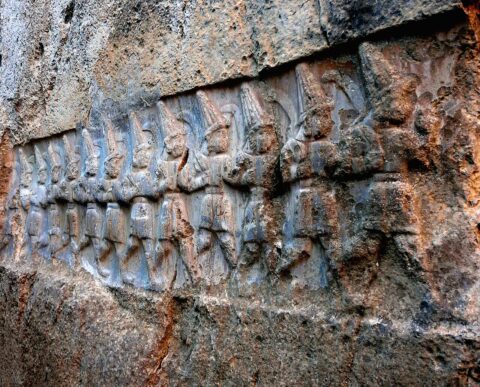
Wurunkatte was a Hattian war god whose name means “King of the Land.” His worship continued under the Hittites, who honored him in royal ceremonies and preserved elements of his older Hattian cult. His connection with kingship and political authority gave him a place in religious life that extended beyond warfare.
Identifying Wurunkatte in Hittite records is not always straightforward. Scribes sometimes used the name Zababa, originally belonging to a Mesopotamian war god, for Wurunkatte and other Anatolian war deities. Festival texts, treaty lists, and temple inventories provide evidence of his worship and religious associations, although references using the name Zababa must be examined individually before they can be attributed to him.
Who Was Wurunkatte in Hattian and Hittite Religion?
Wurunkatte belonged to the Hattian religious tradition of central Anatolia, which preceded the rise of the Hittite kingdom. The Hattians spoke a language distinct from Hittite, but their gods, hymns, and ritual formulas survived in texts copied by Hittite scribes. The god’s name also appears as Wurukatte. As scholar Oğuz Soysal observes, its Hattian meaning refers to rulership over the land rather than warfare itself.
Religious texts place Wurunkatte alongside Taru, the Hattian weather god, and Telipinu. Other divine lists associate him with additional Hattian deities. These references establish his place within the inherited Hattian pantheon, although they reveal little about the precise relationships between these gods.
A Hattic praise text preserves an unusual description of his identity. It calls Šulinkatte the “son of Hattusa,” while describing Wurunkatte as the son of warta and of the lands. The meaning of warta remains unknown, so the passage cannot be interpreted as a clear genealogy. It does, however, preserve a distinctive description of Wurunkatte within Hattian religious poetry.
The continued appearance of his Hattian name in Hittite religious records shows that older traditions remained part of state worship. These surviving texts do not establish when Wurunkatte’s cult first developed or whether all the functions attributed to him under Hittite rule belonged to his earlier Hattian identity.
Was Wurunkatte the Same God as Zababa?
Zababa was originally a Mesopotamian war god associated with the city of Kish. In Hittite cuneiform texts, however, his name was also used as a written designation for Anatolian war gods, including Wurunkatte. This scribal practice explains why the two names sometimes refer to the same deity without implying that Wurunkatte was simply the Mesopotamian god under another name.
The clearest evidence comes from parallel copies of Hittite religious texts. In one version, the Hattian name Wurunkatte appears where another copy uses Zababa. These substitutions establish a direct connection between the names, but the convention was not exclusive to Wurunkatte. Other local war gods could also be designated by the same written name.
A Hittite prayer offers a useful distinction. Its list of deities invokes Zababa followed by “all the War-gods,” treating the named deity and the wider group separately. Such passages show why a reference to Zababa must be read in its religious and geographical context before assigning it to a particular Anatolian god.
The problem appears in treaties with the Kaška of northern Anatolia. In one agreement, Zababa occupies a prominent position among the divine witnesses, immediately after the Sun Goddess and Storm God. Historian Itamar Singer proposed that this war god might be Wurunkatte, whose Hattian origins would fit the religious traditions of the region. The identification remains a scholarly interpretation, however, because the treaty does not preserve Wurunkatte’s name explicitly.
Wurunkatte, Warfare, and Royal Power
Wurunkatte’s title, “King of the Land,” reflects a connection with sovereignty that extended beyond his role as a war god. Piotr Taracha places him alongside the Throne Goddess Ḫanwašuit, known to the Hittites as Ḫalmašuit, in the older Hattian tradition of kingship. The goddess was represented by a ceremonial throne or dais, while Wurunkatte’s title expressed royal authority. Taracha suggests that the war god’s elevated position may preserve beliefs dating from before storm gods became dominant in the religious centers of central Anatolia.
This association did not make Wurunkatte the deity responsible for granting kingship. In an Old Hittite ritual preserved in KUB 29.1, the king declares that the Sun Goddess and Storm God entrusted him with his country and royal household. Another passage describes the Throne Goddess bringing royal power from the sea, together with a ceremonial carriage that symbolized that authority. These accounts distinguish the roles of the gods within Hittite royal ideology without assigning the granting of kingship directly to Wurunkatte.
The War God’s position among the divine witnesses to Hittite treaties also changed over time. In agreements preceding the reign of Šuppiluliuma I, the Anatolian War God occupied a relatively prominent place. From Šuppiluliuma’s reign, he appeared lower in the lists, alongside war gods of other origins. This development reflected changes in official religion, including the growing prominence of the Sun God of Heaven and the incorporation of Hurrian deities into the royal pantheon. Since treaty lists could use the written name Zababa for different war gods, the evidence does not always allow this change in status to be attributed specifically to Wurunkatte.
How Was Wurunkatte Worshipped?
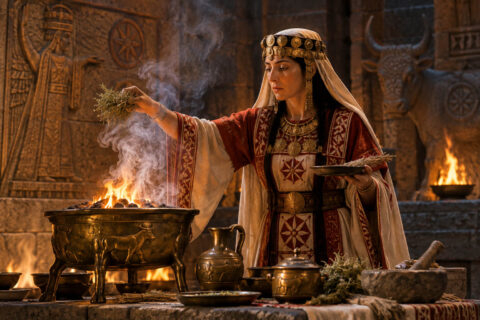
Wurunkatte received animal sacrifices, bread offerings, and ceremonial drinking rites in Hittite religious festivals. His worship formed part of celebrations preserving older Hattian traditions, including the KI.LAM festival. Records mention sheep offered to him, while other texts prescribe different kinds of bread for the war god under the written name Zababa.
A detailed account survives from the sixth day of the nuntarriyašḫa festival (CTH 626), an autumn celebration associated with the king’s return from military campaigns. During a ceremony at Arinna, the king and queen sat together and performed a drinking rite honoring Wurunkatte. A large lyre played, cult singers performed, and dancers were summoned. A cupbearer then presented a special wageššar loaf, which the king broke and tasted. Different copies of this ceremony preserve the names Wurunkatte and Zababa, providing direct evidence of their use for the same deity in this ritual.
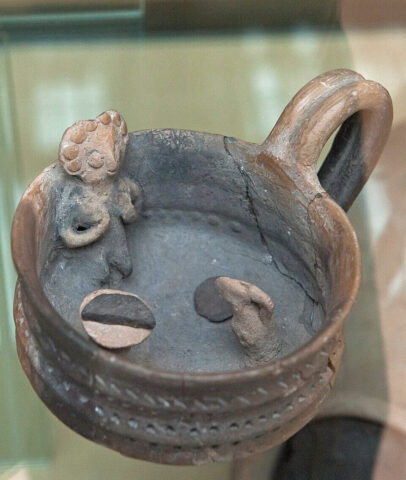
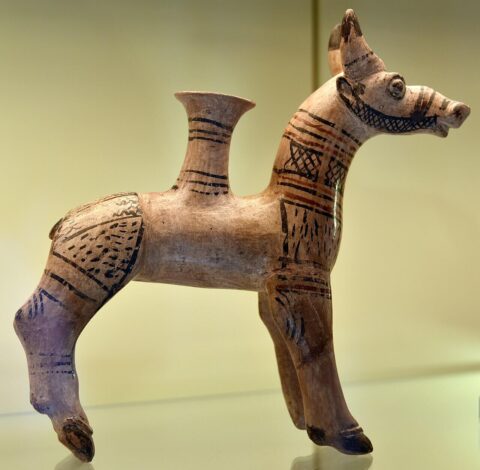
His worship also appeared in local religious traditions. Festival texts from Tuhumiyara preserve Hattian songs invoking Wurunkatte. Another ritual describes the king and queen drinking in honor of a god written as Zababa from a golden lion-shaped vessel, accompanied by performers known as the singers of Kanesh. The ceremony may concern Wurunkatte, although the divine name alone does not establish his identity.
These records offer detailed evidence of royal and local festival worship, but tell us little about whether Wurunkatte received offerings in ordinary households.
How Was Wurunkatte Represented?
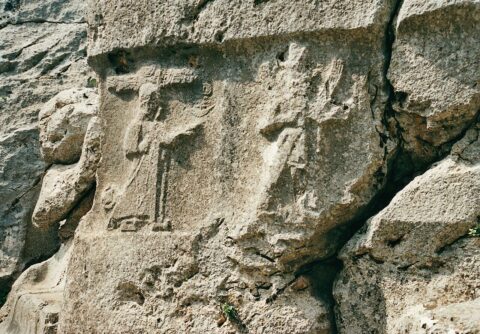
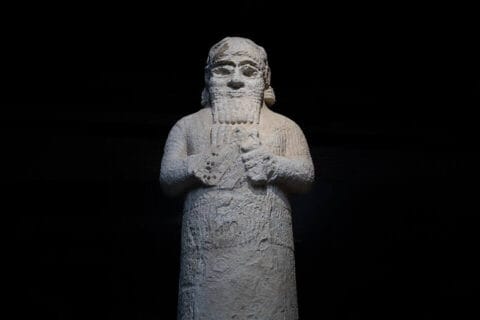
Hittite temple inventories describe several representations of war gods identified in cuneiform as Zababa. Their attributes included maces, shields, spears, and axes, while lions frequently appeared beneath the divine figures. These descriptions help reconstruct the imagery associated with Wurunkatte, although the written name Zababa could refer to other local war gods.
An inventory from Kamana (KUB 38.2) describes a silver statuette of a standing male deity holding a mace in his right hand and a shield in his left. A lion stood beneath the figure on a silver-covered base. At Tarammeka, another inventory (KUB 38.1) records the war god’s image as a silver fist weighing twenty shekels. The deity’s equipment included two large copper shields, a lance, three copper daggers, a spear, a bronze mace, and an axe. The inventory also records the establishment of a new temple and the appointment of a priest. Here, the war god was represented by a fist-shaped cult object rather than a human-shaped statue.
A possible earlier example comes from Kültepe, where excavations in 2006 uncovered an oval gold foil measuring 4.1 by 3 centimeters. The embossed figure stands on a lion, carries an axe resting against his shoulder, and holds a smaller lion by its hind legs. The object was discovered in a settlement layer associated with the Assyrian trading colonies period. Archaeologist Fikri Kulakoğlu suggested that it represents an early form of the Anatolian war god later known as Zababa or Wurunkatte.
The Kültepe figure has no inscription identifying the deity. Its weapons and lion imagery closely resemble attributes documented in later Hittite sources, making the comparison plausible without proving that the figure represents Wurunkatte himself.
Wurunkatte in Hittite Treaties and Mythological Texts
Hittite treaties invoked war gods not only as witnesses but also as punishers of broken oaths. In an agreement with the Kaška (KBo 8.35), those who attack Hittite territory are threatened with divine retribution: the god written as Zababa would turn their weapons against them and make their own arrows pierce their hearts. Itamar Singer proposed that this deity might be Wurunkatte, although the treaty does not preserve his Hattian name. The curse shows how the threat of divine punishment was used to enforce military and political obligations.
Several Hittite myths also feature a War God whose identification remains uncertain. In The Disappearance of the Sun God (CTH 323), the land suffers under the power of Ḫaḫḫima, or Frost. The Storm God sends the War God to search for the missing Sun God, but Frost seizes him. The Tutelary Deity and Telipinu are sent afterward and suffer the same fate. The episode places the War God among the deities unable to overcome the force threatening the land.
A fragment known as Hannahanna and the War God preserves an unusual exchange between the two deities. The War God asks what he should receive if he remains inactive, and Hannahanna tells him to undertake military campaigns year after year. Much of the surrounding narrative is lost, but the exchange directly connects the War God’s responsibilities with recurring warfare. His personal name is not preserved.
Read Also:
Lelwani: The Hittite Deity of the Underworld
Another possible appearance occurs in the Hurrian-influenced Song of Going Forth (CTH 344). A damaged passage mentions a deity written as Zababa in connection with the Storm God’s curse and the expulsion of a war god. Erik van Dongen considers Wurunkatte a possible identification, though the name could designate another Anatolian deity. The fragment offers a glimpse of the War God’s involvement in struggles among the gods, but too little survives to establish Wurunkatte’s precise role in the story.
Sources & Primary Texts
This article draws on Hattian and Hittite religious texts, temple inventories, archaeological discoveries, and modern scholarship. References to the war god Zababa are distinguished from those securely identifying Wurunkatte.
Academic Studies
- Soysal, Oğuz (2016). Wuru(n)katte. Reallexikon der Assyriologie und Vorderasiatischen Archäologie, Vol. 15, pp. 134–135. A specialized reference on the deity’s name, Hattian origins, cult, and identification with Zababa.
- Taracha, Piotr (2013). Political Religion and Religious Policy: How the Hittite King Chose His Patron Gods. Altorientalische Forschungen 40(2), pp. 373–384.
- Singer, Itamar (2007). Who Were the Kaška? Phasis 10(1). Discusses the divine witnesses and treaty curses associated with the war god Zababa.
- Collins, Billie Jean (2005). A Statue for the Deity: Cult Images in Hittite Anatolia. In Cult Image and Divine Representation in the Ancient Near East, edited by Neal H. Walls, pp. 13–42.
- Kulakoğlu, Fikri (2008). A Hittite God from Kültepe. In Old Assyrian Studies in Memory of Paul Garelli, pp. 13–19. Examines the gold foil depicting a deity standing on a lion.
- Hoffner, Harry A., Jr. (1998). Hittite Myths, Second Edition. Writings from the Ancient World. Society of Biblical Literature. Includes translations of the myths involving the War God.
- van Dongen, Erik (2012). The Hittite Song of Going Forth (CTH 344): A Reconsideration of the Narrative. Die Welt des Orients 42(1), pp. 23–84.
Primary Hittite Texts
- The nuntarriyašḫa Festival (CTH 626). Corpus of Hittite Festival Rituals, Day 6. Documents a royal drinking rite honoring Wurunkatte.
- KUB 38.1 and KUB 38.2. Hittite temple inventories describing the war god’s cult objects, weapons, and statues. Discussed in Collins (2005).
- KBo 8.35. Treaty with Kaška groups containing a curse invoking the war god written as Zababa. Discussed in Singer (2007).
- KUB 29.1. Old Hittite ritual preserving traditions about divine authority and kingship. Discussed in Taracha (2013).
- CTH 323 and CTH 344. Mythological texts involving the War God or a deity written as Zababa. Examined in Hoffner (1998) and van Dongen (2012).
Copyright & Image Credits
© 2026 History & Myths. All rights reserved. Original article text and editorial analysis by History & Myths.
Ancient religious texts, inscriptions, and archaeological artifacts discussed in this article are presented for historical and educational purposes. Modern photographs, illustrations, and scholarly translations remain subject to their respective copyright and licensing terms. Individual image credits and applicable licenses are provided alongside the images.