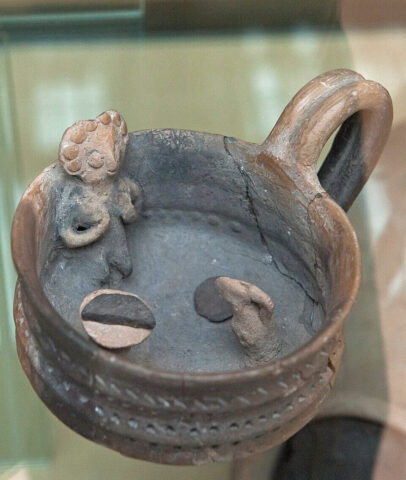
Kamrusepa: The Hittite Goddess of Magic and Healing
Kamrusepa was a goddess of magic, purification, and healing in Hittite religion. Her power lay in incantations and ritual actions intended to remove illness, anger, and other harmful forces. She is best known for calming the god Telipinu, whose disappearance had brought suffering to the land. Through her rites, his destructive anger was removed, allowing the restoration of order.
Kamrusepa also appears in other Hittite and Luwian religious texts. A mythological incantation associates her with the removal of disease, while the Tauriša tradition places her among deities invoked in contexts involving childbirth and illnesses affecting children. These accounts reveal a divine figure whose influence extended beyond a single myth, although the surviving evidence leaves much about her independent worship uncertain.
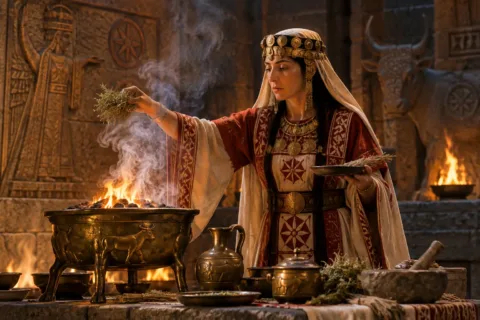
Who Was Kamrusepa in Hittite Religion?
Kamrusepa, also written Kamrušepa, belonged to the religious traditions of Bronze Age Anatolia. Hittite festival texts associate Kamrusepa with singers from Kaneš (Neša), an important early center of Hittite culture. Some scholars have proposed that her cult originated there, but the evidence remains inconclusive.
Her identity also crossed linguistic and cultural boundaries. In bilingual Hattian and Hittite texts, Kamrusepa corresponds to the Hattian goddess Katahzipuri. Their names are linguistically distinct, and scholars differ over whether they were originally separate goddesses who became identified with one another. Kamrusepa also appears in Luwian religious traditions, including texts associated with Tauriša.
These connections show how her identity was preserved and adapted within the religious traditions of ancient Anatolia, rather than belonging exclusively to a single local pantheon.
How Did Kamrusepa’s Magic Work?
Kamrusepa’s magic belonged to a Hittite ritual tradition in which spoken words and symbolic actions were used to remove harmful conditions. Incantations often compared the desired result with something familiar in nature. A curse might be treated as something that could be loosened, while impurity could be removed through actions representing its separation from the affected person.
An example appears in the ritual of Ḫantitaššu (CTH 395). The incantation asks that a person escape danger as a small seed escapes a millstone, and that misfortune fail to reach them just as the rear wheel of a moving vehicle cannot catch the front. The speaker then identifies the words as those of the Sun God and Kamrusepa, invoking their authority over the ritual.
These comparisons were intended to bring about the changes they described. Kamrusepa’s name gave divine authority to such words, although not every Hittite purification ritual was associated with her.
Kamrusepa and the Anger of Telipinu
In The Disappearance of Telipinu (CTH 324), Kamrusepa intervenes after the bee finds the missing god but fails to calm him. Her task is to remove the anger that continues to threaten the land.
Kamrusepa tells the gods to select twelve rams from the Sun God’s flock, tended by Hapantali. She then describes sifting karaš-grain through a basket pierced with a thousand openings. In the accompanying purification rite, she declares that she has removed evil, anger, wrath, and sullenness from Telipinu’s body. These harmful qualities are treated as forces that can be separated from the god.
Her incantations direct Telipinu’s anger away from houses, fields, and settlements toward the Dark Earth. There, bronze vessels with lead lids and iron fastenings are said to hold whatever enters them, preventing its return. The rite is intended not only to remove the anger but also to keep it from harming the living world again.
Once Telipinu is appeased, he returns to his proper place, and the land recovers its fertility. Kamrusepa’s intervention provides a mythological example of how ritual purification was understood to restore order.
Kamrusepa’s Fire Incantation and Healing
A Hittite composition known as the Myth and Incantation of Fire (CTH 457.1) preserves another example of Kamrusepa’s healing role. Looking down from heaven, she instructs attendants to gather fire from the steppe, wheat from irrigated fields, red, black, and green wool, and a reed stalk. These materials are enchanted and used in ritual actions around the neck and feet of an afflicted person.
Kamrusepa’s incantation calls for the illness affecting the person’s head to become mist and rise into the sky. The Dark Earth is asked to remove the affliction, while heaven above and the earth below are invoked to overcome it. Disease is treated as something that can be separated from the sufferer and carried away.
The narrative then takes an unusual turn. Fire loses its heat and laments its condition. After speaking with the Sea God, it approaches Kamrusepa for help. The damaged account continues with images of burning rivers, meadows, and mountains, but its ending is lost.
Kamrusepa in Childbirth and Protection Rituals
Kamrusepa also appears in Hittite-Luwian incantations associated with Tauriša (CTH 764–766). In this tradition, she and the Sun God are presented as the parents of the protective god of Tauriša. The texts concern pregnancy, childbirth, and illness, connecting this divine family with rites intended to protect vulnerable people.
One fragment (CTH 764.6) describes a person suffering from a disorder affecting the head. The Sun God addresses Kamrusepa, while the protective god begins to explain the affliction. Other texts in the collection preserve incantations concerning pregnancy (CTH 766) and the removal of disease (CTH 765).
These compositions differ from the longer mythological narratives in which Kamrusepa performs elaborate acts of purification. Many are short spoken incantations, sometimes incorporating conversations between deities. Not every surviving spell names Kamrusepa, and several are fragmentary. They establish her place within a religious tradition concerned with childbirth and protection, without showing that every rite in the collection was performed under her authority.
Kamrusepa and Hittite Ritual Practitioners
Kamrusepa’s role in mythology has a close parallel in the work of Hittite ritual specialists known as MUNUSŠU.GI, conventionally translated as “Old Women.” The title designated female experts in religious procedures, not necessarily women of advanced age. They performed rites against illness, impurity, sorcery, and divine anger, sometimes on behalf of the royal household.
Some of these practitioners are known by name. Tunnawiya, whose rituals are classified as CTH 409, prescribed purification ceremonies for people believed to suffer from ritual contamination. Her instructions specify the materials, spoken formulas, and actions required, including ceremonies performed beside a river.
Galina Kellerman has interpreted Kamrusepa’s intervention in the Telipinu myth as a divine precedent for mugawar rituals, through which human specialists sought to appease offended gods. The connection helps explain why a goddess could appear as the performer of rites resembling those carried out by trained practitioners. It does not establish that the Old Women formed a priesthood devoted specifically to Kamrusepa.
Evidence for Kamrusepa’s Worship
Evidence for Kamrusepa’s worship extends beyond the myths and incantations in which she appears. In Mursili II’s Fourth Plague Prayer (CTH 378.IV), she is invoked as “Kamrusepa of Taniwanda” among the deities addressed during the kingdom’s epidemic. The reference establishes a specific geographical association and shows that she had a place in royal religious appeals.
Other Hittite records associate her with Lihzina, Tanizila, and Pala. Her name also occurs in festival material, including KBo 11.22 (CTH 656). These attestations indicate that her religious significance was not confined to the traditions of Kaneš or the mythological accounts preserved at Hattusa.
Despite these references, the evidence for Kamrusepa’s independent cult remains limited. The surviving texts do not provide a detailed account of a temple dedicated exclusively to her or a complete calendar of festivals in her honor. Her importance is therefore better documented through invocations and ritual traditions than through the organization of her priesthood or sanctuaries.
Read Also
Conclusion
Kamrusepa held a distinctive place in Hittite religion as a goddess whose power was expressed through ritual knowledge. From appeasing Telipinu to driving away illness, her incantations reflected the belief that harmful forces could be removed through carefully performed rites. References in royal prayers and local religious traditions show that her importance extended beyond mythology. Although much about her temples and worshippers remains unknown, the surviving texts preserve her role in addressing dangers that threatened both individuals and the wider community.
Academic Sources & Primary Texts
Primary Texts
- The Disappearance of Telipinu (CTH 324). Hittite myth and ritual composition describing Kamrusepa’s intervention to remove Telipinu’s anger. Translated in Harry A. Hoffner Jr., Hittite Myths, 2nd ed. (Atlanta: Scholars Press, 1998).
- Myth and Incantation of Fire (CTH 457.1; KUB 17.8). Edited by Francesco Fuscagni, Hethitologie-Portal Mainz. A ritual-mythological text associating Kamrusepa with incantations against illness.
- Ritual of Hantitassu (CTH 395; KBo 11.14). Hittite ritual incantations invoking the authority of the Sun God and Kamrusepa. Discussed in Collins and Torri (2024).
- Ivanov, Valerii, and Ilya Yakubovich, eds. Hittite-Luwian Conjurations (CTH 764–766). Hethitologie-Portal Mainz, 2025. Critical editions of texts concerning the divine triad of Taurisa, disease, pregnancy, and children.
Academic Studies
- Hoffner, Harry A., Jr. Hittite Myths. 2nd ed. Edited by Gary M. Beckman. Writings from the Ancient World 2. Atlanta: Scholars Press, 1998.
- Kellerman, Galina. “The Telepinu Myth Reconsidered.” In Kaniššuwar: A Tribute to Hans G. Güterbock on His Seventy-Fifth Birthday, edited by Harry A. Hoffner Jr. and Gary M. Beckman, 115–24. Assyriological Studies 23. Chicago: Oriental Institute, University of Chicago, 1986.
- Collins, Billie Jean, and Giulia Torri. “Sinister Bees and Desperate Pleas: Hittite Incantation Prayers.” Asia Anteriore Antica 6 (2024): 81–90.
- Mouton, Alice, and Ilya Yakubovich. “Where Did One Speak Luwili? Geographic and Linguistic Diversity of Luwian Cuneiform Texts.” Journal of Language Relationship 19, nos. 1–2 (2021): 25–53.
- Warbinek, Livio. “The -šepa Theonyms in the Hittite Pantheon.” Vicino Oriente 26 (2022): 1–19.
- Taracha, Piotr. Religions of Second Millennium Anatolia. Dresdner Beiträge zur Hethitologie 27. Wiesbaden: Harrassowitz Verlag, 2009.
© 2026 H. Moses | All Rights Reserved | History & Myths