The Sun Goddess of Arinna: Hittite Queen of Heaven and Earth
The Sun Goddess of Arinna was one of the principal deities of the Hittite kingdom and a protector of its rulers. Arinna was the sacred city at the centre of her worship, not her personal name.
Her cult had roots in the older Hattic religion, where the goddess was known as Eštan and by the epithet Wurunšemu (also written Wurusemu). Another name, Arinniti, meant “She of Arinna.” Hittite royal prayers addressed her as “Queen of Heaven and Earth,” reflecting her prominent place in the kingdom’s religious life.
From Hattian Worship to the Hittite State Cult
When the Hittite kingdom emerged in central Anatolia, its rulers adopted deities and religious practices from the older Hattian tradition. The Sun Goddess of Arinna stood alongside the Storm God of Hatti as one of the two principal deities of the state pantheon.
Her worship was closely connected to the royal office. The Hittite king served as her chief priest, while the queen also held important responsibilities in the state cult. In the Apology of Ḫattušili III, a divine promise that he would become the goddess’s priest signalled his future accession to the throne.
Hattian traditions remained part of these ceremonies. Religious tablets preserve songs and recitations in the Hattian language that continued to be performed during Hittite festivals. The kingdom had adopted an older religious tradition without abandoning its original sacred language.
Why Was She Called Queen of Heaven and Earth?
Hittite royal prayers addressed the Sun Goddess of Arinna as “Queen of Heaven and Earth,” a title reflecting her authority over the land of Hatti and its rulers.
A hymn in the prayer of Ḫattušili III and Puduḫepa (CTH 383) calls her the “torch of Hatti” and describes her as the goddess who chooses kings and queens and can withdraw her favour.
This authority mattered particularly to Ḫattušili III, who had taken the throne after a struggle with his nephew Urḫi-Teššub. In his prayer, he defended his conduct during earlier political disputes and sought the goddess’s favour. Her approval was presented as essential to the legitimacy of his rule.
In a separate prayer (CTH 384), Queen Puduḫepa addressed her as the ruler of all lands. Such titles expressed the goddess’s exalted position without making her the sole authority over the Hittite pantheon. The Storm God of Hatti remained another principal deity.
The Sun Goddess of Arinna and Tarhunna
The Sun Goddess of Arinna and Tarhunna, the Storm God of Hatti, formed the principal divine couple of the Hittite state religion. Their family included several deities whose cults were centred in important cities across the kingdom.
Their daughter was the goddess Mezzulla, while Zintuhi was identified as their granddaughter. The Storm God of Zippalanda was also addressed as their son. Royal texts describe the Storm God of Nerik as a son of the Sun Goddess of Arinna, and the two local storm gods were sometimes identified with one another.
These family relationships played a practical role in Hittite worship. In her prayer for the health of King Ḫattušili III (CTH 384), Queen Puduḫepa appealed to Mezzulla, Zintuhi, and the Storm God of Zippalanda to intercede with their divine parents and grandparents.
The queen promised gifts in return for their assistance, including a golden shield for the Storm God of Zippalanda. Her prayer shows how divine family relationships could provide a means of approaching the kingdom’s principal gods.
The Sun Goddess of Arinna and the Hurrian Goddess Ḫepat
By the thirteenth century BCE, the Sun Goddess of Arinna had come to be identified with Ḫepat (also written Ḫebat), a major Hurrian goddess and the wife of the Storm God Teššub.
The two goddesses came from different religious traditions. Unlike the Sun Goddess of Arinna, Ḫepat had no original solar character. She was particularly important in Hurrian religion, including the traditions of northern Syria and Kizzuwatna.
Their identification appears explicitly in Queen Puduḫepa’s prayer to the Sun Goddess of Arinna (CTH 384). The queen declares that the goddess bears the name Sun Goddess of Arinna in Hatti but is called Ḫepat in the land of cedars.
Puduḫepa came from Kizzuwatna, where Hurrian traditions were deeply established. As Hittite queen, she played an active role in organising religious ceremonies and bringing Hurrian practices into the royal cult.
The identification reflected the religious changes of the late Hittite Empire. It did not mean that the two goddesses had always shared the same identity or attributes.
The Sun Goddess of Arinna in Hittite Royal Prayers
Hittite kings and queens turned to the Sun Goddess of Arinna during military defeats, epidemics, and threats to the royal family. Their prayers often presented arguments for divine intervention, drawing on past offerings, religious obligations, and the conduct of their enemies.
King Arnuwanda I and Queen Ašmunikkal addressed her during conflicts with the Kaška people in northern Anatolia. Their prayer (CTH 375) describes temples being plundered, sacred objects carried away, and regular offerings interrupted. The royal couple contrasted these attacks with their own efforts to maintain the gods’ worship.
Muršili II faced an epidemic and rebellions among territories formerly subject to Hatti. In his prayer to the Sun Goddess of Arinna (CTH 376), he recalled earlier Hittite victories over Aleppo and Babylon and complained that neighbouring peoples had stopped paying tribute. He asked the goddess to punish those responsible for offending the gods rather than allowing the innocent to perish alongside the guilty.
The tablet’s closing note records that the goddess was invoked for seven days in Ḫattuša and another seven in Arinna.
Queen Puduḫepa appealed to the goddess for the health of her husband, Ḫattušili III (CTH 384). She reminded her of the king’s efforts to restore Nerik, a sacred city associated with the goddess’s son. Puduḫepa also invoked a traditional saying that the gods grant requests to a woman associated with childbirth, using her own experience to strengthen her plea.
These prayers show how Hittite rulers sought divine assistance through specific claims, whether defending their kingdom, confronting disease, or pleading for a family member’s life.
How Was the Sun Goddess of Arinna Worshipped?
The Sun Goddess of Arinna received offerings of bread, wine, and animals during temple ceremonies and royal festivals. One surviving ritual describes a priest washing his hands and making offerings at dawn. A subsequent invocation was performed from the roof of her temple, with the priest facing the sun.
Her worship featured prominently in the autumn nuntarriyašḫa festival, also known as the Festival of Haste. On the fifth day, the king travelled from Taḫurpa to Arinna, where he made offerings of bread, honey, and wine to various deities and sacred places. Some offerings included new wine and fresh honey from the season’s produce.
Meanwhile, the queen remained in Taḫurpa for a separate ceremony. The ritual instructions describe eight representations of the Sun Goddess of Arinna: three statues and five solar disks. Six were associated with former Hittite queens, including Ašmunikkal and Ḫenti.
The queen’s offerings included seven sheep, bread, honey, fruit, cheese, and wine. Libations were performed before the sacred images, preserving a connection between the goddess’s worship and earlier generations of Hittite royalty.
A separate winter festival dedicated to the Sun Goddess of Arinna is also recorded under CTH 598. Its surviving fragments confirm the festival’s existence but do not preserve a complete account of its ceremonies.
Was She the Same as the Other Hittite Sun Deities?
The Sun Goddess of Arinna was not the only solar deity worshipped by the Hittites. Their religious texts also refer to a male Sun God of Heaven and a Sun Goddess of the Earth, whose identities and functions sometimes overlapped.
The Sun God of Heaven was associated with justice, oaths, and the maintenance of order. He shared important characteristics with the Mesopotamian sun god Šamaš. The Hittite name Ištanu could refer to both male and female solar deities, making it difficult to identify a particular god from the name alone.
The Sun Goddess of the Earth was closely associated with the underworld. She appeared in rituals involving impurity and supernatural dangers, where she could receive and remove harmful substances. She was also identified with the Mesopotamian underworld goddess Ereškigal. A connection with the Hurrian goddess Allani appears in the Epic of Release, but this should not be treated as a universal identification.
The distinctions were complicated by Hittite writing practices. Scribes used the cuneiform designation dUTU for several solar deities, while some religious traditions connected the Sun Goddess of Arinna with the underworld goddess.
Identifying which deity a text describes therefore requires attention to her titles, religious functions, and the context of the particular prayer or ritual.
Read Also
Tarhunna: The Storm God of the Hittites
Discover the storm god who stood beside the Sun Goddess of Arinna at the centre of Hittite state religion, royal worship, and divine kingship.
Who Were the Hittites? History, Origins and Empire
Explore the origins, rulers, religious traditions, and history of the ancient kingdom in which the goddess held such a prominent place.
Samuha: The Hittite Royal City and Cuneiform Archive Found in 2026
Learn about a major Hittite religious centre where Anatolian and Hurrian traditions met, and the archaeological discoveries that illuminate its history.
How Was the Sun Goddess of Arinna Represented?
Hittite texts describe the Sun Goddess of Arinna in both symbolic and human forms. One cult inventory records a golden sun disk dedicated to her, alongside a separate account of a female statue. Other inventories mention silver stelae topped with rays, showing that her cult images were not limited to human figures.
The clearest securely identified depiction appears on a royal seal of Tudḫaliya IV, dating to the thirteenth century BCE. The goddess wears a long garment and a rounded, bonnet-like headdress. Similar headgear appears in Hittite representations of queens, reflecting a shared visual tradition between divine and royal figures.
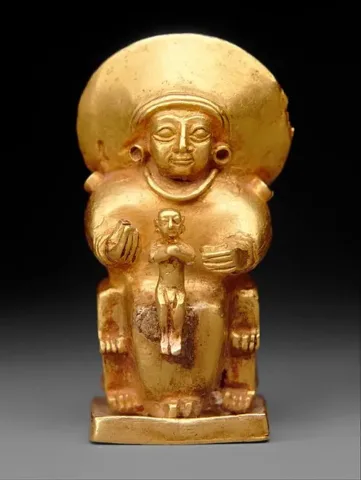
A small gold pendant in the Metropolitan Museum of Art may offer another representation. Dating to the fourteenth or thirteenth century BCE, it depicts a seated goddess holding a naked child on her lap. Her disk-shaped headdress suggests a solar identity, while the chair beneath her has lion-paw feet. The museum considers the Sun Goddess of Arinna a possible identification, but it remains uncertain.
These objects show why identifying Hittite goddesses from their appearance alone can be difficult. A solar disk or distinctive headdress may suggest the Sun Goddess of Arinna, but inscriptions and cult records provide stronger evidence for determining which deity is represented.
Academic Sources & Primary Hittite Texts
This article draws on Hittite royal prayers, religious and festival texts, cult inventories, and modern academic studies of Anatolian religion. The sources document the Sun Goddess of Arinna’s position in Hittite kingship, her Hattian background, her identification with the Hurrian goddess Hepat, and the rituals associated with her worship.
Primary Texts & Scholarly Translations
Singer, Itamar. Hittite Prayers (2002).
Society of Biblical Literature, Writings from the Ancient World 11. Scholarly translations of Hittite royal prayers, including those of Arnuwanda I and Ašmunikkal, Muršili II, Hattušili III, and Puduḫepa. Essential for the goddess’s royal titles, divine authority, and role in times of political and personal crisis.
Catalogue of Hittite Texts (CTH), Hymns and Prayers.
Hethitologie-Portal Mainz. Scholarly catalogue identifying the surviving prayers to the Sun Goddess of Arinna, particularly CTH 375, 376, 383, and 384, and distinguishing them from prayers addressed to other Hittite solar deities.
Corpus of Hittite Festival Rituals (HFR).
Hethitologie-Portal Mainz. Research corpus of Hittite festival tablets, including the nuntarriyašḫa festival (CTH 626). Provides textual evidence for royal journeys, offerings, sacred images, and the ceremonial participation of the king and queen.
Academic Studies of Hittite Religion
Taracha, Piotr. Religions of Second Millennium Anatolia (2009).
Harrassowitz Verlag, Dresdner Beiträge zur Hethitologie 27. A major study of Anatolian religion, Hattian cult traditions, the Hittite state pantheon, and the growing influence of Hurrian deities during the imperial period.
Steitler, Charles W. The Solar Deities of Bronze Age Anatolia (2017).
Harrassowitz Verlag, Studien zu den Boğazköy-Texten 62. A specialized examination of Hittite solar deities, their names, religious functions, and textual identities, including distinctions between celestial and underworld solar traditions.
Cammarosano, Michele. Hittite Local Cults (2018).
SBL Press, Writings from the Ancient World 40. Critical editions and analysis of Hittite cult inventories, with evidence for divine images, solar symbols, offerings, festivals, and local religious practices.
van de Peut, Lidewij E. Persuading the Divine: On the Composition of Hittite Prayers (2022).
Harrassowitz Verlag, Studien zu den Boğazköy-Texten 69. Examines the structure, arguments, and rhetorical strategies of Hittite prayers, including the reuse of earlier compositions in prayers to the Sun Goddess of Arinna.
Güterbock, Hans G. An Addition to the Prayer of Muršili to the Sungoddess and Its Implications.
Anatolian Studies. A focused philological study of a newly identified fragment belonging to Muršili II’s prayer to the Sun Goddess of Arinna, relevant to the reconstruction and interpretation of CTH 376.
Archaeological & Museum Evidence
Metropolitan Museum of Art. Seated Goddess with a Child, Accession 1989.281.12.
Hittite gold pendant, fourteenth to thirteenth century BCE. The museum discusses the possibility that the figure represents the Sun Goddess of Arinna, based on her disk-shaped headdress, while leaving the identification uncertain.
RESEARCH & IDENTIFICATION NOTE
Hittite religious texts preserve different local traditions and several solar deities whose names and functions sometimes overlap. The identification of the Sun Goddess of Arinna with Hepat reflects historical religious developments rather than an original identity shared by the two goddesses. Some surviving images have also been attributed to the Sun Goddess of Arinna only tentatively. Such distinctions are maintained throughout this article.
Copyright & Editorial Notice
© 2026 History & Myths. All rights reserved for the original written content, research synthesis, and editorial presentation of this article.
This article is an independent educational examination of the Sun Goddess of Arinna, based on surviving Hittite religious texts, archaeological evidence, and modern academic scholarship. Established historical evidence is distinguished from scholarly interpretations and uncertain identifications.
Ancient texts and historical facts are not claimed as proprietary material. Modern translations, academic publications, images, and other third-party works remain subject to their respective rights and licenses.