Maponos: The Celtic God of Youth and Music
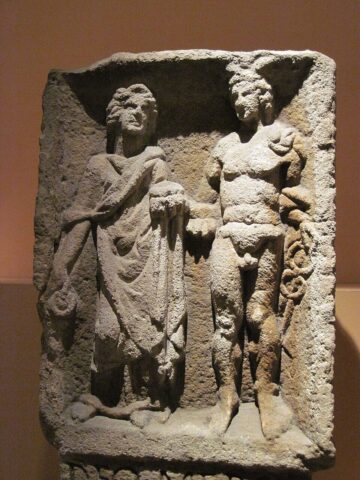
Maponos was a Celtic god worshipped in Roman Britain and Gaul, whose name is commonly interpreted as “Divine Son” or “Great Youth.” In northern Britain, inscriptions identify him with the Roman god Apollo, and an altar from Corbridge depicts Apollo holding a lyre. This provides the clearest evidence for Maponos’s association with music, although it does not establish that music was one of his original Celtic functions.
A Gaulish ritual inscription from Chamalières is commonly read as invoking Maponos Arvernatis without mentioning Apollo, revealing another context in which the deity was worshipped. revealing another context in which the deity was worshipped. His name also survives in Mabon ap Modron, a figure in the medieval Welsh tale Culhwch and Olwen. The linguistic connection is well established, but the later narrative cannot be treated as a direct account of Maponos’s ancient mythology.
Who Was Maponos in Celtic Religion?
Maponos was an indigenous Celtic deity whose worship is documented in Roman Gaul and Britain. His Celtic name and appearance in a Gaulish-language ritual text distinguish him from gods introduced through Roman religion. Although the surviving evidence belongs largely to the Roman imperial period, it does not establish when his cult originated or how he was worshipped before the conquest.
In northern Britain, Maponos received dedications from Roman military personnel, including officers stationed at frontier settlements. His presence in this environment reflects the religious diversity of the Roman army, whose members honoured both Roman and local gods. These dedications show that Maponos attracted worshippers within military communities, but they do not establish that he was a war god or that his cult was restricted to soldiers.
In Gaul, the evidence places Maponos in a different religious setting. His invocation in a Gaulish ritual text deposited at a sacred spring contrasts with the formal Latin dedications of Britain. The two traditions document different ways of approaching the deity, illustrating how his worship could operate within both indigenous and Roman religious practices.
What Does the Name Maponos Mean?
The name Maponos is usually interpreted as “Divine Son” or “Great Youth.” It derives from the Gaulish mapos, meaning “son” or “boy,” with the suffix -onos, which could give names an augmentative or divine sense. The form Maponus, preserved in Latin inscriptions, reflects the adaptation of this Celtic name to Roman spelling.
The underlying word goes back to Proto-Celtic makʷos, which developed into Gaulish mapos and the Welsh mab, both meaning “son.” The related Irish mac preserves a different development of the same Celtic root. These linguistic connections are particularly important because the ancient name Maponos also developed into Welsh Mabon, later recorded in medieval literature.
The name points to youth or divine sonship as a defining aspect of Maponos’s identity, but it does not identify his parents or establish a specific religious responsibility. Its meaning is better understood as a divine title than as evidence of a particular genealogy.
The Inscriptions and Archaeological Evidence of Maponos
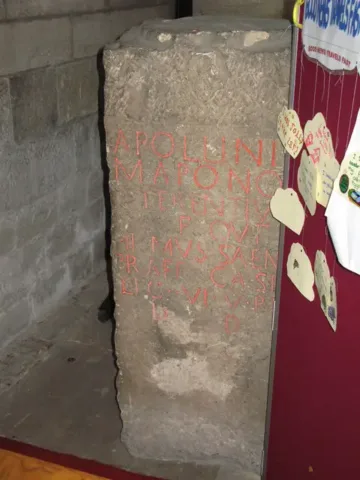
The strongest archaeological evidence for Maponos comes from Roman Britain, where inscribed altars, sculpted monuments, and a silver pendant preserve his name. Some dedications identify him as Apollo Maponus, while others use the Celtic name alone. This distinction is important because it documents both his association with the Roman god and his continued recognition under his indigenous name.
Three altars associated with Corbridge, ancient Coria, preserve dedications to Apollo Maponus (RIB 1120–1122). One was erected by Quintus Terentius Firmus, prefect of the camp of the Sixth Legion Victrix. Another, dedicated by a military tribune whose partially reconstructed name is read as Calpurnius, depicts Apollo holding a lyre and laurel branch on one side and Diana carrying a bow and quiver on the other. The third, preserved in the crypt of Hexham Abbey, bears a damaged inscription naming Maponus Apollo and a centurion apparently serving in the Sixth Legion.
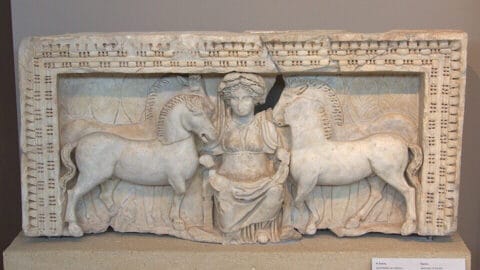
A particularly valuable monument comes from Ribchester, Roman Bremetennacum. Its inscription (RIB 583) records a dedication made on 31 August AD 241 by Aelius Antoninus, a centurion of the Sixth Legion who commanded a unit of Sarmatian cavalry. The offering sought the welfare of the emperor and the cavalry unit during the reign of Gordian III. The surviving stone is part of a monument’s pedestal rather than an altar. Its reliefs depict Apollo beside a lyre and two female figures representing the local district and the province of Britannia Inferior.
Read Also:
Belenus: The Celtic God Linked to Apollo and Healing
Other inscriptions preserve Maponos’s name without Apollo. A red sandstone altar found near Brampton (RIB 2063) records a vow fulfilled by four men identified as Germans, who dedicated it to Maponus and the divine spirit of the emperor. Its exact findspot remains uncertain. At Vindolanda, a crescent-shaped silver pendant discovered in 1970 bears the inscription Deo Mapono, “To the god Maponus” (RIB 2431.2). Unlike the monumental dedications, this small object provides evidence of personal devotion.
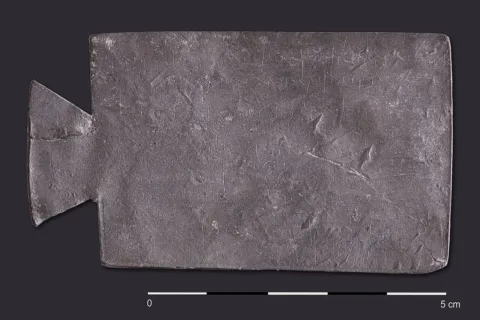
In Gaul, a different form of religious evidence survives at Chamalières, near Clermont-Ferrand. A lead tablet discovered in 1971 among votive offerings at the Source des Roches sanctuary contains a Gaulish inscription invoking the deity commonly identified as Maponos Arvernatis. Written in Latin cursive, the text includes ritual formulas whose purpose and interpretation remain disputed. Its use of the Gaulish language makes it an important witness to the invocation of Maponos outside the Latin dedications that dominate the British archaeological record.
Why Was Maponos Identified with Apollo?
In Roman Britain, worshippers sometimes addressed the Celtic god as Apollo Maponus, an example of interpretatio Romana, the practice of identifying local deities with gods from the Roman pantheon. The association is explicit in dedications from Corbridge and Ribchester. One damaged Corbridge inscription even preserves the combined name in the reverse order, Maponus Apollo. These monuments establish that the identification belonged to ancient religious practice, rather than being a comparison devised by modern scholars.
Why Maponos was associated with Apollo is less certain. His name suggests divine youth, while Apollo was traditionally portrayed as a youthful god, making this a possible point of contact. The British monuments also represent the combined deity using Apollo’s familiar artistic attributes. Such imagery demonstrates how worshippers expressed the identification, but cannot determine which characteristics originally belonged to Maponos. In particular, Apollo’s associations with healing and prophecy do not establish that the Celtic god possessed those functions independently.
The Roman identification did not eliminate Maponos’s indigenous name. Dedications from Brampton and Vindolanda invoke Deo Mapono, while the Gaulish ritual inscription from Chamalières names him without reference to Apollo. These different forms of address show that Maponos could receive worship both through a Roman divine identity and under his Celtic name alone.
Was Maponos a God of Music and Poetry?
Maponos is frequently described as a Celtic god of music and poetry, although neither role is directly attributed to him in surviving Celtic texts. The association comes primarily from his identification with Apollo, who was celebrated in Greek and Roman religion as a musician, a patron of poets, and leader of the Muses.
Two Romano-British monuments provide the clearest evidence. On the altar from Corbridge (RIB 1121), Apollo carries a lyre in his left hand and a laurel branch in his right. At Ribchester (RIB 583), he is depicted resting against a lyre, with a quiver on his back. Both monuments bear dedications to Apollo Maponus, showing that musical imagery formed part of the way worshippers represented the combined deity.
The connection with poetry is less secure. Although Apollo’s patronage of poetic inspiration was well established in classical religion, no known dedication identifies Maponos as a protector of poets or bards. Nor does any surviving ancient account describe him singing, playing an instrument, or inspiring artistic performance.
The lyre therefore provides a genuine archaeological basis for associating Maponos with music in Roman Britain. Whether musical patronage belonged to his earlier Celtic identity, rather than being expressed through Apollo’s established attributes, remains unknown.
The Chamalières Tablet and the Gaulish Maponos
The Chamalières tablet preserves one of the rare surviving examples of Maponos being invoked in the Gaulish language. The lead sheet, measuring approximately 6 by 4 centimetres, contains twelve lines written in Latin cursive. Its opening addresses the deity as Maponos Arvernatis, usually interpreted as “Maponos of the Arverni,” referring to the Celtic people of central Gaul. This reading is disputed: Pierre-Yves Lambert interpreted the accompanying epithet differently, suggesting a meaning closer to “Maponos Who Gives Satisfaction.”
The inscription contains a series of Roman or Romanised personal names and ritual formulas whose purpose has generated considerable debate. Lambert interpreted the text as a binding curse, proposing that it sought to reclaim Maponos for the Gauls after the Romans had appropriated his divine allegiance. Léon Fleuriot favoured an interpretation involving an appeal for favourable change and alliance, while Patrick L. Henry argued that the inscription was intended to secure an oath through divine intervention.
Its archaeological context provides further evidence of its ritual character. Discovered in 1971 at the Source des Roches sanctuary, the tablet lay among thousands of wooden votive offerings, including representations of human bodies and individual limbs. Archaeologists Anne-Marie Romeuf and Monique Dumontet considered its material, wording, and deposition consistent with a defixio, a binding or curse tablet. Although the sanctuary’s offerings suggest healing practices, the inscription does not establish that Maponos was its principal deity or that healing belonged to his religious functions.
The tablet is particularly valuable because it preserves a direct Gaulish invocation of Maponos, independent of his Roman identification with Apollo. Its contested language also illustrates how difficult it remains to reconstruct the rituals through which ancient worshippers sought his assistance.
Where Was Maponos Worshipped?
Most securely identified evidence for Maponos comes from northern Roman Britain, particularly the military settlements around Hadrian’s Wall and the wider frontier region. Inscriptions and offerings have been recovered from Corbridge, Ribchester, and Vindolanda, while an altar reportedly found near Brampton has an uncertain original provenance. The geographical concentration is notable, although it does not establish northern Britain as the birthplace of his cult.
The dedications also reflect the diverse population of the Roman frontier. Worshippers included officers of the Sixth Legion, members of a Sarmatian cavalry unit, and four men identified as Germans on the Brampton altar. Maponos was therefore honoured by people of different backgrounds serving or living within Roman military communities. His worship was not necessarily restricted to the indigenous Celtic population.
A possible religious site associated with Maponos has been sought farther north, near the Solway Firth. The Ravenna Cosmography, an early medieval geographical compilation drawing on older sources, records a place called Locus Maponi, meaning “Place of Maponos.” Scholars have proposed identifying it with Lochmaben in southwestern Scotland or the nearby Lochmaben Stone. A fragmentary inscription discovered at the Roman fort of Birrens (RIB 3482) has also been interpreted as referring to Locus Maponi, although its lettering remains too uncertain for a reliable identification. The place-name may preserve evidence of an ancient association with the god, but no securely identified temple has been found there.
On the Continent, the Gaulish inscription from Chamalières provides direct evidence of Maponos in the territory of the Arverni. Comparable named dedications remain scarce elsewhere in Gaul. This uneven distribution may partly reflect Roman military habits of erecting inscribed monuments in Britain and different patterns of archaeological survival. It cannot be used as a reliable measure of how widely Maponos was worshipped across the Celtic-speaking world.
Maponos and Mabon ap Modron in Welsh Tradition
The clearest surviving narrative about Mabon ap Modron appears in the medieval Welsh tale Culhwch and Olwen, commonly dated to around 1100. Mabon is a remarkable hunter whose name continues that of the ancient Celtic god Maponos. His mother, Modron, bears a name linguistically related to Matrona, a Celtic mother goddess. This pairing has led scholars to suggest that the Welsh characters preserve elements of an older divine mother-and-son tradition, although the tale itself does not portray Mabon as a deity receiving worship.
According to the story, Mabon was stolen from his mother when he was only three nights old, and his whereabouts remained unknown. Arthur’s warriors must find him because he is the only huntsman capable of handling Drudwyn, the hound needed to pursue the enchanted boar Twrch Trwyth. Their search takes them to a succession of ancient animals: a blackbird, stag, owl, and eagle. The Salmon of Llyn Llyw finally reveals that Mabon is imprisoned at Caerloyw, identified with Gloucester. Cai and Bedwyr travel on the salmon’s back to the fortress, where Arthur’s forces launch an attack. Cai breaks through the prison wall and carries Mabon to freedom.
Read Also:
The Dagda: Chief God of the Tuatha Dé Danann
Mabon subsequently plays a decisive role in the hunt for Twrch Trwyth, whose treasures must be obtained as part of the tasks imposed on Culhwch before he can marry Olwen. Riding Gwyn Myngdwn, the horse of Gweddw, Mabon pursues the boar into the River Severn and seizes the razor carried among its treasures. Another warrior, Cyledyr Wyllt, obtains the shears. The episode establishes Mabon’s exceptional hunting abilities and gives him an active role in Arthur’s adventures.
The linguistic connection between Maponos and Mabon is well established, but the historical relationship between their religious and literary identities is harder to reconstruct. The Welsh narrative preserves a youthful figure associated with extraordinary captivity and hunting, yet there is no evidence that these episodes belonged to the mythology of Maponos as worshipped in Roman Gaul or Britain.
Was Maponos Related to Aengus mac Óg?
The closest Irish parallel to Maponos is often considered to be Óengus, also known as Aengus mac Óg or Mac ind Óc, “the Young Lad.” A member of the Tuatha Dé Danann and son of the Dagda and Boann, Óengus is associated with youth in medieval Irish tradition. Celtic scholar Proinsias Mac Cana drew attention to this resemblance, comparing him with the Welsh Mabon and the ancient Maponos. The connection concerns their shared image of divine youth rather than an identical name or a documented common cult.
The Irish tale Aislinge Óenguso (The Dream of Óengus) gives this comparison an additional dimension. Óengus falls in love with Caer Ibormeith, a mysterious woman who visits his dreams and plays a timpán, a stringed instrument. After a prolonged search, he discovers her among swans at Loch Bél Dracon. They eventually take the form of two swans and fly together to Brú na Bóinne, where their singing puts the inhabitants to sleep for three days and nights. The episode associates Óengus with supernatural music, love, and transformation, but none of these characteristics can be securely attributed to Maponos through the comparison alone.
The distinction between the names is equally important. Welsh Mabon developed from the Celtic name Maponos, whereas the Irish title Mac ind Óc expresses a similar idea of youth without deriving from that divine name. The parallel may preserve a broader Celtic conception of youthful male divinity, but the surviving Irish and Welsh narratives do not establish that Óengus and Maponos shared the same mythology.
What Can We Establish About His Divine Functions?
The surviving dedications to Maponos reveal the purposes of individual acts of worship more clearly than they define the god’s responsibilities. At Ribchester, Aelius Antoninus fulfilled a vow to Apollo Maponus for the welfare of Emperor Gordian III and a unit of Sarmatian cavalry. The Latin formula pro salute identifies those for whose well-being the dedication was made. It does not establish that Maponos was specifically a god of healing or military protection.
The altar from Brampton provides another example. Four men identified as Germans dedicated it to Maponus and the divine spirit of the emperor, recording that they had willingly fulfilled a vow. Unlike the Ribchester inscription, it does not specify the circumstances that prompted their offering. Together, these monuments show that Maponos received formal religious vows, but they reveal little about the particular benefits his worshippers expected.
The Chamalières tablet presents a different form of divine invocation. Depending on its disputed interpretation, Maponos may have been called upon in connection with an oath, a binding ritual, or an appeal for supernatural assistance. None of these readings establishes a permanent religious function. The distinction is important: Maponos was approached in several ritual contexts, but the surviving evidence does not support assigning him a fixed set of powers comparable to those of Apollo.
Conclusion
Maponos was a Celtic deity whose worship is documented in Roman-period Britain and Gaul. His identification with Apollo explains his association with music, while his name points to divine youth. Yet the surviving dedications reveal religious practices rather than a clearly defined set of divine powers.
The Welsh Mabon preserves an important linguistic connection to this ancient god, but his medieval adventures cannot be confidently traced back to Maponos’s original mythology. What survives is evidence of a deity whose identity endured across different cultural traditions, even as much of his religious significance remains beyond recovery.
Academic Sources & Primary Texts
The following inscriptions, medieval texts, archaeological reports, and academic studies provide the historical basis for this examination of Maponos. They distinguish direct evidence of ancient worship from later literary traditions and modern interpretations of the god’s identity.
Primary Inscriptions & Archaeological Evidence
- Roman Inscriptions of Britain, RIB 1120, 1121, and 1122. Corbridge, Roman Coria. Three dedications associating Maponus with Apollo, including sculpted representations of Apollo and Diana.
RIB 1120 |
RIB 1121 |
RIB 1122. - Roman Inscriptions of Britain, RIB 583. Ribchester, Roman Bremetennacum. Dedication to Apollo Maponus by Aelius Antoninus for the welfare of Emperor Gordian III and a Sarmatian cavalry unit, dated August 31, AD 241.
Inscription and archaeological record. - Roman Inscriptions of Britain, RIB 2063. Altar reportedly discovered near Brampton. Dedication to Maponus and the divine spirit of the emperor by four men identified as Germans.
Inscription and translation. - Roman Inscriptions of Britain, RIB 2431.2. Vindolanda. Crescent-shaped silver pendant bearing the inscription Deo Mapono. Evidence for personal devotion to Maponus.
Archaeological record. - Roman Inscriptions of Britain, RIB 3482. Birrens, Roman Blatobulgium. Fragmentary inscribed slab tentatively associated with Locus Maponi. The reading and identification remain uncertain.
Critical epigraphic record.
Medieval Celtic Texts
- Culhwch ac Olwen. Medieval Welsh Arthurian narrative, preserved in the White Book of Rhydderch and the Red Book of Hergest. Principal literary source for the captivity, rescue, and hunting exploits of Mabon ap Modron.
English translation with notes by Will Parker. - Aislinge Óenguso (The Dream of Óengus). Medieval Irish tale describing Óengus, Caer Ibormeith, their transformation into swans, and supernatural singing.
Irish text and English translation, University College Cork.
Academic Studies & Reference Works
- Bémont, Colette. “Observations sur quelques divinités gallo-romaines: les rapports entre la Bretagne et le continent.” Études celtiques 18 (1981): 65-88. Examination of Gallo-Roman religious connections between Britain and the Continent, including the geographical distribution of Maponos.
Read study. - Lambert, Pierre-Yves. “La tablette gauloise de Chamalières.” Études celtiques 16 (1979): 141-169. Linguistic analysis of the Gaulish inscription and a proposed interpretation of its ritual purpose.
Read study. - Fleuriot, Léon. “La tablette de Chamalières. Nouveaux commentaires.” Études celtiques 17 (1980): 145-159. Alternative linguistic and religious interpretation of the Chamalières inscription.
Read study. - Henry, Patrick L. “Interpreting the Gaulish Inscription of Chamalières.” Études celtiques 21 (1984): 141-150. Reassessment of the inscription’s language, divine invocation, and possible oath-related ritual.
Read study. - Romeuf, Anne-Marie, and Monique Dumontet. Les ex-voto gallo-romains de Chamalières (Puy-de-Dôme). Documents d’archéologie française. Paris: Éditions de la Maison des sciences de l’homme, 2000. Archaeological study of the sanctuary, its votive deposits, and associated objects.
Archaeological publication. - James, Alan G. The Brittonic Language in the Old North. Vol. 2, Dictionary. Scottish Place-Name Society, online edition. Reference work on Brittonic etymology and place-names, including Mabon and related forms.
Access the dictionary. - Bartrum, Peter C. A Welsh Classical Dictionary: People in History and Legend Up to about A.D. 1000. Aberystwyth: National Library of Wales, 1993. Reference entries concerning Mabon ap Modron, Welsh legend, and related traditions.
National Library of Wales edition
Source note: Roman inscriptions establish the historical worship of Maponos and his identification with Apollo. The Chamalières tablet preserves a Gaulish invocation whose interpretation remains disputed. Medieval Welsh and Irish narratives provide evidence for later Celtic literary traditions, but they cannot independently establish the mythology or religious functions of Maponos in antiquity.
Copyright & Content Notice
© 2026 History & Myths. All rights reserved for the original written content of this article.
Written by H. Moses for History & Myths. This article draws on ancient inscriptions, archaeological discoveries, medieval Celtic literature, and academic research. Interpretations of Maponos’s religious identity and his connections with Apollo, Mabon, and Óengus are presented with reference to the scholarly sources listed above.
Ancient texts, archaeological objects, and third-party images remain subject to their respective rights and attribution requirements. Image credits and applicable licences are provided separately.