Cú Chulainn in Irish Mythology: Hero of the Ulster Cycle
Cú Chulainn is the greatest warrior of the Ulster Cycle and one of the most famous heroes in Irish mythology.
Born as Sétanta, he earns the name Cú Chulainn after killing the hound of Culann and offering to take its place as guardian. From there, his story expands into a cycle of warfare, training, love, supernatural encounters and tragedy.
He is best known for defending Ulster during the Táin Bó Cúailnge, often fighting almost alone while the other warriors of the province are unable to take the field. His legends also connect him with Lugh, Scáthach, Emer, the Morrígan, Fer Diad and the deadly Gáe Bolga.
The surviving Irish texts do not preserve every episode in exactly the same form, but they consistently present Cú Chulainn as an extraordinary warrior whose fame is inseparable from loyalty, violence, isolation and loss.
Who Was Cú Chulainn?
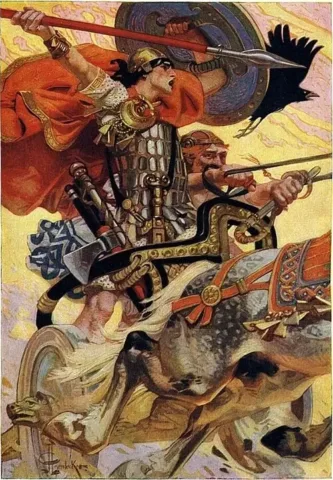
Cú Chulainn was the central warrior hero of the Ulster Cycle, the body of medieval Irish tales centered on the kingdom of Ulaid and the royal court at Emain Macha.
He belongs to the world of Conchobar mac Nessa, king of Ulster, and the warriors traditionally associated with his court. Unlike a king or lawgiver, Cú Chulainn’s status comes from combat. He is repeatedly presented as the warrior Ulster depends on when ordinary military strength is not enough.
That role gives him an unusual position within the cycle. He is part of the Ulster community, yet many of his greatest stories place him apart from it, carrying responsibilities that other warriors cannot share.
Cú Chulainn is therefore best understood first as the heroic champion of Ulster, the figure around whom many of the cycle’s most important conflicts are organized.
Was Cú Chulainn a God or a Hero?
Cú Chulainn is best understood as a hero, not a god.
The surviving Irish tales place him firmly within the heroic world of Ulster, where he serves Conchobar mac Nessa and fights as the outstanding warrior of the Ulaid.
The confusion comes from his supernatural background. Some traditions connect his birth with Lugh, one of the major divine figures of Irish mythology, while other parts of his story give him abilities far beyond those of an ordinary warrior.
Even so, the surviving tales do not present Cú Chulainn as one of the gods or as a ruler of a divine domain. His status depends on heroic action, combat and loyalty to Ulster.
The clearest description is therefore that Cú Chulainn was a superhuman hero with divine connections, not an Irish god.
From Sétanta to Cú Chulainn: How He Got His Name
Cú Chulainn was not born with that name. As a boy, he was called Sétanta.
In the Táin Bó Cúailnge, Sétanta comes to the house of Culann the smith, where a fierce guard hound has been released to protect the property. When the animal attacks him, the boy kills it.
Culann is left without his guard, so Sétanta offers to take the hound’s place until another can be raised.
That act gives him the name Cú Chulainn, usually understood as “the Hound of Culann.” The tale even preserves a moment in which Sétanta initially prefers his old name, before the druid Cathbad tells him that Cú Chulainn will become famous.
From that point onward, the new name replaces Sétanta and becomes the identity under which the hero is remembered throughout Irish tradition.
Cú Chulainn’s Parents and His Connection to Lugh
Cú Chulainn’s parentage is not preserved in a single simple version.
His mother is Deichtine, a woman connected with the royal house of Ulster. In Compert Con Culainn, the story of his birth, she encounters a mysterious supernatural figure who later identifies himself as Lugh mac Ethnenn and links himself directly to the child she will bear.
The tradition also brings Sualtaim into Cú Chulainn’s family story as Deichtine’s husband, giving the hero both human and supernatural connections.
This is why Cú Chulainn is often described as the son of Lugh, although the surviving birth traditions are more complicated than a single straightforward account of divine paternity.
What remains consistent is that Lugh forms an important part of Cú Chulainn’s ancestry, placing his birth story within the supernatural world of Irish mythology.
The Boyhood Deeds of Cú Chulainn
Cú Chulainn’s reputation begins while he is still a child.
The Ulster tales describe the young Sétanta arriving at Emain Macha and joining the boys associated with Conchobar’s court. When they turn against him for entering their games without first seeking their protection, he defends himself and throws fifty of them to the ground before Conchobar intervenes.
The episode already shows the qualities that define him later: extraordinary ability, confidence and a readiness to answer hostility with overwhelming force.
It also reveals the harder side of his character. Sétanta is powerful long before he has learned restraint, and even childhood competition can become violent when he is involved.
The boyhood tales therefore establish an important pattern early: Cú Chulainn’s exceptional gifts are matched by a temperament that is difficult to contain.
Training with Scáthach and the Gáe Bolga
Cú Chulainn’s natural ability was only part of his development as a warrior. Irish tradition also sends him abroad to train under Scáthach, a formidable teacher of martial skills.
In The Wooing of Emer, Scáthach teaches him a range of specialized combat techniques, giving him training beyond what he had learned in Ulster.
The weapon most closely associated with this period is the Gáe Bolga, Cú Chulainn’s deadly spear. Its use becomes one of his most distinctive skills and later proves decisive in some of his most dangerous single combats.
The Gáe Bolga is especially important in the Táin Bó Cúailnge, where it gives Cú Chulainn an advantage even against opponents who know his fighting style.
Scáthach’s training therefore turns exceptional talent into specialized skill, shaping the warrior Cú Chulainn becomes in the major battles of the Ulster Cycle.
Cú Chulainn and Emer
Emer is the woman most closely associated with Cú Chulainn in the Ulster tradition.
In The Wooing of Emer, he seeks her hand and is drawn not only to her beauty but also to her intelligence, skill and reputation. Their courtship unfolds through riddling conversation, tests of worth and the opposition of her father, Forgall Monach.
Forgall resists the match and sends Cú Chulainn away for further warrior training, a journey that eventually brings him to Scáthach.
Emer, however, is not simply a prize to be won. The tale gives her a strong voice and presents her as capable of judging Cú Chulainn’s character and status for herself.
Their courtship places marriage, reputation and personal choice alongside the warfare that dominates so much of Cú Chulainn’s legend, giving Emer a distinct role within his story rather than treating her merely as the hero’s wife.
Cú Chulainn in the Táin Bó Cúailnge
Cú Chulainn’s most important role in Irish heroic tradition comes from the Táin Bó Cúailnge, the great cattle-raid epic of the Ulster Cycle.
The conflict begins when Medb of Connacht invades Ulster to seize the Brown Bull of Cooley. Cú Chulainn becomes the main obstacle in the army’s path.
Rather than confronting the entire force at once, he relies on ambushes, attacks on scouts and a series of single combats at the fords. These encounters allow him to slow Medb’s advance while forcing individual warriors to face him on more equal terms.
The Táin turns Cú Chulainn from a gifted young warrior into the central defender of Ulster. His role is not simply to defeat opponents, but to delay an invasion long enough for the wider conflict to change around him.
Why Did Cú Chulainn Defend Ulster Alone?
Cú Chulainn stands almost alone in the Táin Bó Cúailnge because the warriors of Ulster are temporarily unable to fight.
The tradition explains this through the pangs of the Ulstermen, a supernatural debility linked with the curse of Macha. At the moment Ulster is invaded, its fighting men are struck by weakness and cannot take the field.
Cú Chulainn is therefore left as the province’s effective defender while Medb’s army advances.
The Táin does not hide the cost of that role. Cú Chulainn eventually describes himself as wounded, exhausted and alone, wondering why the Ulstermen have still not come to his aid.
His isolation is built into the structure of the epic. Ulster cannot defend itself, so the survival of the province temporarily depends on a single young warrior holding out until its army can return.
The Ríastrad: Cú Chulainn’s Battle Frenzy
One of Cú Chulainn’s most distinctive traits is the ríastrad, the violent distortion that overtakes his body in battle.
In the Táin Bó Cúailnge, the change is described physically rather than as simple anger. His limbs twist, muscles swell, facial features shift, and his appearance becomes so distorted that he is almost unrecognizable.
The transformation gives Cú Chulainn a monstrous appearance, sharply contrasting with the young warrior he is outside combat.
It is sometimes compared with a berserker rage, but the Irish descriptions are more specific. The ríastrad is presented as a physical transformation, not simply a warrior becoming furious or losing control.
That distinction matters because the ríastrad is not just an expression of Cú Chulainn’s temper. It is one of the features that makes his form of warfare unlike that of the other heroes around him.
Cú Chulainn and the Morrígan
Cú Chulainn’s encounter with the Morrígan is one of the most important supernatural episodes in the Táin Bó Cúailnge.
While he is fighting the warrior Lóch, the Morrígan intervenes against him in several forms, including a heifer, an eel and a wolf.
Cú Chulainn continues the fight while resisting her attacks and wounds her in each form. The scene places him under pressure from both a human opponent and a supernatural one at the same time.
The Morrígan’s role is more than physical interference. Her presence brings divine hostility directly into Cú Chulainn’s struggle, making their encounter one of the clearest points where the heroic and supernatural worlds meet in the Táin.
Read More
Nuada of the Silver Hand: King of the Tuatha Dé Danann
Manannán mac Lir: Irish God of the Sea and the Otherworld
Aos Sí: The Supernatural People of Irish Folklore and Mythology
Cú Chulainn and Fer Diad
The fight between Cú Chulainn and Fer Diad is one of the most tragic episodes in the Táin Bó Cúailnge.
Fer Diad is not a stranger or ordinary enemy. The two warriors had trained together under Scáthach and shared the same martial education. The text presents them as companions and foster-brothers, making the duel far more personal than Cú Chulainn’s other single combats.
Fer Diad initially refuses to fight him, but Medb eventually brings him to the ford through pressure and promised rewards.
Their combat lasts through several forms of fighting before Cú Chulainn finally uses the Gáe Bolga, the weapon that gives him the decisive advantage. Fer Diad is mortally wounded.
Cú Chulainn does not treat the victory as a triumph. He mourns Fer Diad and remembers the friendship they had shared before the war placed them on opposite sides.
The duel remains powerful because Cú Chulainn wins the fight while losing someone who had once been one of his closest companions.
Fergus and Cú Chulainn
Fergus mac Róich occupies an unusual position in the Táin Bó Cúailnge. He marches with Medb’s army, but Cú Chulainn is also his fosterling.
When Medb asks Fergus to fight him, Fergus initially refuses, arguing that it would be wrong to attack the young warrior he helped raise. When they finally meet, neither man wants a genuine fight.
Fergus asks Cú Chulainn to retreat before him for the sake of appearances, promising to repay the favor when Ulster returns to battle. Cú Chulainn agrees.
That promise later becomes important. During the final fighting, Fergus withdraws before Cú Chulainn, and warriors around him follow in retreat.
Their encounter shows how personal loyalties survive even inside the wider conflict. Fergus fights with Medb’s army, but his bond with Cú Chulainn remains strong enough to shape what happens on the battlefield.
Cú Chulainn’s Son Connla
Cú Chulainn’s story with Connla, his son by the warrior woman Aífe, is one of the darkest episodes in the Ulster tradition.
Before leaving Aífe, Cú Chulainn gives her a gold token for their future son and sets conditions for the boy’s journey to Ireland: he must not turn back, reveal his name, or refuse a single combat. When Connla eventually arrives, those commands make recognition almost impossible.
Connla proves himself a formidable young fighter, defeating experienced Ulster warriors who try to stop him. When Cú Chulainn confronts him, the boy still refuses to identify himself.
The fight ends when Cú Chulainn uses the Gáe Bolga, the deadly technique associated with his training under Scáthach. Connla is mortally wounded, and only then does his identity become clear.
Cú Chulainn carries the dying boy before the Ulstermen and acknowledges him as his son. The victory becomes one of the most painful moments in his legend, because the weapon that so often saves him in battle is the same one that kills his own child.
How Did Cú Chulainn Die?
Cú Chulainn’s death is told in Aided Con Culainn, “The Death of Cú Chulainn,” one of the final tales associated with the Ulster Cycle.
His enemies draw him into battle despite warnings that his death is near. During the fighting, Lugaid mac Con Roí uses a spear that mortally wounds him. Some versions of the tradition also describe the deaths of those closest to him, including his charioteer Láeg and his horse Liath Macha.
Knowing he is dying, Cú Chulainn refuses to fall. He ties himself upright to a standing stone so that he can face his enemies on his feet.
No one immediately dares approach him. Only when a raven lands on his body do his enemies believe that he is truly dead. Lugaid then comes forward and cuts off his head.
The scene became one of the most famous images in Irish heroic tradition: Cú Chulainn dies standing, still feared by his enemies even after death.
Was Cú Chulainn a Real Historical Figure?
There is no reliable historical evidence that Cú Chulainn existed as a real individual.
The surviving stories belong to medieval Irish literature, and modern scholarship generally treats him as a legendary heroic figure rather than a person whose life can be independently verified. Scholars also caution against reading the Ulster Cycle as a straightforward record of Iron Age Ireland, since the tales developed through long periods of oral and literary transmission.
That does not mean the stories are disconnected from real places. Emain Macha, the royal center of Ulster in the tales, is associated with the archaeological site of Navan Fort near Armagh, and the cycle preserves a recognizable Irish landscape.
The difficulty is separating such historical and geographical elements from centuries of storytelling, mythology and literary development.
Cú Chulainn is therefore best understood as a legendary hero placed within a landscape that has real historical and archaeological significance, not as a documented Iron Age warrior whose biography can be reconstructed from evidence.
What Cú Chulainn Represents in Irish Mythology
Cú Chulainn represents the heroic ideal pushed to its most dangerous extreme.
His courage, loyalty and skill make him Ulster’s greatest defender, but the same qualities repeatedly bring isolation, suffering and loss. Power gives him fame, yet it never frees him from the consequences of violence or from the fate that surrounds his story.
That tension is what gives the character much of his lasting force. Cú Chulainn is not simply a warrior who wins battles. His legend explores the cost of living by a heroic code in which courage and destruction are often inseparable.
Within the Ulster Cycle, he stands as both the model of the perfect warrior and a warning about what such perfection can demand.
Academic & Primary Sources
This article draws on medieval Irish texts together with modern academic studies of the Ulster Cycle, its manuscript tradition and its historical context.
Primary Texts and Scholarly Editions
- O’Rahilly, Cecile, ed. and trans.
Táin Bó Cúalnge from the Book of Leinster.
Dublin Institute for Advanced Studies, 1967.
Digital edition preserved by the CELT Project, University College Cork. - Meyer, Kuno, ed. and trans.
The Wooing of Emer by Cú Chulainn (Tochmarc Emire).
Based on medieval manuscript traditions including Lebor na hUidre and Stowe MS 992.
CELT Project, University College Cork. - van Hamel, A. G., ed.
Compert Con Culainn and Other Stories.
Medieval and Modern Irish Series III.
Dublin Institute for Advanced Studies, 1933; reprinted 1978. - Tymoczko, Maria, trans.
Two Death Tales from the Ulster Cycle: The Death of Cú Roí and the Death of Cú Chulainn.
Dublin: Dolmen Press, 1981.
Modern Academic Studies
- Mallory, J. P., ed.
Aspects of the Táin.
Belfast: December Publications, 1992. - Dooley, Ann.
Playing the Hero: Reading the Irish Saga Táin Bó Cúailnge.
Toronto: University of Toronto Press, 2006. - Aitchison, N. B.
“The Ulster Cycle: Heroic Image and Historical Reality.”
Journal of Medieval History 13, no. 2 (1987): 87–116.
Copyright Notice
© 2026 History & Myths. All rights reserved.
This article is original editorial content created for HistoryAndMyths.com.
Reproduction, republication or substantial copying of this article, in whole
or in part, is not permitted without prior written permission.