Sucellus: The Gaulish Hammer God and His Symbols
Sucellus was a Gaulish god worshipped during the Roman period, best known for his long-handled mallet and the vessel he often carried in his other hand. His image survives in stone reliefs and bronze figurines, while Latin inscriptions confirm that he received religious offerings. An altar discovered at Sarrebourg identifies him alongside the goddess Nantosuelta, providing one of the clearest examples of his worship.
The meaning of his attributes remains disputed. Scholars have associated the mallet with craftsmanship, agricultural prosperity, and the underworld, while his vessels have suggested connections with food, wine, and abundance. No surviving myth describes Sucellus’s deeds or explains his powers, however. His religious identity must therefore be understood through the archaeological evidence, which preserves his distinctive imagery without fully revealing what it meant to his worshippers.
Who Was Sucellus in Ancient Gaul?
Sucellus was an indigenous deity worshipped in Gaul under Roman rule. His Gaulish name points to a local religious tradition, while the surviving inscriptions and images date primarily to the Roman imperial period. His cult belonged to a society in which older religious practices coexisted with Roman customs, including the use of Latin dedications, stone altars, and sculpted images of the gods.
This cultural interaction is visible in representations of Sucellus. Many depict him in clothing associated with Gaulish inhabitants, while others incorporate artistic conventions familiar from the Mediterranean world. Such differences illustrate how a local deity could be represented within Gallo-Roman religious culture without necessarily losing his distinct identity.
The origins of his worship are less certain. Although his name is Gaulish, the surviving evidence does not establish when his cult first appeared or how widely it was practised before the Roman conquest. Nor can we assume that every community understood Sucellus in precisely the same way. His surviving monuments document a religious tradition that extended across different regions, but they do not reveal a single, uniform set of beliefs.
Read Also:
Belenus: The Celtic God Linked to Apollo and Healing
What Does the Name Sucellus Mean?
The name Sucellus is traditionally translated as “Good Striker” or “He Who Strikes Well.” This interpretation combines the Gaulish prefix su-, meaning “good” or “well,” with a second element linked to an Indo-European root meaning “to strike.” The translation appears consistent with the god’s distinctive mallet, although the resemblance between his name and his attributes does not establish the etymology.
Linguist Blanca María Prósper has challenged this explanation on morphological and comparative linguistic grounds. She proposes that the second element derives instead from a root meaning “to protect,” giving the name a sense closer to “one who provides good protection.” Her reconstruction draws on parallels in other Indo-European languages rather than Sucellus’s appearance in religious art.
The distinction matters because the traditional interpretation has often been used to explain the god’s identity through his hammer. Prósper’s alternative shows why that connection cannot be taken for granted. Neither derivation is confirmed by an ancient explanation of the name, leaving its original meaning open to scholarly debate.
Inscriptions and Archaeological Evidence of Sucellus
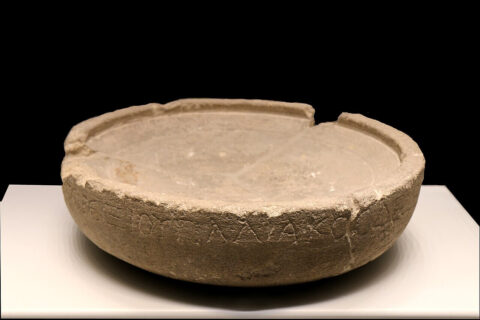
The strongest evidence for Sucellus’s worship comes from Latin votive inscriptions and religious images produced during the Roman imperial period. Inscribed monuments are particularly important because they identify the deity by name. Uninscribed sculptures, by contrast, must be attributed to Sucellus through comparison with securely identified examples.
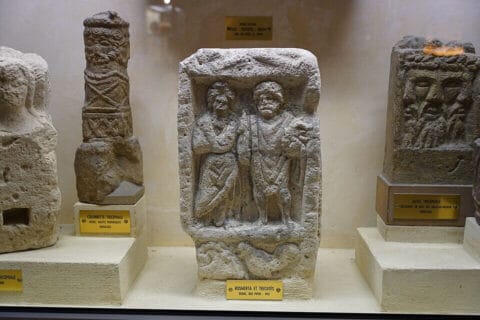
One of the most significant finds is a sandstone altar discovered in 1895 at Sarrebourg, ancient Pons Saravi, in northeastern France. Its inscription (CIL XIII 4542) names Sucellus and the goddess Nantosuelta. The dedication was made by Bellausus, son of Massa, who recorded the fulfilment of a religious vow. Both deities appear in relief beneath the inscription, providing a rare example in which their identities can be established directly from the monument.
Other dedications demonstrate that Sucellus was honoured in different parts of Roman Gaul and neighbouring provinces. At Vienne in southeastern France, an inscription (CIL XII 1836) records a vow fulfilled by Gellia Iucunda. Another dedication from Yverdon, in present-day Switzerland (CIL XIII 5057), names Sucellus with the additional epithet Ipadcus. Farther north, a damaged altar from Worms, Germany (CIL XIII 6224), associates his name with that of the Roman god Silvanus, although parts of the inscription have been reconstructed.
Evidence also survives on smaller objects. An octagonal silver ring discovered in 1875 in the city moat at York, Roman Eboracum, bears the inscription Deo Sucelo, meaning “To the god Sucellus.” Now held by the Yorkshire Museum and catalogued as RIB 2422.21, it is the only known inscription naming Sucellus from Roman Britain. The ring documents an individual religious dedication, but cannot establish the extent of his cult in the province.
Read Also:
Rosmerta: Celtic Goddess of Abundance and Prosperity
Cernunnos: The Horned God of the Celtic World
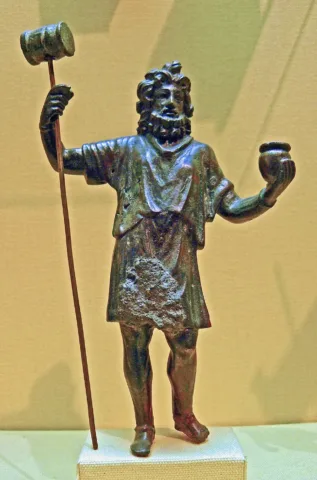
Sculpture provides a different kind of evidence. A bronze statuette excavated at Vienne in 1866, now in the Walters Art Museum in Baltimore, dates to the first or second century CE. It was discovered alongside other bronze figures, including representations of Mercury, as well as lamps and metal objects. Its elaborate depiction of Sucellus makes it an important source for studying his attributes, although the figure itself bears no identifying inscription.
Excavations in 2025 at the Roche d’Aujoux sanctuary near Mancey, France, produced an unusual addition to this record. Archaeologists uncovered three stone altars in a temple dating from the late third to fourth centuries CE. One preserves a painted image identified by the excavation team as Sucellus, described as the only known painted representation of the god. The altar remains under study, and the discovery does not establish which deity the temple was primarily dedicated to.
How Was Sucellus Depicted?
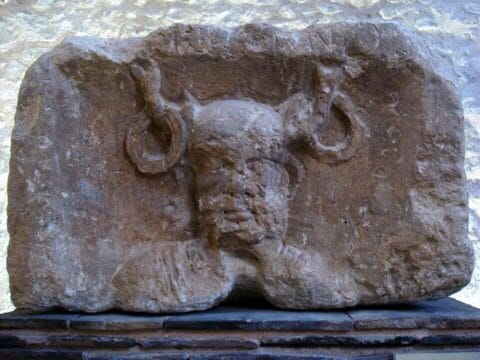
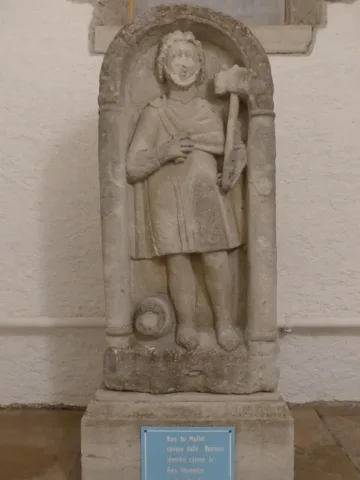
Sucellus is most commonly depicted as a mature, bearded man wearing a short, belted tunic and a cloak, sometimes with trousers or sandals. His appearance differs from that of many classical Roman gods, who were often represented nude or in flowing robes. Several surviving figures retain elements of local Gaulish dress, although their poses and proportions also reflect Greco-Roman artistic conventions.
His principal attributes are a large mallet with a long handle and a vessel held in the opposite hand. The vessel is frequently an olla, a round-bellied pot, but other representations include a shallow dish (patera), an amphora, or a small barrel. The mallet’s distinctive shape helps archaeologists identify otherwise uninscribed figures as Sucellus.
An unusual bronze statuette from Vienne, now in the Walters Art Museum, presents the god in a different form. He wears a wolf skin reminiscent of the lion skin associated with Hercules. The mallet originally held in his raised hand is missing, while an oversized mallet stands behind him with five smaller mallets projecting from its head. This elaborate arrangement distinguishes the statuette from more conventional images of the god.
Animals also feature in his iconography. A dog appears beside Sucellus on several stone monuments, including a miniature altar from Nîmes. A limestone statuette discovered in Lyon once included a dog at the god’s feet, although only traces of its legs survive. Less common attributes include a sickle, serpent, rooster, and panpipes. Their presence in particular representations shows that the familiar mallet-and-vessel combination was not the only way Sucellus could be portrayed.
Why Did Sucellus Carry a Hammer?
The hammer was Sucellus’s most recognisable attribute, but its purpose remains debated. Rather than a conventional weapon, it generally resembles a heavy wooden mallet used in carpentry and other crafts. Bernard Sergent noted that long-handled mallets appear in ancient Greek depictions of woodworkers, suggesting that the unusual size of Sucellus’s implement need not indicate a purely ceremonial object.
An important piece of evidence comes from a large stone statue discovered in 1969 at Javols, in southern France. Its reverse bears a series of carved objects that archaeologists Jean-Claude Béal and Pierre Peyre interpreted as craftsmen’s tools. These include what they identified as a saw, knife, adze, bow drill, and large mallet. They suggested that the monument might have been associated with artisans working in wood. Sergent later developed this interpretation, proposing that Sucellus represented a divine craftsman whose responsibilities may have included protecting woodworkers and coopers, the specialists who made wooden barrels.
Read Also:
The Dagda: Chief God of the Tuatha Dé Danann
The identification of these objects is disputed. In 1989, Jean-Marie Pailler challenged the woodworking interpretation, arguing that the carvings represented Dionysiac ritual equipment instead. He placed the statue within a broader religious context involving Bacchus and wine production. The disagreement is significant because the craftsmanship theory depends partly on how these carvings are understood.
Other interpretations have connected the hammer’s striking power with death and the underworld, or associated the god with agricultural fertility. These proposals rely largely on symbolic comparisons rather than direct evidence of how Sucellus used his hammer. No surviving inscription or myth assigns it a specific supernatural power.
The connection with woodworking offers a concrete explanation for the mallet’s form, particularly if the craft-related interpretation of the Javols sculpture is correct. It does not establish that Sucellus was exclusively a patron of craftsmen, or that his hammer carried the same meaning in every community where he was worshipped.
The Pot, Barrel and Symbols of Abundance
The vessels associated with Sucellus have led scholars to connect him with wine production, food supplies, and agricultural abundance. Although the small pot or olla is among his most familiar attributes, some representations place larger containers beside him. A sandstone statuette from Vichy, for example, combines a barrel with an amphora, two vessels widely used for storing and transporting liquids, particularly wine.
The connection with viticulture is supported by more than the presence of containers. Some images also include vines or pruning tools. Jean-Marie Pailler interpreted the statue from Javols as evidence of an association between Sucellus and Bacchus, arguing that its imagery reflected Dionysiac religious traditions and wine production. Bernard Sergent approached the same evidence from a different perspective. He suggested that the drinking vessel held by Sucellus represented wine served from larger containers, while the barrels reflected the work of coopers and other craftsmen involved in its production and storage.
The olla has also received a broader interpretation. In 1948, F. M. Heichelheim and J. E. Housman proposed that it could represent a container for food or harvested produce. They connected this possibility with the Roman Silvanus, whose rural associations offered a basis for understanding Sucellus as a deity concerned with agricultural fertility and the resources sustaining everyday life.
These interpretations depend partly on the combinations of objects shown in individual monuments. Barrels, amphorae, and vine-related imagery provide stronger grounds for an association with wine than an isolated pot, which could have served several purposes. The vessels therefore suggest connections with production, consumption, and abundance, without establishing a single religious function shared by every representation of Sucellus.
Was Sucellus a God of Fertility or the Underworld?
The interpretation of Sucellus as a fertility deity rests largely on his rural associations and the symbolism of his attributes. His connection with the Roman Silvanus, attested on a damaged altar from Worms, suggests that he may have shared some of the Roman god’s responsibilities for woodlands and countryside. Scholars have also associated Sucellus with agricultural prosperity, although no surviving inscription explicitly identifies him as a protector of crops or harvests.
A different interpretation places Sucellus in the realm of death. Some representations attributed to him have been found in funerary contexts, while his mallet has been compared with the hammer carried by Charun, the Etruscan figure associated with the underworld. The dog sometimes accompanying Sucellus has also received a funerary interpretation. These parallels suggest a possible connection with death, but they do not establish that he ruled the underworld or determined the fate of the deceased.
F. M. Heichelheim and J. E. Housman argued in 1948 that Sucellus combined three functions: fertility, rulership of the underworld, and divine ancestry. They considered these roles complementary, drawing comparisons with other ancient religious traditions. Paul-Marie Duval took a more cautious position, accepting that certain representations might have funerary significance without treating Sucellus as an established ruler of the dead.
The evidence therefore permits a stronger association with rural prosperity than with a specific underworld office. It remains possible that Sucellus fulfilled different religious needs among the communities that worshipped him, but neither interpretation can be treated as an exclusive or universally established function.
Sucellus and Nantosuelta
Nantosuelta was a Gaulish goddess associated with Sucellus, particularly in the territory of the Mediomatrici in northeastern Gaul. Their relationship is documented by the inscribed altar discovered at Sarrebourg in 1895, which names both deities. They are often described as a divine couple, although no surviving text identifies them as husband and wife or preserves a myth involving their relationship.
On the Sarrebourg relief, Nantosuelta carries a long staff topped by a miniature building with a pitched roof and two openings. In her other hand, she holds a shallow offering dish (patera) above an altar. A large bird, traditionally identified as a raven, appears beneath the two figures. The house-shaped emblem is particularly important because it helps identify the goddess in other representations where her name is absent.
A second altar discovered at Sarrebourg depicts a goddess alone, holding a similar staff. She also carries a small, round structure resembling a hut, with a bird perched on its roof. Although the inscription does not name her, the repeated attributes strongly support her identification as Nantosuelta. The separate representation indicates that she could be honoured independently of Sucellus.
Her symbols have led scholars to associate her with domestic protection and prosperity. The miniature buildings have been interpreted as houses, shrines, or funerary structures, while a proposed identification with beehives has suggested connections with honey and abundance. These interpretations remain disputed. The pairing of Nantosuelta and Sucellus may have reflected complementary responsibilities for the household and its resources, but the surviving monuments do not specify how their religious roles were related.
Sucellus, Silvanus and Dis Pater
The association of Sucellus with Roman deities reflects interpretatio Romana, the practice of identifying local gods with figures from the Roman pantheon. The strongest evidence concerns Silvanus, the Roman god associated with woodlands and rural life. A weathered altar from Worms (CIL XIII 6224) bears a dedication commonly read as Deo Sucelo [S]ilvano, suggesting that the two divine names could be associated in local worship. An inscription from Augst, Switzerland, is less conclusive. Its abbreviated Silv. has sometimes been interpreted as Silvanus, but the Augusta Raurica museum identifies it as part of the donor’s name, Silvius Spartus.
The proposed identification with Dis Pater rests on less direct evidence. In De Bello Gallico (6.18), Julius Caesar reports that the Gauls believed themselves descended from a divine ancestor whom he calls Dis Pater. He does not name Sucellus. Later scholars connected the two through interpretations of funerary imagery and ancestral divinity, but no surviving inscription establishes their identity. Stéphanie Boucher examined this longstanding question in 1976, highlighting the difficulties of equating Sucellus with Caesar’s unnamed Gaulish counterpart of Dis Pater.
A further comparison involves the Irish Dagda. In 1948, F. M. Heichelheim and J. E. Housman drew parallels between the Dagda’s enormous club and inexhaustible cauldron and the mallet and vessel carried by Sucellus. They also proposed similarities in the gods’ religious functions. Yet the evidence comes from different periods and traditions: the Dagda’s deeds survive in medieval Irish narratives, while Sucellus is known chiefly through Roman-period monuments. Their shared attributes make the comparison worth examining, but they do not establish that the two gods were identical.
Where Was Sucellus Worshipped?
Evidence for Sucellus is concentrated in Roman Gaul, particularly its southern, central, and eastern regions. His name also appears in inscriptions from the Rhine provinces and present-day Switzerland. The geographical distribution is uneven, however, with some regions preserving numerous images of the mallet-bearing god but few inscriptions identifying him by name.
Southern Gaul provides a striking example. A study of the territory of ancient Nîmes identified thirty archaeological testimonies associated with Sucellus or Silvanus. Twenty-four feature mallets, while eight inscriptions name Silvanus and none names Sucellus. The evidence includes bronze statuettes, carved reliefs, and votive altars. These findings reveal the prominence of the mallet-bearing divine figure in the region, although they do not establish that every representation belonged specifically to the cult of Sucellus.
Farther north, dedications from Sarrebourg and the territory of the Lingones document his worship in eastern Gaul. The evidence extends into Germania Superior, including Worms and Augusta Raurica (modern Augst, Switzerland). At Augst, a dedication to Sucellus was erected on a site granted by the local town council, demonstrating that his name could appear on monuments with a civic setting.
More distant representations have been identified in Raetia and Pannonia. A relief from Ostendorf in modern Bavaria has been attributed to Sucellus, while a bronze statuette discovered at Gorsium in Hungary provides evidence of his imagery in Pannonia. In Roman Britain, the inscribed silver ring from York confirms that his name was known, although it does not establish a widespread British cult.
This distribution reflects both ancient religious practices and the survival of archaeological material. Named dedications provide firmer evidence of worship than uninscribed figures, whose identification depends on their attributes. The finds demonstrate that Sucellus was known across several Roman provinces, without establishing how extensively or uniformly he was worshipped in each region.
Read Also:
Toutatis (Teutates): The Celtic God of the Tribe
Conclusion
Sucellus was a recognisable Gaulish deity whose worship is documented across several Roman provinces. His association with Nantosuelta and the Roman Silvanus reflects the interaction between local religious traditions and Roman beliefs, while his distinctive attributes suggest connections with craftsmanship and rural prosperity.
The precise nature of his powers remains uncertain. His mallet and vessels support interpretations involving productive work, food, and abundance, but their religious significance cannot be firmly established. Connections with death and the underworld rest on less direct evidence. Sucellus may have fulfilled different roles among the communities that honoured him, making him more complex than the familiar description of a Gaulish hammer god suggests.
His importance lies not in a lost mythology that can be reconstructed with certainty, but in the archaeological record itself. The images and dedications preserve aspects of Gaulish religious life that ancient writers rarely described, even when the beliefs behind them remain beyond our reach.
Academic Sources & Primary Texts
The following primary sources, archaeological records, and scholarly studies provide the evidence for Sucellus’s worship, iconography, and proposed religious functions. Interpretations of his attributes and divine associations remain debated in modern scholarship.
Primary Texts & Inscriptions
- Julius Caesar. De Bello Gallico, 6.18. Ancient testimony concerning the Gauls’ claimed descent from Dis Pater. Caesar does not identify this deity as Sucellus.
Read the Latin text. - Corpus Inscriptionum Latinarum (CIL), XIII 4542. Sarrebourg, France. Votive altar naming Sucellus and Nantosuelta, dedicated by Bellausus, son of Massa.
Early archaeological publication. - Corpus Inscriptionum Latinarum (CIL), XIII 6224. Worms, Germany. Damaged dedication associating Sucellus with Silvanus.
University of Graz epigraphic record. - Roman Inscriptions of Britain, RIB 2422.21. Silver finger-ring from York bearing the dedication Deo Sucelo.
Inscription and archaeological record.
Archaeological & Museum Records
- The Walters Art Museum. Sucellus, bronze statuette from Vienne, France, first to second century CE. Accession no. 54.998. Evidence for the deity’s distinctive iconography.
Museum collection record. - Sanctuaire de la Roche d’Aujoux, Mancey. Le projet & les résultats. Official excavation report describing the painted representation attributed to Sucellus, discovered in 2025.
Excavation project and findings.
Academic Studies
- Béal, Jean-Claude, and Pierre Peyre. “Une statue antique de Silvain-Sucellus à Javols (Lozère).” Revue archéologique de Narbonnaise 20 (1987): 349–368. Archaeological study of the Javols statue and its carved attributes.
Read study. - Pailler, Jean-Marie. “À propos du dieu de Javols.” Revue archéologique de Narbonnaise 22 (1989): 395–402. Alternative interpretation emphasizing Dionysiac imagery and religious syncretism.
Read study. - Sergent, Bernard. “Sucellus et Viśvakarman.” Études celtiques 38 (2012): 175–195. Reassessment of Sucellus’s attributes, craftsmanship, woodworking, and comparative mythology.
Read study. - Boucher, Stéphanie. “Sucellus = Dispater? Remarques sur la typologie et les fonctions du dieu gaulois.” Revue belge de philologie et d’histoire 54, no. 1 (1976): 66–77. Critical examination of the proposed identification with Dis Pater.
Read study. - Heichelheim, F. M., and J. E. Housman. “Sucellus and Nantosuelta in Mediaeval Celtic Mythology.” L’Antiquité Classique 17, no. 1 (1948): 305–316. Comparative interpretations of the divine pair and their proposed connections with later Celtic traditions.
Read study. - Prósper, Blanca María. “Celtic Theonymy at the 14th F.E.R.C.AN. Workshops.” Voprosy onomastiki 15, no. 3 (2018): 242–249. Scholarly book review discussing Celtic divine names, including competing etymological interpretations.
Read review. - Kotterba, Manfred. Sucellus und Nantosuelta: Untersuchungen zu einem gallo-römischen Götterpaar in den Nordprovinzen des Imperium Romanum. Doctoral dissertation, University of Freiburg, 2000. Detailed examination of inscriptions, iconography, geographical distribution, and the divine pair.
University repository. - Reinach, Salomon. “Deux autels gallo-romains découverts à Sarrebourg.” Comptes rendus des séances de l’Académie des Inscriptions et Belles-Lettres 40, no. 1 (1896): 35–36. Early publication documenting the altars of Sucellus and Nantosuelta.
Read original publication.
Source note: Inscriptions and archaeological finds establish the historical evidence for Sucellus’s worship. Proposed associations with fertility, craftsmanship, the underworld, and other deities are evaluated as scholarly interpretations rather than established religious doctrines.
Copyright & Content Notice
© 2026 History & Myths. All rights reserved for the original written content of this article.
Written by H. Moses for History & Myths. This article draws on archaeological evidence, ancient inscriptions, museum collections, and academic scholarship. Historical interpretations and scholarly disagreements are presented with reference to the sources listed above.
Ancient texts, archaeological objects, and third-party images remain subject to their respective rights and attribution requirements. Image credits and applicable licences are provided separately.