Toutatis (Teutates): The Celtic God of the Tribe
Toutatis, also known as Teutates, was a Celtic deity whose name derives from a word meaning “people” or “tribe.” He is generally understood as a protector of the community, although the surviving evidence does not define his powers. Roman-period inscriptions associate him with Mars, while other dedications preserve his name without the Roman god’s.
The Roman poet Lucan named Teutates among the gods of Gaul in the first century CE. More direct evidence comes from votive plaques, sanctuary inscriptions, and inscribed rings discovered in Gaul and Roman Britain. These finds document his worship across different communities but leave an important question unresolved: whether Toutatis was a single deity or a title applied to local protective gods. No surviving Celtic myths describe his deeds or relationships with other deities.
Toutatis: Name, Meaning and Tribal Identity
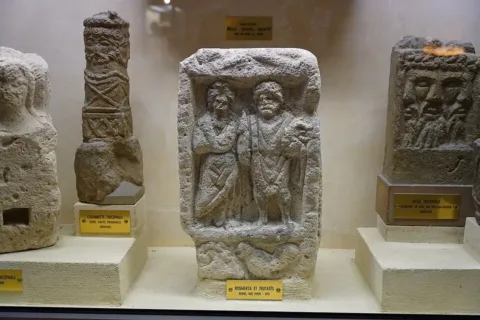
The Celtic word toutā referred to a people or political community. A related term survives in Old Irish as túath, which could also designate a people’s territory. Toutatis is therefore commonly understood as “god of the tribe,” a name suggesting a close connection with the community rather than defining any specific religious duties.
Ancient sources preserve several forms of the divine name. Lucan writes Teutates, while Latin inscriptions use forms such as Toutati, meaning “to Toutatis.” Graffiti from Beauclair in central Gaul record Totates. Scholars have explained these variations through changes in Gaulish pronunciation, particularly the development from eu to ou and eventually o during the Roman period.
Whether Toutatis was a proper name or a title for a community’s patron deity remains disputed. His name appears alongside Mars and, in an inscription from Rome, the name Medurinus. Such combinations have encouraged scholars to interpret Toutatis as a title that could apply to different local gods. The inscriptions, however, cannot establish whether each community had its own Toutatis or whether the name referred to a single deity worshipped across several regions.
Toutatis in Ancient Roman Sources
The earliest surviving literary reference to Toutatis appears in Lucan’s Pharsalia (Bellum Civile), written in the first century CE. In Book I, lines 444–446, the Roman poet names Teutates alongside Esus and Taranis while describing the peoples of Gaul. He portrays Teutates as a fierce god appeased with blood, but gives no details of the rituals performed in his honour.
Lucan was writing an epic about Caesar’s civil war, not a record of Celtic religious practices. His mention of three gods does not establish that they formed a recognized divine triad. In the early fourth century, the Christian writer Lactantius also claimed that the Gauls offered human blood to Teutates and Esus. His brief statement, however, provides no independent description of their worship.
The Commenta Bernensia, a collection of later commentaries on Lucan, preserves two conflicting identifications. One equates Teutates with Mercury, while another associates him with Mars, attributing battles to the god’s influence. These explanations reflect different attempts to interpret the Gallic deity through Roman religion. Neither establishes his actual powers or the practices of his worshippers.
Mars Toutatis and Roman Religious Identity
Roman inscriptions show that some worshippers identified Toutatis with Mars, the Roman god of war. A silver votive plaque from Barkway in Britain bears the dedication Marti Toutati, meaning “To Mars Toutatis.” At Seckau in the Roman province of Noricum, another inscription invokes Mars under several divine epithets, including Toutatis.
This association reflects interpretatio Romana, the practice of identifying local gods with Roman deities. In the Celtic provinces, gods associated with Mars could serve as protectors of communities and territories, not merely as war gods. Given the meaning of Toutatis’s name, scholars have interpreted his connection with Mars as evidence of a protective role extending to both war and peace.
The inscriptions confirm that Toutatis could be worshipped under Mars’s name, but they do not establish that he shared the Roman god’s mythology or every aspect of his religious authority.
Inscriptions and Archaeological Evidence of Worship
One of the strongest surviving records of Toutatis’s worship is a silver votive plaque discovered at Barkway in Hertfordshire, England. Dating to the third century CE, the leaf-shaped plaque stands nearly 53 centimetres tall and is now held by the British Museum. Its inscription, formed from punched dots, records that Tiberius Claudius Primus, a freedman of Attius, willingly fulfilled a vow to Mars Toutatis. The dedication identifies an individual worshipper and shows how a personal religious obligation could be expressed through a valuable offering.
The plaque was discovered around 1744 in a hoard at Rookery Wood, near the Roman road known as Ermine Street. The collection contained seven silver votive plaques, a bronze statuette of Mars, and a bronze handle. Five plaques depict or name Mars, including one dedicated to Mars Alator, while two feature Vulcan. The objects probably came from a sanctuary, but its original location has not been identified.
The Barkway finds preserve more than divine names. Their inscriptions and imagery reveal individual acts of devotion within a religious setting where Roman gods were honoured alongside deities bearing local Celtic names. They do not, however, tell us what ceremonies accompanied the offerings.
The Beauclair Sanctuary and the Totates Graffiti
Beauclair, near Giat and Voingt in central France, was a Roman-period settlement close to the boundary between the Arverni and Lemovices. Its sanctuary at La Grande Gorce stood on elevated ground overlooking the settlement and the Roman road. Excavations produced five graffiti bearing forms of the name Totates, providing rare evidence of his worship in Gaul itself.
The inscriptions were scratched after firing onto four pottery fragments and one piece of architectural terracotta. Two have recorded findspots within the sanctuary, while a third can be securely linked to the building through its construction materials. The remaining two probably came from the same complex, although their exact findspots are unknown. Three inscriptions preserve the complete divine name, while two are fragmentary.
Earlier scholars interpreted Totates as a personal name used in ownership marks. In a 2009 study, Bernard Clémençon and Pierre M. Ganne argued that the repeated inscriptions, their religious setting, and the linguistic relationship with Toutatis support identifying it as a divine name. Differences in handwriting suggest that several individuals made these inscriptions.
The researchers also proposed that Totates might have been the familiar name used by worshippers for a deity whose full cult title is unknown, possibly one associated with Mars. No surviving inscription from Beauclair confirms that identification. The graffiti nevertheless preserve evidence of local devotion, even though the ceremonies performed at the sanctuary remain undocumented.
TOT Rings and Personal Devotion in Roman Britain
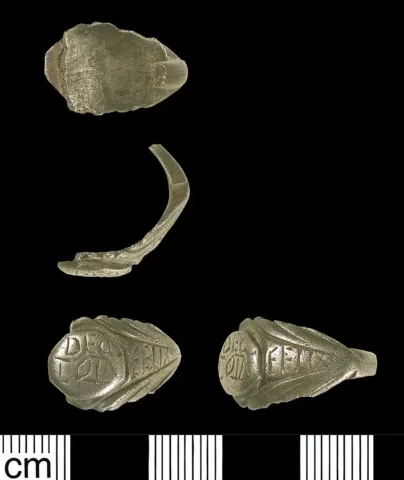
Roman-period finger rings bearing the letters TOT have been discovered across Britain. Most are silver, although copper-alloy examples also survive. The inscription usually appears on the bezel and is generally interpreted as an abbreviation of Toutatis.
A silver ring discovered at Hockliffe in Bedfordshire provides particularly strong evidence for this identification. Its bezel reads DEO TOTA, meaning “To the god Toutatis.” Only one shoulder survives, bearing the word FELIX. Scholars reconstruct the missing word as [utere], completing a familiar Latin expression meaning “Use it and be happy.” The explicit dedication to a god supports interpreting the shorter TOT inscriptions as religious rather than merely decorative.
The distribution of these rings is striking. Archaeologist Adam Daubney’s early catalogue recorded 68 examples, including 44 from Lincolnshire. A later study reported 126 inscriptions by July 2021, concentrated mainly in Lincolnshire and Nottinghamshire. Their geographical pattern broadly corresponds to territory associated with the Corieltauvi, suggesting that devotion to Toutatis had a particularly strong regional presence. The distribution must nevertheless be considered alongside differences in metal-detecting activity and archaeological reporting.
The rings bring evidence of Toutatis’s worship into the sphere of personal possessions. Their inscriptions indicate religious dedication, but cannot establish whether they were worn for protection, deposited as offerings, or used in other devotional practices.
Tribal Protection, Warfare and Divine Identity
Toutatis’s association with tribal protection rests largely on the meaning of his name and his identification with Mars. In Roman Gaul, local gods associated with Mars could have responsibilities beyond warfare, including safeguarding communities and their territories. No surviving dedication, however, specifies the protection Toutatis was expected to provide.
Bernard Clémençon and Pierre M. Ganne suggested that Toutatis may have served as a guardian of the frontier community at Beauclair. The sanctuary’s location near a territorial boundary supports this interpretation, but its inscriptions do not explicitly assign the god such a role.
Toutatis also lacks a clearly identifiable appearance. Some scholars have proposed that an armed warrior depicted on the Mavilly-Mandelot pillar in Burgundy represents him, but the figure bears no inscription confirming its identity. Similarly, images of the Roman Mars cannot automatically be regarded as portraits of Toutatis.
The evidence therefore supports communal protection as a plausible aspect of his worship, while leaving his precise responsibilities and appearance uncertain.
Human Sacrifice in Roman Accounts
The most detailed description of human sacrifice associated with Toutatis appears in the Commenta Bernensia, later commentaries on Lucan’s poetry. One account identifies him with Mercury and describes a person being lowered headfirst into a filled tub until they suffocated. The text does not specify what filled the vessel or where this supposed ritual took place. Another explanation associates Toutatis with Mars and mentions human sacrifice without describing a particular method.
A scene on the Gundestrup Cauldron has sometimes been interpreted as depicting a sacrifice to Toutatis. It shows a large figure lowering a warrior into a vessel beside a procession of armed men. The National Museum of Denmark offers a different reading, suggesting that the scene represents fallen warriors passing into another existence. The cauldron bears no inscription identifying Toutatis, and the imagery cannot confirm the ritual described in the commentaries.
Julius Caesar also reported human sacrifice among the Gauls in The Gallic War (VI.16), but never identified Toutatis as its recipient. Nor do the inscriptions and votive objects associated with the god establish that people were sacrificed in his honour. The literary accounts preserve claims about such practices, but their connection with his actual worship remains unverified.
Toutatis in Celtic Mythological Tradition
No surviving Irish or Welsh narrative identifies Toutatis as a character or preserves stories about his origins, deeds, or relationships with other gods. His name shares a Celtic linguistic root with the Old Irish word túath, meaning “people” or “tribe,” which also appears in the name Tuatha Dé Danann. This linguistic connection does not establish any mythological relationship between the Gaulish deity and the supernatural people of Irish tradition.
Toutatis also survives in popular culture through the Asterix comics, whose Gallic characters frequently exclaim “By Toutatis!” The expression uses a genuine ancient divine name, but no surviving source records the Gauls swearing this particular oath.
Read Also
- Cernunnos: The Horned God of the Celtic World
, examine another Gaulish deity whose identity is reconstructed largely from inscriptions and religious art. - Epona: Celtic Goddess of Horses and Protection
, discover how a Celtic goddess was worshipped across different regions of the Roman Empire. - Lugh: The Many-Skilled Irish God of the Tuatha Dé Danann
, explore a Celtic divine figure whose surviving traditions preserve a much richer mythology.
Conclusion
Toutatis is known not only from Roman literature but also from dedications left by his worshippers. Sanctuary graffiti in Gaul, votive plaques, and inscribed rings in Britain reveal how his name appeared in local religious practices, even though the beliefs and ceremonies associated with him remain poorly documented.
His connection with Mars and the meaning of his name make communal protection a plausible aspect of his worship. Whether Toutatis was a single deity honoured across different regions or a title applied to local protective gods remains unresolved
Academic Sources & Primary Texts
This article draws on ancient literary accounts, Roman inscriptions, archaeological records, and modern scholarship. Direct evidence of Toutatis’s worship is distinguished from later interpretations of his identity and religious functions.
Ancient Literary Sources
- Lucan, Pharsalia (Bellum Civile), Book I, lines 444–446.
The principal surviving literary reference to Teutates alongside Esus and Taranis.
Latin Text, University of Oxford - Lactantius, Divine Institutes, I.21.
A later Roman-period account mentioning human blood offered to Teutates and Esus.
English Translation - Commenta Bernensia, commentary on Lucan, Book I.
Preserves conflicting identifications of Teutates with Mercury and Mars, including accounts of human sacrifice.
Historical Edition, Bavarian State Library - Julius Caesar, De Bello Gallico, VI.16.
Describes human sacrifice among the Gauls without naming Toutatis as the recipient.
Latin Text and Commentary, Dickinson College
Inscriptions & Archaeological Records
- Roman Inscriptions of Britain, RIB 219.
The silver votive plaque from Barkway dedicated to Mars Toutatis by Tiberius Claudius Primus.
Read the Inscription - British Museum, Barkway Silver Votive Plaque, 1817,0308.2.
Official catalogue documenting the plaque, its archaeological context, dimensions, and dedication.
British Museum Collection - Roman Inscriptions of Britain, Brit. 41.10.
The silver finger ring from Hockliffe bearing the dedication DEO TOTA, an important clue to the interpretation of TOT rings.
Read the Inscription
Academic Studies
- Clémençon, Bernard, and Pierre M. Ganne (2009).
“Toutatis chez les Arvernes: les graffiti à Totates du bourg routier antique de Beauclair.”
Gallia, 66(2), 153–169.
Archaeological study of the Beauclair sanctuary, its graffiti, and the possible local identity of Totates.
Read the Study - Duval, Paul-Marie (1958).
“Notes sur la civilisation gallo-romaine, IV. Teutates, Esus, Taranis.”
Études celtiques, 8(1), 41–58.
Examines the ancient literary evidence, divine names, and identifications with Roman gods.
Read the Study - Daubney, Adam (2010).
“The Cult of Totatis.”
In A Decade of Discovery: Proceedings of the Portable Antiquities Scheme Conference 2007, pp. 201–207.
An important early catalogue examining TOT-inscribed rings and their regional distribution in Roman Britain.
Bibliographic Reference, Roman Inscriptions of Britain - Pearce, John, Wendy Scott, and Edwin Wood.
“A Spear for Silvanus, a Horse for Mars, a Rural Shrine?”
Archaeological research discussing religious inscriptions, rural devotion, and the wider context of inscribed objects in Roman Britain.
Read the Study, Archaeology Data Service (PDF)
Museum Interpretation
National Museum of Denmark, The Gundestrup Cauldron: The Cauldron of Fate.
Presents an interpretation of the cauldron’s warrior procession and vessel scene that differs from the proposed human sacrifice reading.
National Museum of Denmark
Research Note: The interpretation of Toutatis as a tribal protector, the relationship between local divine titles, and the accounts of human sacrifice remain subjects of scholarly debate. The article distinguishes attested inscriptions from proposed religious functions and literary claims.
Copyright & Content Notice
© 2026 History & Myths. All rights reserved.
The original editorial content of this article is published by History & Myths. Reproduction or redistribution of substantial portions requires permission, except where permitted by applicable copyright law. Brief quotations should include clear attribution and a link to the original article.
Ancient texts, archaeological objects, scholarly publications, and third-party images remain subject to their respective rights and licenses. Image credits and licensing information are provided separately where applicable.