The First Battle of Mag Tuired: Tuatha Dé Danann vs Fir Bolg
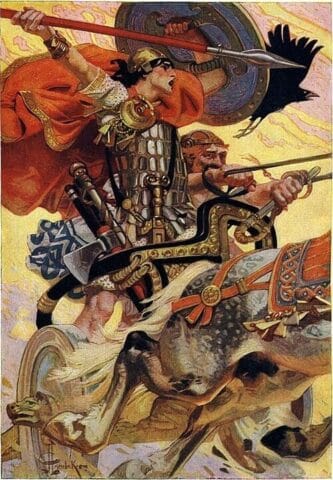
The First Battle of Mag Tuired tells how the Tuatha Dé Danann defeated the Fir Bolg and took control of Ireland in Irish mythology. According to the medieval tale Cath Maige Tuired Cunga, the newcomers demanded half the island from its rulers. The Fir Bolg refused, and the dispute led to a battle near Cong, in western Ireland.
Although the Tuatha Dé Danann won, their king, Nuada, lost his right arm in combat with the Fir Bolg champion Sreng. The injury left him unable to retain the kingship. The Fir Bolg suffered an even greater loss when their king, Eochaid mac Eirc, was killed. Yet their defeat did not mean their destruction. Sreng survived and secured a peace agreement that allowed his people to settle in Connacht.
The account survives in medieval Irish literature, but there is no historical evidence establishing that the battle actually took place.
The Dispute over Ireland
According to Cath Maige Tuired Cunga, the Fir Bolg ruled Ireland for thirty years before the arrival of the Tuatha Dé Danann. Their original leaders, the five sons of Dela, had divided the island into territories with the guidance of Fintan. By the time the newcomers appeared, Eochaid mac Eirc was high king.
The Tuatha Dé Danann came from northern islands with Nuada as their king. After landing in Ireland, they burned their ships and established a camp at the Red Hills of Rian in Breifne. The tale describes their satisfaction at reaching the land of their ancestors. For the Fir Bolg, however, the newcomers had entered a country already under their rule.
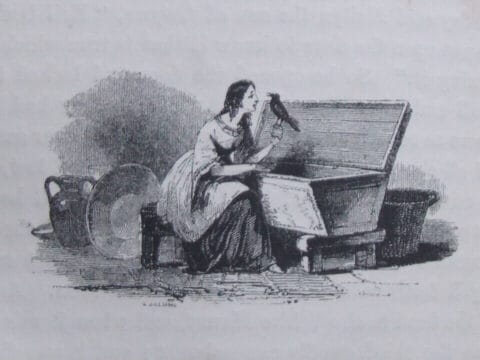
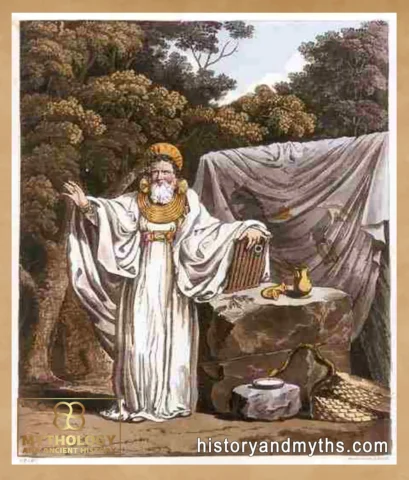
Eochaid had also experienced a troubling dream in which a flock of black birds arrived from the sea and attacked his people. His druid, Cesard, interpreted the vision as a warning that a powerful foreign army was approaching. The prophecy anticipated the conflict between the two peoples.
Sreng and Bres: The Failed Negotiations
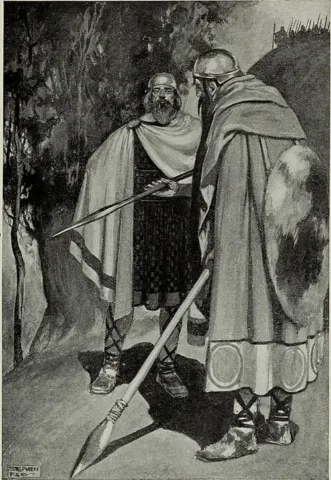
The Fir Bolg sent Sreng, son of Sengann, to discover where the newcomers had come from and what they intended to do in Ireland. The Tuatha Dé Danann sent Bres, son of Elatha, to meet him. Both approached cautiously, keeping their shields raised. When they began speaking, they recognised a common language and discovered that their peoples shared ancestry through Nemed.
Their weapons were unfamiliar to each other. Sreng carried heavy, broad-bladed javelins, while Bres had long, sharp-pointed spears. They exchanged weapons as samples of their respective armies’ equipment and made a pact of friendship.
Bres then delivered Nuada’s demand: the Fir Bolg must surrender half of Ireland or face battle. Sreng returned to Tara and advised Eochaid and his leaders to accept the division, warning them about the newcomers’ formidable weapons. They refused, fearing that surrendering half the island would eventually cost them the rest.
Preparations for the Battle at Mag Tuired
After the Fir Bolg rejected the first demand, the Tuatha Dé Danann moved west to Mag Nia, near Sliabh Belgadain, where they established a defensible position. The battlefield is traditionally associated with the area around Cong, in County Mayo, close to the Galway border.
While the Fir Bolg were still at Tara, Badb, Macha, and the Morrígan attacked them with magical clouds of mist and showers of fire and blood. The assault lasted three days and nights before the Fir Bolg druids broke the spell.
The Fir Bolg then assembled eleven battalions at Mag Nia, facing seven battalions of the Tuatha Dé Danann. Nuada sent three poets, Cairbre, Ai, and Edan, with a second offer to divide Ireland equally. The Fir Bolg refused but requested time to repair their armour and manufacture weapons resembling those carried by their opponents. Both sides agreed to a truce.
During this interval, Ruad and twenty-seven young Fir Bolg challenged an equal number of Tuatha Dé Danann players to a hurling contest. The match turned violent, leaving the Tuatha Dé players dead.
When the Fir Bolg asked how the coming battle would be fought, Nuada and his commanders proposed using equal numbers of warriors on each side. The more numerous Fir Bolg disliked the arrangement, which limited their numerical advantage. Both armies also fortified their camps and prepared healing wells where wounded warriors could receive treatment with medicinal herbs.
The Four Days of Fighting
The Fir Bolg gained the advantage on the first day. The Dagda led the Tuatha Dé Danann’s opening assault, cutting through the enemy ranks, but the Fir Bolg champion Cirb launched a fierce counterattack. In one of the day’s duels, Nertchu killed the Tuatha Dé warrior Aidleo. By evening, the Tuatha Dé had withdrawn to their camp, leaving the Fir Bolg in possession of the field.
The second day reversed their fortunes. That morning, three Tuatha Dé physicians confronted Eochaid at a healing well, but an unnamed warrior intervened to defend the king. All four died in the encounter. When the armies met again, Ogma, Midir, Dian Cécht, and other Tuatha Dé leaders faced the sons of Slainge and their allies. Slainge the Fair killed the warrior Nemed, while Ruad fought against several opponents. Despite these successes, the Fir Bolg were eventually driven back.
On the third day, Sreng, his brothers Semne and Sithbrug, and Cirb led another attack. The Dagda commanded the opposing forces and killed Cirb in single combat. Sreng continued pressing the Tuatha Dé lines, but the Fir Bolg were forced to retreat. The tale also connects the battle-props and pillars used that day with the name Mag Tuired, which it interprets as the Plain of Props.
The fourth day brought the rival kings into the fighting. Eochaid led the Fir Bolg alongside his son Slainge the Fair, while Nuada fought at the centre of the Tuatha Dé army, surrounded by his bodyguard. Bres attacked Eochaid, striking his shield nine times. Eochaid answered by inflicting nine wounds on Bres.
Sreng Severed Nuada’s Arm
During the fourth day’s fighting, Sreng confronted Nuada in single combat. He struck the king’s shield nine times, while Nuada inflicted nine wounds in return. As the surrounding warriors cleared space for them, the duel continued, with both men suffering further injuries. Sreng eventually struck through the rim of Nuada’s shield with his sword, severing the king’s right arm at the shoulder.
Nuada called for help, and Aengaba of Norway came to his defence. Aengaba and Sreng exchanged fierce blows, leaving both wounded. When the Dagda arrived, Sreng refused to fight the two warriors together.
The Tuatha Dé Danann leaders then consulted one another, and the Dagda brought fifty soldiers, accompanied by physicians, to carry Nuada from the battlefield. The tale also describes his severed hand being raised on a stone enclosure, where its blood continued to flow.
The Death of Eochaid mac Eirc
By the fourth day of fighting, Eochaid mac Eirc had lost many of his warriors. After fighting alongside his son, Slainge the Fair, the Fir Bolg king was overcome by exhaustion and thirst. He ordered Sreng and Slainge to hold their positions, then left the battlefield with a guard of one hundred men to search for water.
Slainge intercepted the Tuatha Dé Danann warriors pursuing his father. He fought Lugaid, Nuada’s son, and initially gained the advantage. Other Tuatha Dé warriors joined the fight, but both champions were killed in the encounter.
Eochaid’s search brought no relief. According to Cath Maige Tuired Cunga, the Tuatha Dé Danann’s sorcerers concealed Ireland’s rivers and streams from him. He continued searching until he reached the Strand of Eothail, where three sons of Nemed, accompanied by 150 warriors, caught up with him.
Eochaid fought the three brothers on the shore. All four died in the struggle, along with warriors from both sides. The tale places Eochaid’s burial beneath a cairn at Eothail and the brothers’ gravestones at the western end of the strand.
The Peace Settlement and the Fate of the Fir Bolg
Even after his fellow warriors withdrew, Sreng continued fighting for another day and night. By the time the opposing forces separated, both sides were too exhausted to continue.
Sreng and his brothers, Semne and Sithbrug, then called a council attended by three hundred Fir Bolg warriors. They considered leaving Ireland, negotiating a division of the island, or continuing the war. Despite their losses, they decided to fight again.
The Fir Bolg advanced, and Sreng challenged Nuada to another duel. Nuada demanded that Sreng bind his right arm to make the contest fair after his own injury. Sreng refused, arguing that their first encounter had been fought on equal terms and that Nuada’s lost arm gave him no reason to accept a disadvantage.
Rather than continue the fighting, the Tuatha Dé Danann offered peace. Sreng could choose any province of Ireland for his people in exchange for an agreement of peace and friendship. He selected Connacht, where the surviving Fir Bolg gathered under his leadership.
This is the ending preserved in Cath Maige Tuired Cunga. Another medieval account, in the opening of the Second Battle of Mag Tuired, states that Fir Bolg survivors fled to the Fomorians and settled on Arran, Islay, Man, and Rathlin. The two traditions therefore give different accounts of where the defeated people found refuge.
The Consequences for Nuada and the Tuatha Dé Danann
The defeat of the Fir Bolg gave the Tuatha Dé Danann control of Ireland, but Nuada could no longer rule. His severed arm made him ineligible for kingship, reflecting the requirement that a king be physically whole in medieval Irish tradition. Bres, son of Elatha, was chosen to replace him.
According to Cath Maige Tuired Cunga, Bres ruled Ireland for seven years before dying after taking a drink while hunting at Sliab Gam. Nuada then regained the throne, his missing hand having been replaced.
The surviving accounts differ on how Bres’s reign ended. In Cath Maige Tuired, he loses the support of the Tuatha Dé Danann because of his oppressive rule and is eventually forced to surrender the kingship. The same text describes how the physician Dian Cécht, assisted by the metalworker Crédne, fitted Nuada with a silver hand. A later episode credits Dian Cécht’s son Míach with restoring his natural hand.
The First Battle in Irish Myth and Medieval Tradition
The First Battle of Mag Tuired belongs to Ireland’s Mythological Cycle, a collection of medieval narratives about the island’s legendary peoples and rulers. Its most detailed surviving account, Cath Maige Tuired Cunga, is preserved in a fifteenth-century manuscript at Trinity College Dublin. The text appears to have undergone several revisions and may preserve older traditions, although its original composition date remains uncertain.
The tale places the fighting at Moytura near Cong, County Mayo, in a landscape containing prehistoric cairns and other monuments. Such remains may have helped medieval storytellers associate particular locations with the warriors and their burial places. However, no archaeological evidence establishes that the battle described in the narrative actually occurred.
Scholar Vera Potopaeva suggests that the emphasis on Connacht reflects the interests of the text’s probable compiler, whose family belonged to the region’s learned tradition. The geographical details therefore offer insight into how medieval Irish writers connected their legendary past with familiar places, rather than providing a reliable record of an ancient war.
Read Also
The Second Battle of Mag Tuired: Tuatha Dé Danann vs Fomorians
Academic & Primary Sources
This article draws on medieval Irish narrative traditions and scholarly research. The principal source is Cath Maige Tuired Cunga, with related accounts used to identify differences in the surviving traditions.
- Fraser, J. (1916).
The First Battle of Moytura.
Ériu, 8, 1–63.
The principal edition and English translation of Cath Maige Tuired Cunga, used for the negotiations, battle narrative, Nuada’s injury, Eochaid’s death, and the settlement with Sreng.
Journal publication.
English translation. - Gray, Elizabeth A., ed. and trans. (1982).
Cath Maige Tuired: The Second Battle of Mag Tuired.
Irish Texts Society, Vol. 52.
Its opening sections preserve another account of the First Battle, including Nuada’s injury and the fate of the surviving Fir Bolg. The text also provides a different tradition concerning Bres’s reign and Nuada’s restoration.
University College Cork, CELT. - Potopaeva, Vera (2015).
Irish Historical Thinking in the Saga Cath Maige Tuired Conga.
Studia Celto-Slavica, 7, 285–287.
A scholarly examination of the narrative’s pseudo-historical framework, geographical references, and relationship to medieval Irish historical writing.
Academic study.
Copyright Notice
Copyright © 2026 History & Myths. Original article text, analysis, and editorial presentation are protected by copyright. All rights reserved. Ancient mythological narratives, scholarly publications, translations, and third-party images remain subject to their respective rights and licenses. Image credits are provided separately where applicable.