Lugh: The Many-Skilled Irish God of the Tuatha Dé Danann
Lugh stands among the most prominent gods of Irish mythology. A leading figure of the Tuatha Dé Danann, he is associated with warfare, kingship, craftsmanship, poetry, music, and exceptional skill.
He plays a central role in the Second Battle of Mag Tuired, where he leads the Tuatha Dé against the Fomorians and kills Balor, his own grandfather. Other traditions connect him with Lughnasadh, Tailtiu, Cú Chulainn, and the wider Celtic figure often called Lugus.
Lugh is often described as a sun god, but the medieval Irish sources present a broader figure. His importance lies not in one fixed divine domain, but in the unusual range of skills and authority attached to him.
Who Was Lugh?
Lugh is one of the leading divine figures of medieval Irish tradition and a prominent member of the Tuatha Dé Danann.
In Cath Maige Tuired, he first appears at Tara as a newcomer who must prove his value before being admitted to the court. He does not begin as its ruler or senior authority, but his unusual range of abilities quickly sets him apart.
That position becomes crucial in the conflict with the Fomorians. Lugh develops from an outsider at Tara into one of the central figures in the Tuatha Dé victory, combining personal skill with growing political and military authority.
What Does the Name Lugh Mean?
The meaning of Lugh remains uncertain.
Older interpretations often connect the name with light or brightness, a link that helped popularize the idea of Lugh as a solar god. That etymology is disputed, however, and the medieval Irish texts do not define him through sunlight or a clearly solar role.
Other linguistic explanations have been proposed, including connections with binding, oaths, or social obligation, but none has achieved complete agreement.
The name therefore cannot be used as firm evidence for a single divine function. What Lugh represents is better established from the stories and titles attached to him than from any one proposed etymology.
Why Was Lugh Called Samildánach?
One of Lugh’s most important titles is Samildánach, usually understood as “skilled in many arts” or “master of many crafts.”
The title does not mean that Lugh was necessarily better than every specialist in every field. Its force lies in the range of abilities gathered in one figure.
This becomes especially clear in the Tara tradition, where Lugh’s value comes from possessing many skills at once rather than offering one unique craft.
Samildánach therefore describes breadth, versatility, and mastery across disciplines, not unlimited power.
Lugh’s Family and His Fomorian Ancestry
Lugh’s ancestry connects him directly to both sides of the conflict at Mag Tuired.
His father, Cian, belongs to the Tuatha Dé Danann, while his mother, Ethne or Ethniu, is the daughter of the Fomorian leader Balor.
That makes Lugh both a champion of the Tuatha Dé and the grandson of one of their greatest enemies. His family background is a reminder that the Tuatha Dé and the Fomorians are not presented as two completely separate worlds. Their traditions include marriage, kinship, alliance, and conflict.
Lugh’s later confrontation with Balor therefore carries a personal dimension as well as a military one.
What Do the Sources Say About Lugh’s Birth?
Cath Maige Tuired does not preserve the elaborate birth story now commonly associated with Lugh. It gives a much simpler account of his parentage without the full prophecy-and-tower narrative.
The more dramatic version appears in later tradition: Balor learns that his grandson will eventually kill him and tries to prevent that fate by controlling his daughter and stopping the child from surviving.
That later story became extremely influential, but it should not be read back into every medieval source as though all versions told the same tale.
The contrast shows how Lugh’s biography developed over time, from a relatively spare genealogical tradition into a much more elaborate story built around prophecy, danger, and destiny.
Who Raised Lugh: Tailtiu or Manannán?
The surviving traditions do not give Lugh a single foster-parent story.
In Cath Maige Tuired, Tailtiu is closely associated with him as a foster-mother. That relationship later becomes important in traditions surrounding Lughnasadh and the games held in her memory.
Other tales connect Manannán mac Lir with Lugh’s upbringing, equipment, or preparation for his later role.
The two traditions do not need to be forced into one version. They come from different strands of the mythology, and together they show that Lugh’s fosterage developed in more than one direction.
Read More
How Did Lugh Enter Tara?
At the gate of Tara, Lugh is asked what skill he can offer the court. He lists one ability after another, including building, smithcraft, combat, music, poetry, magic, medicine, and other specialized arts.
Each time, the gatekeeper answers that Tara already has someone who performs that role.
Lugh then asks whether the court has one person who possesses all of those skills together. It does not, and that is what secures his entry.
Once inside, he is tested further through games, strength, and music. Nuada recognizes that Lugh’s versatility could be useful in the coming conflict with the Fomorians and gives him a position of unusual importance at court.
Was Lugh Really a Sun God?
Lugh is often described as a sun god, but the medieval Irish sources do not present him in such a narrow role.
The label was reinforced by older interpretations of his name and by his association with Lughnasadh, a festival held in late summer.
In the Irish narratives themselves, however, Lugh is never defined simply as the god of the sun. His role is much broader, and no surviving medieval text makes solar identity the center of his character.
A solar association is therefore possible as an interpretation, but calling Lugh simply “the Celtic sun god” gives a much more certain picture than the sources support.
What Powers and Skills Was Lugh Associated With?
Lugh is associated with a wide range of abilities rather than one fixed divine power.
The Irish texts connect him with warfare, physical skill, poetry, music, craftsmanship, magic, strategy, and learned knowledge. Some of these are clearly supernatural, while others resemble human arts raised to an exceptional or divine level.
His powers therefore come less from one miraculous ability than from the breadth of skills attributed to him across different stories.
Lugh and the Second Battle of Mag Tuired
Lugh becomes one of the central figures in the Second Battle of Mag Tuired, where the Tuatha Dé confront the Fomorians.
Before the fighting begins, he helps organize the different specialists of the Tuatha Dé, including smiths, healers, poets, warriors, and magicians, so that each contributes a specific part to the war effort.
Lugh also takes part in the fighting himself. His most important confrontation is with Balor, his maternal grandfather and one of the strongest Fomorian leaders.
The battle shows Lugh in two roles at once: as a commander who helps coordinate the Tuatha Dé, and as a warrior who personally faces one of their most dangerous enemies.
How Did Lugh Kill Balor?
Lugh kills Balor during the Second Battle of Mag Tuired using a sling stone.
When Balor’s deadly eye is opened, Lugh strikes it before its power can be fully turned against the Tuatha Dé. The blow drives the eye backward through Balor’s head, directing its destructive force toward the Fomorian army behind him.
The scene is one of the clearest descriptions of Lugh in combat and fixes an important detail in the tradition: Balor is killed by Lugh’s sling, not by his spear.
Read More
Lugh’s Spear
Lugh is strongly associated with a supernatural spear, although the surviving traditions do not preserve every detail in exactly the same form.
In Cath Maige Tuired, the spear is said to come from Gorias, one of the four legendary cities of the Tuatha Dé. It is described as a weapon of extraordinary power, one against which an enemy could scarcely maintain battle.
Later traditions sometimes attach additional names, origins, or properties to Lugh’s weapons, which is why modern lists often appear more uniform than the medieval evidence actually is.
What Happened After Lugh Defeated the Fomorians?
After the battle, Bres is captured and asks to be spared.
He first offers impossible benefits, including permanent milk from Ireland’s cows and repeated harvests throughout the year. Lugh consults Máeltne, a learned adviser, who rejects those promises as unrealistic.
Bres is finally spared after giving practical knowledge about when to plough, sow, and reap.
The episode adds an important postwar detail to Lugh’s story: victory over the Fomorians ends not only with defeat, but with useful agricultural knowledge being extracted from the surviving enemy leader.
Lugh, Tailtiu and Lughnasadh
Lugh is closely associated with Lughnasadh, the late-summer festival that bears his name, but the tradition is more complex than simply calling him a “harvest god.”
Irish tradition links the festival with Tailtiu, Lugh’s foster-mother. After her death, Lugh is said to have established funeral games and an assembly in her honor.
That gives Lughnasadh several layers at once: remembrance, public gathering, competition, fosterage, and the seasonal movement toward harvest.
The festival keeps Lugh at its center, but its connection with Tailtiu shows that its meaning is broader than a simple celebration of agricultural abundance.
Lugh and Cú Chulainn
Lugh is closely connected with Cú Chulainn, but the relationship is not preserved in one single form.
In an important strand of the birth tradition, Lugh appears as Cú Chulainn’s supernatural father, alongside the hero’s human family ties. Later tales also bring Lugh back into Cú Chulainn’s story as a divine helper.
Modern retellings sometimes describe Cú Chulainn as an “incarnation” of Lugh, but the medieval tradition is more cautious. It supports a strong father-son connection without presenting one fixed doctrine of reincarnation.
Lugh, Lugus and Lleu: Are They the Same God?
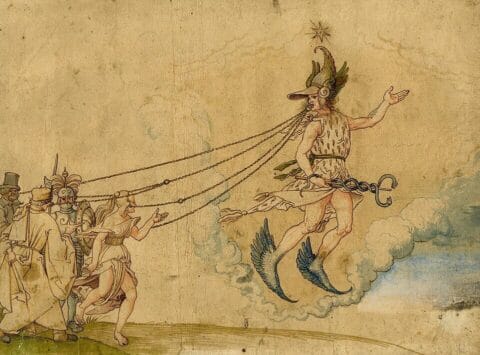
Lugh is often compared with the continental Celtic Lugus and the Welsh Lleu Llaw Gyffes.
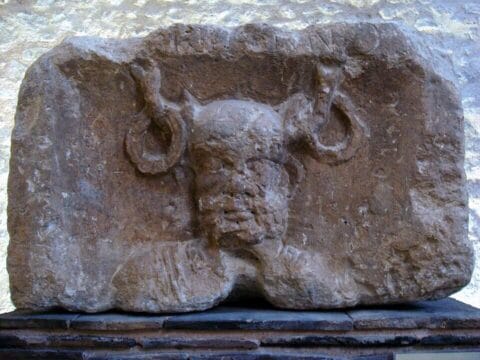
The names are linguistically related, and similarities in skill, status, and mythic function make comparison reasonable. Roman-era place names and inscriptions also suggest that a divine name related to Lugus was known beyond Ireland.
But the evidence is uneven. Lugh belongs to a rich Irish literary tradition, while Lugus is known much more fragmentarily. Lleu develops within Welsh tradition and has his own distinct stories.
The three figures are best understood as related Celtic traditions, not as perfectly identical versions of one god.
Was Lugh Worshipped in Ancient Ireland?
Lugh was almost certainly more than a literary character, but direct evidence for his cult in pre-Christian Ireland is limited.
Medieval tradition preserves strong associations with Lughnasadh, place-lore, assemblies, and seasonal customs, all of which suggest that Lugh had deep roots in pre-Christian belief.
What is missing is a clear archaeological record of temples, statues, or inscriptions naming him in Ireland. Most of the surviving evidence comes from texts written after Christianization.
So we can speak with confidence about an enduring religious and mythological tradition around Lugh, but not reconstruct a complete system of worship or ritual practice from the surviving evidence alone.
What Symbols Are Actually Associated With Lugh?
Lugh does not have one fixed emblem in the medieval Irish sources.
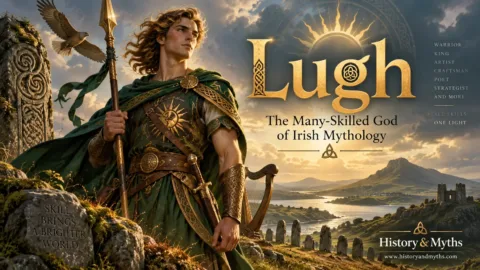
His spear is the clearest recurring attribute and one of the objects most strongly associated with him. The sling also belongs to his traditional imagery because of its role in the death of Balor, although it is tied to a specific episode rather than functioning as a universal symbol.
Modern depictions sometimes add solar discs, ravens, wheels, or other standardized emblems. These usually come from later interpretation or broader Celtic comparison rather than from a consistent Irish tradition.
For that reason, the spear remains the strongest traditional visual attribute of Lugh, while other symbols should be treated with more caution.
Frequently Asked Questions
Who was Lugh in Irish mythology?
Lugh was a major god of the Tuatha Dé Danann, known for his many skills, leadership at Tara, and central role in the Second Battle of Mag Tuired.
Was Lugh a sun god?
Not in any simple sense. Later interpretations often describe him as a sun god, but the medieval Irish sources present a much broader figure associated with skill, kingship, warfare, music, craft, and magic.
What does Samildánach mean?
Samildánach is usually understood as “skilled in many arts” or “master of many crafts.” It refers to Lugh’s unusual range of abilities rather than superiority over every specialist in every field.
How did Lugh kill Balor?
In Cath Maige Tuired, Lugh kills Balor with a sling stone that strikes his deadly eye. The text does not make Lugh’s famous spear the weapon used in that moment.
Are Lugh, Lugus, and Lleu the same god?
They are related through language and wider Celtic tradition, but they should not be treated as perfectly identical figures. Lugh belongs to Irish tradition, Lugus is known mainly from continental evidence, and Lleu develops in Welsh mythology.
Academic Sources & Primary Texts
Cath Maige Tuired: The Second Battle of Mag Tuired
Edited and translated by Elizabeth A. Gray, Irish Texts Society, Vol. 52, 1982.
The principal medieval source for Lugh’s arrival at Tara, his title Samildánach,
his leadership against the Fomorians, the spear from Gorias, the death of Balor,
and his dealings with Bres after the battle.
Brian Ó Cuív, “Lugh Lámhfhada and the Death of Balar Ua Néid”
Celtica, Vol. 2, 1952–1954, pp. 64–66.
A focused scholarly study dealing directly with Lugh and the tradition surrounding
the death of Balor.
Máire MacNeill, The Festival of Lughnasa
The Festival of Lughnasa: A Study of the Survival of the Celtic Festival of the Beginning of Harvest,
Oxford University Press, 1962.
A major study of Lughnasadh traditions, seasonal gatherings, folklore, and the
surviving relationship between Lugh, Tailtiu, and the early-August festival.
Mark Williams, Ireland’s Immortals: A History of the Gods of Irish Myth
Princeton University Press, 2016.
A major modern academic study of Ireland’s divine figures and the way pre-Christian
gods, including members of the Tuatha Dé, were reshaped in medieval literature and
later Irish tradition.
Proinsias Mac Cana, Celtic Mythology
Hamlyn, 1970.
A classic scholarly overview of Celtic gods and mythological traditions, useful for
placing the Irish Lugh within the wider Celtic context and for comparing Irish,
Welsh, and continental evidence without treating them as one identical mythology.
Copyright & Use
Written by H. Moses for
History & Myths.
This article is original content created for History & Myths.
Reproduction, republication, or full redistribution of this content is not permitted
without prior permission.
Short quotations may be used for educational, academic, or commentary purposes
with clear attribution and a link back to the original article.