Brigid: Irish Goddess of Poetry, Healing, Fire and Imbolc
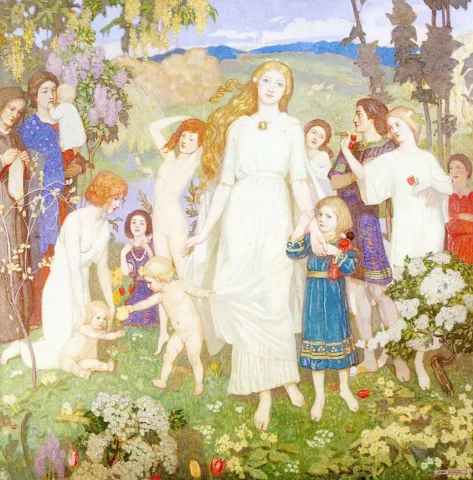
Brigid was one of the most important figures in early Irish mythology, associated with poetry, healing, smithcraft, and the Tuatha Dé Danann. Medieval Irish sources describe her as a daughter of the Dagda, while later traditions connected her with sacred fire, holy wells, Imbolc, and eventually Saint Brigid of Kildare.
But Brigid is more complex than the familiar image of a Celtic fire goddess. Early texts do not present all of these traditions in the same way, and some popular ideas about her developed much later. Even the claim that she was a single triple goddess of poetry, healing, and smithcraft requires closer examination.
So who was Brigid according to the earliest Irish sources? Why was she linked with poetry and healing, what is the basis for her connection with sacred fire, and how did she become so closely associated with one of Ireland’s most famous saints?
Who Was Brigid in Irish Mythology?
Brigid, also written Brigit or Bríg in medieval Irish sources, belonged to the Tuatha Dé Danann, the supernatural people at the centre of much of Ireland’s mythological tradition. She was described as a daughter of the Dagda and became especially associated with poetry, healing, and smithcraft.
One of the earliest important descriptions appears in Cormac’s Glossary, a medieval Irish compilation traditionally associated with Cormac mac Cuilennáin. It identifies Brigit as a poet and a daughter of the Dagda, describing her as a goddess revered by poets. The same passage also names a Brigit connected with healing and another connected with smithcraft, all three described as daughters of the Dagda.
The text does not clearly explain whether these were three separate figures or different forms of one deity, a question that later interpretations often simplify by describing Brigid as a “triple goddess.”
Brigid also appears in Cath Maige Tuired as the mother of Ruadán, whose death during the Second Battle of Mag Tuired gives her one of her most important surviving mythological scenes.
Brigid, Poetry, Healing and Smithcraft
Poetry, healing, and smithcraft were all highly skilled professions in early Irish society, which helps explain why they appear together in traditions surrounding Brigid.
Her connection with poetry is the clearest in Cormac’s Glossary, which describes Brigit as a woman of wisdom and a goddess revered by poets. The filid were not simply entertainers. They were trained professionals who preserved genealogy, historical tradition, law, and learned lore as well as composing verse. Brigid’s association with them therefore linked her with knowledge and learned culture.
Healing appears in the same source through another Brigit, described as a woman of healing. The text does not simply present medicine as another power belonging to the poet Brigit.
A third Brigit is associated with smithcraft. Metalworking was one of the skilled crafts represented among the Tuatha Dé Danann, and the forge provides the clearest early basis for Brigid’s later association with fire. The source gives us smithcraft explicitly, rather than a general title such as “goddess of sacred fire.”
Together, these traditions connect Brigid with forms of specialized knowledge and skilled work. Whether the three Brigits were originally separate figures or different expressions of one deity is a separate question, and one the surviving sources do not fully resolve.
Was Brigid Really a Triple Goddess?
Brigid is often described today as a triple goddess, but the early Irish evidence is more specific than that phrase suggests.
Cormac’s Glossary refers to Brigit the poet and then names two other women of the same name: Brigit the healer and Brigit the smith. All three are described as daughters of the Dagda. This is the strongest early basis for Brigid’s triple character.
What the text does not explain is whether these were three separate divine sisters, three forms of one goddess, or different traditions that had already become connected by the time the glossary was compiled. The surviving evidence does not allow us to choose confidently between those possibilities.
The familiar Maiden, Mother, and Crone interpretation should not be projected back onto medieval Irish mythology. Nothing in the early description assigns the three Brigits different ages or places them within a female life cycle. Their distinction is based on function: poetry, healing, and smithcraft.
So while Brigid is often called a triple goddess, the early source gives us something more precise: three Brigits, all daughters of the Dagda, associated with three skilled professions. The idea that they represent three ages or stages of one goddess belongs to much later interpretation.
Brigid and the Death of Ruadán
One of Brigid’s most memorable appearances in Irish mythology comes not through poetry, healing, or the forge, but through the death of her son.
In Cath Maige Tuired, Brigid has a son named Ruadán with Bres, the former king who sides with the Fomorians. This places Ruadán between the two sides in the Second Battle of Mag Tuired: through his mother he belongs to the family of the Tuatha Dé Danann, while through his father he is tied to their enemies.
The Fomorians send Ruadán to observe the preparations of the Tuatha Dé Danann. He later returns with a more dangerous task: to kill Goibniu, the divine smith.
Ruadán approaches Goibniu and obtains a spear. Once it is assembled, he turns the weapon against the smith and wounds him. Goibniu survives, pulls out the spear, and throws it back at Ruadán, fatally striking him.
Brigid arrives after her son’s death and mourns him. The tale says that she cries out and weeps, describing this as the first such lamentation heard in Ireland. The episode became associated with keening, the ritual lament for the dead.
The scene gives Brigid a dimension that lists of divine attributes cannot capture. Here she appears as a mother grieving a son caught between opposing peoples, while her lament becomes part of the mythology surrounding mourning itself.
Brigid, Sacred Fire and Imbolc
Fire has become one of the strongest symbols associated with Brigid, but the connection is more complicated than simply calling her an ancient Celtic “goddess of sacred fire.”
The earliest material gives us a firmer link with smithcraft. A smith depended on controlled fire to transform metal, so the forge provides a natural connection between Brigid and flame. The broader idea of a sacred or perpetual fire is much more clearly documented in later traditions surrounding Saint Brigid and Kildare.
Kildare became one of the great religious centres associated with Saint Brigid, and medieval accounts describe a perpetual fire maintained there by women of her community. That tradition helped make fire one of Brigid’s most enduring symbols, although it cannot be traced with certainty back to a pre-Christian cult of the goddess.
Brigid is also closely associated with Imbolc, the seasonal festival traditionally observed around February 1. In the old Irish seasonal calendar, Imbolc marked the beginning of spring and was connected with returning light, livestock, fertility, and the start of new agricultural activity.
February 1 also became the feast day of Saint Brigid. Later Irish customs around the date included making Brigid’s crosses, preparing special foods, and seeking protection for the household and animals.
Brigid’s connection with fire and Imbolc therefore belongs to more than one layer of tradition. Smithcraft appears in the early mythological material, while sacred flame, Saint Brigid, and seasonal customs became increasingly intertwined in later Irish tradition.
What Do the Earliest Irish Sources Actually Say About Brigid?
The earliest Irish sources preserve a more limited picture of Brigid than later tradition. They give us direct evidence for her family, her association with skilled professions, and her role in the story of Ruadán.
| Source | What It Says About Brigid | Why It Matters |
|---|---|---|
| Cormac’s Glossary | Brigit is described as a poet, a daughter of the Dagda, and a goddess revered by poets. The same passage also names a Brigit associated with healing and another with smithcraft. | It provides the clearest early basis for Brigid’s links with poetry, healing, smithcraft, and the later idea of a triple Brigid. |
| Cath Maige Tuired | Bríg is the daughter of the Dagda, the mother of Ruadán by Bres, and the figure who mourns Ruadán after his death in the Second Battle of Mag Tuired. | It gives Brigid her most important surviving narrative role and connects her lament with the tradition of keening. |
| Lebor Gabála Érenn | Brigit appears as a poetess and daughter of the Dagda, with additional traditions attached to her within the Tuatha Dé Danann material. | It reinforces her place within the wider mythological tradition and preserves material beyond the better-known battle narrative. |
In short: poetry, healing, smithcraft, her descent from the Dagda, and the story of Ruadán have early textual support. Sacred flames, crosses, holy wells, and many customs associated with Imbolc are documented mainly through later Christian and folk traditions.
Brigid and Saint Brigid
No part of Brigid’s story is more difficult to separate than the relationship between the pagan goddess and Saint Brigid of Kildare.
Saint Brigid was one of the most important figures in early Irish Christianity. Sources from at least the seventh century describe her as the founder of the religious community at Kildare, which became a major ecclesiastical centre. Her feast day was celebrated on February 1, the same date later associated with Brigid traditions around Imbolc.
The shared name, the date, Kildare, and recurring themes such as fire, fertility, animals, protection, and the natural world have led many writers to argue that the Christian saint simply replaced an older goddess. That explanation, however, goes further than the surviving evidence allows.
Early biographies present Saint Brigid as a Christian holy woman, not as a disguised pagan deity. At the same time, some traditions surrounding her may have absorbed or reinterpreted older Irish material as pre-Christian customs and symbols acquired new meanings.
The evidence therefore supports a close relationship between the two traditions without proving that the goddess and the saint were the same figure. Their shared name, symbolism, places, and seasonal associations point to overlap, but exactly how that relationship developed remains uncertain.
Brigid’s tradition ultimately sits at the meeting point of Irish mythology, Christianity, and later folklore.
Brigid’s Cross, Sacred Wells and Later Folklore
Some of the best-known symbols associated with Brigid come not from the early mythological texts, but from centuries of Irish folk tradition surrounding Saint Brigid.
The most recognizable is St Brigid’s Cross, traditionally made from rushes or straw around January 31 and February 1. Crosses were placed in homes, barns, and animal shelters for protection. They also appeared in several regional forms, including four-armed, diamond-shaped, and wheel-shaped designs.
Holy wells form another important part of Brigid’s later tradition. Wells dedicated to Saint Brigid are found across Ireland, and visiting them around her feast day became a customary practice. People sought blessings, collected water, and sometimes left ribbons or other small offerings.
Other customs included leaving a piece of cloth known as the Brat Bríde outside overnight in the belief that Brigid would bless it as she passed. It could then be kept for protection or used when someone in the household was ill. In some regions, groups carried an effigy of Brigid from house to house, while others used a large straw girdle known as the Crios Bríde in protective rituals.
These traditions show how strongly Brigid became associated with the home, health, livestock, protection, and the beginning of spring. Most, however, are documented through Christian or later folk practice, so they should not automatically be treated as direct evidence of how the pre-Christian goddess was worshipped.
Read More
Was Brigid the Same Goddess as Brigantia?
Brigid is sometimes identified with Brigantia, a goddess worshipped in Roman Britain, but the relationship is better described as a strong connection than a proven identity.
The names are closely related linguistically, and both appear to come from a Celtic root associated with height or exalted status. This has led scholars to suggest that the two traditions may ultimately preserve an older shared divine figure.
Unlike the Irish Brigid, Brigantia is known partly through physical evidence. Roman-period inscriptions from northern Britain record dedications to the goddess, including an altar from Adel dedicated “to the goddess Brigantia.” Another inscription from AD 208 identifies her with Victoria, the Roman goddess of victory.
The linguistic connection and the evidence for Brigantia’s worship make a relationship between the two traditions plausible, but they do not prove that Brigid and Brigantia were understood as the same goddess. They may have developed from a common earlier tradition while remaining distinct regional figures.
How Was Brigid Worshipped?
The surviving evidence tells us far more about Brigid’s mythology than about how she was worshipped in pre-Christian Ireland.
Early Irish texts do not describe temples, priesthoods, prayers, or a regular set of rituals dedicated specifically to her. They preserve her divine identity, her family relationships, and her associations with poetry, healing, and smithcraft, but provide little detail about an organized cult.
This makes later traditions difficult to use as evidence for pagan worship. Sacred wells, perpetual flames, Brigid’s crosses, and many customs surrounding February 1 are well documented in Christian and later Irish folklore, but they cannot automatically be projected back into the pre-Christian period.
We can therefore say that Brigid was remembered as an important divine figure, but the surviving sources do not allow us to reconstruct exactly how people worshipped her before Christianity. Any detailed description of a pagan Brigid ritual system would go beyond the evidence.
Academic Sources
The article draws on early Irish texts, scholarly studies of Brigid and Saint Brigid, archaeological evidence, and institutional folklore collections.
Cormac’s Glossary (Sanas Chormaic)
An important medieval Irish glossary preserving the early description of Brigit as a poet, daughter of the Dagda, and a goddess associated with poets, together with Brigit the healer and Brigit the smith.
Cath Maige Tuired: The Second Battle of Mag Tuired
Edited and translated by Elizabeth A. Gray. This primary text preserves the story of Ruadán, identifies Bríg as the daughter of the Dagda, and describes her lament after her son’s death.
Lawrence, Lisa. “Pagan Imagery in the Early Lives of Brigit: A Transformation from Goddess to Saint?”
A scholarly study examining possible pagan elements in the early Lives of Saint Brigid and the debated relationship between the goddess and the Christian saint.
Bitel, Lisa M. Landscape with Two Saints
An Oxford University Press study of Saint Brigit of Kildare, early Christianity, religious landscape, conversion, and the development of Brigit’s cult in medieval Ireland.
Roman Inscriptions of Britain: Brigantia
The epigraphic corpus preserves Roman-period dedications to Brigantia, including the altar from Adel and inscriptions identifying the goddess in northern Britain.
National Museum of Ireland, Irish Folklife Collection
Institutional documentation of later traditions associated with Saint Brigid, including Brigid’s crosses, the Brat Bríde, Crios Bríde, holy wells, household protection, and St Brigid’s Day customs.
Copyright Notice: This article is an original work published by
History & Myths
.
All rights reserved. The text may not be copied, republished, translated, or redistributed in whole or in substantial part without prior written permission.