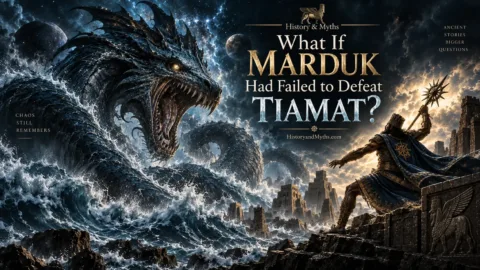
What If Marduk Had Failed to Defeat Tiamat?
In the Enūma Eliš, Marduk’s victory over Tiamat does far more than end a divine war. It gives him supreme authority, allows him to reshape the cosmos from Tiamat’s body, and sets in motion the events that lead to human creation and the rise of Babylon.
If Marduk had failed, that entire sequence would be thrown into doubt.
Tiamat would remain undefeated, Kingu could keep the Tablet of Destinies, and the cosmic order described in the Babylonian creation epic might never take the form we know.
But Tiamat’s victory would not simply mean that “chaos wins.” The Enūma Eliš never tells us what happens in a world where Marduk fails, so the scenario has to build from what the text actually makes possible.
The real question is not just who wins the battle, but how much of the Babylonian cosmos depends on Marduk winning it.
What Happened in the Original Myth?
In the Enūma Eliš, tensions between generations of gods eventually turn into open war. Tiamat raises an army, creates monstrous allies and places Kingu at their head, giving him the Tablet of Destinies.
The younger gods struggle to find anyone willing to face her. Marduk finally agrees, but only after demanding supreme authority among the gods if he succeeds.
He defeats Tiamat, takes control of her forces and divides her body to organize the cosmos. Kingu is later condemned, and humanity is created from his blood to perform labor for the gods.
From that victory, Marduk’s supremacy and the new cosmic order described in the rest of the epic become possible.
The Point of Divergence: Marduk Fails Against Tiamat
The alternate timeline breaks from the Enūma Eliš at the battle with Tiamat.
In the original epic, Marduk traps her with the winds and delivers the blow that ends the war. In this scenario, that attack fails. Tiamat survives, and Marduk is unable to secure the victory the younger gods expected from him.
He does not need to die for the consequences to be enormous. Once Tiamat remains undefeated, the chain of events that follows Marduk’s triumph can no longer unfold as it does in the epic.
From this point onward, the question is not simply whether Marduk survives, but what kind of divine and cosmic order can emerge without his victory.
The Alternate Scenario: Tiamat Wins the Battle
Counterfactual scenario: The following section explores what might happen if Marduk failed to defeat Tiamat. It is an alternate interpretation, not an event described in the Enūma Eliš.
Marduk’s failed attack leaves Tiamat in control of the battlefield.
The younger gods have already placed their hopes in him after others proved unable to confront her. If Marduk cannot finish the war, they are suddenly left without an obvious champion strong enough to replace him.
Tiamat, meanwhile, still commands her monstrous forces. Kingu remains at their head with the Tablet of Destinies, and nothing has yet broken the coalition she built against the younger gods.
The most immediate result would probably be retreat rather than a settled new kingdom. Tiamat’s side has survived the challenge, Marduk’s authority has been damaged, and the younger gods must now decide whether to submit, regroup or continue a war they have already failed to end.
For the first time, the balance of power favors Tiamat without any clear path back to the outcome of the original epic.
What Happens to Marduk’s Kingship?
Before the battle, the younger gods grant Marduk exceptional authority because he has agreed to face Tiamat when no one else can stop her.
In the alternate scenario, that bargain becomes unstable. Marduk still holds the authority given to him as their champion, but he has failed to produce the victory that would turn that authority into lasting supremacy.
The Enūma Eliš never tells us how the gods would respond to such a defeat. They might continue to support him because no stronger alternative exists, or his failure could weaken the authority they had just placed in his hands.
What disappears is the secure kingship Marduk achieves in the original epic. Without Tiamat’s defeat and the cosmic order that follows it, his rise remains unfinished.
He may still be powerful, but he is no longer the unquestioned ruler the poem ultimately celebrates.
Would Tiamat Become Ruler of the Gods?
Defeating Marduk would make Tiamat the dominant force in the conflict, but it would not automatically make her queen of all the gods.
In the Enūma Eliš, Tiamat leads the forces opposing the younger gods and places Kingu in a position of major authority rather than concentrating every role in herself.
If Marduk fails, that arrangement can continue. The younger gods would face a victorious coalition, not simply a new ruler replacing Marduk at the top of the pantheon.
Some gods might submit, while others could continue resisting. The epic never tells us that Tiamat intended to build a new divine hierarchy centered entirely on herself.
Her victory would therefore change the balance of power without necessarily creating a stable new kingship. Tiamat and her allies would hold the advantage, but the final structure of divine rule would remain unsettled.
Kingu and the Tablet of Destinies
Kingu is one of the clearest beneficiaries of Marduk’s failure.
In the original Enūma Eliš, Tiamat appoints him commander of her forces and gives him the Tablet of Destinies, placing unusual authority in his hands. After Marduk wins, Kingu is captured and the tablet is taken from him.
In the alternate scenario, that collapse never happens.
If Tiamat remains undefeated, Kingu keeps both his command and the authority she granted him. He remains a central figure in the victorious coalition rather than becoming a defeated rebel awaiting judgment.
That matters because the Tablet of Destinies also stays outside Marduk’s control. The balance of divine authority therefore remains divided, with Kingu preserving a power that the original epic removes from him after Tiamat’s defeat.
Would the World Still Be Created?
Not in the way the Enūma Eliš describes it.
After defeating Tiamat, Marduk divides her body and uses it to establish the structure of the cosmos. Her death is therefore not just the end of the battle; it becomes part of the act of cosmic organization itself.
If Tiamat survives, that sequence cannot occur. Her body is never transformed into the structure Marduk creates in the original epic.
That does not mean no ordered world could ever emerge. The poem gives us no alternate creation story for a failed Marduk. What we can say is that the specific cosmos described in the Enūma Eliš would lose one of the events on which its creation depends.
The world might still take shape in some other way, but it would no longer the cosmos Marduk organizes after defeating Tiamat.
Would Humans Exist Without Marduk’s Victory?
Humanity would not be created in the way the Enūma Eliš describes.
In the original epic, Kingu is captured after Tiamat’s defeat, identified as responsible for the revolt and executed, and executed. His blood is then used in the creation of humans.
If Marduk fails, that sequence breaks. Kingu survives within Tiamat’s coalition, so the specific act of human creation described in the epic never takes place.
That does not mean humans could not exist at all. Mesopotamian tradition preserves more than one account of human origins, and the Enūma Eliš gives no alternative for a world in which Marduk loses.
What disappears in this scenario is therefore not humanity in every possible sense, but the particular human origin story that depends on Kingu’s defeat and death.
What Happens to Babylon?
Marduk’s victory in the Enūma Eliš does more than establish his authority among the gods. It also gives Babylon, the city most closely associated with him, a powerful mythic claim to religious centrality.
Once Marduk becomes the dominant divine authority, Babylon is presented as part of the new order built around his rule.
If he fails, that connection weakens. Babylon might still exist as a major city, but the epic could no longer justify its central position through Marduk’s triumph over Tiamat.
A defeated or diminished Marduk would therefore mean more than a different divine hierarchy. It would also remove one of the myth’s strongest foundations for placing Babylon at the center of the sacred world.
Could Another God Defeat Tiamat?
The Enūma Eliš does not present an obvious replacement for Marduk.
Before he steps forward, other gods fail to resolve the crisis. Marduk becomes the decisive figure precisely because he is willing and able to confront Tiamat under terms the others accept.
If he fails, the younger gods could search for another champion, but the epic gives us no clear candidate with the same combination of power and support.
A second attempt is therefore possible, but it would move beyond any path the text itself establishes.
Later Assyrian tradition offers an interesting comparison: Ashur could take over Marduk’s role in adapted versions of the creation story. That, however, reflects a later reshaping of the myth and does not show that Ashur would have replaced Marduk within the original Babylonian narrative.
In this scenario, Marduk’s defeat leaves the gods without an immediate successor capable of ending the war.
What Would Tiamat’s Victory Actually Look Like?
Tiamat’s victory would not necessarily produce a stable new order.
Her coalition would hold the advantage, while the younger gods would be forced to retreat, submit or search for another way to continue the struggle.
What follows is therefore less a new kingdom than an unresolved balance of power. Tiamat and Kingu remain dominant, but no replacement system has yet emerged to match the ordered divine hierarchy created after Marduk’s victory in the original epic.
The conflict could end through submission, negotiation or another challenge, but none of those outcomes is provided by the Enūma Eliš itself.
Tiamat’s victory would therefore leave the cosmos politically unsettled rather than simply handing her the same kind of rule Marduk eventually achieves.
What Marduk’s Failure Reveals About the Enūma Eliš
Imagining Marduk’s defeat makes one thing clear: his victory is not simply the climax of the Enūma Eliš. It is the event that gives the rest of the epic its structure.
His success establishes a new divine hierarchy, makes the ordering of the cosmos possible, leads to Kingu’s punishment, provides the basis for human creation, and strengthens Babylon’s place within the myth.
Without that victory, those elements no longer connect in the same way.
The battle with Tiamat is therefore more than a fight between two divine powers. It is the moment when the poem turns conflict into order and transforms Marduk from a champion into the central god of its political and theological vision.
Seen from the alternate scenario, the logic of the epic becomes unusually clear: Marduk’s victory is the foundation on which everything that follows depends.
Academic Sources
This article is based on academic translations and modern scholarship on the
Enūma Eliš, Mesopotamian religion, Marduk, Tiamat and Babylonian
literary tradition.
- Lambert, W. G. (2013).
Babylonian Creation Myths.
Mesopotamian Civilizations 16. Eisenbrauns / Penn State University Press.
DOI: 10.5325/j.ctv18r6rfr.
Critical edition, transliteration and translation of the Enūma Eliš,
with extensive discussion of Marduk, creation traditions and Babylonian theology.
- Dalley, Stephanie (2000).
Myths from Mesopotamia: Creation, the Flood, Gilgamesh, and Others.
Revised edition. Oxford University Press.
Academic translation and commentary on major Mesopotamian myths, including
the Babylonian Epic of Creation.
- Foster, Benjamin R. (2005).
Before the Muses: An Anthology of Akkadian Literature.
3rd edition. Pennsylvania State University Press.
Major scholarly anthology of Akkadian literature providing textual and
historical context for Mesopotamian mythological traditions.
- Dalley, Stephanie (2021).
The City of Babylon: A History, c. 2000 BC–AD 116.
Cambridge University Press.
DOI: 10.1017/9781316479728.
Modern academic study of Babylon, including the rise of Marduk and the role
of the Epic of Creation in Babylon’s religious and ideological prominence.