Rosmerta: Celtic Goddess of Abundance and Prosperity
Rosmerta was a Celtic goddess associated with abundance and prosperity, worshipped primarily in northeastern Gaul during the Roman period. Her name is commonly interpreted as “the Great Provider,” reflecting her association with the provision of wealth and resources. Unlike deities known through surviving myths, Rosmerta is documented chiefly through inscriptions and religious monuments.
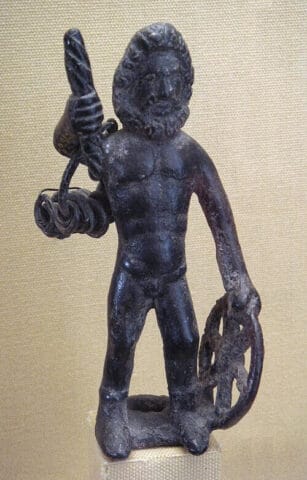
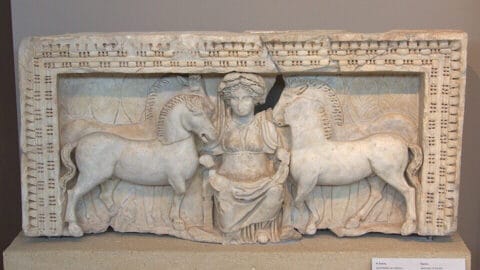
She was frequently worshipped alongside Mercury, the Roman god associated with commerce and financial gain. Their names appear together on numerous dedications, revealing a close religious partnership in Gallo-Roman communities. Yet Rosmerta was not simply Mercury’s female counterpart. Some inscriptions honour her independently, while surviving sculptures associate her with symbols of abundance, including the cornucopia.
Who Was Rosmerta in Gallo-Roman Religion?
Rosmerta belonged to the religious world of Roman Gaul, where local deities continued to receive worship alongside gods of the Roman pantheon. Inscriptions bearing her name are concentrated in northeastern Gaul and the Rhine region, particularly in territories associated with the Treveri, Mediomatrici, and Leuci. These communities provide the strongest evidence for her worship, rather than a cult shared by all Celtic peoples.
Her worship reflects the interaction between Gaulish traditions and Roman religious practices. Devotees preserved her Celtic name in Latin dedications, often carved on stone altars following Roman conventions. These monuments show how a local religious tradition continued within the wider religious culture of the Roman provinces.
What Does the Name Rosmerta Mean?
The Gaulish name Rosmerta is generally translated as “the Great Provider.” It combines the intensive prefix ro-, meaning “very” or “great,” with smert-, a linguistic element associated with care, provision, and foresight. Scholars differ over its precise meaning, but the name suggests a goddess concerned with providing for needs rather than wealth alone.
The same root appears in other Gaulish divine names, notably Smertrios. This linguistic connection reflects a shared vocabulary of care and provision, but does not establish a mythological relationship between the two deities.
Rosmerta and Mercury: Why Were They Worshipped Together?
Mercury occupied a prominent place in the religion of Roman Gaul. Julius Caesar, writing in the first century BCE, described him as the most widely worshipped god among the Gauls, associated with travel, commerce, and financial gain. Caesar used Roman names for Gallic deities, however, and the identity of the indigenous god or gods represented by Mercury remains debated.
Rosmerta’s association with Mercury may have reflected complementary religious functions. Mercury’s connection with trade and wealth suited a goddess whose name suggested provision and care. Their joint worship could have expressed hopes for prosperity and the resources needed to sustain it, although no surviving ancient account explains why their cults became so closely connected.
Rosmerta is often described as Mercury’s consort, but this term refers to their partnership in worship rather than a marriage established by a surviving myth. Mercury was also associated with other goddesses, including Maia and Visucia, showing that his partnership with Rosmerta was not exclusive.
What Do the Inscriptions Reveal About Rosmerta?
Most evidence for Rosmerta’s worship comes from Latin votive inscriptions carved on altars and religious monuments. Some identify individual worshippers, while others document the images and sanctuaries dedicated to the goddess.
Eisenberg: A Named Image of Mercury and Rosmerta
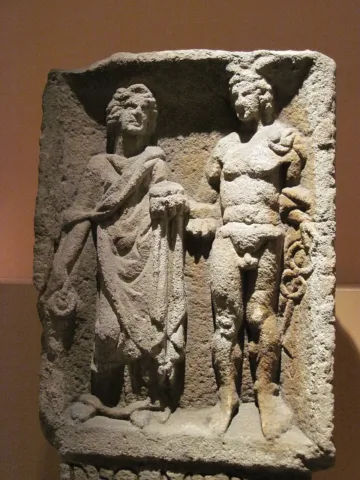
A sandstone relief discovered at Eisenberg, in present-day Germany, depicts Mercury and Rosmerta standing together. The inscription beneath them names both deities and identifies the donor as Marcus Adiutorius Memor, a local councillor who fulfilled a religious vow.
Mercury wears a winged cap and holds his caduceus, with a possible purse in his right hand. Rosmerta carries a shallow offering dish, or patera, and a covered vessel. Because both figures are identified by inscription, the monument provides one of the clearest representations of their partnership in Gallo-Roman art (CIL XIII 11696).
Escolives: Rosmerta Represented Alone
A relief discovered at Escolives-Sainte-Camille in Burgundy depicts Rosmerta standing alone beneath an arch. She wears a diadem and holds a patera in her right hand and a large cornucopia filled with fruit in her left.
The inscription names the goddess and identifies the donor as Iunianus, a priest of the imperial cult who fulfilled a vow. This makes the sculpture particularly important: it connects Rosmerta directly with the cornucopia, without relying on comparisons with unidentified female figures.
The monument was found reused in the foundations of a Roman bath building. Its original religious setting cannot be established from that discovery alone.
Wasserbillig: A Shrine Dedicated to Both Deities
An inscription discovered at Wasserbillig, in present-day Luxembourg, records the dedication of a shrine to Mercury and Rosmerta in AD 232. The original stone fragments were subsequently lost, but nineteenth-century copies preserve a partly reconstructed text referring to statues and furnishings associated with the sanctuary.
The reconstructed inscription identifies a donor named Acceptus, a record-keeper and sevir Augustalis, an official associated with the imperial cult. It also appears to mention accommodation intended for religious celebrations.
Although parts of the inscription are missing, it provides valuable evidence that the joint worship of Mercury and Rosmerta involved dedicated religious buildings, not merely individual offerings (CIL XIII 4208).
Where Was Rosmerta Worshipped?
Rosmerta’s worship was concentrated in northeastern Gaul and the Rhine region, particularly in the Roman provinces of Gallia Belgica and Germania Superior. Inscriptions bearing her name have been found across parts of modern France, Germany, and Luxembourg, with additional dedications from Gallia Lugdunensis.
One notable concentration comes from Soulosse-sous-Saint-Elophe in northeastern France, where three inscriptions (CIL XIII 4683–4685) name Mercury and Rosmerta together. One dedication was made by the villagers of Solimariaca, while the others record individual offerings. These monuments provide evidence of both communal and personal devotion to the divine pair.
Rosmerta’s name also appears at Sarmizegetusa in Roman Dacia, now Romania. An inscription dedicated by the imperial financial official Quintus Axius Aelianus invokes her alongside Mercury, Mars Camulus, and Mithras. Aelianus had previously served in Belgica and the Germanies, which may explain his familiarity with these deities. The inscription demonstrates how their worship could extend beyond its principal region.
In Roman Britain, sculptures from Gloucester and Bath have been interpreted as representations of Mercury and Rosmerta. However, no surviving British inscription securely identifies the goddess by name. These artistic identifications remain debated, making the evidence less certain than the named dedications found on the continent.
Rosmerta’s Symbols and Their Meanings
Rosmerta’s principal symbols included the cornucopia and the patera, both securely identified on the inscribed relief from Escolives-Sainte-Camille. The cornucopia, filled with fruit, represented abundance and the provision of resources, while the patera was a shallow dish used in religious offerings.
Other representations associate her with Mercury’s symbols of prosperity. Some show a purse, although scholars have occasionally disputed whether the object depicted is a purse or a vessel. A second-century statue discovered in Paris in 1989, now held by the Musée Carnavalet, shows a goddess identified as Rosmerta carrying a basket of fruit and Mercury’s caduceus. It was found alongside a statue of Mercury, reinforcing the interpretation of the figures as a divine pair.
Scholars have identified two overlapping artistic traditions: one emphasizing the cornucopia and patera, the other incorporating Mercury’s purse and caduceus. These symbols were not exclusive to Rosmerta. Fortuna, Maia, and other goddesses could share similar attributes, making it difficult to identify her in sculptures that lack inscriptions.
Did Rosmerta Have an Independent Cult?
Although Rosmerta frequently appears alongside Mercury, several inscriptions record dedications to her without his name. At Gissey-le-Vieil in Burgundy, Gnaeus Cominius Candidus and Apronia Avitilla fulfilled a vow to the goddess. Their altar, also dedicated in honour of Augustus, names Rosmerta but not Mercury (CIL XIII 2831).
At Champoulet in central France, another inscription addresses her as Rosmerta Dubnocaratiaca. The same local epithet appears in dedications to Mercury and Apollo, suggesting that it was associated with a particular place or religious community rather than Rosmerta alone. Its precise meaning remains disputed.
These inscriptions confirm that Rosmerta received offerings in her own name. They do not establish whether she had a separate priesthood or an organized cult independent of Mercury. Her worship may have originated in pre-Roman Gaul, but no securely dated evidence reveals when it began or how her association with Mercury developed.
Read Also
Rituals, Beliefs, and the Limits of the Evidence
Rosmerta’s worship involved votive offerings and donations to local sanctuaries. At Dompierre-sur-Authie in northern France, archaeologists discovered an inscribed silver strip that had formed part of the base of a votive statuette. The inscription names Rosmerta Augusta and includes the Latin phrase ex stipibus, meaning that the offering was funded through collected contributions. The statuette itself has not survived.
A Gaulish inscription on a pottery vessel from Lezoux offers a less certain glimpse of religious practice. It mentions Rigani and Rosmerta, which some scholars interpret as a dedication to the Queen and Rosmerta. The Celtic linguist Pierre-Yves Lambert proposed another reading, referring to a queen presiding over festivities in Rosmerta’s honour. This could indicate celebrations associated with the goddess, but the disputed interpretation provides no reliable details of their ceremonies or dates.
Rosmerta may also have played a role in healing. In her study of Gallo-Roman religious practices, Audrey Ferlut suggests that Rosmerta, when worshipped alongside Mercury, could represent restored health, or Salus. Her interpretation draws partly on dedications and representations involving the caduceus. This possible healing function remains distinct from Rosmerta’s better-documented association with abundance and provision.
Conclusion
Rosmerta’s surviving monuments document worshippers who honoured her both independently and alongside Mercury. Their altars, offerings, and sanctuaries reveal a goddess whose importance extended beyond the familiar imagery of abundance.
Although these remains tell us little about the myths or beliefs associated with her, they establish Rosmerta as a distinct figure in Gallo-Roman religion. Her identity survives not through stories, but through the dedications of those who worshipped her.
Academic Sources & Primary Texts
Academic Studies
- Bémont, Colette. “Rosmerta.” Études celtiques 9, no. 1 (1960): 29–43.
https://doi.org/10.3406/ecelt.1960.1335. - Bémont, Colette. “À propos d’un nouveau monument de Rosmerta.” Gallia 27, no. 1 (1969): 23–44.
https://doi.org/10.3406/galia.1969.2517. - Ferlut, Audrey. “Goddesses as Consorts of the Healing Gods in Gallia Belgica and the Germaniae: Forms of Cult and Ritual Practices.” Open Library of Humanities 2, no. 1 (2016): e5.
https://doi.org/10.16995/olh.43. - Piso, Ioan. “Inschriften von Prokuratoren aus Sarmizegetusa (II).” Zeitschrift für Papyrologie und Epigraphik 120 (1998): 253–271.
Read the study.
Primary Texts and Archaeological Evidence
- Julius Caesar. De Bello Gallico 6.17. Ancient account of Mercury’s importance among the Gauls.
Latin text and commentary, Dickinson College. - Corpus Inscriptionum Latinarum (CIL), XIII 11696. Eisenberg, dedication to Mercury and Rosmerta.
FERCAN, University of Graz. - Escolives-Sainte-Camille, inscribed relief of Rosmerta, Année Épigraphique 1968, no. 306.
Ubi Erat Lupa, Monument 25721. - Corpus Inscriptionum Latinarum (CIL), XIII 4208. Wasserbillig, dedication concerning a sanctuary of Mercury and Rosmerta, AD 232.
Institut national de recherches archéologiques, Luxembourg. - Corpus Inscriptionum Latinarum (CIL), XIII 2831 and XIII 4683–4685. Dedications from Gissey-le-Vieil and Soulosse documenting independent and joint worship of Rosmerta.
Epigraphic discussion in Bémont (1960). - Lezoux Gaulish inscription, L-67. Ritual dedication mentioning Rigani and Rosmerta, with alternative linguistic interpretations.
Mnamon, Scuola Normale Superiore di Pisa.
Copyright © 2026 History & Myths.
Written by H. Moses. All rights reserved. Unauthorized reproduction or redistribution of the original article is prohibited. Historical sources and third-party images remain subject to their respective copyrights and licenses.