The Voyage of Bran: An Irish Myth of the Otherworld
The Voyage of Bran is an early Irish legend about Bran mac Febail, who sails across the sea in search of a mysterious land where sickness, sorrow, and death are unknown. His adventure begins when he hears enchanting music, discovers a silver branch, and encounters a woman who describes a beautiful realm beyond Ireland’s shores.
Bran sets sail with twenty-seven companions and meets Manannán mac Lir, the Irish sea god, before visiting an island of laughing people and reaching the Land of Women. There, the travellers enjoy a seemingly timeless existence, unaware that many years are passing in Ireland.
When homesickness finally draws them back, one of Bran’s companions steps onto Irish soil and immediately crumbles to ashes. Bran remains aboard his boat, recounts the voyage to the people on shore, and departs without revealing his destination.
Preserved in the medieval Irish tale Immram Brain maic Febail, the story explores the extraordinary rewards of entering the Otherworld and the danger of returning from it.
Who Was Bran mac Febail?
Bran mac Febail, meaning “Bran son of Febal,” is the central figure of the early Irish tale Immram Brain. The narrative places him in a fortified residence described as a royal house, where kings gather in his hall. This suggests that Bran belonged to the ruling elite, although the surviving text gives no detailed genealogy or clear account of his kingdom.
Little is said about his life before the voyage. The story names his father but provides no account of Bran’s childhood or earlier achievements. It does, however, identify three of his foster-brothers and companions as leaders of the groups that accompany him overseas.
Bran is not presented as a god, nor should he be confused with Brân the Blessed (Bendigeidfran), the giant king of Welsh mythology who appears in the Mabinogi. Despite their similar names, they belong to different narrative traditions.
The Silver Branch and the Mysterious Woman
One day, while walking alone near his stronghold, Bran heard music behind him. Whenever he turned to find its source, the sound remained at his back. The melody was so enchanting that he eventually fell asleep. When he awoke, he found a silver branch covered in white blossoms lying beside him. He picked it up and carried it to his royal hall.
Later, while Bran’s hall was filled with guests, a woman dressed in unfamiliar clothing suddenly appeared before them. No one knew where she had come from or how she had entered, since the stronghold’s ramparts were closed.
The stranger began to sing, and everyone present could hear her. Her song consisted of fifty quatrains, opening with a description of the silver branch. She identified it as a branch from an apple tree growing in Emain, a land beyond the familiar world.
The woman gave no name, but her appearance and knowledge of the branch connected her to the mysterious realm she had come to describe.
The Woman’s Invitation to the Land Beyond the Sea
The woman’s song described Emain as a beautiful land of flowering trees, shining fields, and birds singing in harmony. Its inhabitants enjoyed music, games, and feasting without knowing grief, sickness, or death. Nothing there was expected to decay, and the pleasures of life continued without the hardships familiar to mortals.
Her verses also spoke of 150 islands in the western ocean, each said to be larger than Ireland. Among the places she described were lands of extraordinary wealth, golden chariots, and horses of brilliant colours.
Yet the song was directed particularly at Bran. Near its end, the woman urged him to abandon idleness, resist drunkenness, and sail across the sea in search of Tír na mBan, the Land of Women.
When she finished singing, she disappeared without revealing where she had gone. The silver branch sprang from Bran’s hand into hers, and he was powerless to hold it. With the branch gone, only her extraordinary invitation remained.
Bran Sets Sail with His Companions
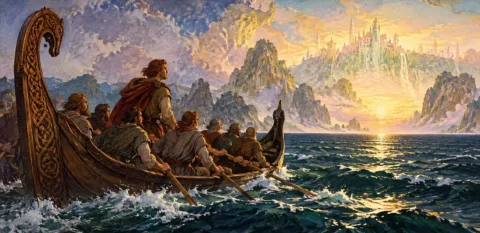
The morning after the mysterious woman disappeared, Bran set out across the sea with twenty-seven companions. They were divided into three groups of nine, each led by one of Bran’s foster-brothers, men who had grown up alongside him.
The tale does not describe elaborate preparations or explain how Bran chose his course. He simply followed the invitation to seek the distant land the woman had described.
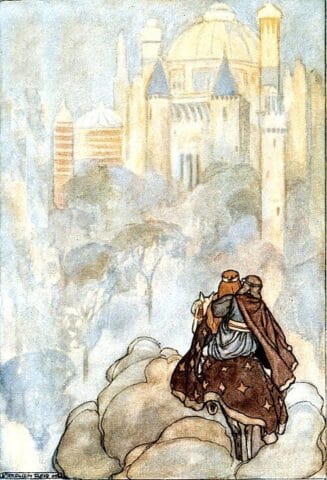
After two days and two nights at sea, the voyagers saw an extraordinary sight: a man approaching them in a chariot that seemed to travel across the water. The stranger was Manannán mac Lir, whose appearance marked the first supernatural encounter of their voyage.
Bran’s Encounter with Manannán mac Lir
The stranger identified himself as Manannán mac Lir and began singing to Bran. Although Bran saw only the open sea around his boat, Manannán described the same waters as a flowering plain. Where Bran saw waves, Manannán saw fields covered in blossoms. Fish leaping through the water appeared to him as calves and lambs moving peacefully across the land.
Manannán called this realm Mag Mell, the Pleasant Plain. He described streams of honey, trees bearing fruit, and a country free from decay. Even the sea beneath Bran’s boat was, from Manannán’s perspective, a landscape of forests and fertile ground.
His song also contained a prophecy. Manannán foretold that he would travel to Ireland and father a son named Mongán, who would be acknowledged as the son of Fiachna. The prophecy connects Bran’s voyage with another tradition in early Irish literature.
Before departing, Manannán urged Bran to continue rowing. The Land of Women was now close, and he told the voyagers they could reach it before sunset.
The Island of Joy and the Laughing People
After leaving Manannán, Bran came upon an island crowded with people who stared at his boat and burst into laughter. As he rowed around its shores, the inhabitants continued laughing but refused to answer when the voyagers tried to speak to them.
Bran sent one of his companions ashore to investigate. The man joined the islanders and soon began behaving exactly like them, staring and laughing without explanation.
Bran and his remaining crew circled the island, repeatedly calling to their companion whenever they passed him. He looked at them but gave no reply, apparently unable or unwilling to recognise his former shipmates.
The island was called Inis Subai, the Island of Joy. Unable to persuade their companion to return, Bran and his men left him behind and continued their voyage.
The Land of Women and the Enchanted Feast
Not long after leaving the Island of Joy, Bran and his companions reached Tír na mBan, the Land of Women. At the harbour, the leader of the women welcomed Bran by name and invited him ashore. He hesitated, unwilling to leave his boat.
The woman threw a ball of thread towards him. When Bran caught it, the ball clung to his palm. Holding the other end of the thread, she pulled the boat into the harbour, leaving him no opportunity to refuse.
The voyagers entered a large house containing twenty-seven beds, one for each couple. Food was brought to them in dishes that never became empty, and every flavour they desired was available.
Bran and his companions remained there, enjoying the island’s hospitality. They believed they had spent about a year in the Land of Women, but many years had actually passed.
Why Did Bran and His Men Return to Ireland?
Despite the pleasures of the Land of Women, one of Bran’s companions, Nechtan mac Collbrain, became homesick. His relatives urged Bran to take him back to Ireland, and Bran eventually agreed to leave.
The leader of the women warned them that they would regret their departure. When they insisted on going, she gave them two instructions: none of the voyagers must set foot on Irish soil, and they should collect the companion they had abandoned on the Island of Joy.
Bran and his men departed despite her warning. They had experienced no apparent hardship during their stay, but they were returning to a country from which they had been absent far longer than they realised.
The Return to Ireland and Nechtan’s Death
Bran and his companions eventually reached Srub Brain, where people had gathered along the Irish coast. When the strangers were asked who they were, Bran identified himself as Bran mac Febail. Nobody recognised his name as belonging to a living man. Instead, the people explained that the Voyage of Bran was already part of their ancient stories.
Nechtan ignored the warning against landing and jumped from the boat. The moment he touched Irish soil, his body crumbled into ashes, as though he had been buried for hundreds of years. The voyage that had seemed to last little more than a year had separated the travellers from generations of their own people.
Bran remained aboard and recited a quatrain describing Nechtan’s decision as foolish, particularly his attempt to defy the effects of age. He then told the gathering everything that had happened during his journey and recorded the verses of the tale in Ogham, an early Irish writing system.
After bidding the people farewell, Bran disappeared from the narrative. The surviving account reveals nothing more about his travels or final destination.
The Origins of the Voyage of Bran in Irish Literature
The Voyage of Bran, known in Old Irish as Immram Brain maic Febail, is one of the earliest surviving Irish tales of a supernatural sea voyage. Its author is unknown. Linguistic evidence suggests that the story may have been composed around the early eighth century, although its precise date remains disputed.
The oldest surviving manuscript witness appears in Lebor na hUidre (The Book of the Dun Cow), compiled around 1100, but preserves only the final portion of the tale. More complete versions survive in later manuscripts, including Rawlinson B 512 and the Yellow Book of Lecan. Kuno Meyer published an edition and English translation in 1895, followed by Séamus Mac Mathúna’s scholarly edition in 1985.
The narrative combines prose with extensive poetry and draws on two related Irish literary traditions: the immram, a voyage through extraordinary islands, and the echtrae, an adventure into the Otherworld. Its supernatural figures and landscapes reflect older Irish mythology, but the text also contains unmistakable Christian elements. In Manannán’s song, the serpent’s arrival brings corruption and decay into the world, while a later verse foretells salvation through one who is both God and man. These passages show how the tale developed within the Christian literary culture of medieval Ireland.
Academic Sources & Primary Texts
This article draws on the Old Irish text of Immram Brain, its scholarly editions and translations, and academic studies of early Irish voyage literature, supernatural women, and the Otherworld.
Primary Texts and Editions
- Mac Mathúna, Séamus, ed. Immram Brain: Bran’s Journey to the Land of the Women. Tübingen: Max Niemeyer Verlag, 1985.
University College Cork, CELT edition. - Meyer, Kuno, and Alfred Nutt. The Voyage of Bran Son of Febal to the Land of the Living. 2 vols. London: David Nutt, 1895–1897.
Irish Sagas, University College Cork: Text and translation.
Academic Studies
- Key, Heather C. Otherworld Women in Early Irish Literature. Amsterdam: Amsterdam University Press, 2023.
Cambridge Core, book details. - Mac Mathúna, Séamus. “Immram Brain/The Voyage of Bran.” In The Encyclopedia of Medieval Literature in Britain, edited by Sian Echard and Robert Rouse. Wiley, 2017.
Academic encyclopedia entry. - Ruggero, Maria. “The Otherworld in the Voyage of Bran: A Comparative Approach.” ECHO, no. 6 (2024): 119–127.
Read the academic article.
Research Note: The date of composition of Immram Brain remains debated. The surviving medieval manuscripts preserve a literary narrative combining Irish mythological traditions with Christian elements. The voyage is not presented here as a verified historical event.
Copyright Notice
© 2026 History & Myths. Written by H. Moses. All rights reserved. Original article text may not be reproduced or republished without permission. Ancient source texts, scholarly works, and images remain subject to their respective rights and licenses.