Odin: All-Father, Chief of the Norse Gods and God of Wisdom
Odin was one of the most powerful and complex gods in the Norse world. He is best known as the All-Father, a god associated with wisdom, war, death, poetry, magic, and the runes, but none of those labels explains him on its own.
In the surviving Norse texts, Odin is a restless seeker of knowledge. He sacrifices an eye for wisdom, hangs himself on Yggdrasil to gain the runes, gathers fallen warriors, wanders in disguise, and uses both magic and deception to shape events.
He is often described as the chief god of Norse mythology, yet that simple title can hide how varied his role was across different sources and traditions.
To understand Odin properly, we need to separate what the medieval texts actually say from later interpretations, modern retellings, and the archaeological evidence for his worship.
Who Was Odin Among the Norse Gods?
Odin was one of the central gods of the Æsir and one of the most important figures in the surviving Norse tradition.
He appears throughout the Poetic Edda and Prose Edda as a god of unusual range. He is connected with rulers and warriors, but also with poetry, magic, the dead, prophecy, and the pursuit of hidden knowledge. In several stories, his greatest strength is not physical power but his ability to gain information, manipulate events, and see further than those around him.
Odin is also closely tied to Asgard, Valhalla, the Valkyries, and the fate of the gods at Ragnarök. Yet he does not dominate every Norse myth. Thor, Freyja, Tyr, Baldr, and other gods have their own roles and traditions, and Odin’s importance can vary depending on the source.
That makes him a leading figure of the Norse divine world, but not simply a northern version of Zeus or a king who permanently controls every other god.
What Does the Name Odin Mean?
The name Odin comes from Old Norse Óðinn, a form related to the earlier Germanic name Wōdanaz, which also lies behind the Old English Woden.
The root of the name is connected with óðr, a word that can carry meanings such as inspiration, mental excitement, fury, poetry, or an altered state of mind. That range is unusually appropriate for Odin.
He is not simply a calm god of wisdom. His stories repeatedly connect knowledge with intensity, danger, poetry, magic, battle frenzy, and states that lie outside ordinary experience. Even the linguistic history of his name reflects that mixture.
The different forms of the name also show that Odin was not originally confined to Scandinavia. Related versions such as Woden and Wotan belonged to a wider Germanic religious tradition long before the medieval Icelandic texts preserved the form Óðinn.
Why Was Odin Called the All-Father?
Odin is often called All-Father, from the Old Norse title Alföðr. Modern summaries sometimes take that literally and describe him as the father of every Norse god, but the surviving tradition is more complicated.
In Snorri Sturluson’s Prose Edda, Odin is presented as the father of the gods and of humankind, which gives the title a very broad meaning. Yet the same tradition includes divine families that do not descend from him, especially the Vanir.
Earlier poetic material also uses the name Alföðr, so the title itself was not invented by Snorri. What is less certain is whether pre-Christian worshippers understood it in exactly the same universal sense that later medieval writers did.
The safest reading is that “All-Father” expresses Odin’s authority, ancestry, and role as a powerful divine patron rather than a literal family tree in which every god is his child.
That distinction matters because Odin’s family relationships vary across the sources, and Norse religion was never preserved as one perfectly consistent system.
Was Odin Really the Chief God of the Norse?
Odin is often described as the chief or supreme god of the Norse pantheon, and the medieval sources certainly give him extraordinary status. He rules in Asgard, receives kings and warriors in Valhalla, and is repeatedly associated with sovereignty, knowledge, and victory.
But that does not mean every Norse community placed him above all other gods in the same way.
Pre-Christian Scandinavian religion varied by region, social group, and period. Archaeological and place-name evidence suggests that Odin was especially important among rulers, warrior elites, and parts of Denmark, while other gods could be more prominent elsewhere.
This makes “chief god” a useful description of Odin’s position in much of the surviving literary tradition, but not proof of one fixed religious hierarchy shared across the entire Norse world.
His status was exceptional, but his importance was not necessarily identical everywhere.
What Was Odin Actually the God Of?
Odin does not fit neatly into a single category. The surviving sources connect him with war, death, wisdom, poetry, magic, prophecy, and the runes, but these roles are not separate pieces added at random.
A common thread runs through them: Odin seeks knowledge and the power to influence what comes next.
In war, he is less a frontline fighter than a god who decides victory, advises rulers, and claims selected dead warriors. His connection with poetry and magic also depends on gaining knowledge that others do not possess. Even his interest in prophecy reflects the same obsession with understanding a future that he knows cannot ultimately be escaped.
This makes Odin different from a simple “god of war” or “god of wisdom.” His authority comes from crossing boundaries between knowledge and power, life and death, inspiration and danger.
The stories that follow make that pattern clearer. Odin repeatedly gains what he wants through sacrifice, ordeal, deception, or magic, and the price of knowledge is often one he is willing to pay himself.
Why Did Odin Sacrifice His Eye for Wisdom?
Odin’s missing eye is one of the clearest symbols of how he approaches knowledge: he is willing to lose something valuable in order to gain access to what others cannot know.
In Snorri Sturluson’s Prose Edda, Mímir guards a well beneath one of Yggdrasil’s roots. The water is associated with wisdom and understanding, and Odin is allowed to drink only after leaving one of his eyes as a pledge.
The older poem Völuspá also knows the tradition. It refers to Odin’s eye hidden in Mímir’s well and treats it as something already sacrificed before the events of the poem unfold.
What the early sources do not give us is a long dramatic scene explaining every step of the exchange. Many modern retellings add dialogue, motives, and details that are not present in the surviving medieval accounts.
The core idea is much simpler and more revealing. Odin does not receive wisdom because of his rank. He pays for it.
Odin on Yggdrasil: Nine Nights and the Runes
Odin’s ordeal for the runes is one of the darkest expressions of his pursuit of knowledge.
In Hávamál, Odin says that he hung for nine nights on a windswept tree, wounded by a spear and offered to Odin, “myself to myself.” He receives neither food nor drink. Only after enduring the ordeal does he seize the runes and fall from the tree.
The poem does not present this as Odin casually inventing an alphabet. The runes already belong to a deeper body of knowledge and power that must be gained through suffering, sacrifice, and understanding. Later stanzas connect them with carving, reading, ritual practice, and knowledge of powerful songs.
The tree is commonly identified with Yggdrasil, although the stanza itself does not name it directly. That distinction is worth keeping because modern retellings often combine later interpretation with the poem’s exact wording.
The episode also differs from the sacrifice of Odin’s eye. At Mímir’s well he gives up part of himself to gain wisdom. Here, the sacrifice is his whole body, offered by Odin to Odin.
Both stories reveal the same principle: for Odin, knowledge is valuable precisely because it demands a price.
The Mead of Poetry: Why Odin Steals Knowledge as Well as Earns It
Odin does not always gain knowledge through sacrifice. Sometimes he takes it.
In Skáldskaparmál, the Mead of Poetry is made from the blood of Kvasir and eventually comes into the possession of the giant Suttungr, who hides it inside a mountain under the protection of his daughter Gunnlöð.
Odin approaches under the name Bölverkr. He works for Suttungr’s brother Baugi, uses deception to gain access to the mountain, enters in the form of a serpent, and reaches Gunnlöð. After spending three nights with her, he is allowed three drinks of the mead, but each drink empties an entire vessel. Odin then escapes as an eagle and brings the mead back to the gods.
Hávamál preserves a shorter version of the same tradition and makes clear that Gunnlöð helped him obtain it.
The episode complicates the usual image of Odin as a noble seeker of wisdom. He is willing to suffer for knowledge, but he is also willing to manipulate, seduce, deceive, and steal when that gives him access to something valuable.
That makes the Mead of Poetry more than a story about how poets gained inspiration. It shows that Odin’s hunger for knowledge has few moral boundaries.
Huginn and Muninn: What Odin’s Ravens Actually Do
Odin’s two ravens, Huginn and Muninn, are among his most recognizable companions, but their role is more specific than simply “spying for the gods.”
In Grímnismál, Odin says that the two ravens fly across the world each day. He worries that Huginn may not return, but fears even more for Muninn. Snorri later explains that they bring Odin news of everything they see and hear, which is why he becomes associated with the title “Raven-God.”
Their names are usually connected with thought and memory, which makes them more than decorative animals. They fit Odin’s wider obsession with knowledge, observation, and information gathered from beyond his immediate reach.
The poem also gives the ravens a slightly darker edge. Odin’s concern that they may not return suggests dependence as well as power. Even a god defined by knowledge still relies on agents who travel where he cannot be present himself.
That makes Huginn and Muninn part of Odin’s intelligence network, but also symbols of the mental powers on which his authority depends.
Gungnir, Sleipnir, Geri and Freki
Odin is surrounded by objects and animals that reinforce different sides of his character, but they are more than decorative symbols.
His spear, Gungnir, is closely tied to his role in war. In the surviving tradition, Odin carries it into battle and is associated with dedicating enemies to himself through the casting of a spear. At Ragnarök, he rides against Fenrir with Gungnir in hand.
His horse, Sleipnir, is even more unusual. The eight-legged stallion is described as the best of all horses and belongs to Odin. Sleipnir can carry riders across boundaries that ordinary horses cannot easily cross, including the road toward the world of the dead, which fits Odin’s own connection with travel between realms, death, and hidden knowledge.
Odin is also accompanied by two wolves, Geri and Freki. In Grímnismál and Snorri’s Prose Edda, Odin gives them the food placed before him in Valhalla while he himself lives on wine.
Together, Gungnir, Sleipnir, Geri, and Freki reflect different parts of Odin’s identity, from war and death to movement between worlds and his place among the chosen dead.
Odin, War and the Warriors He Chose
Odin is often called a god of war, but he is not usually portrayed as the strongest fighter on the battlefield. His power lies elsewhere.
He is associated with deciding victory, advising rulers, inspiring warriors, and claiming selected men who die in battle. In several traditions, a warrior can enjoy Odin’s favor for years and still lose it when the god has another purpose for his death.
That makes Odin’s relationship with warriors unusually unsettling. His support is valuable, but it is never completely safe.
His connection with war is therefore less about physical combat than control over its outcome, the fate of rulers, and the selection of those whose deaths still serve a larger purpose.
This is also why Odin differs from Thor. Thor is frequently shown confronting enemies directly, while Odin more often influences who wins, who falls, and what that death means.
Did Every Fallen Warrior Go to Odin’s Valhalla?
Not every warrior who died in battle was said to go to Odin’s Valhalla.
In Grímnismál, Freyja rules Fólkvangr and chooses half of the slain, while the other half belong to Odin. Snorri repeats the same division in the Prose Edda. That means the popular idea that Odin receives all fallen warriors is too simple.
Those who join Odin in Valhalla become the einherjar, warriors who feast, fight, and prepare for Ragnarök. Their presence there reflects Odin’s interest in gathering exceptional fighters for the final battle, not a universal rule for everyone who dies with a weapon in hand.
This also changes how Valhalla should be understood. It is not the automatic Norse destination for every brave warrior, and it is certainly not the only possible fate after death.
For Odin, the important point is selection. He does not simply receive the dead; he chooses part of them for a purpose.
Odin and Seiðr: The Strange Side of His Magic
Odin’s magic includes seiðr, a form of Norse sorcery associated with prophecy, altered states, influence over events, and access to hidden knowledge.
In Ynglinga Saga, Freyja is said to have introduced seiðr to the Æsir, and Odin becomes highly skilled in it. The same text credits him with changing shape, calling up the dead, influencing weather, and discovering distant or hidden events.
But seiðr carried a social complication.
In medieval Norse sources, some forms of this magic were associated with behavior considered feminine or unmanly for men. Odin’s use of it is therefore significant: he practices a form of power that could carry social stigma for other men.
That makes seiðr more than just another magical ability. It shows that Odin’s authority could extend into practices that sat outside ordinary expectations of masculine behavior in the Norse world.
Read More
- What If Loki Had Never Turned Against the Gods? Norse Myth Scenarios
- What If Ragnarök Never Happened? Norse Mythology Reimagined
- Norse Creation Myth: Ginnungagap, Ymir and the Birth of the World
- Thor: Norse God of Thunder, Mjölnir and Viking-Age Worship
- Yggdrasil: The World Tree of Norse Mythology Explained
- Loki in Norse Mythology: Trickster, Shapeshifter, Enemy of the Gods
Why Does Odin Wander in Disguise?
Odin rarely needs to appear openly as the ruler of the gods. In many stories, he travels under another name, often as an old man, wanderer, or mysterious stranger.
Grímnismál preserves a long list of names associated with him, including forms that can be understood as “the Masked One” and “the Wanderer.” The poem itself is built around concealment: Odin visits King Geirröð under the name Grímnir and reveals who he is only near the end.
Disguise gives Odin access to places and information that authority alone cannot provide. It allows him to question people, test rulers, enter dangerous situations, and observe events without immediately changing how others behave around him.
His many names also reflect the different roles he takes on. Some refer to wandering, battle, concealment, wisdom, or physical appearance rather than representing separate gods.
This habit fits Odin’s wider character. He values information more than display. Remaining unknown can be more useful to him than being recognized.
Who Were Odin’s Wife and Children?
Odin’s family is large, but the surviving sources do not give one perfectly consistent genealogy.
His best-known wife is Frigg, who is closely associated with him in the Prose Edda and other Norse traditions. Their son Baldr is one of the clearest family relationships in the myths.
Odin is also named as the father of several other gods, including Thor, Víðarr, and Váli, although their mothers differ. Thor is born to Jörð, the personified Earth, while Váli is the son of Rindr. Víðarr is also treated as Odin’s son and later becomes important at Ragnarök.
Other genealogies vary between texts, and later summaries sometimes combine every surviving tradition into one neat family tree. That can create more certainty than the sources justify.
The safest approach is to treat Odin as the center of a broad divine family network rather than the literal father of every Norse god. His strongest and most consistent relationships are with Frigg and several sons who play major roles in the surviving myths.
Read More
How Does Odin Die at Ragnarök?
Odin knows that Ragnarök is coming, but knowledge does not allow him to escape it.
During the final battle, he confronts Fenrir, the monstrous wolf long feared by the gods. The wolf kills and devours Odin, fulfilling the fate that prophecy had already revealed.
Odin’s death is immediately avenged by his son Víðarr, who attacks Fenrir and kills him.
The episode captures one of the central tensions in Odin’s character. He spends much of his existence seeking knowledge about the future, yet even the greatest knowledge cannot remove every limit. He understands his fate better than most, but he still has to face it.
Was Odin Really Worshipped? What History and Archaeology Show
Unlike many figures known mainly from medieval stories, Odin can also be traced through historical and archaeological evidence.
Related forms of his name appear across the Germanic world, including Woden in Old English and Wotan in later German tradition. Place-names in Scandinavia also preserve associations with Odin, suggesting that his importance was not limited to literary storytelling.
One of the strongest pieces of evidence comes from the Vindelev Hoard in Denmark. A gold bracteate from the early fifth century contains the oldest currently known inscription naming Odin, showing that his cult or divine identity was established centuries before the Icelandic Eddas were written.
What archaeology cannot give us is a complete picture of how every community worshipped him. Rituals, status, and regional importance likely varied.
The evidence nevertheless makes one point clear: Odin was not simply a medieval literary invention. His roots belong to a much older Germanic religious tradition.
Read More
The Norns in Norse Mythology: Fate Beneath Yggdrasil
Fenrir in Norse Mythology: Why the Gods Feared Odin’s Killer
Do We Know What Odin Really Looked Like?
There is no single ancient image that can be accepted as a definitive portrait of Odin.
Some archaeological objects are interpreted as showing him because of features such as a spear, ravens, a missing eye, or association with a horse, but identification is often uncertain.
The Vindelev inscription is a good example of the difference between name and image. Odin’s name appears on the object, but that does not automatically mean the human figure shown on it is Odin himself.
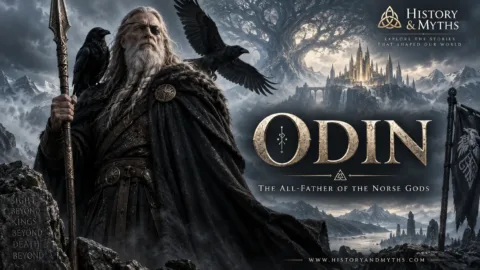
Modern images of Odin as a one-eyed, bearded wanderer with ravens and a spear therefore combine genuine features from the literary tradition with later artistic interpretation.
What We Can Say with Confidence About Odin
Strongly Attested
Odin is a major god of the wider Germanic and Norse tradition, associated in surviving texts with wisdom, war, death, poetry, magic, runes, Valhalla, and the pursuit of hidden knowledge. His name is also attested centuries before the medieval Icelandic Eddas.
Reasonable Interpretation
Odin appears to have held exceptional status in parts of the Norse world, especially among rulers and warrior elites, but his importance probably varied by region and period rather than forming one fixed hierarchy everywhere.
Uncertain or Later Claim
Claims that Odin was literally the father of every Norse god, universally worshipped as the supreme god, or securely identified in every one-eyed or raven-associated ancient image go beyond what the surviving evidence can prove.
Frequently Asked Questions About Odin
Is Odin the father of all Norse gods?
Not literally. The title All-Father reflects Odin’s authority and ancestry in the tradition, but several Norse gods belong to families that do not descend from him.
What is Odin actually the god of?
Odin is associated with wisdom, war, death, poetry, magic, prophecy, and the runes. These roles are linked by his constant pursuit of knowledge and influence over fate and conflict.
Why does Odin have only one eye?
According to the surviving tradition, Odin gave one eye as a pledge so he could drink from Mímir’s well and gain greater wisdom.
Did every warrior who died in battle go to Valhalla?
No. In Grímnismál, Freyja receives half of the slain in Fólkvangr, while Odin receives the other half.
Was Odin really worshipped before the Viking Age texts were written?
Yes. Archaeological and linguistic evidence shows that Odin belonged to a much older Germanic religious tradition, and the Vindelev inscription preserves his name centuries before the Icelandic Eddas.
Academic Sources
- Poetic Edda, especially Hávamál, Grímnismál, and Völuspá. These poems preserve key traditions about Odin’s sacrifice for the runes, Huginn and Muninn, Valhalla, Mímir’s well, and Ragnarök.
- Snorri Sturluson, Prose Edda, especially Gylfaginning and Skáldskaparmál. Used for Odin’s titles, family relationships, Mímir’s well, Sleipnir, Gungnir, Valhalla, and the Mead of Poetry.
- Snorri Sturluson, Ynglinga Saga. Important for Odin’s association with seiðr, magic, shape-changing, prophecy, and the wider traditions surrounding his cult.
- John Lindow, Norse Mythology: A Guide to the Gods, Heroes, Rituals, and Beliefs. Oxford University Press, 2001.
- Rudolf Simek, Dictionary of Northern Mythology. D. S. Brewer, 1993. A major scholarly reference for Odin’s names, roles, myths, and place within the wider Germanic tradition.
- H. R. Ellis Davidson, Gods and Myths of Northern Europe. Penguin Books, 1964. Used for the religious context of Odin, warfare, kingship, death, and cult practices.
- Neil Price, The Viking Way: Magic and Mind in Late Iron Age Scandinavia, 2nd ed. Oxbow Books, 2019. Particularly relevant to seiðr, ritual practice, gender, and the religious world in which Odin was understood.
- National Museum of Denmark. Research on the Vindelev Hoard and the early fifth-century bracteate containing the oldest currently known inscription naming Odin.
- Archaeological and place-name studies of pre-Christian Scandinavia. Used to distinguish Odin’s later literary portrayal from evidence for his historical worship, regional importance, and association with rulers and warrior elites.
The surviving evidence for Odin comes from sources written in different periods and contexts. This article distinguishes between early poetic material, Snorri’s later medieval synthesis, archaeological evidence, and modern scholarly interpretation rather than treating them as one perfectly unified tradition.
Copyright & Use
Written by H. Moses. This article is original content created for History & Myths.
Reproduction, republication, or full redistribution of this article is not permitted without prior permission.
Short quotations may be used for educational, academic, or commentary purposes when accompanied by clear attribution and a link to the original article.