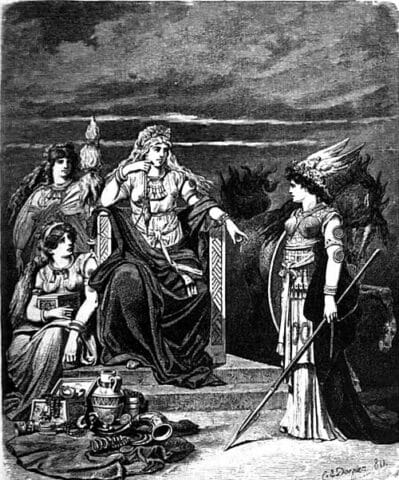
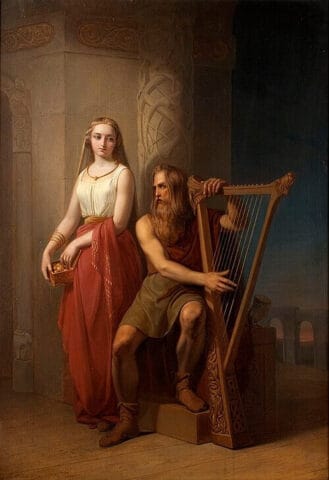
Eir: Norse Goddess of Healing or a Valkyrie?
Eir was a figure associated with healing in Norse mythology. In Gylfaginning, Snorri Sturluson lists her among the Ásynjur and calls her the best physician. The Eddic poem Fjölsvinnsmál also names Eir among nine women attending Menglöð at Lyfjaberg, a mountain associated with healing.
Her identity, however, is not entirely clear. Eir also appears in some versions of a list of Valkyries, raising the question of whether these references describe the same figure or different beings sharing a name. Although the medieval sources connect her with healing, they preserve no account of her personally treating the sick.
Who Was Eir in Norse Mythology?
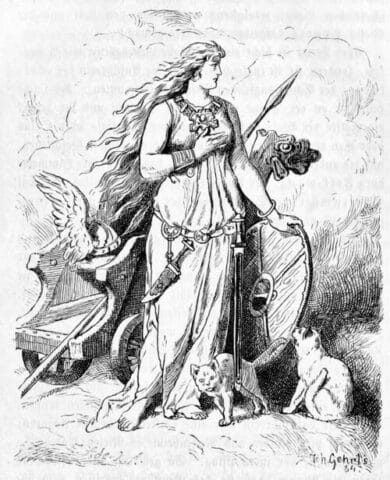
Eir belonged to the Ásynjur, the female deities associated with the Æsir in Norse mythology. In Gylfaginning, chapter 35, Snorri Sturluson places her third in his catalogue of goddesses, after Frigg and Sága. He describes her with the Old Norse words hon er læknir beztr, meaning “she is the best physician.” Her position in the list does not necessarily indicate her rank among the gods.
The name Eir also means “peace” or “clemency” in Old Norse, although its meaning alone does not establish her divine responsibilities.
Unlike Frigg and Sága, whose dwellings Snorri identifies, Eir is given no residence or family connections. Her parentage and relationships with other gods remain unknown.
Eir, Menglöð, and the Nine Maidens
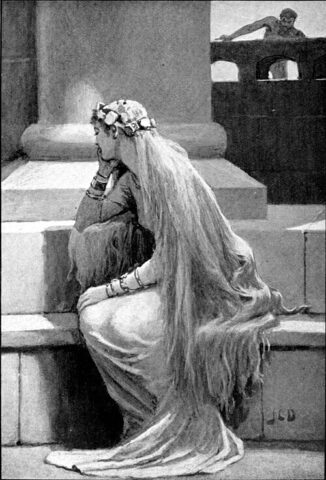
Eir appears in Fjölsvinnsmál, a poem traditionally grouped with Grógaldr under the title Svipdagsmál. The story follows Svipdagr, who arrives at the guarded dwelling of Menglöð, the woman he is destined to marry. Concealing his identity under the name Vindkaldr, he questions the gatekeeper Fjölsviðr about the inhabitants and the extraordinary features of the place.
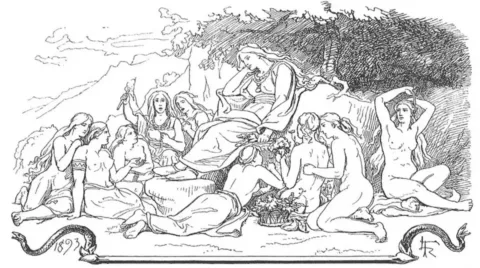
In stanzas 37–38, Fjölsviðr names nine maidens gathered around Menglöð: Hlíf, Hlífþursa, Þjóðvarta, Björt, Blíð, Blíðr, Fríð, Eir, and Aurboða. Several names suggest protection, brightness, or favorable qualities, although their precise meanings are not always certain.
When Svipdagr asks whether these women help those who make offerings to them, Fjölsviðr explains that they protect people from danger and distress when sacrifices are made at a sacred altar. Their protective role belongs to the group as a whole, with no separate duties assigned to individual maidens.
Eir is therefore presented as one of Menglöð’s companions rather than their leader. She receives no dialogue or independent action, but her inclusion among women associated with supernatural protection provides another context for understanding her place in Norse tradition.
Lyfjaberg: The Mountain of Healing
In Fjölsvinnsmál, stanzas 35 and 36, Svipdagr asks the gatekeeper Fjölsviðr about the mountain where he sees a woman sitting, apparently Menglöð. Fjölsviðr calls it Lyfjaberg, usually translated as “Healing Mountain,” and describes it as a place that has long brought relief to the sick and wounded. Any woman who climbs it is promised recovery, even after a prolonged illness.
The wording of this promise is open to interpretation. The Old Norse expression árs sótt can be understood as an illness lasting a year, but Peter M. W. Robinson has argued that it may refer to infertility. The mountain’s name also presents a textual difficulty. Lyfjaberg is an editorial reconstruction, since surviving manuscripts preserve forms such as Hyfja- and Hlyfja-.
The mountain appears again in stanza 49, when Menglöð tells Svipdagr that she has waited for him day after day. The manuscripts here read ljúfu bergi, meaning “on the beloved mountain,” which editors have emended to Lyfjabergi. Comparing the two passages has helped scholars reconstruct the mountain’s name, although neither manuscript reading is entirely straightforward.
Although Eir belongs to Menglöð’s nine companions, the promise of recovery concerns the mountain itself rather than any healing power attributed specifically to her. Her presence in this setting strengthens her literary association with healing, but the poem does not identify her as the source of the mountain’s restorative powers. Nor does it provide a geographical location for Lyfjaberg outside its supernatural setting.
Was Eir a Goddess or a Valkyrie?
Eir appears in different categories of supernatural beings in the surviving Norse sources. Snorri Sturluson identifies her as an ásynja in Gylfaginning, chapter 35, but her name also appears among Odin’s maidens in versions of the Nafnaþulur, a collection of poetic name-lists associated with Skáldskaparmál. There, Eir is listed alongside figures such as Hildr, Göndul, and Skuld, who are associated with the Valkyries, supernatural women known for choosing the slain in battle.
The evidence requires some caution. In the Nafnaþulur stanza, several published versions include Eir, while Anthony Faulkes’s 1998 edition prints Mist in the corresponding position, repeating a name already present in the list. Even where Eir appears, the text provides no account of her participating in battle or choosing warriors for death.
In his 2014 study Goddesses Unknown II, Joseph S. Hopkins examines the overlap between different categories of female supernatural beings. He notes that Þrúðr appears among both goddesses and Valkyries, while Skuld is identified as both a Norn and a Valkyrie. Hopkins suggests that these categories may have described different aspects of a figure’s identity rather than strictly separate classes of beings. Eir presents a particular difficulty because her name, associated with mercy and help, differs from the martial meanings typical of many Valkyrie names.
Eir could therefore have been understood as both a goddess and a Valkyrie, or the references may preserve different figures sharing the same name. The sources do not establish which explanation is correct.
How Old Are the Surviving Traditions About Eir?
The surviving written accounts of Eir date from medieval Iceland, centuries after the beginning of the Viking Age. Snorri Sturluson composed his Edda in the thirteenth century, following Iceland’s conversion to Christianity around 1000. One of its earliest surviving manuscripts, Codex Upsaliensis (DG 11 4to), dates to approximately 1300–1325. Snorri’s identification of Eir as a physician may reflect an older belief, but the text provides no way to determine when that association first developed.
Fjölsvinnsmál has a more complicated history. Its oldest surviving manuscripts date from the second half of the seventeenth century, and no medieval copy is known. However, Peter M. W. Robinson’s examination of the manuscript tradition led him to propose that the poem was composed in the early thirteenth century. Its late manuscript preservation therefore does not mean the story originated at that time. The surviving copies also contain textual variations, making some details of the original poem difficult to reconstruct.
The Nafnaþulur, which includes Eir in some versions of a list of Valkyries, presents a separate dating problem. These poetic catalogues appear in certain manuscripts of Snorri’s Edda, but scholars generally regard them as material compiled independently rather than part of his original composition. Their precise dates and the origins of individual names remain uncertain.
These sources preserve different aspects of Eir’s identity, but none can securely establish how far those traditions extend into the pre-Christian period. Her appearance in thirteenth-century literary material does not, by itself, demonstrate how widely she was known or worshipped during the Viking Age.
Eir in Skaldic Poetry and Runic Inscriptions
Eir’s name also appears in Old Norse skaldic poetry, where poets frequently used the names of goddesses in kennings, figurative expressions for women. In the dream verses preserved in Gísla saga Súrssonar, the phrase Eir aura, meaning “Eir of riches” or “Eir of gold,” occurs twice. These expressions address a woman rather than describe the healing goddess performing any divine action. Similar kennings throughout the saga combine divine names with references to wealth, jewelry, or clothing.
An earlier poetic tradition may be reflected in verses attributed to Kormákr Ögmundarson, a tenth-century Icelandic skald. Eir appears among the divine names used in his kennings for women, particularly in poems concerning his beloved Steingerðr. However, these verses survive in manuscripts produced centuries after Kormákr’s lifetime, and scholars have debated how many can reliably be attributed to him. They offer evidence for the possible antiquity of Eir’s use in skaldic language, rather than a securely dated record of religious devotion.
A physical example survives on a wooden runic stick discovered at Bryggen in Bergen, Norway, catalogued as N B255 and dated to around 1300. The inscription begins with a record of quantities associated with an ordinary commercial transaction, followed by a short skaldic poem. In the verse, the writer complains that a woman has deprived him of sleep, referring to her as the “Eir of the mackerel’s ground.”
Read Also
The expression is deliberately elaborate. In Runic Amulets and Magic Objects, Mindy MacLeod and Bernard Mees interpret the reference to the mackerel’s ground as part of a metaphor for gold, making the phrase another poetic description of a woman associated with jewelry. They interpret the verse as a complaint about women or romantic difficulties rather than a magical formula.
The Bergen inscription is particularly valuable because it preserves this poetic usage on an actual medieval object, independently of the Icelandic saga manuscripts. Alongside the verses attributed to earlier skalds, it demonstrates the continued use of Eir’s name in Scandinavian poetic vocabulary. Such references cannot establish whether the poets or people who used her name worshipped her as a healing deity.
Healing, Medicine, and Magic in Norse Tradition
Snorri’s description of Eir as the best physician offers no indication of how she practiced healing. Other medieval Norse sources, however, describe treatments ranging from medicinal preparations to runic inscriptions and spoken charms. These accounts provide context for the healing traditions in which Eir’s reputation can be understood, without establishing any practices specific to her.
In Sigrdrífumál, stanza 11, the Valkyrie Sigrdrífa instructs Sigurðr to learn limrúnar, or limb-runes, to become a healer and treat wounds. She tells him to carve them on bark and on trees whose branches bend eastward. The poem associates runic knowledge with healing but does not connect these instructions to Eir.
A more detailed episode appears in Egils saga Skalla-Grímssonar. A young woman named Helga is suffering from a prolonged illness, which becomes worse after a local farmer’s son attempts to treat her with runes. Egill discovers the inscription carved on a piece of whalebone beneath her bed, destroys it, and carves new runes. Helga subsequently recovers. The episode emphasizes the dangers of using runic knowledge without understanding it.
Medical manuscripts offer a different kind of evidence. The thirteenth-century Icelandic fragment AM 655 XXX 4to preserves 52 entries covering illnesses, remedies, and the medicinal properties of plants and other substances. Brynja Þorgeirsdóttir’s research traces elements of this material to medical knowledge transmitted through medieval Europe. Luthien Cangemi has also examined how Icelandic healers and scribes adapted foreign remedies alongside charms, prayers, and locally developed practices.
These literary and medical sources reveal different approaches to healing in medieval Scandinavia. None identifies a particular herb, rune, or treatment as belonging to Eir, and their medieval dates prevent us from treating every practice they describe as evidence of Viking Age medicine.
Was Eir Worshipped in the Viking Age?
The clearest literary reference to worship involving Eir comes from Fjölsvinnsmál, stanzas 39–40. The poem describes Menglöð’s nine attendants as receiving sacrifices at a sacred altar and protecting those who seek their help. Since Eir is named among these women, the passage places her within a supernatural group associated with offerings and divine protection. It does not, however, identify a ritual dedicated to Eir individually.
This distinction is important when considering her historical worship. Fjölsvinnsmál describes religious activity within a mythological setting, but cannot independently establish that such practices existed in Viking Age Scandinavia. No known temple, dedicatory inscription, or securely identified place-name provides independent evidence of a cult devoted specifically to Eir.
Her association with healing makes it plausible that people might have sought her help during illness, but no surviving source records such an invocation or specifies offerings made in her name. Whether Eir received private or local worship remains an open question.
Academic Sources & Primary Texts
Primary Texts
- The Poetic Edda: A Dual-Language Edition. Edited and translated by Edward Pettit. Cambridge: Open Book Publishers, 2023. Relevant poems: Fjölsvinnsmál, stanzas 35–40 and 49, and Sigrdrífumál, stanza 11.
Open-access scholarly edition. - Snorri Sturluson. Edda: Prologue and Gylfaginning. Edited by Anthony Faulkes. 2nd ed. London: Viking Society for Northern Research, 2005. Chapter 35, Eir among the Ásynjur.
Scholarly edition. - Snorri Sturluson. Edda: Skáldskaparmál. Edited by Anthony Faulkes. London: Viking Society for Northern Research, 1998. Relevant material: Nafnaþulur and the lists of female supernatural beings.
Scholarly edition. - Gísla saga Súrssonar. English translation by G. W. Dasent, 1866. Relevant passages: Gísli’s dream verses containing the expression Eir aura.
Icelandic Saga Database. - Kormáks saga. English translation by W. G. Collingwood and Jón Stefánsson, 1901. Relevant material: verses attributed to Kormákr Ögmundarson.
Icelandic Saga Database. - Egils saga Skalla-Grímssonar. English translation by W. C. Green, 1893. Relevant episode: Egill’s treatment of Helga and the incorrectly carved runes.
Icelandic Saga Database. - RuneS Database. Bergen runic inscription N B255, Gullsko-passasjen, Bryggen, Norway. Medieval wooden inscription containing a skaldic verse using Eir’s name.
Runic inscription record.
Modern Academic Scholarship
- Robinson, Peter M. W. An Edition of Svipdagsmál. PhD diss., University of Oxford, 1991. Critical examination of the manuscripts, textual variants, dating, and interpretation of Fjölsvinnsmál.
Oxford Research Archive. - Hopkins, Joseph S. “Goddesses Unknown II: On the Apparent Old Norse Goddess Ilmr.” RMN Newsletter 8 (2014): 32–37. Discusses the overlap between goddesses and Valkyries, including Eir, and the use of divine names in skaldic poetry.
University of Helsinki (PDF). - MacLeod, Mindy, and Bernard Mees. Runic Amulets and Magic Objects. Woodbridge: Boydell Press, 2006. Relevant discussion of the Bergen inscription N B255 and its poetic interpretation.
Publisher’s record. - Þorgeirsdóttir, Brynja. “‘Eyrsilfr drukkit, þat gerir bana’: The Earliest Old Norse Medical Book, AM 655 XXX 4to, and Its Context.” Gripla 34 (2023): 207–240. Examines the earliest surviving Icelandic vernacular medical manuscript.
Peer-reviewed article. - Cangemi, Luthien. The Art of Healing in Medieval Iceland: Old Norse Cultural Perspectives on Illness and Health and Its Debt to the English Medical Tradition. PhD diss., University College London, 2024.
UCL Research Repository.
Research Note: Eir’s identification as a healer is preserved in medieval literary sources. The available evidence does not securely establish her individual cult, healing rituals, or the extent of her worship during the Viking Age. References to Eir in skaldic kennings are evidence of poetic usage, not necessarily religious devotion.
Copyright & Usage
© 2026 History & Myths. Written by H. Moses. All rights reserved for the original article text.
Ancient texts, scholarly publications, and historical sources remain subject to their respective rights and licenses. Images are credited separately according to their applicable licensing terms. Unauthorized reproduction of the original article is not permitted.