Hodr: The Blind Norse God Who Killed Baldr
Höðr was a Norse god best known for killing his brother Baldr, an act that led to his own death. In Snorri Sturluson’s Prose Edda, Höðr is blind and unaware that Loki has given him the one weapon capable of harming Baldr. Guided by Loki, he throws the mistletoe that kills his brother. The older poem Völuspá, however, names Höðr as the killer without describing the same deception.
His story changes considerably across the surviving sources. Saxo Grammaticus portrays Hotherus as a warrior who fights Balderus over Nanna, rather than a blind god manipulated by Loki. Although Höðr is killed in revenge, Norse poetry places him alongside Baldr in the renewed world after Ragnarök.
Who Was Hodr in Norse Mythology?
Höðr, also written Hǫðr or Hodr, belonged to the Æsir and was a son of Odin. In Gylfaginning, chapter 28, Snorri Sturluson describes him as physically strong but warns that the gods would rather his deeds were forgotten. Although Höðr was Baldr’s brother, the surviving Eddic sources do not identify his mother. His common identification as Frigg’s son is therefore uncertain.
In Skáldskaparmál, chapter 13, Snorri lists several poetic titles for Höðr, including the thrower of the mistletoe, Baldr’s killer, Váli’s enemy, and companion of Hel.
Höðr’s name is traditionally associated with battle or fighting. Linguist Riccardo Ginevra has proposed an alternative interpretation meaning “darkness,” but this remains a scholarly hypothesis rather than an established etymology. Neither interpretation establishes that Höðr was worshipped as a god of darkness or winter.
Was Hodr Really Blind?
Snorri Sturluson explicitly describes Höðr as blind in Gylfaginning, chapter 28, using the Old Norse word blindr. His blindness also shapes the account of Baldr’s death in chapter 49, where he relies on Loki to direct his aim. Snorri further identifies him as “the Blind God” in Skáldskaparmál, chapter 13.
Neither Völuspá nor Baldrs draumar mentions Höðr’s blindness. Both identify him as Baldr’s killer without describing his eyesight.
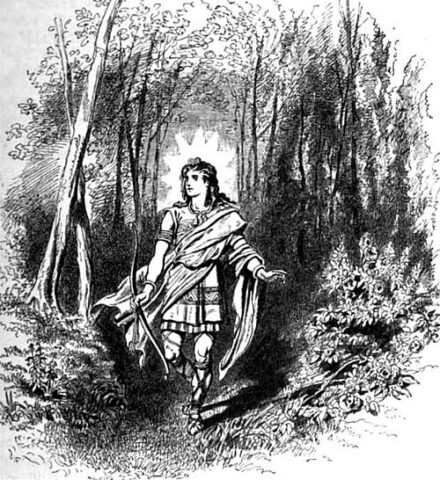
Saxo Grammaticus presents a different picture in Gesta Danorum. His Hotherus is a skilled archer and warrior, with no indication of blindness. Scholar Sharon Choe argues that Snorri’s portrayal places Höðr on the margins of the Æsir while making his blindness central to Loki’s manipulation. She also examines these differences in the context of changing religious and social attitudes in thirteenth-century Iceland. Whether blindness belonged to the earliest form of the myth remains unknown.
How Did Hodr Kill Baldr?
In Gylfaginning, chapter 49, Snorri Sturluson describes the gods testing Baldr’s invulnerability by throwing weapons and stones at him. Frigg had secured promises from nearly everything not to harm her son, but had overlooked mistletoe because she considered it too young to require an oath.
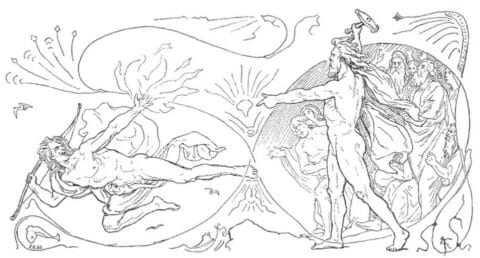
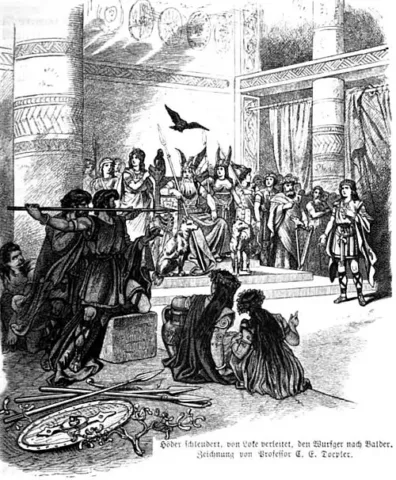
Disguised as a woman, Loki learns this secret from Frigg and collects the mistletoe. He approaches Höðr, who stands apart from the gathering. When Höðr explains that he cannot see Baldr and has no weapon, Loki gives him the mistletoe and directs him toward his brother. Höðr shoots it at Baldr, and the projectile passes through him, killing him.
In Völuspá, stanzas 31–32, mistletoe likewise becomes the deadly projectile, with Höðr identified as the one who shoots it. Unlike Snorri’s account, the poem does not describe Loki’s deception or guidance. Neither source specifies that Höðr used a bow.
Was Hodr Responsible for Baldr’s Death?
Höðr delivered the fatal blow, but whether he intended to kill Baldr depends on how the surviving accounts are read. Völuspá identifies him as the killer without revealing his intentions.
In Gylfaginning, chapter 49, Höðr acts under Loki’s direction, with no indication that he knows the mistletoe can harm Baldr. After the killing, the gods want revenge but cannot act immediately because the assembly is a protected place where violence is forbidden.
Lokasenna, stanza 28, offers further evidence of Loki’s involvement. Speaking to Frigg, Loki claims responsibility for Baldr’s absence from the halls of the gods, although the poem does not describe how he brought it about.
Snorri’s account therefore portrays Höðr as an unwitting participant in Loki’s scheme. Yet the surviving texts offer no explicit judgment of his personal guilt, even though he ultimately suffers the consequences of the killing.
Why Was Hodr Killed by Vali?
Höðr was killed by his half-brother Váli in revenge for Baldr’s death. In Baldrs draumar, a seeress tells Odin that Rindr will bear him a son destined to avenge Baldr. Völuspá describes the avenger fighting when only one night old, while Hyndluljóð, stanza 29, names Váli as the god who killed his brother’s handbani, the person who dealt the fatal blow.
The poems do not describe the confrontation or identify Váli’s weapon. The vengeance takes place within Odin’s own family, with one son killing another to avenge a third.
Hotherus in Saxo Grammaticus: A Different Story
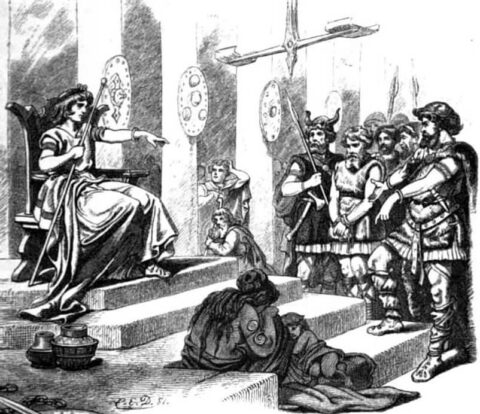
In Book III of Gesta Danorum, Saxo Grammaticus portrays Hotherus as a human prince raised at the court of King Gevar. Skilled in archery, swimming, and music, he wins the affection of Gevar’s daughter Nanna. Balderus also desires her and plans to kill Hotherus to remove his rival.
Gevar warns Hotherus that ordinary weapons cannot harm Balderus, but reveals that a supernatural being named Miming possesses a sword capable of wounding him. Hotherus travels to Miming’s dwelling, captures him, and forces him to surrender the weapon.
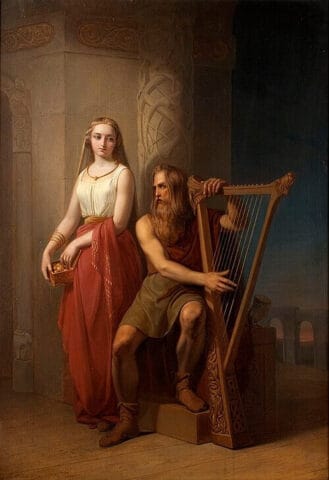
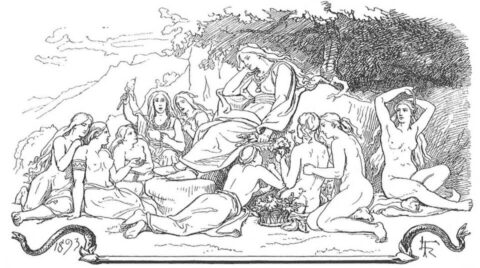
Their rivalry leads to several battles involving human armies and gods. During one campaign, Hotherus secretly approaches the enemy camp at night and follows three maidens who prepare food that strengthens Balderus. Claiming to be a musician, he gains their confidence by playing the lyre. They refuse him the food but give him a belt said to ensure victory. Returning from their dwelling, Hotherus encounters Balderus and stabs him in the side. Balderus dies three days later.
Hotherus’s victory does not secure his survival. He later learns through prophecy that he will die fighting Boe, a son of Odin and Rinda. After arranging for his son Rorik to succeed him, Hotherus meets Boe in battle and is killed. Boe also suffers mortal wounds and dies the following day.
Unlike Snorri’s blind Höðr, Saxo’s Hotherus knowingly fights a rival who threatens his relationship with Nanna. Neither Loki nor mistletoe plays a role in this version.
Read Also
Did Hodr Return After Ragnarök?
Höðr returns to the world after Ragnarök rather than surviving its destruction. In Völuspá, stanza 62, the seeress foretells that Baldr will return and dwell alongside Höðr in Hroptr’s dwellings, named for Odin.
In Gylfaginning, chapter 53, Snorri Sturluson states that both brothers emerge from Hel and join the surviving gods at Iðavöllr, where Asgard once stood. There, the gods gather and recall the events of the old world.
Baldr and the brother who killed him thus share a place in the renewed world. Their reunion may suggest reconciliation, but neither source describes such an event or explains how they were released from Hel.
Was Hodr Worshipped in the Viking Age?
There is no securely established evidence that Höðr received independent worship in Viking Age Scandinavia. Although medieval Norse texts identify him among the Æsir, they record no offerings, festivals, or rituals dedicated to him. No archaeological site, inscription, or place-name has been securely linked to his cult.
Historian Stefan Brink’s study of Scandinavian religious place-names found evidence for the worship of several Norse deities, but none specifically associated with Höðr. This does not rule out local worship that left no surviving traces. His historical veneration remains unconfirmed.
Academic Sources & Primary Texts
Primary Texts
- The Poetic Edda. Edited and translated by Edward Pettit. Cambridge: Open Book Publishers, 2023. Relevant poems: Völuspá, Baldrs draumar, Hyndluljóð, and Lokasenna.
Open-access scholarly edition. - Snorri Sturluson. Edda: Prologue and Gylfaginning. Edited by Anthony Faulkes. 2nd ed. London: Viking Society for Northern Research, 2005. Chapters 28, 49, and 53.
Scholarly edition. - Snorri Sturluson. Edda: Skáldskaparmál. Edited by Anthony Faulkes. London: Viking Society for Northern Research, 1998. Chapter 13.
Scholarly edition. - Saxo Grammaticus. Gesta Danorum: The History of the Danes. Edited by Karsten Friis-Jensen and translated by Peter Fisher. Oxford: Oxford University Press, 2015. Book III.
Oxford Medieval Texts.
Academic Studies
- Choe, Sharon. “Hann var blindr: The Function of Disability in the Aftermath of Ragnarök.” Mirator 20, no. 2 (2021): 5–20.
Academic journal. - Lindow, John. Murder and Vengeance among the Gods: Baldr in Scandinavian Mythology. Folklore Fellows Communications 262. Helsinki: Academia Scientiarum Fennica, 1997.
Publisher’s record. - Ginevra, Riccardo. “The Myth of Baldr’s Death and the Vedic Wounded Sun: The Old Norse Theonyms Nanna Neps-dóttir (‘Maiden Sky’s-Daughter’) and Hǫðr (‘Darkness’) in Germanic and Indo-European Perspective.” 2023.
Brill academic publication. - Brink, Stefan. “How Uniform Was the Old Norse Religion?” In Learning and Understanding in the Old Norse World, edited by Judy Quinn, Kate Heslop, and Tarrin Wills, 105–136. Turnhout: Brepols, 2007.
Academic study (PDF).
Copyright & Usage
© 2026 History & Myths. Written by H. Moses. All rights reserved. Unauthorized republication of this article is prohibited. Brief quotations may be used with proper attribution and a link to the original article, subject to applicable copyright law. Historical sources and third-party materials retain their respective rights.