The Aesir-Vanir War: Why the Norse Gods Fought and Who Won
The Aesir-Vanir War is one of the earliest major conflicts in Norse mythology, fought between the two groups of gods known as the Aesir and the Vanir. Unlike Ragnarök or many of Thor’s adventures, however, the war does not survive as a single complete story. Its events are scattered across several Old Norse sources, and those sources do not always agree.
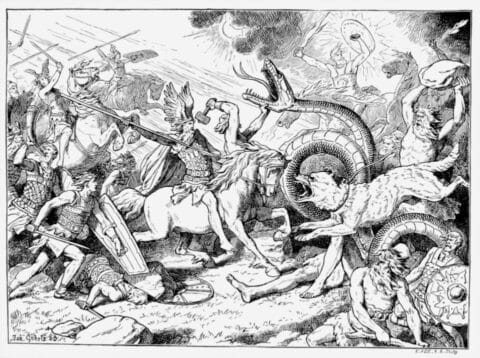
In Völuspá, the conflict is linked to Gullveig, a mysterious figure whom the gods pierce with spears and burn three times, only for her to survive. Odin then casts his spear into battle, and the defenses of the gods are breached. Later accounts describe a longer struggle that ends in peace and an exchange of hostages, bringing gods such as Njörðr and Freyr into the Aesir’s world.
There is no clear final victor, and the sources never give a simple reason for why the war began. Gullveig stands near the start of the conflict, but the texts do not explain exactly how her treatment led to war, nor do they confirm the popular claim that she was Freyja. Understanding the conflict therefore means separating what the surviving sources actually preserve from the later attempts to turn those fragments into one continuous story.
Who Were the Aesir and Vanir?
The Norse gods are often divided into two groups, the Aesir and the Vanir. The Aesir include gods such as Odin, Thor, and Tyr, while the Vanir are most clearly represented by Njörðr, Freyr, and Freyja.
Modern retellings often describe the Aesir as gods of war, power, and rulership, and the Vanir as gods of fertility, wealth, and prosperity. That division is useful as a rough guide, but the surviving sources are less clear-cut. Odin is associated with magic as well as war, while Freyr is connected with prosperity, kingship, and peace.
The distinction becomes even less rigid after the war, when members of the Vanir become part of the Aesir’s world. Some modern scholars have also questioned how clearly the surviving evidence supports the idea of the Vanir as a completely separate and unified family of gods.
What the sources do show is that the two groups were distinct enough to fight, negotiate peace, and exchange members between their communities. That relationship forms the background to the event that stands near the beginning of the conflict: the arrival and repeated burning of Gullveig.
Why Did the Aesir and Vanir Go to War?
The surviving sources never give a single clear reason for the Aesir-Vanir War. The earliest account, preserved in Völuspá, places a mysterious figure named Gullveig immediately before the outbreak of fighting, but it never explains exactly what she had done or why the gods turned against her.
Gullveig and the First War in Völuspá
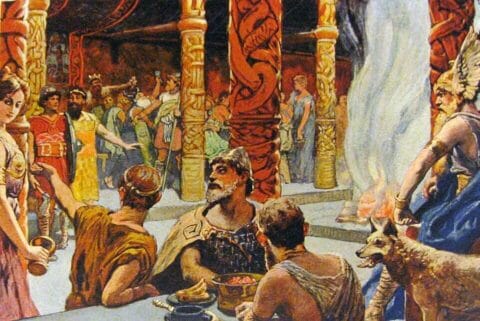
Gullveig appears in one of the most difficult passages in the Poetic Edda. She is pierced with spears and burned in the hall of Hárr, a name associated with Odin. The gods burn her three times, yet she survives each attempt.
The poem then introduces Heiðr, a seeress who practices seiðr. She is often interpreted as another name or form of Gullveig, although the text never states this directly.
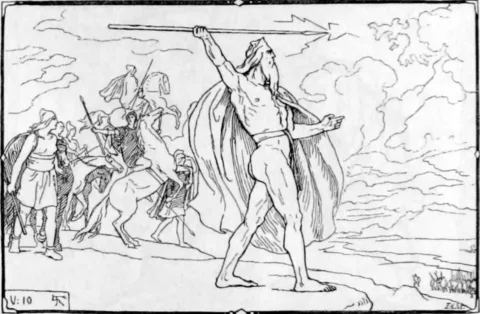
Soon afterward, the gods gather in council. The verses raise questions involving payment, rights, or obligations among the gods, but their exact meaning remains disputed. Odin then throws his spear into the opposing force, and open battle begins.
Gullveig clearly stands near the start of the conflict, but the poem never tells us why her treatment led to war. Her magic, her connection with gold, and disputes over status or rights have all been proposed as explanations, but none is confirmed by the text.
The same problem applies to broader theories about the war. It has been interpreted as a struggle over magic, wealth, religious authority, or even as a memory of two religious traditions coming together. These interpretations may help explain the myth, but they go beyond what Völuspá actually says.
Was Gullveig Really Freyja?
Gullveig is often identified with Freyja, but no surviving Norse source explicitly says that they are the same goddess.
There are reasons for the comparison. Gullveig’s name has long been associated with gold, while Freyja is strongly linked with wealth and is said to weep tears of gold. Heiðr also practices seiðr, a form of magic closely associated with Freyja in later Old Norse tradition.
These parallels have led some scholars to connect Gullveig, Heiðr, and Freyja closely, sometimes treating them as different names or forms of the same figure. Other interpretations disagree, identifying Gullveig instead with a broader supernatural figure or even a giantess.
The evidence is therefore suggestive rather than decisive. Gullveig may have been connected with Freyja, but the sources do not allow us to identify them with certainty.
There is a wider uncertainty as well. Scholars have even debated how the opposing sides in these verses should be understood, which makes attempts to reconstruct a precise cause for the war even more difficult.
What survives is a fragmentary account: Gullveig is attacked, the gods deliberate, Odin throws his spear, and war follows. The sources preserve the sequence, but not a complete explanation of why it happened.
What Happened During the Aesir-Vanir War?
The surviving account of the war itself is brief. Völuspá gives us no long campaign, named battles, or detailed list of combatants. Instead, it preserves a few scenes showing that the conflict reached the very defenses of the Aesir.
Odin Throws the First Spear
At the outbreak of open fighting, Odin casts his spear into the opposing force. Völuspá describes this as the first war in the world.
Throwing a spear over an enemy force was later associated with dedicating battle to Odin, fitting his close connection with warfare. In this context, the act marks the beginning of battle rather than the original cause of the conflict, since the events surrounding Gullveig have already taken place.
The Aesir’s Defenses Are Broken
The poem then describes the defenses of the Aesir being breached as the Vanir advance onto the battlefield.
This is the clearest military success preserved from the war. It shows that the Vanir could challenge the Aesir directly, but the poem does not describe the conquest of Asgard, the destruction of the Aesir, or any final surrender.
Nor does it tell us what happened in the fighting immediately afterward. For a fuller picture of the war’s outcome, we have to turn to a later source.
Who Won the Aesir-Vanir War?
Ynglinga saga describes a prolonged struggle in which both sides win victories and raid each other’s lands. Odin leads an army against the Vanir, but they defend themselves successfully, and neither side is able to secure a lasting advantage.
Eventually, the fighting exhausts both groups and they agree to negotiate.
The surviving tradition therefore gives the Aesir-Vanir War no decisive winner. The Vanir achieve an important battlefield success in Völuspá, but the wider conflict ends through negotiation rather than the defeat of either side.
That settlement would reshape the relationship between the two groups through one of the most important features of the peace agreement: the exchange of hostages.
How Did the Aesir-Vanir War End?
Ynglinga saga gives the clearest account of what happened next. The Aesir and Vanir made peace and exchanged hostages, bringing prominent members of each group into the community of their former enemies.
The Hostage Exchange
The Vanir sent Njörðr and his son Freyr to the Aesir. In return, the Aesir sent Hœnir, whom the Vanir expected to become a capable leader, together with the wise Mímir.
The account also names Kvasir, described here as the wisest among the Vanir, as part of the exchange.
One familiar name is missing: Freyja. Although she is a Vanir goddess and later appears among the Aesir, Ynglinga saga does not list her among the hostages. Her inclusion in the exchange is common in modern retellings, but it is not stated in this account.
The settlement ended the war, but it did not remove all suspicion between the two sides. That became clear soon after Hœnir and Mímir arrived among the Vanir.
Why Was Mímir Beheaded?
According to Ynglinga saga, the Vanir accepted Hœnir because he appeared capable of leadership. In difficult situations, however, he relied heavily on Mímir for advice.
When Mímir was absent, Hœnir reportedly refused to make firm decisions. The Vanir came to believe that the Aesir had deceived them by sending a leader who depended on another man for guidance.
They killed Mímir, cut off his head, and sent it back to the Aesir.
Odin preserved the head with herbs and magic, then spoke spells over it so that Mímir could continue giving him knowledge. This later tradition helps explain why Mímir remains associated with wisdom even after his death.
The episode shows that formal peace did not immediately remove suspicion between the two groups.
Read More
Kvasir and the Two Different Traditions
Kvasir is one of the clearest signs that the surviving accounts of the Aesir-Vanir peace preserve different traditions.
Kvasir as a Vanir Hostage
In Ynglinga saga, Kvasir already exists when the two sides exchange hostages. After the Aesir send Hœnir and Mímir, the Vanir send Kvasir, described as the wisest among them.
In this version, Kvasir belongs to the Vanir tradition before the peace settlement is complete.
Kvasir Created from the Gods’ Spittle
Skáldskaparmál, part of Snorri Sturluson’s Prose Edda, gives a different account.
Here, the Aesir and Vanir seal their peace by spitting into a vessel. From this shared pledge they create Kvasir, a man of extraordinary wisdom who can answer any question put to him.
His story later continues with his murder by the dwarves Fjalar and Galar. His blood, mixed with honey, becomes the Mead of Poetry.
These two versions cannot be fitted neatly into a single timeline. In Ynglinga saga, Kvasir already exists and is exchanged by the Vanir. In Skáldskaparmál, he is created because the two groups have made peace.
Both traditions connect Kvasir with the reconciliation between the Aesir and Vanir, but they preserve very different explanations of who he was and where he came from.
What Changed After the Aesir-Vanir War?
The peace did more than end the fighting. It permanently changed the relationship between the Aesir and Vanir.
Njörðr and Freyr Among the Aesir
After the hostage exchange, Njörðr and Freyr remained among the Aesir and became major figures in the wider Norse pantheon. In Ynglinga saga, both receive important roles in Odin’s community, while Freyr later becomes strongly associated with prosperity, good seasons, and rulership.
Their presence shows how thoroughly the old division changed after the war. The two groups were no longer simply opposing camps, because members of the Vanir had become part of the Aesir’s world.
Freyja and the Arrival of Seiðr
Freyja also appears in Ynglinga saga as Njörðr’s daughter and as a practitioner of seiðr, a form of magic said to have been customary among the Vanir. The text credits her with introducing this practice among the Aesir.
This is important because Freyja is not named among the hostages in the same account. Her role belongs to the wider aftermath of the conflict, when traditions associated with the Vanir became part of the religious world of the Aesir.
The war therefore ends not only with an exchange of individuals, but with a deeper blending of the two divine traditions.
Did the Aesir-Vanir War Reflect a Real Historical Conflict?
Scholars have long debated whether the Aesir-Vanir War preserves a distant memory of real religious or cultural change in prehistoric Scandinavia.
One influential theory saw the myth as the result of two religious traditions coming together: one represented by the Aesir and associated with warfare and political power, the other represented by the Vanir and associated with fertility and prosperity. Some earlier interpretations went further and linked the story to conflict between prehistoric populations.
There is no direct evidence, however, for a historical war that matches the myth. No archaeological evidence has securely identified a specific prehistoric conflict as the historical source of the story, and the surviving written accounts were recorded centuries after the periods these theories usually refer to.
Georges Dumézil proposed a different explanation. Rather than treating the story as disguised history, he compared it with other Indo-European myths in which different divine or social functions begin in conflict and are later brought together. In this reading, the focus is reconciliation, not the memory of a forgotten invasion.
More recent scholarship has complicated the picture further. Some researchers have questioned whether the Vanir were ever understood as a fully separate and unified family of gods, while others argue that the distinction remains meaningful in the Old Norse sources.
The safest conclusion is therefore limited: the myth may reflect ideas about religious change, social order, or the integration of different traditions, but there is no firm evidence that it preserves the memory of a specific historical war.
What the Aesir-Vanir War Actually Tells Us
The Aesir-Vanir War is not remembered as a story of total victory. The surviving traditions end instead with negotiation, exchange, and a new relationship between gods who had previously stood on opposing sides.
The sources disagree on important details, from Gullveig’s identity to Kvasir’s origin. Yet they share a broader pattern: the conflict does not destroy either group. It ends by bringing them into a closer divine order.
That is what gives the war its lasting importance in Norse mythology. It explains not who conquered whom, but how two once-opposed groups came to inhabit the same mythological world.
Academic Sources
- Hollander, Lee M., trans.
The Poetic Edda. University of Texas Press.
Used for Völuspá and the surviving account of Gullveig and the first war. - Snorri Sturluson.
Ynglinga saga, in Heimskringla.
Bibliotheca Polyglotta, University of Oslo.
Used for the war with the Vanir, the peace agreement, hostage exchange, Mímir, Kvasir, and Freyja’s association with seiðr. - Olsson, Stefan.
“The Æsir–Vanir War (or Peace).”
In The Hostages of the Northmen: From the Viking Age to the Middle Ages.
Stockholm University Press, 2019.
Peer-reviewed study of the different medieval versions of the conflict, peace process, and hostage exchange. - Kuusela, Tommy.
“Halls, Gods, and Giants: The Enigma of Gullveig in Óðinn’s Hall.”
In Myth, Materiality, and Lived Religion.
Stockholm University Press, 2019.
Academic analysis of Gullveig, Völuspá, and competing interpretations of the first war. - Frog and Jonathan Roper.
“Verses versus the Vanir: Response to Simek’s ‘Vanir Obituary’.”
RMN Newsletter, no. 2, 2011, pp. 29–36.
University of Helsinki.
Used for the modern scholarly debate over whether the Vanir should be understood as a distinct group in Old Norse tradition.