The Mead of Poetry: How Odin Stole the Gift of Inspiration
The Mead of Poetry was a magical drink in Norse mythology that granted poetic skill and learning to anyone who tasted it. According to Skáldskaparmál, the dwarfs Fjalar and Galar created it by mixing honey with the blood of Kvasir, a being renowned for his wisdom. The mead eventually passed into the possession of the giant Suttungr, who concealed it inside a mountain under the protection of his daughter Gunnlöð.
Odin obtained the drink through deception rather than battle. Disguised as Bölverkr, he gained access to Suttungr’s stronghold, emptied the vessels containing the mead, and escaped in the form of an eagle. He brought it back to the gods, making its gift available to poets. Yet his success came at a cost to those he deceived. While Snorri Sturluson’s Prose Edda recounts the full adventure, Hávamál preserves a shorter account that draws attention to Odin’s broken oath and his treatment of Gunnlöð.
What Was the Mead of Poetry?
In Skáldskaparmál, Snorri describes the mead’s power in precise terms: anyone who drank it became a skáld (poet) or a fræðamaðr (learned person). Its gift therefore included learning as well as poetic ability, reflecting the extraordinary wisdom associated with Kvasir.
The myth also explains several expressions used in Old Norse poetry. Snorri records names such as “Kvasir’s blood” and “Suttungr’s mead,” while other expressions associate poetry with Odin’s acquisition of the drink. These are kennings, indirect poetic descriptions whose meaning depends on knowledge of the underlying story. Bragi recounts the myth in response to Ægir’s question about the origin of poetry, connecting the story of the mead with the language used by skaldic poets.
Kvasir’s Death and the Creation of the Mead
According to Skáldskaparmál, Kvasir’s existence began with a peace agreement between the Æsir and Vanir. To seal their reconciliation, the two groups of gods spat into a common vessel. Rather than discard this symbol of their agreement, the gods fashioned Kvasir from its contents. He possessed such extraordinary wisdom that no one could ask him a question he could not answer.
Kvasir travelled widely, sharing his knowledge with others. During a visit to the dwarfs Fjalar and Galar, his hosts invited him into a private conversation and murdered him. They collected his blood in three containers: two vats called Són and Boðn, and a kettle named Óðrerir. By mixing the blood with honey, they produced the Mead of Poetry.
The dwarfs told the Æsir that Kvasir had suffocated on his own wisdom because nobody was knowledgeable enough to question him.
Read Also
How Suttungr Acquired the Mead
After killing Kvasir, Fjalar and Galar invited the giant Gillingr and his wife to visit them. The dwarfs took Gillingr out to sea in a boat, deliberately ran it onto a shoal, and capsized it. Gillingr could not swim and drowned, while the dwarfs righted the boat and returned safely to shore.
When they told Gillingr’s wife what had happened, she broke down in grief. Fjalar offered to show her the place where her husband had drowned, claiming that the sight might comfort her. As she stepped outside, Galar dropped a millstone onto her head from above the doorway, killing her. Fjalar had ordered the murder because he was tired of hearing her cries.
Gillingr’s son Suttungr learned of the killings and seized both dwarfs. He carried them out to sea and abandoned them on a rocky islet that would disappear beneath the rising tide. Facing death, Fjalar and Galar offered him the Mead of Poetry as compensation for his father’s murder. Suttungr accepted the bargain and took possession of the drink.
He brought the mead to Hnitbjörg, a mountain stronghold, and entrusted its protection to his daughter Gunnlöð.
How Odin Planned to Steal the Mead
Odin began his plan to steal the mead by approaching nine workers cutting hay for Baugi, Suttungr’s brother. He offered to sharpen their scythes with a whetstone, and the blades cut so much better that every worker wanted to buy it. Odin threw the stone into the air, and the men struggled to catch it, killing one another with their scythes.
That evening, Odin sought lodging with Baugi, who complained that his nine workers had died and he had no one to replace them. Introducing himself as Bölverkr, Odin offered to do the work of all nine men in exchange for a single drink of Suttungr’s mead. Baugi explained that he had no control over the drink, which his brother intended to keep for himself, but agreed to accompany Odin and ask for his payment.
Odin worked throughout the summer. When winter came, Baugi took him to Suttungr, who refused to surrender even a drop. Odin then persuaded Baugi to help him enter the mountain where the mead was hidden.
Using an auger called Rati, Baugi began drilling through the rock. He initially claimed to have reached the other side, but when Odin blew into the hole, the stone fragments flew back toward him. Realizing that Baugi had deceived him, Odin demanded that he continue drilling. This time the fragments passed through the opening. Odin transformed into a serpent and slipped inside, narrowly escaping when Baugi tried to strike him with the auger.
Odin, Gunnlöð, and the Three Drinks
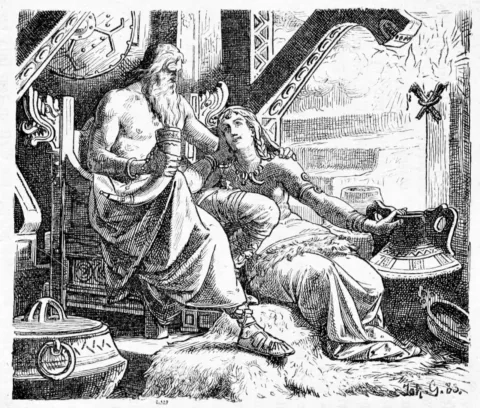
Inside Hnitbjörg, Odin found Gunnlöð, whom Suttungr had entrusted with guarding the mead. According to Skáldskaparmál, Odin slept with her for three nights, after which she permitted him three drinks from the vessels. Snorri does not describe their conversations or explain what persuaded her to grant him access.
Odin used each drink to empty an entire container. His first draught drained Óðrerir, the second emptied Boðn, and the third Són. In three drinks, he consumed the entire supply of mead that Suttungr had hidden inside the mountain.
The Eagle’s Escape and the Gift of Poetry
With the mead inside him, Odin transformed into an eagle and flew out of Hnitbjörg. Suttungr spotted him, assumed an eagle’s form himself, and gave chase. As Odin approached Asgard, the Æsir saw him coming and placed large vessels in the courtyard. He reached them just ahead of Suttungr and expelled the mead into the waiting containers.
Suttungr came so close to catching Odin that some of the mead escaped backward during the flight. This portion was left uncollected and could be claimed by anyone. Snorri calls it skáldfífla hlutr, the “poetasters’ share,” a mocking explanation for the existence of inferior poetry.
Odin gave the recovered mead to the Æsir and to humans skilled in composing poetry. Snorri consequently includes expressions such as “Odin’s gift” and “the drink of the Æsir” among the poetic names for their art.
How Does Hávamál Tell the Story Differently?
The poem Hávamál, stanzas 104–110, preserves a shorter account of Odin’s acquisition of the Mead of Poetry. Unlike Snorri’s narrative in Skáldskaparmál, much of the episode is told in Odin’s own voice. He recalls visiting Suttungr, using Rati to make a passage through the rock, and receiving the mead from Gunnlöð, whom he credits with helping him escape from the giants.
The poem omits several events described by Snorri, including Kvasir’s murder, Odin’s agreement with Baugi, and Suttungr’s pursuit in eagle form. It also introduces an episode absent from the prose account. In stanza 109, frost giants visit Odin’s hall and ask whether Bölverkr, the name Odin used during his adventure, has returned to the gods or been killed by Suttungr. Another difference concerns Óðrerir. Snorri identifies it as one of the vessels containing the mead, while its appearance in Hávamál 107 may refer to the drink itself.
Gunnlöð’s treatment receives particular attention. In stanza 105, Odin acknowledges that she gave him the precious drink but received a poor reward for her affection. Stanza 110 casts doubt on the trustworthiness of Odin’s ring-oath and describes how he cheated Suttungr of the mead and left Gunnlöð in tears. The identity of the speaker is uncertain, since Odin is referred to in the third person rather than continuing his earlier first-person account.
Read Also
What Did the Mead of Poetry Represent?
The Mead of Poetry presents poetic knowledge as something precious enough to inspire rivalry, violence, and deception. Its association with Kvasir’s wisdom and Odin’s eventual possession connects the ability to compose verse with knowledge and divine power. Poetry emerges from the myth not simply as entertainment, but as a gift whose possession carries considerable value.
In Scandinavian society, skalds composed verses praising rulers, recounting achievements, and commemorating the dead. Their poetry could preserve reputations and strengthen the memory of individuals and events across generations. Composing such verse required mastery of demanding metres, intricate syntax, and traditional poetic expressions. The supernatural gift described in the myth thus stood alongside a literary practice that depended on training, memory, and technical skill.
Hannah Burrows interprets the mead as a metaphor for poetry’s effects on the mind. Her research examines how poetic forms could support memory and thought, while performance allowed knowledge and emotion to be communicated between people. The image of poetry entering the body as a drink gives physical form to these effects, presenting poetic inspiration as something capable of changing how a person thinks and understands the world.
Academic Sources & Primary Texts
Primary Norse Texts & Critical Editions
- Snorri Sturluson. Edda: Skáldskaparmál. Edited by Anthony Faulkes. London: Viking Society for Northern Research, 1998.Primary source for Kvasir’s death, the creation of the mead, Suttungr’s acquisition, Odin’s deception, and the origin of poetic expressions.
- Pettit, Edward, ed. and trans. The Poetic Edda: A Dual-Language Edition. Cambridge, UK: Open Book Publishers, 2023.Hávamál, stanzas 104–110, preserves the poetic account of Odin, Gunnlöð, and the acquisition of the mead.
- Evans, D. A. H., ed. Hávamál. London: Viking Society for Northern Research, 1986. Glossary and index by Anthony Faulkes, 1987.Critical text and commentary for interpreting Odin’s account, the ring-oath, and the references to Óðrerir.
Academic Studies
- Burrows, Hannah. “The Mead of Poetry: Old Norse Poetry as a Mind-Altering Substance.” In Distributed Cognition in Medieval and Renaissance Culture, 99–119. Edinburgh University Press, 2019.Scholarly interpretation of the mead myth and the relationship between poetry, memory, thought, and cognition.
- Clunies Ross, Margaret. A History of Old Norse Poetry and Poetics. Cambridge: D. S. Brewer, 2005.Historical and literary context for skaldic composition, poetic language, and the social position of poets in medieval Scandinavia.
Copyright & Usage
© 2026 History & Myths. All rights reserved.
Original article written by H. Moses for History & Myths. Unauthorized reproduction or republication of the original text is prohibited. Brief quotations with appropriate attribution and a link to the original article are welcome. Ancient texts, scholarly translations, and third-party images remain subject to their respective rights and licenses.