Yggdrasil: The World Tree of Norse Mythology Explained
Yggdrasil is the great World Tree of Norse mythology, a vast sacred tree at the center of the Norse cosmos, linking the worlds of gods, humans, jötnar, the dead, and other supernatural beings.
The surviving sources describe it as an ash tree with immense roots and branches, connected with sacred wells, the Norns, Odin, Níðhöggr, Ratatoskr, and the wider idea of the Nine Worlds.
Yggdrasil appears in both the Poetic Edda and Snorri Sturluson’s Prose Edda, but the two do not always present it in exactly the same way. That difference is important, because many modern diagrams and retellings make the Norse cosmos look far more fixed and orderly than the medieval sources actually suggest.
What Is Yggdrasil in Norse Mythology?
Yggdrasil is the immense World Tree at the heart of Norse cosmology. Its roots and branches extend through different regions of the cosmos, connecting the worlds of gods, humans, jötnar, and the dead.
It appears in major Old Norse sources including Völuspá, Grímnismál, and Snorri Sturluson’s Prose Edda. These texts connect the tree with sacred wells, the Norns, supernatural creatures, and forces that continually damage or sustain it.
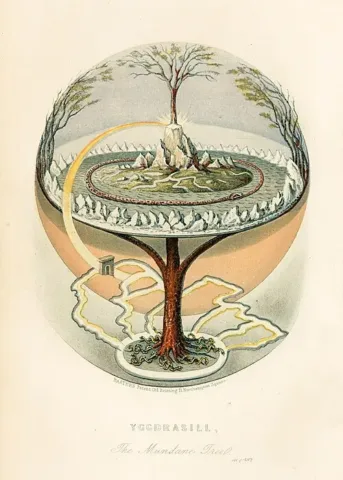
Modern diagrams often show Yggdrasil as a fixed map of the Nine Worlds. The medieval sources are less precise, especially about where its roots lead and how the surrounding realms are arranged.
How Large Was Yggdrasil?
Snorri describes Yggdrasil as the greatest of all trees, with branches spreading across the world and rising above heaven. The image is cosmic rather than botanical: the sources do not give the tree a measurable height or width.
Its scale comes from what it connects. Roots reach into different regions of the cosmos, while its branches extend over the world of gods and other beings. Yggdrasil is therefore immense because it forms part of the structure of the Norse universe, not because the texts provide a physical size for it.
What Does the Name Yggdrasil Mean?
The name Yggdrasil is usually understood as “Yggr’s horse.” Yggr is one of Odin’s names, while drasill means horse.
The expression is poetic rather than literal. In Old Norse imagery, a gallows or hanging tree could be described as a “horse” ridden by the person hanging from it.
This interpretation creates a strong connection between Yggdrasil and Odin, although the name alone does not prove that every tree associated with Odin in the surviving poems is Yggdrasil.
Was Yggdrasil an Ash Tree?
The surviving Norse sources describe Yggdrasil as an askr, the Old Norse word normally translated as ash tree. Snorri Sturluson also identifies it as an ash in the Prose Edda.
Some modern scholars have suggested that Yggdrasil may preserve traits associated with the yew, partly because of descriptions of its enduring or evergreen character. That remains a secondary interpretation rather than the straightforward reading of the medieval texts.
How Do the Three Roots of Yggdrasil Differ Between the Sources?
Yggdrasil is described as having three great roots, but the surviving sources do not place them in exactly the same way.
In Grímnismál, one root reaches toward Hel, another toward the frost jötnar, and the third toward human beings.
Snorri gives a different arrangement in Gylfaginning: one root extends among the Æsir, another among the frost giants, and a third over Niflheim.
The two accounts overlap, but they do not form a single identical map of the Norse cosmos.
The Norns and Urðarbrunnr
At Urðarbrunnr, or the Well of Urðr, Yggdrasil is closely connected with the Norns, supernatural figures associated with fate.
Völuspá names three of them as Urðr, Verðandi, and Skuld, while Snorri places their dwelling beside the well beneath one of Yggdrasil’s roots.
These three are the best-known Norns, but the tradition does not limit all norns to them. Snorri also describes other norns connected with the lives and destinies of individual people.
Yggdrasil and the Gods’ Assembly
In Snorri’s Gylfaginning, Yggdrasil is not only a cosmic tree but also a place of divine assembly. The gods are said to gather at Urðarbrunnr, beneath one of its roots, to hold judgment.
The Æsir travel there each day, usually across Bifröst, while Thor is described as reaching the assembly by wading through rivers instead. This makes Yggdrasil part of the political and judicial life of the gods as well as the structure of the cosmos.
The detail is especially important because it gives the World Tree a practical role within the mythology: it is a meeting place as well as a cosmic landmark.
Which Worlds Were Connected to Yggdrasil?
Yggdrasil is often described as the tree that connects the Nine Worlds, but the surviving Norse texts do not provide a fixed list of nine realms arranged around it.
The poems refer to nine worlds, while Snorri describes Yggdrasil as extending through different regions of the cosmos associated with gods, humans, jötnar, and the dead.
Realms such as Ásgarðr, Miðgarðr, Jötunheimr, and Niflheimr clearly belong to the wider cosmological picture. What the medieval sources do not provide is the familiar modern diagram placing nine named worlds in exact positions on the tree.
Who Lives on Yggdrasil?
Several creatures are associated with Yggdrasil in Grímnismál and Snorri Sturluson’s Prose Edda.
At the top of the tree sits a great eagle, with the hawk Veðrfölnir between its eyes. The squirrel Ratatoskr runs along the trunk, carrying hostile messages between the eagle above and Níðhöggr below.
Four stags, Dáinn, Dvalinn, Duneyrr, and Duraþrór, feed on the tree’s foliage, while Níðhöggr and other serpents are associated with the roots beneath it.
The medieval texts describe these creatures and their actions, but they do not assign each one a fixed symbolic meaning. Interpretations such as wisdom, conflict, or destruction belong mainly to later readings.
How Is Yggdrasil Damaged and Sustained?
Yggdrasil is not portrayed as untouched or indestructible. Grímnismál describes the tree as suffering from several directions: its foliage is eaten, its sides decay, and its roots are attacked from below.
Snorri also describes a process of preservation. At Urðarbrunnr, the Norns draw water and material from around the well and use it to tend the tree, keeping its branches from decaying.
Yggdrasil is therefore presented as a living structure under continual strain, not as an unchanging cosmic monument.
Was Odin Hanging from Yggdrasil?
In Hávamál, Odin describes hanging for nine nights on a windy tree, wounded by a spear and without food or drink, before gaining the runes.
The poem does not name that tree as Yggdrasil. The connection is nevertheless strong because Yggdrasil is commonly interpreted as “Yggr’s horse,” with Yggr being one of Odin’s names and the “horse” referring poetically to a hanging tree or gallows.
Most modern retellings therefore identify Odin’s tree with Yggdrasil, but the identification remains an interpretation rather than an explicit statement in Hávamál.
Was Yggdrasil Worshipped?
The surviving texts do not describe a formal cult devoted specifically to Yggdrasil, and there is no clear archaeological evidence for the worship of one physical tree identified as the World Tree.
Trees and sacred groves did have an important place in pre-Christian Germanic religion, however, and later sources preserve traditions in which particular trees or wooded places carried religious significance. That broader background may help explain why a cosmic tree could occupy such a central place in Norse mythology.
It is therefore safer to distinguish between Yggdrasil as a mythological World Tree and the wider religious importance of sacred trees in Germanic tradition, rather than treating them as the same thing.
Is Yggdrasil Really the Norse Tree of Life?
Yggdrasil is often called the Norse Tree of Life, but that phrase is a modern description rather than a name used in the medieval sources.
The Old Norse texts present Yggdrasil as the World Tree, linking different regions of the cosmos and connecting gods, humans, the dead, sacred wells, and supernatural beings.
“Tree of Life” can be useful as a modern comparison, but World Tree is the more accurate description when discussing the surviving Norse sources.
Read More
What Happens to Yggdrasil at Ragnarök?
At Ragnarök, Yggdrasil is caught in the upheaval of the old cosmic order. In Völuspá, the great ash trembles and groans as the final events unfold.
The sources do not clearly say that Yggdrasil is destroyed, nor do they state that it survives unchanged. Its final condition remains uncertain.
The human survivors Líf and Lífþrasir shelter in Hoddmímis holt, a place sometimes connected with Yggdrasil in later interpretation. The surviving texts, however, do not explicitly say that they hide inside the World Tree.
Mímisbrunnr and Hvergelmir
Two other wells are closely connected with Yggdrasil in Snorri’s account.
Mímisbrunnr, the Well of Mímir, lies beneath the root extending toward the frost jötnar. It is associated with wisdom, and Snorri says that Odin gave one of his eyes for a drink from its waters.
Hvergelmir lies beneath the root extending over Niflheim, where Níðhöggr gnaws at Yggdrasil from below.
Together with Urðarbrunnr, these wells form the three principal wells associated with Yggdrasil in Snorri’s description. The older poetic material does not arrange the roots and wells in exactly the same way.
Academic Sources & Primary Texts
Translated with introduction and notes by Carolyne Larrington, revised edition,
Oxford University Press, 2014. Key poems used for Yggdrasil include
Völuspá, Grímnismál, Hávamál, and
Vafþrúðnismál.
Edited by Anthony Faulkes, second edition, Viking Society for Northern Research,
2005. A principal source for Yggdrasil’s three roots, Urðarbrunnr,
Mímisbrunnr, Hvergelmir, the Norns, the creatures of the tree, and the gods’
assembly.
Tracing Old Norse Cosmology: The World Tree, Middle Earth and the Sun in
Archaeological Perspectives, Nordic Academic Press, 2014.
A major interdisciplinary study comparing the literary World Tree with
archaeological evidence and wider ideas of space and cosmology in pre-Christian
Scandinavia.
Norse Mythology: A Guide to the Gods, Heroes, Rituals, and Beliefs,
Oxford University Press, 2002.
A standard academic reference for Old Norse mythological figures, places,
cosmology, source traditions, and terms connected with Yggdrasil.
Translated by Angela Hall, D. S. Brewer, 1993.
A major scholarly reference for Yggdrasil, the Norns, Níðhöggr, Ratatoskr,
the Nine Worlds, sacred wells, and related Germanic mythological traditions.
The End of the World in Scandinavian Mythology: A Comparative Perspective
on Ragnarök, Oxford University Press, 2022.
A recent academic study of Ragnarök, destruction and renewal, and the surviving
textual traditions behind the end of the Norse cosmos.
Copyright & Use
Written by H. Moses for
History & Myths.
This article is original content created for History & Myths.
Reproduction, republication, or full redistribution of this content is not permitted
without prior permission.
Short quotations may be used for educational, academic, or commentary purposes
with clear attribution and a link back to the original article.