Skadi: Norse Goddess of Winter and the Hunt
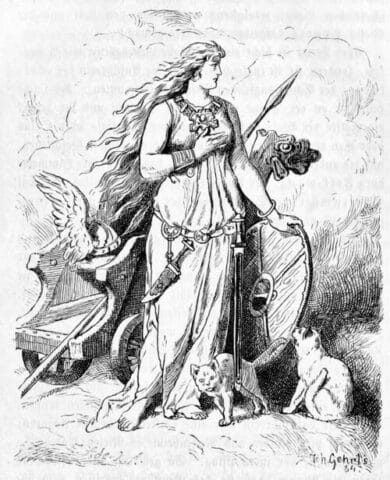
Skadi (Old Norse: Skaði) is a jötunn who is also counted among the goddesses in Norse mythology. She hunts with a bow, travels on skis, and lives in the mountains. Often called the Norse goddess of winter, she is not explicitly described in the surviving texts as controlling snow or the seasons.
After the gods kill her father, Thjazi, Skadi arrives in Asgard armed and demands compensation. She marries Njord, the god of the sea, but their different preferences for the mountains and the coast eventually drive them apart. Skadi also confronts Loki and takes part in his punishment. A separate tradition preserved in Ynglinga saga says she later married Odin and became the mother of Sæmingr.
Who Was Skadi in Norse Mythology?
Skadi was the daughter of Thjazi, a jötunn, a term commonly translated as “giant.” In Norse mythology, the jötnar were not necessarily enormous creatures. They could oppose the gods, marry them, or become part of their families. Skadi’s giant ancestry therefore did not prevent her from being recognized as a goddess.
Her home was Þrymheimr (Thrymheim), the mountain dwelling once occupied by her father. In Grímnismál, stanza 11, the poem names Þrymheimr among the divine residences and describes Skadi as the “bright bride of the gods,” living in her father’s former halls.
Her divine status is also reflected in Nafnaþulur, a catalogue of poetic names preserved with the Prose Edda. It lists Skaði among the ásynjur, the goddesses, alongside figures such as Frigg, Freyja, and Idunn.
Snorri Sturluson’s Gylfaginning confirms her relationship to Thjazi but offers little information about her life before his death. Neither her mother nor the circumstances of her upbringing are identified in the surviving accounts.
Why Did Skadi Demand Compensation from the Gods?
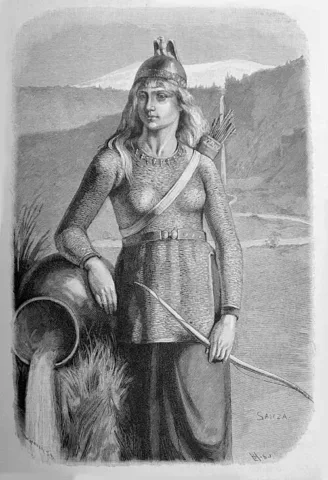
Skadi arrived in Asgard wearing a helmet, chainmail, and carrying weapons to avenge her father, Thjazi. He had abducted Idunn, whose apples preserved the gods’ youth. When Loki rescued her, Thjazi pursued him in eagle form. The gods set his feathers on fire and killed him at the gates of Asgard.
Instead of fighting Skadi, the Æsir offered to compensate her for her father’s death. The settlement included an unusual condition: she could choose a husband from among the gods, but only by looking at their feet. Seeing one particularly handsome pair, Skadi assumed they belonged to Baldr. She chose them, only to discover that her husband would be Njord, the sea god.
Skadi demanded something else as part of the agreement. The gods had to make her laugh, a task she believed was beyond their abilities. Loki tied one end of a rope to a goat’s beard and the other around his own genitals. As they pulled against each other, both cried out. Loki eventually fell into Skadi’s lap, making her laugh and completing the settlement.
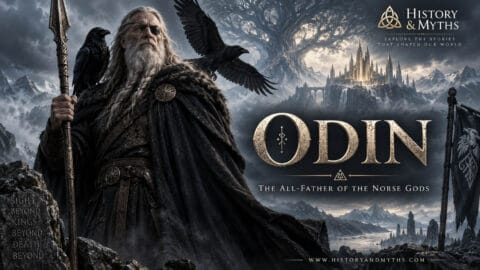
Snorri Sturluson also records a further act of compensation. Odin took Thjazi’s eyes and placed them in the sky as two stars, preserving a reminder of Skadi’s father in the heavens.
Idunn: The Norse Goddess Who Kept the Gods Young
Discover the full story of Idunn’s abduction by Thjazi and Loki’s dangerous rescue.
Skadi and Njord: Why Did Their Marriage Fail?
After marrying Njord, Skadi wanted to live in Þrymheimr, the mountain home she had inherited from her father. Njord, a god of the Vanir, preferred Nóatún, his dwelling beside the sea. Unable to agree, they decided to divide their time between the two places.
In Gylfaginning, chapter 23, their disagreement is preserved in verses attributed to each of them. After nine nights in the mountains, Njord complains about the howling wolves, whose cries he finds unpleasant compared with the swans he knows by the coast. Skadi is equally unhappy at Nóatún. The cries of seabirds disturb her sleep, and a gull wakes her every morning.
The length of their agreed stays varies between textual versions. Some give nine nights in each home, while others give only three nights at Nóatún.
Skadi eventually returns to Þrymheimr. A verse by the skald Þórðr Sjáreksson, quoted in Skáldskaparmál, also refers to her unhappiness with her Vanir husband. Snorri identifies it as a reference to Skadi’s separation from Njord. Neither account describes a formal divorce or a later reconciliation.
Njord: Norse God of the Sea, Wealth and Seafaring
Explore Njord’s Vanir origins, his powers over the sea, and his place among the Norse gods.
Was Skadi Really the Goddess of Winter?
Skadi is often described as the Norse goddess of winter, but this is a modern description rather than a title explicitly given to her in the surviving Old Norse texts. Her established associations are with mountains, skiing, archery, and hunting.
In Gylfaginning, chapter 23, Snorri Sturluson describes Skadi traveling on skis with a bow and hunting wild animals. He calls her öndurgoð or öndurdís, titles commonly translated as “ski-deity” and “ski-goddess.” Older English translations sometimes use “snowshoe goddess,” reflecting different ways of rendering the Norse terminology.
Her connection with skiing predates Snorri’s account. A verse attributed to the early skald Bragi Boddason identifies Thjazi through his relationship to the öndurdís, referring to Skadi without naming her directly. This provides an earlier poetic witness to her distinctive association with skis.
Skadi was not the only Norse deity linked to these activities. In Gylfaginning, chapter 31, Ullr is also described as an exceptionally skilled skier and archer. The surviving accounts distinguish their identities but do not assign either exclusive control over winter.
Skadi’s mountain home, Þrymheimr, and her traditional activities explain her later reputation as a winter goddess.
Skadi and Loki: From Reconciliation to Punishment
Loki had once helped secure Skadi’s reconciliation with the gods by making her laugh. Yet their exchange in Lokasenna reveals a much more hostile relationship.
During a feast hosted by Ægir, Skadi warns Loki that the gods will eventually bind him with the entrails of his own son. Loki responds by boasting that he played a leading role in killing her father, Thjazi. Skadi replies that cold counsel will come against him from her dwellings and fields.
Loki then claims that Skadi once invited him into her bed. The accusation appears among the personal insults exchanged throughout Lokasenna, and no other surviving account confirms that such a relationship existed.
Skadi’s warning is fulfilled in the story of Loki’s punishment. In Gylfaginning, chapter 50, the gods capture Loki and bind him across three stones using the entrails of his son Narfi. The bonds turn to iron, leaving him unable to escape.
Skadi then fastens a venomous serpent above Loki’s face, allowing its poison to drip onto him. His wife, Sigyn, holds a bowl beneath the serpent to catch the venom. Whenever she leaves to empty it, the poison strikes Loki, causing him to writhe so violently that the earth shakes. The myth explains earthquakes through these movements and says Loki remains bound until Ragnarök.
The prose ending of Lokasenna also identifies Skadi as the one who places the serpent above Loki. Neither account, however, explicitly states whether her participation in the punishment was motivated by her father’s death.
Loki in Norse Mythology: Trickster, Shapeshifter, Enemy of the Gods
Follow Loki’s transformation from an unpredictable ally of the gods to their enemy at Ragnarök.
Did Skadi Marry Odin and Have Children?
According to Ynglinga saga, Skadi married Odin after her separation from Njord. The saga states that she and Odin had several sons, although only one is named: Sæmingr, a legendary ancestor of the Norwegian jarls of Lade.
Snorri Sturluson supports this account with verses from Háleygjatal, a genealogical poem composed by the tenth-century poet Eyvindr skáldaspillir. The surviving verses associate Skadi with Odin and their offspring, describing her through poetic imagery connected with her giant ancestry and mountainous home.
The genealogy also connected Earl Hakon’s ruling family to the gods. Snorri states that Earl Hakon the Great traced his paternal ancestry to Sæmingr, giving the ruling family a legendary connection to the gods.
There is, however, a complication. In the prologue to Heimskringla, Snorri identifies Sæmingr as a son of Yngvi-Freyr rather than Odin. The conflicting references show that the genealogy was not entirely consistent.
Neither the saga nor the surviving verses describe Skadi’s relationship with Odin in detail or identify their other sons. Her importance in this tradition lies primarily in her place within a legendary royal ancestry, not in a separate surviving account of her marriage.
What Does Skadi’s Name Mean?
The origin of Skadi’s Old Norse name, Skaði, remains disputed. One explanation connects it with the Old Norse noun skaði, meaning “harm” or “damage,” from which the English word scathe also derives. Another links the name to Germanic words for “shadow,” including Old English sceadu and Gothic skadus.
A more intriguing possibility concerns the name Scandinavia. The Roman writer Pliny the Elder recorded a geographical name in the first century CE as Scadinavia or Scatinavia, referring to what he believed was an island in the Baltic region. The name is often connected with Skáney, the Old Norse name for Scania in southern Sweden.
Some scholars have suggested that Scandinavia originally meant “Skaði’s island.” Others have questioned whether the goddess gave her name to the region at all. One alternative interpretation connects the geographical name with a Germanic word for danger or damage, giving it the approximate meaning “dangerous island.”
The resemblance between Skaði and Scandinavia is therefore significant, but it does not establish which name came first or whether they share the same origin.
What Do the Old Norse Sources Tell Us About Skadi?
Our knowledge of Skadi comes largely from medieval Icelandic texts, some of which preserve much older poetry. The Poetic Edda includes references to her in Grímnismál and Lokasenna, while skaldic verses attributed to Bragi Boddason and Eyvindr skáldaspillir provide additional evidence for traditions known before Snorri Sturluson’s writings.
The fullest narratives appear in Snorri’s thirteenth-century Prose Edda, particularly Gylfaginning and Skáldskaparmál. His Ynglinga saga preserves a separate genealogical tradition. These works were recorded in Christian Iceland, making it important to distinguish older poetic references from the later prose accounts that explain them.
Was Skadi Worshipped in Norse Religion?
Direct evidence of Skadi’s historical worship is limited. In Lokasenna (stanza 51), she refers to her vé, a term associated with sacred places or sanctuaries, alongside her fields. The passage suggests a possible connection with cultic locations, but it cannot establish how worship was conducted.
Place names offer another possible clue. Swedish names such as Skedevi contain an element meaning “sacred place,” and some researchers have connected their first element with Skadi. Other explanations relate it to horse racing or different geographical features. The connection to the goddess therefore remains uncertain.
No detailed description of rituals, offerings, or festivals dedicated specifically to Skadi survives. Her prominence in Norse literature is clear, but the extent of her worship in pre-Christian Scandinavia remains unknown.
Academic Sources & Primary Texts
This article draws on medieval Old Norse texts, scholarly editions, and modern academic research. The sources below distinguish the surviving mythological accounts from later interpretations of Skadi’s identity, name, and worship.
Primary Texts & Scholarly Editions
- The Poetic Edda
Translated by Carolyne Larrington. Revised edition. Oxford University Press, 2014.
Grímnismál 11 and Lokasenna 49–52: Skadi’s mountain home, confrontation with Loki, and references to sacred places.
Oxford University Press
- Snorri Sturluson, Edda: Prologue and Gylfaginning
Edited by Anthony Faulkes. 2nd edition. Viking Society for Northern Research, 2005.
Chapters 23 and 50: Skadi’s skiing and hunting, her marriage to Njord, and her role in Loki’s punishment.
Viking Society for Northern Research
- Snorri Sturluson, Edda: Skáldskaparmál
Edited by Anthony Faulkes. Viking Society for Northern Research, 1998.
Skadi’s compensation for Thjazi’s death, her selection of Njord, and earlier skaldic references to her mythology.
Viking Society for Northern Research
- Snorri Sturluson, Heimskringla, Volume I
Translated by Alison Finlay and Anthony Faulkes. 2nd edition. Viking Society for Northern Research, 2016.
The Prologue and Ynglinga saga: Skadi’s association with Odin, Sæmingr, and legendary Norwegian genealogies.
Read the Scholarly Translation (PDF)
- Skaldic Poetry of the Scandinavian Middle Ages
Edited by Diana Whaley and contributing scholars. Brepols, 2012.
Critical editions of early Norse poetry, including Eyvindr skáldaspillir’s Háleygjatal, with textual notes and variant readings.
Academic Edition, Brepols
Modern Academic Research
- John Lindow, Norse Mythology: A Guide to the Gods, Heroes, Rituals, and Beliefs
Oxford University Press, 2002.
Scholarly reference for Norse divine figures, giants, mythological traditions, and the interpretation of medieval sources.
Oxford Academic
- Rudolf Simek, Dictionary of Northern Mythology
Translated by Angela Hall. D. S. Brewer, 1993.
Reference work on Norse deities, mythological terminology, names, and their historical interpretations.
Bibliographic Record, WorldCat
- Institute for Language and Folklore, Sweden
Svenskt ortnamnslexikon, entry: Skedevi.
Official Swedish place-name research discussing the disputed origin of Skedevi and its element meaning “sacred place.”
Swedish Place-Name Dictionary
Note: The surviving Old Norse texts were recorded in medieval Christian contexts. References to Skadi’s divine status or possible worship should not be treated as direct archaeological proof of a widespread cult.
Copyright & Content Rights
© 2026 History & Myths. All rights reserved.
The original writing, research synthesis, analysis, and editorial presentation of this article are protected by copyright. Reproduction or republication of substantial portions requires prior written permission, except where permitted by applicable copyright law.
Ancient Norse myths and historical traditions are part of the shared cultural heritage. Original source texts, modern translations, scholarly publications, and other third-party materials remain subject to their respective copyright status and licensing terms.
Historical and academic sources are acknowledged for research and educational purposes. All third-party rights are respected.