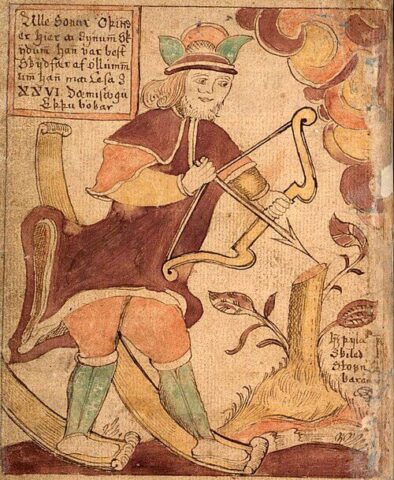
Vali: The Norse God Born to Avenge Baldr
Váli was a son of Odin and Rindr, born to avenge the death of his half-brother Baldr. In Völuspá, Baldr’s unnamed brother fights when only one night old, without washing his hands or combing his hair before taking revenge. Other Norse sources identify the avenger as Váli and his victim as Höðr, the god who killed Baldr.
The accounts differ over what became of the avenger. Icelandic sources place Váli among the gods who survive Ragnarök, while Saxo Grammaticus preserves a contrasting story in which the avenger dies.
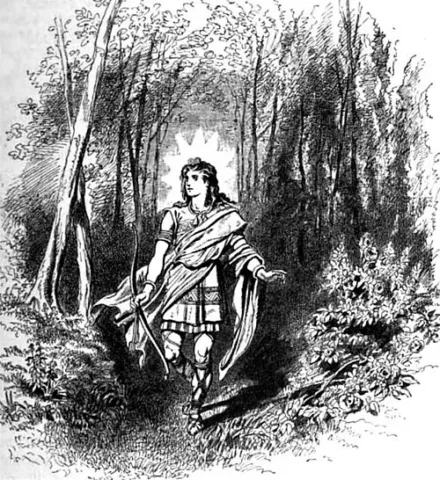
Who Was Vali in Norse Mythology?
Váli, also called Áli, belonged to the Æsir, the principal group of gods in Norse mythology. In Gylfaginning, chapter 30, Snorri Sturluson describes him as bold in battle and a skilled marksman.
Skáldskaparmál, chapter 12, preserves several of Váli’s poetic titles, including Frigg’s stepson, brother of the Æsir, and “dweller in the fathers’ homesteads.” He is also called Baldr’s avenger and Höðr’s killer. Snorri does not explain the reference to ancestral homesteads.
The Icelandic sources provide little information about Rindr beyond her role as Váli’s mother. Baldrs draumar identifies her as the woman destined to bear Baldr’s avenger but gives no account of her ancestry.
Why Was Vali Born to Avenge Baldr?
Váli’s birth was foretold in Baldrs draumar, where Odin awakens a dead seeress to learn the meaning of Baldr’s troubling dreams. She identifies Höðr as Baldr’s future killer and predicts that Rindr will bear Odin a son who will avenge the death.
In Gylfaginning, chapter 49, Snorri Sturluson explains how Höðr became responsible for Baldr’s death. Frigg had obtained oaths from nearly everything not to harm her son, but considered mistletoe too young to require such a promise. Loki discovered this exception and gave the mistletoe to the blind Höðr, directing him to throw it at Baldr. The weapon struck and killed him.
Although Loki orchestrated the killing in Snorri’s account, Höðr delivered the fatal blow. The prophecy in Baldrs draumar identifies Höðr as the target of vengeance without addressing Loki’s responsibility.
How Did Vali Kill Höðr?
In Völuspá, stanza 32, Baldr’s brother is born shortly after his death and fights when only one night old. The poem does not describe his physical growth or explain how an infant became capable of fighting.
Hyndluljóð, stanza 29, explicitly names Váli as the avenger who killed his brother’s handbani, an Old Norse term for the person who directly inflicted the fatal blow.
Neither poem describes the confrontation or identifies the weapon Váli used. Although Snorri describes him as a skilled marksman in Gylfaginning, this does not establish that he killed Höðr with an arrow.
Why Did Vali Refuse to Wash His Hands or Comb His Hair?
In Völuspá and Baldrs draumar, Baldr’s avenger refuses to wash his hands or comb his hair until he has brought Baldr’s killer to the funeral pyre. This abstention is commonly interpreted as a vow of vengeance, although neither poem describes him formally swearing an oath.
A comparable custom appears in Tacitus’s Germania, chapter 31. The Roman historian describes warriors of the Chatti who allowed their hair and beards to grow until they had killed an enemy. John Lindow discusses this parallel in Murder and Vengeance among the Gods, suggesting that Váli’s unkempt appearance reflects a wider Germanic tradition of abstaining from grooming until a martial obligation was fulfilled. The comparison does not establish that such a practice was universal among the Norse.
Vali in Saxo Grammaticus: The Story of Rinda and Bous
Saxo Grammaticus tells a different version of Baldr’s death and its aftermath in Book III of Gesta Danorum, written around 1200. In his account, Hotherus is a human warrior who marries Nanna, despite Balderus’s desire for her. Their rivalry leads to war, and Hotherus eventually wounds Balderus with a sword. Balderus dies three days later.
Seeking revenge, Odin consults a Finnish seer named Rostioph, who predicts that Rinda, daughter of the Ruthenian king, will bear the son destined to kill Hotherus. Odin approaches her disguised first as a soldier, then as a smith, and finally as a soldier again. She repeatedly rejects him. After his third rejection, he uses an enchanted piece of bark to drive her into a frenzy.
Odin then returns disguised as a female healer named Wecha. When Rinda falls ill, he persuades her father to have her restrained under the pretext of medical treatment, then rapes her. Saxo also records an alternative version in which her father permits the encounter. Rinda gives birth to Bous, called Boe in some English translations.
The other gods expel Odin for his conduct and replace him with Oller for nearly ten years. After regaining his position, Odin urges Bous to avenge Balderus. Bous kills Hotherus in battle but suffers fatal wounds and dies the following day.
Bous is generally identified as Saxo’s counterpart to Váli, although their stories differ considerably. Saxo makes no mention of a one-night-old avenger, and Bous dies after fulfilling his purpose. In the Icelandic tradition, Váli survives Ragnarök.
Was Vali Also the Son of Loki?
Snorri Sturluson also names a son of Loki called Váli, a figure distinct from Odin’s son who avenged Baldr.
In Gylfaginning, chapter 50, the Æsir capture Loki and transform his son Váli into a wolf. He tears apart his brother Nari, also called Narfi, whose entrails the gods use to bind Loki to three stones.
The prose ending of Lokasenna preserves different names. In the text of Codex Regius, Nari’s entrails become Loki’s bonds, while Narfi is transformed into a wolf. Váli is not mentioned, although some later editions substitute his name. This discrepancy leaves the identities of Loki’s sons uncertain, but provides no evidence that Loki’s Váli and Baldr’s avenger were the same deity.
Did Vali Survive Ragnarök?
Váli survived Ragnarök according to both the Poetic Edda and Snorri Sturluson’s Prose Edda. In Vafþrúðnismál, stanza 51, the giant Vafþrúðnir predicts that Váli and Víðarr will inhabit the sanctuaries of the gods after Surtr’s flames have died out.
In Gylfaginning, chapter 53, Snorri states that neither the sea nor Surtr’s fire will harm them. They will settle at Iðavöllr, where Asgard once stood. Baldr and Höðr will also return from Hel and join the surviving gods.
Váli will therefore inhabit the renewed world alongside Höðr, the brother he killed. Snorri describes the gods gathering and recalling the past, but records no specific reconciliation between the brothers or any new responsibility assigned to Váli.
Read Also
Was Vali Worshipped in the Viking Age?
There is no securely established evidence of an independent cult devoted to Váli in Viking Age Scandinavia. No known inscription, archaeological find, or historical account confirms that people maintained shrines, made offerings, or held festivals specifically in his honor.
A possible connection appears in Grímnismál, stanza 6, which describes a silver-roofed hall called Valaskjálf. Its name has sometimes been interpreted as “Váli’s Shelf,” although another reading connects it with the slain. The poem does not identify Váli as its owner, and Snorri Sturluson assigns the hall to Odin in Gylfaginning, chapter 17. This uncertain linguistic connection provides no firm evidence of Váli’s historical worship.
Academic Sources & Primary Texts
Primary Texts
- The Poetic Edda. Edited and translated by Edward Pettit. Cambridge: Open Book Publishers, 2023. Relevant poems: Völuspá, Baldrs draumar, Hyndluljóð, Vafþrúðnismál, Grímnismál, and Lokasenna. Open-access edition.
- Snorri Sturluson. Edda: Prologue and Gylfaginning. Edited by Anthony Faulkes. 2nd ed. London: Viking Society for Northern Research, 2005. Chapters 17, 30, 49, 50, and 53. Scholarly edition.
- Snorri Sturluson. Edda: Skáldskaparmál. Edited by Anthony Faulkes. London: Viking Society for Northern Research, 1998. Chapter 12. Scholarly edition.
- Saxo Grammaticus. Gesta Danorum: The History of the Danes. Edited by Karsten Friis-Jensen and translated by Peter Fisher. Oxford: Oxford University Press, 2015. Book III. Oxford Medieval Texts.
- Tacitus. Germania, chapter 31. A comparative Roman account of the Chatti’s warrior customs. Perseus Digital Library.
Academic Studies
- Lindow, John. Murder and Vengeance among the Gods: Baldr in Scandinavian Mythology. Folklore Fellows Communications 262. Helsinki: Academia Scientiarum Fennica, 1997. Publisher’s record.
- Lindow, John. Norse Mythology: A Guide to the Gods, Heroes, Rituals, and Beliefs. Oxford: Oxford University Press, 2002. Entries on Váli, Baldr, and related figures. Oxford Academic.
- McKinnell, John. Meeting the Other in Norse Myth and Legend. Cambridge: D. S. Brewer, 2005. Publisher’s record.
- Boulhosa, Patricia Pires. “Scribal Practices and Three Lines in Völuspá in Codex Regius.” Gripla 26 (2015): 29–55. Academic journal.
- Frog. Baldr and Lemminkäinen: Approaching the Evolution of Mythological Narrative through the Activating Power of Expression. PhD diss., University College London, 2010. UCL Research Repository.
Copyright & Usage
© 2026 History & Myths. Written by H. Moses. All rights reserved. Unauthorized republication of this article is prohibited. Brief quotations may be used with proper attribution and a link to the original article, subject to applicable copyright law. Historical sources and third-party materials retain their respective rights.