Freyja: Norse Goddess of Love, War and Seiðr Magic
Freyja was one of the most prominent goddesses in Norse mythology, associated with love, desire, seiðr, and the dead of battle. A member of the Vanir and the daughter of Njörðr, she appears among the Æsir and ruled Fólkvangr, where the surviving sources say she received half of those who fell in battle while Odin received the other half.
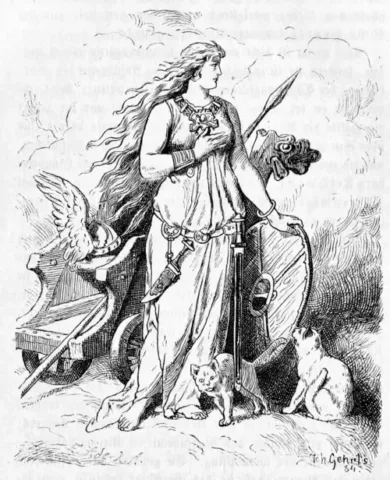
Her mythology extends far beyond love. Freyja possessed the famous necklace Brísingamen, travelled in a chariot drawn by cats, owned a magical feather garment, and was closely associated with seiðr, a form of magic that Ynglinga saga says she introduced among the Æsir.
But some familiar claims about Freyja go further than the Old Norse sources themselves. Was she really a warrior goddess? Did she personally teach Odin seiðr? Was she the queen of the Valkyries, and what do the earliest sources actually say about Brísingamen? Answering those questions requires separating what the texts preserve from later interpretation.
Who Was Freyja in Norse Mythology?
Freyja belonged to the Vanir, the group of Norse gods most often associated with fertility, prosperity, and certain forms of magic. She was the daughter of Njörðr and the sister of Freyr, two other major Vanir gods.
Snorri Sturluson describes Freyja as one of the foremost goddesses and calls her Vanadís, “Lady of the Vanir.” The same tradition identifies her as the wife of Óðr and the mother of Hnoss. In Ynglinga saga, she also appears in the wider tradition linking the Vanir and the Æsir and is associated directly with seiðr.
Although Freyja was Vanir by origin, much of her surviving mythology places her among the Æsir and alongside figures such as Odin, Thor, and Loki.
Her name means “Lady,” a title that fits the high status she holds in the surviving sources. Across the tradition, she becomes associated with love, wealth, magic, and the fate of the battle-dead.
Freyja, Love, Desire and Fertility
Freyja’s connection with love is one of the clearest parts of her surviving tradition. In Gylfaginning, Snorri says that love songs please her and that it is good to call on her in matters of love. Skáldskaparmál also includes “Goddess of Love” among the poetic ways of referring to her.
Her sphere extended beyond romance. Desire, marriage, sexuality, beauty, and wealth all gather around her, and myths sometimes treat her as a highly valued bride. The builder of Asgard, for example, demands Freyja as part of his payment.
Her association with fertility is broader and less direct. Freyja belongs to the Vanir, a divine group strongly connected with prosperity and abundance, but the surviving texts speak more explicitly about love, desire, wealth, and sexual attraction than about crops or childbirth under Freyja’s personal control.
Calling her simply a “fertility goddess” therefore risks making the evidence look more specific than it is.
Freyja and Seiðr: What the Sources Actually Say
Freyja is one of the figures most closely associated with seiðr, a form of Old Norse magic linked with prophecy, influence, and the shaping of events.
The clearest statement comes from Ynglinga saga. There, Freyja is called a blótgyðja and is said to have first taught seiðr among the Æsir, a practice that was customary among the Vanir.
This is often simplified into the claim that Freyja personally taught Odin magic, but the passage does not say that. It presents her as introducing seiðr to the Æsir as a group.
Odin is strongly associated with seiðr elsewhere in Norse tradition, which probably helped produce the later shorthand that Freyja taught him directly. The surviving passage, however, gives Freyja a broader role as the carrier of a Vanir magical tradition into the world of the Æsir.
Later Norse sources connect seiðr with prophecy, harmful influence, and practices that could carry social stigma, especially for men. Freyja’s connection with it therefore places her within a specific and important form of Norse magic rather than simply making her a generic “goddess of magic.”
Was Freyja Really a Goddess of War?
Calling Freyja a goddess of war is not wrong, but it needs qualification.
Her connection with battle is clearly established in the surviving sources. She is associated with the battle-dead, receives a share of those slain, and is described in Skáldskaparmál with titles linked to the dead.
What the sources do not give us is a clear picture of Freyja fighting with weapons, commanding armies, or performing battlefield exploits. Her role is tied much more closely to the fate of the slain than to combat itself.
So Freyja can reasonably be described as a goddess connected with war and battle-death, but calling her a “warrior goddess” goes beyond what the surviving texts actually show.
Fólkvangr and the Half of the Slain
Freyja’s connection with the battle-dead centres on Fólkvangr, the realm she rules in the surviving Norse sources.
In Grímnismál, Fólkvangr is named as Freyja’s domain, and the poem says that she chooses half of those slain each day while Odin receives the other half. Snorri repeats the tradition in Gylfaginning and adds that Freyja’s hall there is called Sessrúmnir, described as large and beautiful.
Compared with Valhalla, however, Fólkvangr is only briefly described. We are not told how the dead live there, whether they feast or train for battle, or whether they have any role at Ragnarök. The process by which the slain are divided between Freyja and Odin is also left unexplained.
For that reason, calling Fólkvangr “Freyja’s Valhalla” is useful only as a rough comparison. Both are destinations associated with the battle-dead, but the surviving texts give us far less information about Fólkvangr.
The sources also do not say that Freyja gets “first choice” of the dead. Grímnismál says that she chooses half and Odin has the other half, but gives no order or procedure for that division.
Was Freyja the Queen of the Valkyries?
Freyja is sometimes called the “Queen of the Valkyries,” but no surviving Old Norse source gives her that title.
The confusion is understandable. Freyja receives half of the battle-slain in Fólkvangr, while the Valkyries are also closely connected with choosing the dead in battle. In Gylfaginning, however, Snorri says that Odin sends the Valkyries to battles, where they determine who will die and who will win. Freyja is not described as commanding them.
Her connection with battle and the slain is strong, but that does not make her leader of the Valkyries. “Queen of the Valkyries” is a modern interpretation rather than an Old Norse title.
Brísingamen: Freyja’s Famous Necklace
Brísingamen is Freyja’s most famous possession, but the surviving sources preserve its story in fragments rather than giving us one consistent origin.
In Þrymskviða, the necklace is already treated as something unmistakably associated with Freyja. It breaks from her neck when she reacts angrily to Þrymr’s marriage demand and is later used as part of Thor’s disguise as Freyja.
Another tradition preserved by Snorri connects Brísingamen with Loki and Heimdall. Loki is called the thief of the necklace, while Heimdall is said to have fought him for it at Singasteinn, with both taking the form of seals. The surviving account is brief and does not explain the full story behind the theft.
The best-known explanation of how Freyja obtained Brísingamen comes from Sörla þáttr. In that story, four dwarfs make the necklace and refuse gold or silver as payment. Each demands a night with Freyja, and after four nights she receives it.
That version is much later than the Eddic references and should not be treated as the original form of the myth. The earlier sources clearly associate Brísingamen with Freyja, but they do not explain how she first acquired it. Sörla þáttr provides a later origin story for a necklace that was already well established in the tradition.
Freyja in Þrymskviða: The Theft of Thor’s Hammer
One of Freyja’s most memorable appearances comes in Þrymskviða, the Eddic poem about the theft of Thor’s hammer.
The giant Þrymr steals Mjölnir and refuses to return it unless Freyja is brought to him as his bride. Thor and Loki take the proposal to Freyja, but she reacts with immediate anger. The poem says that the hall of the Æsir shakes and Brísingamen breaks from her neck as she refuses to go to Jötunheim and marry Þrymr.
The gods then devise another plan. Thor is dressed as Freyja, complete with bridal clothing and Brísingamen, while Loki accompanies him disguised as a maid. The deception lasts long enough for Mjölnir to be brought out to bless the supposed marriage, allowing Thor to recover the hammer and kill Þrymr.
Freyja does not join the journey or the fighting, but the poem makes her refusal unmistakable. She will not accept the marriage demanded by Þrymr.
The episode also shows how closely Brísingamen and bridal imagery were associated with Freyja within the mythic tradition.
Freyja’s Cats, Feather Garment and Boar
Several animals and objects are closely associated with Freyja in the surviving sources, but they do not all come from the same tradition.
In Gylfaginning, Snorri says that Freyja travels in a chariot drawn by two cats. The same cats appear again when she attends Baldr’s funeral. The text gives them no names and does not describe their breed, so the detailed identities sometimes assigned to Freyja’s cats today are later additions.
Freyja also owns a feather garment that allows its wearer to fly. In Þrymskviða, Loki borrows it after Mjölnir is stolen and uses it to travel to the land of the giants. It is often called a falcon cloak today, although the poem itself describes it simply as a feather garment.
In Hyndluljóð, Freyja is also associated with a golden-bristled boar named Hildisvíni, “Battle-Swine.” She travels with the boar while seeking information from the giantess Hyndla about Óttar’s ancestry. The poem also creates an ambiguity between Hildisvíni and Óttar, and some editors have interpreted the boar as Óttar in disguise, though the surviving text does not state this outright.
The sources therefore give Freyja a distinctive set of companions and possessions, but they are far less specific than many modern lists of her “sacred animals” suggest.
Read More
Freyja and Óðr
Freyja is married to a figure named Óðr, but the surviving sources tell us very little about him.
In Gylfaginning, Snorri says that Óðr travels away for long periods. Freyja searches for him among unfamiliar peoples, taking different names as she travels. During his absence, she weeps tears of red gold.
That image became part of skaldic poetic language. Skáldskaparmál preserves “Freyja’s tears” as a way of referring to gold and also identifies her as the wife of Óðr and mother of Hnoss.
Hnoss is described as so beautiful that her name became associated with precious things. Ynglinga saga also names a second daughter, Gersemi, whose name likewise carries the sense of something valuable or treasured.
Óðr himself remains obscure. Scholars have long noted the linguistic similarity between his name and Odin’s, but the surviving Norse texts treat Óðr as Freyja’s husband rather than identifying him directly with Odin.
The sources therefore leave us with a brief but distinctive tradition: Óðr disappears, Freyja searches for him, and her tears become gold.
Freyja and Frigg: Were They Originally the Same Goddess?
Freyja and Frigg are separate goddesses in the surviving Norse texts. Frigg is the wife of Odin and mother of Baldr, while Freyja is a Vanir goddess married to Óðr and associated with seiðr, love, and the battle-dead.
The comparison comes from several striking similarities. Both are high-ranking goddesses, both are connected with love and marriage, and both are associated with feather garments. The names Óðr and Óðinn are also linguistically related, which has encouraged comparisons between the two divine couples.
These parallels have led some scholars to suggest that Freyja and Frigg may have developed from an earlier Germanic goddess before becoming distinct figures in Scandinavian tradition. That remains a reconstruction rather than something stated in the Norse myths themselves.
By the time the surviving Eddic traditions were recorded, Freyja and Frigg are consistently treated as different goddesses with different husbands, families, and mythological roles. A possible shared origin may belong to an earlier stage of Germanic religion, but in the Norse sources that survive, they are distinct figures.
How Was Freyja Worshipped?
The surviving sources tell us much more about Freyja’s mythology than about the details of her worship.
In Ynglinga saga, Freyja is called a blótgyðja, a term associated with sacrificial religious practice, and is presented as an important figure among the Vanir. The same passage links her with seiðr and its introduction among the Æsir.
Place-name evidence may also preserve traces of Freyja’s cult in Scandinavia, although such evidence has to be handled carefully. Names that appear to contain a divine name can sometimes have other linguistic explanations, so they cannot all be treated as certain proof of worship.
What the surviving evidence does support is Freyja’s place within pre-Christian Scandinavian religion and her association with sacrifice, seiðr, love, prosperity, and the battle-dead. What it does not give us is a detailed picture of temples, prayers, festivals, or rituals dedicated exclusively to her.
What Do the Old Norse Sources Actually Say About Freyja?
Freyja’s surviving image comes from sources written at different times and for different purposes. Reading them separately helps distinguish early mythological traditions from later additions and modern assumptions.
| Source | What It Says | What It Does Not Prove | Why It Matters |
|---|---|---|---|
| Poetic Edda Grímnismál, Þrymskviða, Hyndluljóð |
Freyja rules Fólkvangr and chooses half of the battle-slain. She possesses Brísingamen, refuses Þrymr’s marriage demand, owns a feather garment, and appears with the boar Hildisvíni. | It does not call her Queen of the Valkyries, say she gets first choice of the slain, or describe her as a battlefield warrior. | These poems preserve some of the most important mythological evidence for Freyja independent of later explanations. |
| Prose Edda Gylfaginning and Skáldskaparmál |
Snorri describes Freyja’s links with love, Fólkvangr, Sessrúmnir, the battle-dead, her cat-drawn chariot, Óðr, Hnoss, Brísingamen, Loki, and Heimdall. | It does not give a complete origin story for Brísingamen or describe a detailed cult devoted exclusively to Freyja. | It preserves traditions absent or fragmentary in the surviving poems, but was written after Scandinavia had become Christian. |
| Ynglinga saga | Freyja is called a blótgyðja and is said to have taught seiðr among the Æsir, a practice customary among the Vanir. | The passage does not say that Freyja personally taught Odin seiðr. | This is the clearest surviving source for Freyja’s connection with the transmission of seiðr and sacrificial religious practice. |
| Sörla þáttr Later medieval tradition |
It tells the famous story in which four dwarfs make Brísingamen and Freyja spends one night with each of them in exchange for the necklace. | Its story cannot be assumed to preserve the original or earliest explanation of how Freyja obtained Brísingamen. | It shows how Freyja’s mythology continued to develop in later Icelandic literature and why source dating matters. |
In short: the sources firmly connect Freyja with love, seiðr, Fólkvangr, the battle-dead, Brísingamen, cats, Óðr, and several distinctive myths. Claims that she personally taught Odin, commanded the Valkyries, received the slain before Odin, or obtained Brísingamen exactly as described in the later Sörla þáttr go beyond what the earlier evidence establishes.
Academic Sources
This article draws on specialist scholarship in Old Norse religion, mythology, literary sources, and cultic evidence, with particular attention to the differences between medieval texts and later interpretation.
Ásdísardóttir, Ingunn. “Freyja.”
A major modern scholarly treatment of Freyja in the four-volume reference work The Pre-Christian Religions of the North: History and Structures, edited by Jens Peter Schjødt, John Lindow, and Anders Andrén. It examines Freyja within the wider evidence for pre-Christian Scandinavian religion.
Näsström, Britt-Mari. Freyja, the Great Goddess of the North.
A full-length academic study devoted specifically to Freyja, covering the Old Norse source material, earlier scholarship, cult, fertility, magic, death, and her place within Scandinavian religion.
Grundy, Stephan. “Freyja and Frigg.”
A focused scholarly discussion of the similarities and differences between Freyja and Frigg, including the debated possibility that the two figures developed from an earlier shared Germanic tradition.
Routledge – The Concept of the Goddess
Simek, Rudolf. Dictionary of Northern Mythology.
A standard scholarly reference for Old Norse and Germanic mythology, drawing on Eddic poetry, medieval prose, place names, inscriptions, archaeological material, and later literary sources.
Clunies Ross, Margaret. Prolonged Echoes: Old Norse Myths in Medieval Northern Society, Vol. 1: The Myths.
A major academic study of the social structure, gender roles, relationships, magic, and ideology preserved in Old Norse myth, including Freyja, the Vanir, seiðr, and interactions between gods and giants.
Brink, Stefan. Studies of Old Norse religion and cultic place-names.
Brink’s work on Scandinavian theophoric and cultic place-names is important for evaluating claims about historical worship. He also stresses the linguistic difficulty of identifying Freyja securely in some place names, making this evidence useful but not automatically conclusive.
Copyright Notice: This article is an original work published by
History & Myths
.
All rights reserved. The text may not be copied, republished, translated, or redistributed in whole or in substantial part without prior written permission.