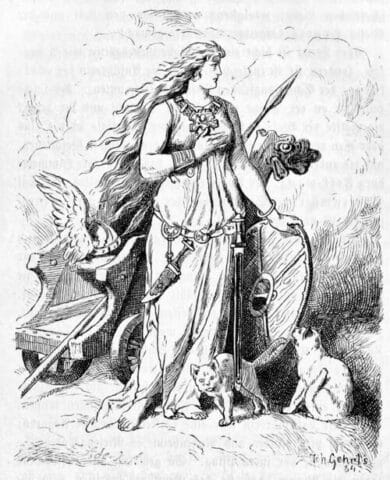
Freyr: Norse God of Fertility, Peace and Prosperity
Freyr was one of the most important Vanir gods in Norse mythology, associated with fertility, good harvests, peace, and prosperity. Snorri Sturluson describes him as a god who rules over rain, sunshine, and the fruits of the earth, and says people called on him for good seasons and peace.
He was the son of Njörðr and the brother of Freyja. Although Vanir by origin, Freyr became part of the wider divine community centered on the Æsir. The poem Grímnismál also connects him with Álfheimr, which the gods give him as a childhood gift.
Calling Freyr simply a “fertility god” therefore misses much of his role. His mythology brings together weather, crops, peace, wealth, and political stability, making him a god of abundance in a much broader sense.
His stories also contain a sharp contrast. Freyr is closely associated with peace and prosperity, yet in the story of Gerðr he gives away the extraordinary sword he will later need at Ragnarök. That choice connects some of his most important myths through desire, prosperity, kingship, and fate.
Who Was Freyr in Norse Mythology?
The surviving sources present Freyr as a major divine figure whose importance extends beyond any single function.
In Lokasenna, Týr describes him as foremost among heroes and says that he harms neither women nor men and frees captives from their bonds. Coming from a poem built around accusation and insult, the passage gives Freyr an unusually favorable reputation.
He is not primarily portrayed as a warrior, ruler, or trickster. His importance comes from the benefits associated with his presence: good seasons, peace, wealth, fertility, and social well-being.
His myths repeatedly place him where natural abundance and human prosperity meet, while later traditions also connect him with kingship, land, peace, and legitimate rule.
What Does the Name Freyr Mean?
The name Freyr is generally understood to mean “Lord” in Old Norse. It appears to have developed from a Germanic title rather than an ordinary personal name, with related forms in other Germanic languages carrying the sense of “lord” or “master.”
This raises the possibility that Freyr was originally a title rather than the god’s personal name. The later form Yngvi-Freyr may preserve that older pattern, with Freyr functioning as “Lord” alongside another divine name or identity.
Some scholars have proposed a different etymology connecting the name with fertility or generation. Olof Sundqvist notes arguments for a Proto-Scandinavian root meaning “fertile” or “generative,” although “Lord” remains the traditional and more widely accepted interpretation.
The original personal name behind the title, if there ever was one, is not securely known.
Was Freyr an Æsir or a Vanir God?
Freyr was Vanir by origin, but he became part of the divine community centered on the Æsir.
Skáldskaparmál explicitly calls him a “God of the Vanir.” Yet elsewhere in the Prose Edda, Freyr is counted among the Æsir and appears alongside them as one of the major gods.
The two descriptions reflect different aspects of his identity rather than a simple contradiction. Freyr retains his Vanir origin while living among, and participating in the society of, the Æsir.
So the clearest answer is straightforward: Freyr is a Vanir god who becomes fully integrated into the world of the Æsir.
Why Was Freyr Associated With Fertility, Peace and Prosperity?
Freyr’s connection with fertility was broader than reproduction alone. In Gylfaginning, Snorri says that he rules over rain, sunshine, and the fruits of the earth, and that people call on him for fruitful seasons and peace. He is also associated with human prosperity.
In an agricultural society, those ideas naturally belonged together. Reliable weather meant successful crops; successful crops meant food, wealth, and stability; peace allowed that prosperity to continue. Freyr’s role therefore links natural abundance with social well-being rather than fertility in a narrow sense.
The same pattern appears in Ynglinga saga. Freyr’s rule is remembered there as a time of good seasons, peace, and growing wealth, and the Swedes are said to have honored him especially because prosperity increased during his reign. The saga is not a straightforward historical record, but it preserves the same cluster of associations found elsewhere in the tradition.
Freyr and Álfheimr
Freyr has one of the most unusual territorial connections in Norse mythology: Álfheimr, the realm associated with the elves.
In Grímnismál, the gods give Álfheimr to Freyr as a tooth-gift, a present traditionally given to a child when its first tooth appeared. The poem does not explain why Freyr receives this particular realm, but the connection is explicit.
Snorri later describes Álfheimr as the dwelling place of the Light-Elves, yet he does not clearly say that Freyr rules the elves themselves. The sources therefore support a connection between Freyr and Álfheimr, but not the stronger modern claim that he was formally “king of the elves.”
Exactly what Freyr’s relationship with Álfheimr meant remains unclear. The surviving texts give him the realm, but do not explain the extent or nature of his authority there.
Freyr’s Family: Njörðr and Freyja
Freyr is the son of Njörðr and the brother of Freyja, one of the clearest family relationships preserved in the Norse sources.
Freyr and Freyja share strong associations with abundance and prosperity, but their roles are not identical. Freyja is more closely linked with love, desire, wealth, magic, and the slain, while Freyr is more consistently connected with good seasons, peace, prosperity, and the fertility of the land.
Freyr’s mother is less certain. In Lokasenna, Loki accuses Njörðr of fathering Freyr with his own sister, a tradition also reflected in later sources. That sister, however, is not given a secure personal name in the surviving texts.
So the clearest family picture is simple: Njörðr is Freyr’s father, Freyja is his sister, and the identity of his mother remains uncertain.
Freyr, Gerðr and the Sword He Gave Away
One of Freyr’s most important myths centers on Gerðr, daughter of the giant Gymir, and the weapon he gives up in order to pursue her.
In Skírnismál, Freyr sees Gerðr and becomes consumed by desire for her. He sends his servant Skírnir to seek her agreement, but Skírnir demands Freyr’s horse and his extraordinary sword, a weapon capable of fighting on its own when wielded by a worthy hero.
Gerðr initially refuses the gifts offered to her, including golden apples and Odin’s ring. Skírnir then turns to threats and magical coercion, and she finally agrees to meet Freyr after nine nights. The episode is therefore much less romantic than simplified retellings often suggest.
The cost to Freyr is lasting. By giving up the sword, he loses one of his greatest advantages, and that decision later becomes important at Ragnarök.
The story links desire with consequence: Freyr gains Gerðr, but only by surrendering something he will one day need.
Gullinbursti: Freyr’s Golden Boar
One of Freyr’s most recognizable attributes is the boar Gullinbursti, whose name means “Golden Bristles.”
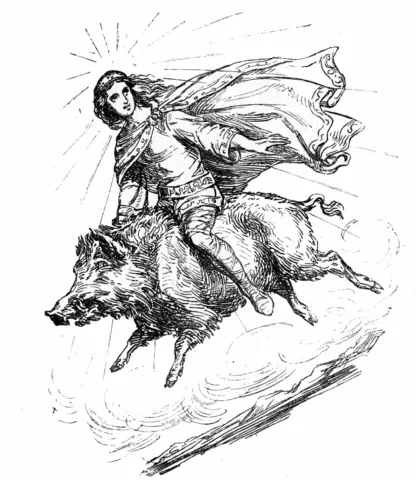
In Skáldskaparmál, Gullinbursti is created by the dwarf smith Sindri and given to Freyr during the contest sparked by Loki. The boar can run through air and water faster than any horse, and its golden bristles shine brightly enough to light the way in darkness.
Freyr is also shown riding the boar. Snorri quotes the skald Úlfr Uggason describing him arriving at Baldr’s funeral on a golden-bristled boar, which suggests that the association between Freyr and the animal predates Snorri’s own prose account.
The sources do not give Gullinbursti a single explicit symbolic meaning. What they do show clearly is that the golden boar was one of Freyr’s distinctive supernatural possessions and an established part of his mythological identity.
Skíðblaðnir: Freyr’s Magical Ship
Freyr’s other famous possession is Skíðblaðnir, a supernatural ship made by the sons of Ívaldi.
In Gylfaginning, Snorri calls it the finest of ships. It is large enough to carry all the Æsir with their weapons and equipment, yet when it is not needed, it can be folded up like cloth and carried in a pouch. Whenever its sail is raised, it also receives a favorable wind no matter where it is heading.
Skáldskaparmál confirms that the ship belongs to Freyr and preserves an older poetic reference describing the sons of Ívaldi making it for Njörðr’s son. This shows that Freyr’s connection with Skíðblaðnir was not created by Snorri’s prose account alone.
Together with Gullinbursti, Skíðblaðnir is one of the supernatural possessions most clearly associated with Freyr in the surviving sources.
Was Freyr Really Worshipped at Uppsala?
Freyr is strongly connected with Gamla Uppsala in medieval accounts of pre-Christian Swedish religion, but the evidence does not allow us to reconstruct his cult there in detail.
Around 1070, Adam of Bremen described a sanctuary at Uppsala containing images of Thor, Wodan, and Fricco, a figure usually identified with Freyr. Adam says Fricco brought peace and pleasure to mortals and was represented with an explicitly sexual symbol, while sacrifices to him were associated with marriage.
Adam was not an eyewitness. He wrote from Hamburg and relied on reports about Sweden, so his description cannot be treated as a direct record of the sanctuary exactly as it existed.
Archaeology nevertheless confirms that Gamla Uppsala was a major political and ceremonial center during the Late Iron Age, with monumental halls, burial mounds, processional features, workshops, and long-term elite activity. What has not been found is an inscription or cult image identifying a particular building specifically with Freyr.
The most careful conclusion is therefore that Freyr was probably important in the religious traditions associated with Uppsala, while the exact form of his worship and the accuracy of Adam’s famous temple description remain uncertain.
Freyr, Yngvi and Swedish Kingship
Freyr is closely tied to Swedish royal tradition through the name Yngvi-Freyr and the legendary Yngling dynasty.
In Ynglinga saga, Snorri presents Freyr as a ruler of the Swedes who succeeds Njörðr and establishes his seat at Uppsala. His reign is remembered as a period of peace, good harvests, and growing wealth.
The saga also says that Freyr was called Yngvi and that his descendants became known as the Ynglings. This made him the legendary ancestor of a royal line associated with Sweden and, in later saga tradition, with Norwegian kings.
That genealogy should not be read as straightforward history. Snorri presents the old gods as ancient rulers and ancestors, a form of euhemerism that turns divine figures into figures of the distant human past.
The importance of the tradition lies in what it says about Freyr’s later reputation. Yngvi-Freyr became connected not only with abundance, but with royal ancestry and the legitimacy of ruling dynasties.
How Does Freyr Die at Ragnarök?
Freyr dies at Ragnarök fighting the fire giant Surtr.
In Gylfaginning, Snorri says Freyr falls because he no longer has the sword he once gave to Skírnir. The consequence of that earlier decision becomes clear only at the final battle.
Völuspá also places Surtr among the forces advancing at Ragnarök, carrying fire as the world collapses, but the poem does not describe Freyr’s duel with him in the same detail.
Freyr’s death is therefore closely tied to an earlier episode in his mythology. He reaches Ragnarök without the extraordinary weapon he had surrendered in the story of Gerðr, and Surtr becomes the enemy he cannot overcome.
What the Sources Actually Tell Us About Freyr
Freyr’s mythology does not survive as one continuous story. What we know about him comes from several sources written down at different times and for different purposes.
The Poetic Edda preserves some of the oldest surviving poetic material, including Freyr’s connection with Álfheimr, Gerðr, and his peaceful reputation in Lokasenna.
The Prose Edda, written by Snorri Sturluson in the thirteenth century, brings many traditions together and supplies much of the detailed narrative that survives about Freyr. It is essential evidence, but it was written in Christian Iceland long after the conversion of Scandinavia.
Ynglinga saga preserves a different kind of tradition, linking Freyr with Swedish kingship and ancestry, while Adam of Bremen offers an outside Christian account of worship at Uppsala.
These sources are most useful when compared rather than treated as parts of a single perfectly consistent tradition. Together, they show Freyr as a Vanir god strongly associated with abundance, peace, prosperity, and high status, while leaving many details of his original worship uncertain.
Conclusion
Freyr is often described simply as a fertility god, but the surviving sources give him a much broader role. He is associated with good seasons, peace, wealth, prosperity, kingship, and the stability that allows communities to flourish.
His mythology also shows how those ideas connect with personal stories of desire, status, and fate, especially in the tale of Gerðr and the sword he gives away.
Taken together, the evidence presents Freyr as a god of abundance in the broadest sense, not only of fertility, but of the natural and social conditions that make prosperity possible.
Academic & Primary Sources
- Gunnell, Terry, Jens Peter Schjødt & Olof Sundqvist (eds.).
The Old Norse God Freyr: New Perspectives in Mythology and Religion.
Kungl. Gustav Adolfs Akademien, 2025. Open-access academic volume devoted entirely to Freyr, his mythology, cult, names, functions, and surviving evidence. - Sundqvist, Olof. “On Freyr: The ‘Lord’ or ‘the Fertile One’?”
Onoma 48 (2013), pp. 11–35. Academic study of the name Freyr, its meaning, and the god’s connections with fertility, peace, rulership, and political authority. - Snorri Sturluson, Prose Edda: Gylfaginning and Skáldskaparmál.
Bibliotheca Polyglotta, University of Oslo. Primary source for Freyr’s family, fertility and prosperity associations, Gullinbursti, Skíðblaðnir, Gerðr, and his death at Ragnarök. - Skírnismál, Poetic Edda.
Bibliotheca Polyglotta, University of Oslo. Primary poetic source for Freyr’s desire for Gerðr, Skírnir’s mission, and the surrender of Freyr’s sword. - Grímnismál, Poetic Edda.
Bibliotheca Polyglotta, University of Oslo. Primary source for the tradition that the gods gave Álfheimr to Freyr as a tooth-gift. - Ljungkvist, John & Per Frölund. “Gamla Uppsala – the Emergence of a Centre and a Magnate Complex.”
Journal of Archaeology and Ancient History. Archaeological study of Gamla Uppsala, its monumental halls, elite activity, and development as a major political and ceremonial center.