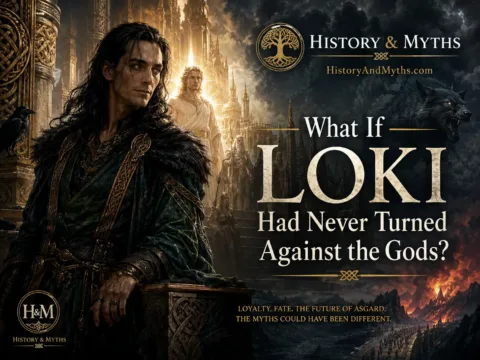
What If Loki Had Never Turned Against the Gods? Norse Myth Scenarios
Loki was never a simple enemy of the Norse gods. He caused disasters, deceived allies, and repeatedly pushed the Æsir into danger, but he also helped them escape crises and recover some of their most valuable possessions. For much of Norse mythology, he remained an unstable part of their world rather than an open opponent.
That changes with Baldr.
In the best-known surviving account, Loki discovers the one substance that can harm Baldr, gives the mistletoe to the blind Höðr, and guides the fatal attack. After Baldr’s death, Loki’s relationship with the gods collapses. He is eventually bound and punished, and at Ragnarök he appears among the forces fighting against the Æsir.
But what if Loki never crossed that line?
Baldr could remain alive, Loki might never suffer the punishment that turns him into a captive enemy, and Asgard could enter Ragnarök with both of them still present. That would not automatically prevent the final battle. Fenrir, Jörmungandr, Surtr, and the wider forces threatening the gods would still exist.
The real question is therefore not whether a loyal Loki could erase Ragnarök. It is whether the gods would face it stronger, with one fewer enemy, a surviving Baldr, and the most unpredictable figure in Norse mythology still on their side.
The Mythological Turning Point
Loki’s final break with the gods is most clearly tied to the death of Baldr.
In Snorri Sturluson’s Prose Edda, Baldr begins having dreams that warn of his death. Frigg responds by taking oaths from nearly everything in the world not to harm him. The gods then amuse themselves by throwing weapons and objects at Baldr because nothing can injure him.
Loki discovers the exception. Disguised as a woman, he learns from Frigg that mistletoe was considered too young to swear the oath. He takes it to Höðr, Baldr’s blind brother, places the weapon in his hands, and directs his throw. Baldr is killed instantly. Snorri describes the death as a catastrophic loss for the Æsir, especially for Odin.
The gods later attempt to recover Baldr from Hel, but the effort fails when the figure Þökk refuses to weep for him. Snorri identifies Þökk as Loki in disguise. Loki is eventually captured and subjected to the punishment that leaves him bound until Ragnarök.
This is the turning point for our scenario.
Loki remains unpredictable, deceptive, and dangerous, but he never engineers Baldr’s death and never takes the final steps that turn him into an open enemy of the gods.
The Scenario Used in This Article
This is a hypothetical scenario, not a claim about what actually happened.
This article assumes that Loki remains the same dangerous trickster found throughout Norse mythology, but he never deliberately turns against the Æsir.
His earlier deceptions, bargains, and conflicts still occur. Fenrir, Jörmungandr, and Hel already exist, and the major forces associated with Ragnarök remain part of the mythic world.
The point of divergence comes with Baldr. Loki does not discover and exploit the mistletoe weakness, does not guide Höðr into killing Baldr, and does not prevent Baldr’s return from Hel.
As a result, Baldr remains alive and Loki is never subjected to the punishment that leaves him bound until Ragnarök.
This scenario does not assume that Loki suddenly becomes virtuous or obedient. He remains unpredictable and capable of causing trouble. What changes is that he never becomes an open enemy of the gods.
The central question is therefore:
Would Ragnarök still unfold the same way if Loki remained on the side of the Æsir?
Would Baldr Still Die?
Probably not in the way preserved by Snorri.
Baldr’s death depends on a very specific chain of actions. Loki learns that mistletoe is the only thing not bound by Frigg’s oath, obtains it, gives it to the blind Höðr, and directs his aim. Without Loki’s intervention, Höðr has neither the weapon nor the knowledge needed to kill Baldr.
That makes Baldr’s survival the clearest immediate consequence of this scenario.
It would be too strong, however, to call him permanently immortal. The sources only show that Frigg’s protections made him invulnerable to the things that had sworn not to harm him. They do not establish that Baldr could never die under any possible circumstances.
What changes is the known sequence of events. The fatal mistletoe strike never occurs, the gods do not lose one of their most beloved figures, and the attempt to recover Baldr from Hel is never needed.
Baldr therefore remains in Asgard, and the Æsir avoid a loss that Snorri explicitly describes as one of their greatest disasters.
Would Loki Still Be Bound and Punished?
Probably not in the same way.
Loki’s brutal punishment comes after his conflict with the gods has reached its breaking point. In Snorri’s account, he is hunted down, captured, and bound with the entrails of his son, while a serpent drips venom above him. He remains imprisoned until Ragnarök.
If Loki never engineers Baldr’s death or prevents his return, the strongest reason for that final punishment disappears. He could still anger the Æsir through insults, deception, or reckless schemes, but those earlier offenses had repeatedly ended with Loki remaining inside their world rather than being permanently cast out.
That distinction matters. A free Loki would enter the period before Ragnarök as an unpredictable member of the divine community, not as a tortured enemy waiting to break loose.
He might still face punishment for future misconduct, but there would be no clear reason for the specific imprisonment that turns his relationship with the gods into open hostility.
Without Baldr’s death, Loki is far more likely to remain dangerous, distrusted, and useful than permanently bound beneath the earth.
Would Loki Remain a Dangerous but Valuable Ally?
Most likely, yes.
Loki’s usefulness to the Æsir is easy to overlook because many of his stories begin with trouble he helped create. Yet the same stories repeatedly depend on his intelligence, mobility, disguise, or willingness to deal with beings the other gods cannot easily manage.
When Iðunn is taken by Þjazi, Loki is responsible for luring her out of Asgard, but he is also the one forced to recover her and bring back the apples that preserve the gods’ youth. In Þrymskviða, Loki helps Thor recover Mjölnir after the hammer is stolen, and older Eddic scholarship explicitly notes his recurring role as the gods’ helper and Thor’s companion.
That pattern would probably continue in this scenario.
The gods would not suddenly trust Loki. His lies, insults, bargains, and reckless schemes would still make him difficult to tolerate. But there is an important difference between distrusting someone and treating him as an enemy.
If Loki never crosses that final line, Asgard keeps access to a figure who understands giants, can change shape, improvises under pressure, and often succeeds precisely because he does not think like the other gods.
He would remain a liability.
He would also remain one of the most useful liabilities the Æsir possessed.
Would Baldr’s Survival Make Asgard Stronger?
Yes, although not necessarily in a military sense.
The surviving sources do not present Baldr as a great battlefield champion like Thor. His importance lies elsewhere. Snorri describes his death as an enormous loss to the Æsir and says Odin understood better than anyone how damaging it would be for the gods.
Keeping Baldr alive would therefore preserve an important figure inside Asgard at a time when the divine order was moving toward Ragnarök. The gods would avoid the grief surrounding his death, the failed attempt to recover him from Hel, and the chain of events that deepens Loki’s conflict with them.
His survival would also remove one of the clearest signs that the old order was beginning to break apart.
That does not mean Baldr would suddenly become Asgard’s strongest warrior or prevent Ragnarök by himself. The sources give us no basis for that.
The advantage is simpler: Asgard enters the final crisis without suffering one of its most devastating losses beforehand.
Would Loki’s Children Still Turn Against the Gods?
Possibly, because their hostility toward the gods does not depend entirely on Loki’s later betrayal.
Fenrir is already feared and bound because the gods believe he will become dangerous. Jörmungandr is cast into the sea, where he grows into the serpent that encircles Midgard. Hel is sent to rule over the dead who do not fall in battle. These fates are established long before Loki’s final break with the Æsir.
That means a loyal Loki would not automatically make his children loyal as well.
Fenrir would still have strong reason to hate the gods who deceived and chained him. Jörmungandr’s conflict with Thor could still develop independently, and Hel would continue ruling her own realm rather than becoming an ally of Asgard simply because of her father’s choices.
Loki’s loyalty might affect how he responds to them, but it would not erase the grievances and prophecies already attached to his children.
The gods could therefore keep Loki on their side and still face the same dangerous family at Ragnarök.
Would Fenrir Still Kill Odin?
Possibly. Loki’s loyalty would not erase Fenrir’s fate.
In both Vafþrúðnismál and later accounts of Ragnarök, Fenrir kills Odin and is then slain by Odin’s son Víðarr. That confrontation is tied to Fenrir himself, not to Loki commanding him during the battle.
Fenrir would also still have every reason to hate the Æsir. The gods feared his growth, deceived him into testing the magical binding Gleipnir, and left him chained until Ragnarök. None of those events depends on Loki later turning against the gods.
So even if Loki remained loyal, Odin would still face the same enemy.
What could change is the situation around that confrontation. A living Baldr, an unbound Loki, and fewer internal losses might leave Asgard better prepared when Fenrir breaks free. That could affect the battle, but the surviving sources give no basis for claiming that Loki could simply prevent Odin’s death.
The safest conclusion is that Odin would remain in serious danger. Loki’s loyalty weakens the forces opposing Asgard, but it does not remove the wolf already destined to face the Allfather.
Would Thor and Jörmungandr Still Destroy Each Other?
Probably. Their hostility exists independently of Loki’s later betrayal.
Thor confronts Jörmungandr long before Ragnarök in the fishing episode preserved in Hymiskviða and retold by Snorri. Thor hooks the serpent and nearly strikes it with Mjölnir before it escapes back into the sea. Their conflict is therefore already established without Loki directing either side.
At Ragnarök, Snorri gives the confrontation a clear ending. Thor kills the Midgard Serpent, walks nine steps away, and then dies from its venom. Loki is fighting elsewhere against Heimdall and does not control this encounter.
That makes this one of the events least likely to disappear in our scenario.
A loyal Loki might strengthen Asgard overall, but there is no strong reason to think Jörmungandr would abandon its ancient enemy or that Thor would avoid the serpent once Ragnarök began.
Their final battle would therefore probably still happen, and Thor could still die even in a version of Ragnarök where Loki never turns against the gods.
Would Ragnarök Still Happen?
Probably, but not in exactly the same form.
Loki is important to Ragnarök, but he is not its only cause. By the time the final battle begins, Fenrir is already bound and waiting to break free, Jörmungandr is already Thor’s enemy, and Surtr leads the forces of Muspell against the gods. Snorri’s account places Loki among these enemies, but the destruction of the world is driven by several independent threats.
That means removing Loki’s betrayal does not remove Ragnarök itself.
What it changes is the balance of power. Loki would no longer arrive with the forces opposing the Æsir, Baldr would still be alive, and the gods would avoid some of the internal losses that weaken them before the final conflict.
The result could therefore be a less disastrous Ragnarök for Asgard, but not necessarily no Ragnarök at all.
Fenrir could still face Odin. Jörmungandr could still fight Thor. Surtr could still bring fire against the gods. Those dangers exist beyond Loki’s personal choices.
The strongest conclusion is that Loki’s loyalty might change the outcome of Ragnarök more than its existence.
Read More
Which Side Would Loki Choose at Ragnarök?
If Loki never turned against the gods, he would have little reason to join the forces attacking Asgard.
In the surviving tradition, his final role is openly hostile. Völuspá places him with the forces arriving against the gods, while Snorri has him fight Heimdall, with both killing each other.
Our scenario removes the events that create that break. Loki never engineers Baldr’s death, is never bound beneath the earth, and remains part of the Æsir’s world. The most plausible outcome is therefore that he does not fight against them at Ragnarök.
That does not make his choice simple. Fenrir, Jörmungandr, and Hel are his children, and several of them remain enemies of the gods regardless of Loki’s loyalty. There is no surviving myth that tells us how he would respond if forced to choose between Asgard and his own family.
He might fight beside the Æsir, avoid direct conflict with his children, or use deception rather than take a conventional place on the battlefield.
What becomes far less likely is the traditional outcome: Loki arriving as one of Asgard’s enemies and dying in combat with Heimdall.
Could Loki Help the Gods Survive Ragnarök?
Possibly, and this may be the biggest advantage of keeping Loki inside Asgard.
Loki is not the Æsir’s strongest fighter, but strength is not what makes him dangerous. His value comes from deception, shapeshifting, negotiation, and his familiarity with giants and other beings outside the gods’ usual circle.
Those same qualities repeatedly help the Æsir escape problems earlier in the myths. At Ragnarök, they could be used differently: misleading enemies, disrupting alliances, gathering information, or creating openings that brute force alone could not achieve.
That would not let Loki defeat Fenrir, Jörmungandr, or Surtr by himself. The sources give no basis for turning him into a battlefield savior.
But a loyal Loki would give the gods something they largely lack in the final conflict: an ally who understands how their enemies think.
He might not stop Ragnarök. He could still make Asgard much harder to destroy.
What Would Probably Not Change
Loki’s loyalty would not erase the forces already moving toward Ragnarök.
Fenrir would still be bound and hostile, Jörmungandr would still remain Thor’s enemy, and Surtr would still threaten the gods from Muspell. Odin would continue preparing for the final conflict, while the broader destruction associated with Ragnarök would remain possible.
What changes is the position from which Asgard faces that crisis.
Baldr remains alive, Loki is not an enemy, and Heimdall no longer has the same fatal opponent. Ragnarök may still come, but the gods would enter it with fewer losses and a stronger internal position.
Most Likely
The most likely outcome is that Ragnarök still happens, but Asgard faces it in a stronger position.
Baldr remains alive, Loki is not fighting against the gods, and Heimdall no longer has the same fatal duel waiting for him. Fenrir, Jörmungandr, and Surtr still pose the major threats, so the final conflict does not disappear.
Loki’s loyalty therefore changes the balance more than the prophecy itself. The gods gain an extra ally and avoid several losses before the battle begins.
Plausible but Uncertain
Several outcomes become possible, but none are guaranteed.
Loki might fight beside the Æsir, Heimdall could survive, and Baldr’s presence might strengthen the gods before the final battle. Odin could also face Fenrir with more support than in the traditional account.
It is even possible that Loki would try to avoid direct conflict with his own children while still helping Asgard against Surtr and the giants.
These changes could reduce the losses suffered at Ragnarök, but the surviving myths do not give enough evidence to say how far that advantage would go.
Highly Unlikely
The least convincing outcome is that Loki’s loyalty prevents Ragnarök entirely.
Fenrir, Jörmungandr, and Surtr would still exist, and their conflicts with the gods do not depend solely on Loki. It is also unlikely that Fenrir would become friendly, that Thor would avoid Jörmungandr, or that every god would survive simply because Loki remained loyal.
Loki himself would not suddenly become perfectly trustworthy or heroic.
The stronger scenario is a changed Ragnarök, not a cancelled one.
Final Verdict: Loki’s Loyalty Might Not Stop Ragnarök, but It Could Change Who Survives It
If Loki never turned against the gods, Ragnarök would probably still happen. Fenrir, Jörmungandr, Surtr, and the wider forces threatening Asgard would remain.
What changes is the condition of the gods when the final battle begins.
Baldr would still be alive, Loki would remain free and potentially useful, and Heimdall would no longer be destined to die fighting him. Asgard would enter Ragnarök with fewer internal losses and one of its most unpredictable figures still on its side.
That would not guarantee victory.
But Loki’s betrayal may have made the end of the gods worse than it needed to be. A loyal Loki might not prevent Ragnarök, yet he could change who survives it and how much of Asgard remains afterward.
Frequently Asked Questions
Was Loki always an enemy of the Norse gods?
No. Loki causes many problems for the Æsir, but he also travels with them, helps recover stolen possessions, and solves crises in several Norse myths. His role becomes openly hostile later, especially in traditions surrounding Baldr’s death and Ragnarök.
What would happen if Loki never turned against the gods?
Baldr would most likely survive the mistletoe attack, Loki would probably avoid his later imprisonment, and Asgard would enter Ragnarök with fewer internal losses. Loki could remain a dangerous but useful ally rather than becoming one of the gods’ enemies.
Would Baldr still die without Loki’s betrayal?
Probably not in the way described by Snorri. Loki discovers Baldr’s weakness to mistletoe, gives it to Höðr, and guides the fatal attack. Without that intervention, the known chain of events leading to Baldr’s death does not occur.
Would Ragnarök still happen if Loki remained loyal?
Probably. Ragnarök involves threats that exist independently of Loki, including Fenrir, Jörmungandr, Surtr, and other enemies of the gods. Loki’s loyalty could change the balance of the final battle without preventing it entirely.
Would Fenrir and Jörmungandr still fight the gods?
Most likely. Fenrir is already bound by the gods, while Jörmungandr has an established rivalry with Thor. Their hostility does not depend entirely on Loki becoming an enemy of the Æsir.
Could more Norse gods survive Ragnarök if Loki stayed loyal?
Possibly. Baldr would enter the crisis alive, Loki would no longer fight against Asgard, and Heimdall would lose the opponent who kills him in the traditional account. Odin and Thor would still face Fenrir and Jörmungandr, however, so greater survival would not be guaranteed.
Sources & Further Reading
This article draws on the Poetic Edda, Snorri Sturluson’s Prose Edda, and modern scholarship on Loki, Baldr, Ragnarök, divine conflict, and the surviving Old Norse mythological tradition.
BALDR, LOKI & THE BREAK WITH THE GODS
Snorri Sturluson, Prose Edda, Gylfaginning.
The principal detailed source for Baldr’s invulnerability, Loki’s discovery of the mistletoe weakness, Höðr’s fatal throw, the failed attempt to recover Baldr from Hel, and Loki’s later punishment.
Poetic Edda, Baldrs draumar.
An important Eddic poem centered on Baldr’s ominous dreams and Odin’s attempt to learn why preparations are being made for Baldr in the realm of Hel.
LOKI AS TRICKSTER & ALLY
Snorri Sturluson, Prose Edda, Skáldskaparmál.
Preserves several myths in which Loki causes serious problems for the gods but also helps resolve them, including traditions involving Iðunn and the acquisition of important divine treasures.
Poetic Edda, Þrymskviða.
Shows Loki working with Thor after Mjölnir is stolen, demonstrating his recurring role as an unconventional but useful companion of the Æsir.
Poetic Edda, Lokasenna.
Presents Loki in open verbal conflict with the gods and preserves one of the clearest poetic portraits of his increasingly hostile relationship with the divine community.
FENRIR, JÖRMUNGANDR & LOKI’S CHILDREN
Snorri Sturluson, Prose Edda, Gylfaginning.
Gives the most extensive prose account of Fenrir, Jörmungandr, and Hel, including the gods’ fear of Loki’s children, Fenrir’s binding, and Jörmungandr’s placement in the sea around Midgard.
Poetic Edda, Hymiskviða.
Preserves the famous fishing encounter between Thor and Jörmungandr, showing that their hostility exists independently of Loki’s later role at Ragnarök.
RAGNARÖK & THE FATE OF THE GODS
Poetic Edda, Völuspá.
One of the most important sources for Ragnarök, including the breaking of bonds, the advance of hostile forces, the deaths of major gods, cosmic destruction, and the renewed world that follows.
Poetic Edda, Vafþrúðnismál.
Preserves prophetic material concerning Ragnarök, Odin’s death at the jaws of Fenrir, Víðarr’s vengeance, and gods who survive the final catastrophe.
Snorri Sturluson, Prose Edda, Gylfaginning.
Provides the fullest continuous medieval account of Ragnarök, including Fenrir against Odin, Thor against Jörmungandr, Surtr’s attack, and the fatal confrontation between Loki and Heimdall.
MODERN SCHOLARSHIP ON LOKI
James Parkhouse.
Loki the Slandered God? Selective Omission of Skaldic Citations in Snorri Sturluson’s Edda.
A specialist study of Loki’s complex character and the possibility that Snorri’s presentation emphasizes his antagonistic side more strongly than some earlier poetic traditions.
Anna Birgitta Rooth.
Loki in Scandinavian Mythology.
A major scholarly study of the varied traditions surrounding Loki and the difficulty of reducing him to a single role such as villain, trickster, or enemy of the gods.
MAJOR NORSE MYTHOLOGY REFERENCES
John Lindow. Old Norse Mythology. Oxford University Press, 2021.
John Lindow. Norse Mythology: A Guide to the Gods, Heroes, Rituals, and Beliefs. Oxford University Press.
Rudolf Simek. Dictionary of Northern Mythology. D. S. Brewer.
Margaret Clunies Ross. Prolonged Echoes: Old Norse Myths in Medieval Northern Society. Odense University Press.
Carolyne Larrington. The Poetic Edda. Oxford World’s Classics.
Research note: Norse mythology does not survive as a single fixed canon. Much of the evidence comes from medieval Icelandic manuscripts written after the conversion to Christianity, and the surviving sources sometimes preserve different or incomplete versions of the same myths. Snorri’s Prose Edda gives the clearest account of Loki causing Baldr’s death, while the Poetic Edda preserves older poetic traditions concerning Baldr, Loki, Fenrir, Jörmungandr, and Ragnarök. The alternate outcome explored in this article is therefore an analytical scenario based on these sources, not a lost Norse myth or a claim about what pre-Christian Scandinavians believed would have happened.
Copyright & Use
Written by H. Moses
This article is original content published by History & Myths. Its alternate-history analysis, structure, and written interpretation may not be reproduced, republished, or redistributed in full without permission.
Short quotations may be used for reference or discussion when accompanied by clear attribution and a link to the original article on HistoryAndMyths.com.