The Dream of Rhonabwy: A Strange Vision of King Arthur
Rhonabwy falls asleep on a yellow calfskin in a filthy house in medieval Wales and dreams of King Arthur’s world. There, a magnificent army prepares for battle against the Saxons, but Arthur is absorbed in a board game with Owain while their followers fight and die. The contrast between royal splendor and the violence unfolding around the two leaders makes this an unusual Arthurian story.
The Dream of Rhonabwy (Breuddwyd Rhonabwy) raises questions that go beyond its extraordinary events. Its disrupted chronology, elaborate descriptions, and unflattering portrayal of Arthur have prompted competing interpretations. Is the tale criticizing medieval Welsh rulers, mocking the conventions of heroic storytelling, or questioning how the past is remembered? Scholars disagree, and the surviving text offers evidence for more than one reading.
What Is The Dream of Rhonabwy, and When Was It Written?
The Dream of Rhonabwy is an anonymous Welsh prose tale traditionally included in the Mabinogion, although it stands apart from the Four Branches of the Mabinogi. It survives in a single medieval manuscript, the Red Book of Hergest (Jesus College MS 111), copied between 1382 and around 1400. Its absence from the White Book of Rhydderch, which preserves several other Mabinogion tales, leaves scholars without a second medieval version for textual comparison.
The date of composition is disputed. Helen Fulton places the work in the first half of the thirteenth century, while historian David Stephenson favors the late thirteenth century. Other scholars have considered an early fourteenth-century date, partly on the evidence of the armor and heraldic details described in the story.
The narrative itself begins during the reign of Madog ap Maredudd, ruler of Powys until his death in 1160, before shifting into Arthur’s legendary past. These settings should not be confused with the date of composition. The author was looking back on an earlier Welsh political world while drawing upon traditions of Arthur that were already well established.
How Does Rhonabwy Enter Arthur’s World?
The story opens with a dispute between Madog ap Maredudd, ruler of Powys, and his brother Iorwerth, who resents his lesser position. Madog offers him the office of master of the household, but Iorwerth refuses and leads destructive raids into England. Rhonabwy joins the men sent to find him, travelling with Cynwrig Frychgoch and Cadwgan Fras.
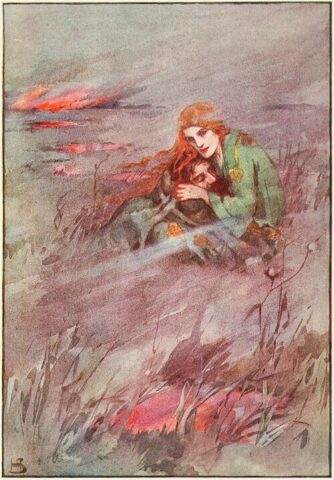
The three seek shelter at the house of Heilyn Goch, a squalid hall filled with smoke, mud, and cattle dung. A storm prevents them from leaving, and they settle onto bedding infested with vermin. Unable to sleep, Rhonabwy moves to a yellow calfskin lying on the floor. The narrator describes it as a particularly fortunate place to rest, setting it apart from everything else in the neglected house.
As Rhonabwy falls asleep, he dreams that he and his companions are crossing the plain of Argyngroeg towards Rhyd y Groes, a ford on the River Severn. The landscape remains recognizably Welsh, but the approaching horseman will soon bring them into Arthur’s legendary world.
Who Is Iddawg, Rhonabwy’s Guide?
The first rider Rhonabwy meets is Iddawg ap Mynio, known as Iddawg Cordd Prydain, the Agitator of Britain. His fierce appearance frightens the travellers, while his horse has an extraordinary power: its breath drives them backwards when it exhales and draws them closer when it inhales. Despite this intimidating arrival, Iddawg promises them safety.
His nickname comes from his role in the Battle of Camlann. Iddawg admits that Arthur sent him to negotiate peace with his nephew Medrawd (Mordred), hoping to prevent the deaths of Britain’s noblemen. Eager for battle, Iddawg deliberately turned Arthur’s conciliatory messages into insults, helping provoke the conflict. He abandoned the fighting shortly before its end and spent seven years performing penance at Llech Las in northern Britain, eventually receiving forgiveness.
Iddawg now serves as Rhonabwy’s guide, identifying Arthur’s warriors and explaining unfamiliar sights. After they meet Arthur, he draws Rhonabwy’s attention to a stone in the emperor’s ring, explaining that seeing it will allow him to remember the dream.
There is a revealing irony in his position. A former messenger who once distorted another man’s words now becomes Rhonabwy’s chief source of information. His story introduces a recurring concern in the tale: how messages are delivered, understood, and acted upon, particularly when the consequences involve war.
What Does Rhonabwy See at Arthur’s Court?
Rhonabwy finds Arthur at a military encampment beside the River Severn, seated on a small island near the ford with Bishop Bedwini and Gwarthegyd son of Kaw. When Iddawg introduces the visitors, Arthur mocks their small stature and laments that men so inferior to Britain’s former warriors now defend the island.
The gathering reflects Arthur’s imperial status. Among his forces are warriors from Norway, commanded by March son of Meirchion, and Denmark, led by Edeyrn son of Nudd. The Norwegian troops wear white with black borders, while the Danish warriors display the reverse colors. Their carefully matched horses and banners add to the spectacle.
Despite the army’s magnificence, Caradawg Strong Arm, Arthur’s chief adviser, must remind him that his forces have promised to reach the Battle of Badon by midday to confront Osla Big Knife. Arthur agrees, and the army advances towards Caer Badou.
Disorder follows. When Cai (Kay) rides through the assembled troops, soldiers rush to watch him or retreat to avoid his powerful horse. Rhonabwy mistakes the commotion for an army in retreat, prompting Iddawg to warn him against suggesting that Arthur could ever withdraw from battle. Order returns only when Cadwr, Earl of Cornwall, draws Arthur’s sword, decorated with two golden serpents whose mouths appear to release flames.
The scene presents Arthur’s military power through impressive warriors and ceremonial displays, but also shows an army easily distracted from its purpose. Even the emperor’s authority requires a dramatic display of his sword to restore discipline.
Why Do Arthur and Owain Keep Playing Gwyddbwyll?
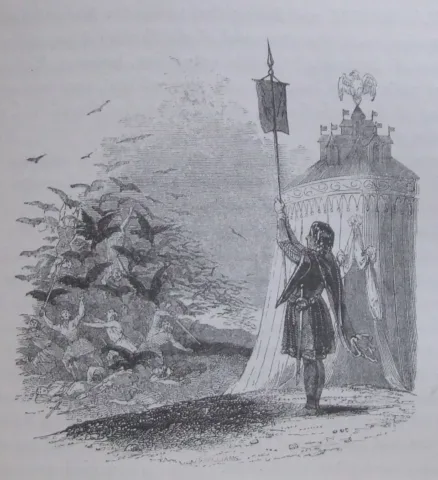
Arthur invites Owain, son of Urien, to play gwyddbwyll, a Welsh board game often translated as chess, although its exact rules remain uncertain. They use golden pieces on a silver board while Arthur’s attendants begin attacking Owain’s ravens.
Three messengers report the attacks to Owain, who repeatedly asks Arthur to restrain his men. Arthur refuses, insisting that they continue playing. After the third warning, Owain orders Gwres son of Rheged to raise his banner. The ravens regain their strength and turn on Arthur’s warriors, carrying men into the air and tearing them apart.
The pattern then reverses. Three messengers bring Arthur reports of mounting casualties, but Owain responds to his appeals with the same indifference. Finally, Arthur crushes the golden game pieces into dust. Owain orders his banner lowered, and the fighting ends.
The repeated exchanges expose the failure of both leaders to intervene while their own followers suffer. The game mirrors the conflict, although the text does not establish that moves on the board directly determine the fighting. Owain’s banner visibly changes the battle, while Arthur’s destruction of the pieces brings the contest to an end. Whether that act represents surrender or a rejection of further competition remains open to interpretation. Either way, peace comes only when the leaders stop playing.
Why Is Time Out of Order in Rhonabwy’s Dream?
Rhonabwy encounters a contradiction in Arthurian chronology. Iddawg speaks of the Battle of Camlann as an event already past, yet Arthur’s army is preparing for Badon, traditionally fought earlier. The Annales Cambriae, a medieval Welsh chronicle, places Badon in 516 and Camlann in 537. These dates are not securely established historical facts, but they show the sequence preserved in medieval tradition.
Scholars have offered different explanations for this reversal. Edgar Slotkin argued that the narrative deliberately moves backwards through Arthurian history, from the catastrophe of Camlann towards the earlier age of Badon. Sam Lasman examines the dream as a form of time-travel fiction, in which Rhonabwy’s encounter with the legendary past disrupts ordinary relationships between cause and consequence.
The expected Battle of Badon never takes place. Instead, twenty-four representatives of Osla Big Knife arrive requesting a truce for a month and a fortnight. Arthur summons his advisers, and Cadyriath son of Saidi supports the proposal. Cai later speaks of the truce as being in effect, although the narrative never describes a formal declaration of peace.
This unexpected outcome gives the reversed chronology particular significance. Rhonabwy approaches a celebrated Arthurian victory that the story refuses to show, while the disastrous conflict at Camlann has supposedly already occurred. The dream rearranges familiar history without offering a definitive explanation for the reversal.
What Do the Colors and Strange Descriptions Mean?
The Dream of Rhonabwy repeatedly interrupts its action to describe clothing, horses, and weapons in extraordinary detail. Iddawg wears yellow silk embroidered with green, another rider’s red garments are compared to blood, and even messengers carrying urgent news receive elaborate descriptions of their appearance and equipment. At times, the narrator devotes more attention to what a messenger wears than to the news he brings.
Could these colors carry hidden meanings? Catherine McKenna compares them with medieval Welsh dream books, which assigned meanings to particular images. One text associated a red tunic with hell, while riding a red horse signified good news. Such interpretations become difficult to apply when Rhonabwy encounters horses and garments combining several colors.
McKenna also notes that the four dominant colors, black, white, red, and yellow, correspond to the four bodily humors recognized in medieval medicine. Dream imagery could be interpreted as evidence of bodily imbalance, but the mixture of colors in Rhonabwy’s vision offers no reliable diagnosis.
The descriptions make Arthur’s world vivid while resisting straightforward interpretation. The dream contains an abundance of potentially meaningful details, but no consistent system for explaining them.
Read Also
Is The Dream of Rhonabwy a Satire of King Arthur?
Many scholars interpret The Dream of Rhonabwy as satire, although they disagree about its target. Helen Fulton sees Arthur’s unflattering portrayal as a comic criticism of kingship and the heroic reputation built around him.
The contrast with Culhwch and Olwen is revealing. There, Arthur mobilizes his warriors to accomplish an extraordinary quest. In Rhonabwy, his imperial status is repeatedly undermined. One horseman recklessly rides through a ford, splashing Arthur, his bishop, and their advisers with water. The grandeur of the royal gathering sits uneasily beside such moments of disorder.
The criticism may also reflect contemporary Welsh politics. Fulton connects Arthur’s portrayal with the ambitions of Llywelyn the Great. A different interpretation, proposed by historian Rees Davies and discussed by David Stephenson, suggests that Arthur’s contempt for Britain’s diminished defenders may allude to the numerous descendants of Gruffudd ap Gwenwynwyn who shared power in Powys during the late thirteenth century. Both readings depend partly on the disputed date of composition, and neither can establish the author’s intentions with certainty.
Ceridwen Lloyd-Morgan emphasizes the tale’s literary satire. Rather than parodying a single Arthurian romance, it appears to challenge familiar conventions of heroic storytelling. The elaborate gathering of warriors promises great deeds, but ceremonial displays and distractions repeatedly take precedence over action.
The satire may therefore extend beyond Arthur himself to the political and literary traditions that celebrated powerful rulers. Whether the author had particular Welsh princes in mind remains unresolved.
Why Does the Dream End Without an Explanation?
The dream’s final scenes bring poets and royal advisers into focus. At Arthur’s council, the poets perform verses that only the young adviser Cadyriath can fully understand, apart from their praise of Arthur. Twenty-four pack animals then arrive carrying gold and silver as tribute from the Islands of Greece. Cadyriath proposes rewarding the poets with this wealth and paying them during the truce. Shortly afterwards, Cai calls Arthur’s followers to assemble in Cornwall. The resulting uproar awakens Rhonabwy on the yellow calfskin, after three days and three nights. His search for Iorwerth is never resolved.
The narrator then makes an unusual claim: neither a poet nor a professional storyteller (cyfarwydd) could know the dream without a book, because of its countless descriptions of horses, weapons, garments, and precious stones.
Scholars disagree about the significance of this remark. Sioned Davies sees it as evidence that the tale was probably composed as a written work rather than inherited directly from oral storytelling. Catherine McKenna suggests an additional possibility: the reference to a book may evoke medieval dream manuals, inviting readers to seek explanations that the bewildering vision refuses to provide.
The preceding scene gives the ending another dimension. Even Arthur’s poets perform words that almost nobody understands. Earlier, Iddawg promised that a stone in Arthur’s ring would preserve Rhonabwy’s memory of the dream, yet the narrative never explains how that private experience became a written account. As Sam Lasman observes, the tale leaves the relationship between experience, memory, and storytelling unresolved.
Conclusion
The Dream of Rhonabwy offers neither the heroic victory expected from an Arthurian tale nor a clear explanation of its extraordinary vision. The anticipated battle gives way to a truce, Rhonabwy’s original mission remains unresolved, and the narrator leaves readers questioning how such an elaborate dream could be preserved.
Whether the author intended political satire, literary parody, or both remains uncertain. What distinguishes the tale is its willingness to question the authority of Arthur’s legendary past rather than simply celebrate it.
Sources & Primary Texts
Primary Texts and Translation
Red Book of Hergest (Jesus College MS 111)
. Bodleian Libraries, University of Oxford. The surviving medieval manuscript containing Breuddwyd Rhonabwy.- Davies, Sioned, trans. (2007).
The Mabinogion
. Oxford University Press, Oxford World’s Classics.
Academic Studies
- McKenna, Catherine (2009).
“What Dreams May Come Must Give Us Pause”: Breudwyt Ronabwy and the Red Book of Hergest
. Cambrian Medieval Celtic Studies, 58, 69-99. - Fulton, Helen (2017).
“Breuddwyd Rhonabwy”
. The Encyclopedia of Medieval Literature in Britain. Wiley. - Lasman, Sam (2023).
“Dreaming the Past’s Futures: Rhonabwy’s Dream as Chronofiction”
. Arthuriana, 33(1), 33-54. - Lloyd-Morgan, Ceridwen (1991).
“Breuddwyd Rhonabwy and Later Arthurian Literature”
. In The Arthur of the Welsh, pp. 183-208. University of Wales Press. - Stephenson, David.
“Re-Thinking Thirteenth-Century Powys”
. The Honourable Society of Cymmrodorion. See p. 23 for the political interpretation of Breuddwyd Rhonabwy.
Copyright & Image Credits
© 2026 History & Myths. All rights reserved. Original article text, historical analysis, and editorial commentary by History & Myths. Medieval Welsh texts and historical sources are discussed for educational and research purposes. Third-party images, where used, remain subject to their respective licenses and attribution requirements. Individual image credits are provided alongside the relevant illustrations.