The Destruction of Da Derga’s Hostel: A Tragic Irish Myth
In the Irish saga Togail Bruidne Da Derga (The Destruction of Da Derga’s Hostel), King Conaire Mór of Tara enjoys a prosperous reign under a set of supernatural prohibitions known as geasa. His fortunes unravel when his foster-brothers turn to raiding, royal obligations come into conflict, and a series of broken taboos and ominous encounters leads him toward Da Derga’s hostel.
There, Conaire faces a devastating attack by raiders led by Ingcél and his own foster-brothers. The king’s death brings an end to the peace associated with his rule. Preserved in medieval Irish literature, the tale explores how sacred kingship could fail when loyalty to family, royal duty, and supernatural demands became impossible to reconcile.
What Is The Destruction of Da Derga’s Hostel?
The Destruction of Da Derga’s Hostel, known in Irish as Togail Bruidne Da Derga, belongs to the medieval Irish tradition of destruction tales. The word bruiden, commonly translated as “hostel,” referred to a large hall offering hospitality and accommodation rather than an inn in the modern sense. The saga draws on traditions of legendary Irish kingship and includes characters associated with the Ulster Cycle.
The tale survives in several medieval manuscripts. One of its earliest witnesses is Lebor na hUidre (The Book of the Dun Cow), written around 1100, although its opening is missing. The Yellow Book of Lecan, compiled around 1400, preserves a complete version. Differences between the manuscripts reflect the narrative’s development and transmission over time.
The author and original date of composition remain uncertain. Although the saga may incorporate older traditions, its surviving versions reflect medieval Irish literary culture. It cannot be treated as a historical record of Conaire Mór’s reign or evidence that the destruction of Da Derga’s hostel was an actual event.
Conaire Mór’s Birth and Rise to the Kingship of Tara
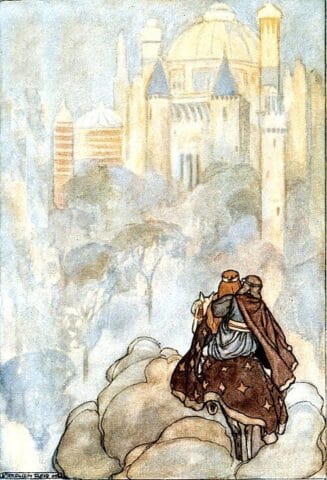
Conaire Mór’s ancestry connected Ireland’s royal families with the Otherworld. His great-grandmother was Étaín, a woman from the supernatural mounds who married King Eochaid Feidlech. Their daughter, also named Étaín, married Cormac, king of Ulaid, and gave birth to Mess Buachalla. Cormac ordered the infant killed, but his servants spared her and placed her in the care of cowherds belonging to Eterscél, king of Tara.
Eterscél was childless, and his diviners had foretold that a woman of unknown parentage would bear him a son. When he learned of Mess Buachalla, he ordered her brought to him. Before his men arrived, a supernatural visitor appeared as a bird, shed his feathered skin, and told her that she would bear his child. The boy would be named Conaire and must never kill birds. Mess Buachalla was subsequently taken to Eterscél, who became Conaire’s acknowledged father.
Conaire grew up alongside three foster-brothers, Fer Lé, Fer Gar, and Fer Rogain, descendants of Donn Désa. The four shared meals, clothing, armor, and horses. Conaire possessed exceptional hearing, sight, and judgment, and the saga says he taught one of these gifts to each of his foster-brothers.
Read Also:
The Voyage of Bran: An Irish Myth of the Otherworld
After Eterscél’s death, the nobles of Ireland assembled for a bull-feast (tarbfheis) to determine his successor. A bull was slaughtered, and a chosen man ate its flesh and drank its broth before sleeping under a truth-spell. In his dream, he saw a naked man approaching Tara with a stone in his sling. Whoever matched this vision would become king.
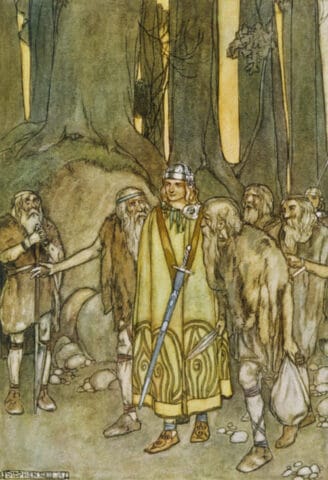
Meanwhile, Conaire pursued a flock of unusually large, white-speckled birds toward the sea near Dublin. When he raised his sling against them, they shed their birdskins and appeared as armed men. One of them, Némglan, identified himself as king of the birds belonging to Conaire’s father. He revealed the prohibition against harming birds and directed Conaire to Tara, where the young man would fulfill the prophetic vision.
The nobles initially questioned whether a beardless youth should rule Ireland. Conaire defended his hereditary claim to Tara, and the assembly accepted him as king. His accession fulfilled both the divination performed at the bull-feast and the instructions he had received from Némglan.
The Geasa of Conaire Mór and His Prosperous Reign
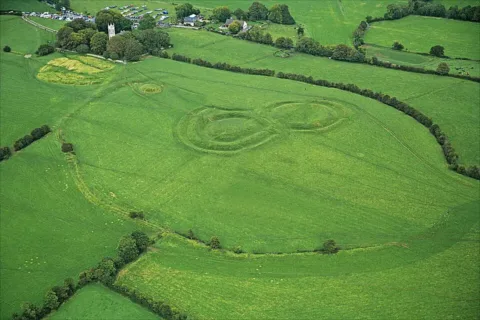
Conaire’s kingship came with supernatural restrictions known as geasa (singular geis). In early Irish literature, a geis could impose a personal prohibition or obligation whose violation carried serious consequences. After his accession, Conaire recited the restrictions given to him by Némglan.
Some governed his movements. He could not travel clockwise around Tara and counterclockwise around Brega, hunt the dangerous beasts of Cerna, or go beyond Tara on every ninth night. Others concerned where he could stay. He was forbidden to sleep in a house whose firelight shone outside after sunset while light also entered it from outdoors. Three men dressed in red could not precede him to the house of a man named Red.
Conaire was also forbidden to admit a lone man or woman into his lodging after sunset or to settle a quarrel between his two thralls. Another restriction prohibited raiding anywhere in Ireland during his reign. Unlike the rules governing his own conduct, this last prohibition depended on the actions of others, making it particularly difficult for a king to uphold.
The saga portrays Conaire’s early reign as a time of remarkable prosperity. Seven ships arrived at Inver Colptha every June, acorns lay knee-deep beneath the oaks in autumn, and the rivers Bush and Boyne were abundant with fish. No one killed another in Ireland, and each person’s voice sounded as pleasant to others as the strings of a lute. From spring to autumn, the weather was so calm that the wind did not stir a cow’s tail.
The Foster-Brothers’ Rebellion and Ingcél’s Alliance
Conaire’s foster-brothers, Fer Lé, Fer Gar, and Fer Rogain, resented losing what they regarded as their family’s inherited privileges: theft, violence, and raiding. Each year, they stole a pig, an ox, and a cow from the same farmer to test how the king would punish them. When the farmer complained, Conaire directed him to confront the brothers himself. They threatened him so severely that he stopped returning to the king. The brothers eventually gathered young men from noble families and turned to organized raiding.
While 150 of their young followers were raiding in Connacht, a swineherd spotted them and raised the alarm. They were captured with their companions and brought to Tara. Conaire initially ordered their fathers to execute them while sparing his own foster-brothers. He then withdrew the sentence, sending the offenders out of Ireland with veteran warriors to raid Alba. His decision spared their lives but did not end their raiding.
At sea, the exiles encountered Ingcél the One-eyed, a formidable British raider accompanied by Eiccel and Tulchinne. The two forces nearly fought, but Ingcél objected to facing a larger army. Instead, he proposed an agreement: the Irish would join his raids in Britain and Alba, and he would help them carry out an attack in Ireland. Both sides gave pledges to uphold the bargain.
Lots determined that Ingcél’s country would be attacked first. In Britain, his father, mother, and seven brothers were killed. The raiders then plundered Alba before returning to Ireland. Having helped the Irish exiles, Ingcél was now entitled to their support in an attack of his choosing on their homeland.
How Conaire Broke His Geasa on the Road to Da Derga’s Hostel
As Ingcél and the Irish exiles prepared to return to Ireland, Conaire faced another crisis. In Thomond, two men known as the Carbres, described in the saga as his foster-brothers, were engaged in a violent dispute. Conaire intervened to reconcile them, although one of his geasa forbade him to settle their quarrel before they came to him. He restored peace but remained five nights with each man, breaking another prohibition.
Returning toward Tara through Uisnech in Meath, Conaire encountered signs of widespread disorder. Armed bands were raiding from every direction, and the lands of the southern Uí Néill were ablaze. His companions understood that the king’s law had broken down.
Further violations followed. Conaire’s company traveled clockwise around Tara and counterclockwise around Brega, both forbidden directions. The dangerous beasts of Cerna were also hunted, although he did not realize this until the chase had ended. The saga attributes a strange, smoky mist covering the land to supernatural beings from the síd, who had intervened because Conaire’s geasa had been broken.
Fearful and unable to find another route, Conaire was left with the roads of Midluachair and Cualu. His company took the southern coastal route. When he asked where they might spend the night, his champion Mac Cécht reminded him that the king of Ireland had rarely needed to seek hospitality for himself.
Conaire remembered Da Derga of Leinster, whom he had once rewarded generously with cattle, horses, weapons, clothing, and other valuables. Confident that Da Derga would welcome him in return, he directed his company toward the hostel.
The Omens and Supernatural Visitors at Da Derga’s Hostel
As Conaire approached Da Derga’s hostel, he saw three horsemen riding ahead of him. Their clothes, shields, spears, hair, and horses were entirely red. One of his geasa forbade three red men from preceding him into the house of a man named Red. He sent his son Lé fri flaith after them, but the boy could never close the distance, no matter how hard he rode.
Conaire repeatedly offered the riders cattle, pigs, and hospitality, but they refused to turn back. They spoke of horses from the síd, the supernatural mounds, and foretold slaughter through images of feeding ravens, bloodied swords, and broken shields. The three entered the hostel before Conaire, fulfilling the prohibition he had tried to prevent.
A strange figure named Fer Caille then approached the royal company. He had one eye, one hand, and one foot, and carried a black, singed pig that squealed continuously. Behind him walked his wife, Cichuil, a monstrous woman with an enormous mouth. Fer Caille offered the pig as food for Conaire, but the king asked him to leave them alone for the night. The stranger refused and continued toward the hostel. The saga later identifies Fer Caille and his pig as another of Conaire’s taboos.
Read Also:
The Pursuit of Diarmuid and Gráinne: A Tragic Irish Love Legend
After Conaire entered the hostel, a solitary woman arrived at the door after sunset. She wore a grey cloak and had unnaturally long limbs. Calling herself Cailb, she foretold that none of Conaire’s flesh would leave the building except what birds carried away. Among the many names she recited were Badb and Némain, both associated with battle and destruction in Irish tradition. Conaire initially refused her entry because admitting a lone woman after sunset violated another geis. He offered her food elsewhere, but when she challenged his hospitality, he allowed her inside.
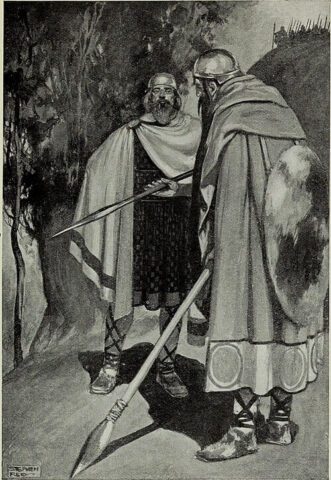
Meanwhile, Ingcél prepared to inspect the hostel. Its great fire was visible from outside through the wheels of the chariots gathered around it. Using his extraordinary single eye, Ingcél looked inside before returning to the raiders. Fer Rogain, one of Conaire’s foster-brothers, identified the occupants from his descriptions. Among them was Cormac Condlongas, son of Conchobar, accompanied by nine warriors. Fer Rogain warned that attacking such men would bring heavy losses.
Lomna Drúth also urged the raiders to abandon their plan. He foretold his own death, declaring that his severed head would be thrown into the hostel three times and cast out each time. Ingcél refused to withdraw, reminding the Irish exiles of the deaths of his parents and brothers and the obligation created by their alliance. Despite knowing that Conaire and formidable warriors were inside, the raiders continued their preparations.
The Destruction of the Hostel and the Death of Conaire Mór
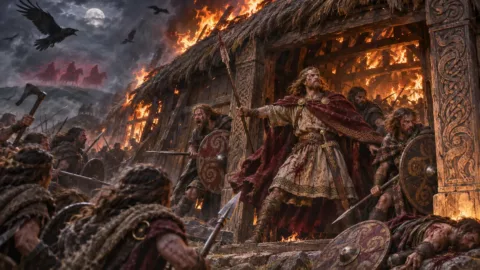
Ingcél’s raiders surrounded Da Derga’s hostel, and Lomna Drúth entered ahead of them. The doorkeepers immediately beheaded him. His severed head was thrown into the building three times and cast out each time, fulfilling the prediction he had made before the attack.
Conaire led his warriors against the raiders. According to the saga, he killed six hundred enemies before reaching his weapons and another six hundred after arming himself. The attackers set the hostel ablaze three times, but the defenders extinguished each fire. Conall Cernach, Cormac Condlongas, and other champions fought repeated engagements, forcing the raiders back despite their overwhelming numbers.
Unable to overcome Conaire in combat, the raiders’ sorcerers brought about a supernatural shortage of drink. Exhausted by fighting, the king was seized by desperate thirst. The hostel’s supplies had been used to extinguish the fires, and his cupbearers could find no water even in the River Dodder, which flowed through the building. Conaire appealed to Mac Cécht, his champion and protector. Mac Cécht initially refused to abandon his duty of guarding the king, but Conall Cernach agreed to take his place while he searched for water.
Read Also:
Nuada of the Silver Hand: King of the Tuatha Dé Danann
Carrying Conaire’s enormous golden cup and his young son Lé fri flaith beneath his arm, Mac Cécht fought through the attackers. He searched Ireland’s principal rivers and lakes, but none yielded enough water to fill the vessel. Eventually, he reached the spring of Uaran Garad in Mag Ái, whose waters could not hide from him.
Meanwhile, the defenders continued fighting their way out of the hostel. Conall Cernach, Cormac Condlongas, and other warriors escaped wounded, while Conaire remained inside with only a few companions. Overcome by thirst and a consuming fever, the king died before Mac Cécht returned.
Approaching the hostel before dawn, Mac Cécht found two attackers cutting off Conaire’s head. He killed one and hurled a pillar-stone at the other, breaking his back as he fled with the head. After killing the second man, Mac Cécht recovered Conaire’s head and poured water into its throat. The severed head spoke, praising the warrior for bringing the drink, although the king could no longer be saved.
The saga also records the death of Conaire’s seven-year-old son, Lé fri flaith, who perished from the intense heat and sweat of Mac Cécht while being carried beneath his arm. One account says that Mac Cécht later buried Conaire at Tara. Conall Cernach survived with 150 wounds to his shield arm, while differing versions give conflicting numbers of casualties and survivors. One version has Ingcél escape to Alba, where he succeeds his father as king.
What Does Conaire Mór’s Fall Mean in Irish Mythology?
Conaire’s reign reflects a connection between kingship and the prosperity of the land. The abundant harvests, peaceful communities, and absence of violence suggest that rightful rule sustains order throughout Ireland. His geasa express the obligations attached to that authority. Yet the prohibition against raiding reveals a weakness: the king’s safety depends partly on the conduct of people he cannot fully control.
His foster-brothers expose this problem. Conaire must uphold the peace, but punishing men raised alongside him threatens bonds of kinship. Exiling them spares their lives without ending the danger. They face a similar conflict when their pledge to Ingcél requires them to attack their former companion. Ralph O’Connor identifies these parallel obligations as central to the saga’s tragedy, comparing the foster-brothers’ pact with Ingcél to Conaire’s relationship with the Otherworld.
The supernatural warnings do not remove the characters’ responsibility for what happens. Conaire attempts to prevent the red riders from reaching the hostel, Fer Rogain warns against the attack, and Ingcél insists on honoring his agreement. Their choices help bring about a catastrophe that the omens have already foretold. The story leaves little room for a simple division between unavoidable fate and human error.
The saga also reflects the literary culture of medieval Christian Ireland. O’Connor has identified possible parallels between Conaire’s downfall and the biblical account of King Saul in 1 Samuel, particularly in their troubled relationships with sacred authority. These parallels remain a scholarly interpretation rather than proof of direct borrowing. They suggest that Togail Bruidne Da Derga explores the difficulties of kingship through both inherited Irish traditions and concerns familiar to medieval Christian writers.
Conclusion
Mac Cécht’s return with water brings the tragedy of Da Derga’s hostel into focus. He has crossed Ireland to save Conaire, only to find the king dead and his head severed. When the head speaks to thank him, it confirms a loyalty that has endured beyond the king’s death. Yet neither Mac Cécht’s devotion nor the courage of Conaire’s defenders can restore the peace that marked his reign.
Sources & Primary Texts
This article draws on medieval Irish versions of Togail Bruidne Da Derga and modern scholarship examining its narrative structure, sacred kingship, supernatural prohibitions, and political themes.
Primary Texts and Editions
- Stokes, Whitley. The Destruction of Da Derga’s Hostel. Published in Revue Celtique, vols. 22 (1901) and 23 (1902). English translation based on Lebor na hUidre, available through the CELT Project, University College Cork.
Read the English translation. - Knott, Eleanor, ed. Togail Bruidne Da Derga. Dublin: Dublin Institute for Advanced Studies, 1936. Critical edition of the medieval Irish text, including textual variants. Digitized by the CELT Project, University College Cork.
Consult the Irish text.
Academic Studies
- O’Connor, Ralph. The Destruction of Da Derga’s Hostel: Kingship and Narrative Artistry in a Mediaeval Irish Saga. Oxford: Oxford University Press, 2013. A detailed study of Conaire’s kingship, the obligations binding him and his foster-brothers, and the saga’s literary and Christian contexts.
View the academic book. - O’Connor, Ralph. “Prophecy, Storytelling and the Otherworld in Togail Bruidne Da Derga.” In Approaches to Religion and Mythology in Celtic Studies, edited by Katja Ritari and Alexandra Bergholm, pp. 55–68. Newcastle: Cambridge Scholars Publishing, 2008. Examines prophecy, supernatural knowledge, and the narrative’s progression toward catastrophe.
Read the scholarly paper.
Manuscript Reference
University College Cork, Irish Sagas Online. “Togail Bruidne Da Derga: Sources.” A guide to manuscript witnesses, including Lebor na hUidre and the Yellow Book of Lecan, with references to printed editions and translations.
Explore manuscript sources.
Copyright & Attribution
© 2026 History & Myths. Original article text by H. Moses. All rights reserved. The medieval Irish saga Togail Bruidne Da Derga is discussed as a historical literary source. Modern translations, scholarly works, and illustrations remain subject to their respective copyrights and licensing terms.