Epona: Celtic Goddess of Horses and Protection
Epona was a Celtic goddess associated with horses, their protection, and fertility. Her worship was rooted in Gaul and spread across parts of the Roman Empire, where she became particularly popular among cavalry soldiers and people who depended on horses and other working animals.
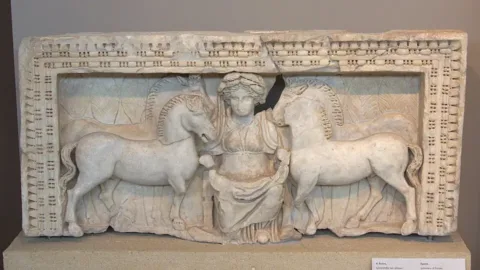
Unlike many figures known mainly through medieval Celtic legends, Epona is documented through Roman-period inscriptions, statues, and reliefs. She is often depicted riding a horse or seated between two horses, sometimes accompanied by symbols of abundance.
Although her worship is well attested, little survives of her mythology. The archaeological and written evidence reveals far more about how people honored Epona than about any stories they may have told concerning her.
Who Was Epona in Celtic Religion?
Epona’s name comes from Gaulish, a Celtic language spoken across much of ancient Gaul. It derives from epos, the Gaulish word for “horse,” combined with a suffix found in other Celtic divine names. The name is commonly interpreted as “divine mare” or “horse goddess.”
Roman inscriptions preserve her Celtic name and sometimes honor her as Epona Regina, meaning “Queen Epona.” These dedications show that worshippers continued to recognize her by her original name throughout the Roman Empire.
Exactly when her worship began remains uncertain. Although her name points to Celtic origins, the securely dated evidence comes from the Roman period. No reliable Celtic tradition survives that establishes her parentage or place within a divine family.
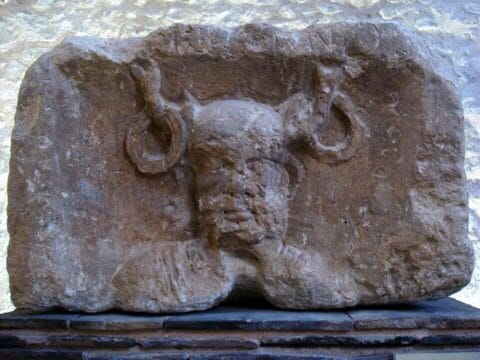
Cernunnos: The Horned God of the Celtic World
Explore another deity of ancient Gaul whose identity survives through Roman-period sculptures, inscriptions, and religious imagery.
What Did Epona Protect?
Epona was primarily a protector of horses, but her association extended to other equines, including donkeys and mules. In the Roman world, these animals carried riders and goods, pulled carts, and transported military supplies. Their health and survival were essential to the people who depended on them.
Her protective role appears to have included breeding and the care of young horses. Representations of mares with foals support this association, although they do not reveal exactly what blessings individual worshippers sought.
Epona was especially relevant to people who worked with horses, including grooms, breeders, mule drivers, and cavalry soldiers. For them, losing an animal could mean losing transport, income, or the ability to perform their duties.
Although she is sometimes described as a protector of travelers or a goddess of war, the strongest surviving evidence connects her with equines and their welfare rather than warfare itself.
Where Was Epona Worshipped?
The strongest concentration of evidence for Epona’s worship comes from eastern and northeastern Gaul and the neighboring Rhineland. Major clusters of monuments occur in the territories of the Aedui, around present-day Burgundy, and the Treveri, in the Moselle valley. Reliefs, figurines, and inscribed altars provide evidence of her cult in both regions.
Beyond Gaul, Epona’s images and dedications have been found along the Danube, in the Balkan provinces, Italy, Spain, and Roman Britain. Two British altars offer particularly clear evidence. One, from Carvoran near Hadrian’s Wall, is dedicated to Epona. Another, discovered at Auchendavy on the Antonine Wall, names her alongside Mars, Minerva, Hercules, Victory, and the Campestres, goddesses associated with military training grounds.
Epona was also honored in Rome itself. Inscriptions found near the barracks of the equites singulares Augusti, the emperor’s mounted guards, attest her worship in the imperial capital.
The distribution of these monuments shows how far Epona’s cult extended beyond Gaul, particularly through regions connected by Roman military routes. Her worship, however, was not confined to soldiers.
Why Did Roman Cavalry Soldiers Worship Epona?
Roman cavalry soldiers relied on their horses for scouting, patrols, carrying messages, and combat. Losing a mount could endanger a rider or prevent him from carrying out his duties. Epona’s protective association with horses made her particularly relevant to mounted troops.
An altar from Pförring, in the Roman province of Raetia, records a vow fulfilled by the Ala I Singularium, an auxiliary cavalry unit commanded by the prefect Aelius Bassianus. The dedication honors Epona alongside the Campestres, deities associated with military training grounds.
Another inscription comes from Szentendre (ancient Ulcisia Castra) in Pannonia. Dated June 1, AD 241, it records a dedication by Julius Victor, a mounted standard-bearer serving in a cohort of Syrian archers. He honored Epona Regina alongside the Genius of his turma, the protective spirit of his cavalry squadron.
These inscriptions show that Epona’s worship extended beyond soldiers of Celtic origin. Her association with the Campestres and a squadron’s Genius also places her within the wider religious practices of Roman military units.
How Was Epona Worshipped?
Epona was honored through votive altars, offerings, and images placed in temples and smaller shrines. At Entrains-sur-Nohain in Gaul, an inscription records that Connonius, son of Icotasgus, donated a temple dedicated to Epona, complete with its furnishings, at his own expense.
Her worship also reached the places where horses were kept. In Metamorphoses (3.27), the Roman writer Apuleius describes a small shrine set into a stable’s central supporting pillar. Inside stood an image of Epona decorated with freshly picked roses. Although the scene comes from a novel, it offers a glimpse of how her presence in stables was understood in Roman society.
A large stone relief from Beihingen in Roman Germany provides another possible insight into her worship. It depicts Epona above a scene in which a pig is brought toward an altar. The scene may represent an animal sacrifice associated with her cult, although it does not establish a standard ritual.
When Was Epona’s Festival Celebrated?
A Roman-period calendar discovered at Guidizzolo in northern Italy marks December 18 as a day associated with Epona. It provides rare evidence of a specific date dedicated to her worship.
The calendar does not describe the ceremonies performed or establish whether the celebration took place elsewhere in the Roman Empire.
What Did Epona Look Like?
Epona’s appearance is known primarily from Roman-period statues and reliefs. Artists generally portrayed her as a woman accompanied by horses, although her clothing and posture varied between regions.
Two types of representation were particularly widespread. In Gaul, she frequently appears riding sidesaddle, usually wearing a long dress and sometimes resting a hand on the horse’s mane or holding its reins. In another form, more common outside Gaul, she sits on a throne between two or more horses.
A small copper-alloy figurine discovered in Wiltshire, now in the British Museum, shows Epona seated between two ponies. A larger stone relief from Thessaloniki, dated to the early fourth century AD, depicts her enthroned between four horses facing toward her. She wears a long tunic, a mantle covering the back of her head, and a leafy wreath.
Other representations show Epona holding a patera, a shallow dish used in religious offerings, a basket of fruit, or a cornucopia, the horn of plenty. These attributes appear in Roman depictions of other goddesses as well, but the accompanying horses make Epona’s identity particularly recognizable.
Was Epona a Goddess of Fertility and the Afterlife?
Epona’s association with fertility is supported by more than the fruit and cornucopia found in her images. At Thil-Châtel in Burgundy, an inscription links her with the Matres, the mother goddesses of Gallo-Roman religion. Another monument, from Hagondange near Metz, portrays Epona in triple form, resembling their traditional imagery.
These connections place Epona within a wider religious tradition of fertility and abundance, although they do not establish that she specifically governed human childbirth.
Evidence for her possible role in the afterlife comes from funerary monuments. Several sculptures depicting Epona were discovered in the Roman cemetery at La Horgne-au-Sablon near Metz. One depicts Epona riding a mare ahead of a human figure, a scene some scholars interpret as the goddess leading the deceased toward the afterlife.
A key carried by Epona in carvings from Gannat and Grand has also attracted attention. It might represent access to a stable or symbolically suggest passage into the world of the dead.
These interpretations give Epona a possible funerary role, but no surviving ancient text explicitly describes her leading souls into the afterlife.
Did Epona Have a Mythological Story?
An unusual account of Epona’s birth appears in Parallela Minora (section 29), an ancient collection of Greek and Roman stories traditionally attributed to Plutarch but generally considered the work of another author.
The story concerns Fulvius Stellus, a man who supposedly hated women and had intercourse with a mare. The animal gave birth to a beautiful girl named Epona, whom the text identifies as a goddess responsible for the care of horses.
The author attributes the account to the third book of Agesilaus’s Italian History, a work that has not survived independently. More importantly, the story appears alongside a closely matching Greek tale about Aristonymus, whose union with a donkey produces a girl named Onoskelis.
This resemblance raises the possibility that Epona’s birth story was shaped to fit the collection’s literary pattern rather than drawn from an established Gaulish myth. No surviving Celtic-language text confirms the account, leaving its connection to Epona’s original worshippers uncertain.
Epona and Rhiannon: Were They the Same Goddess?
Epona is sometimes linked with Rhiannon, a prominent figure in the medieval Welsh Mabinogi. Rhiannon first appears riding a white horse that no one can overtake. Later, she is punished by having to offer to carry visitors on her back. These episodes have encouraged scholars to consider whether her story preserves elements of an older horse goddess.
Their names, however, have different origins. Epona derives from the Gaulish word for “horse,” while Rhiannon is generally traced to the reconstructed Celtic Rigantonā, meaning “Great Queen” or “Divine Queen.” Some Roman inscriptions call Epona Regina, meaning “Queen,” but this title was used for other goddesses and does not establish a direct connection.
The historical evidence also differs. Epona was worshipped during the Roman period, as inscriptions and sculptures confirm. Rhiannon is known from medieval Welsh literature, which neither identifies her with Epona nor records her worship.
The similarities may reflect older Celtic traditions, but there is no evidence establishing that Rhiannon was a direct continuation of Epona.
Read Also:
Rhiannon: The Story of a Mysterious Woman in Welsh Mythology
Discover Rhiannon’s complete story in the Mabinogi, her extraordinary white horse, and the debate over her possible divine origins.
Academic Sources & Primary Texts
This article draws on ancient literary texts, Roman inscriptions, archaeological collections, and modern scholarship. These sources document Epona’s worship, iconography, and geographical distribution while distinguishing historical evidence from later interpretations.
Ancient Literary Sources
- Apuleius, Metamorphoses (The Golden Ass), Book III, Chapter 27.
A second-century Roman literary reference describing an image of Epona in a stable shrine, decorated with fresh roses.
Read the Original Latin Text
- Pseudo-Plutarch, Parallela Minora (Greek and Roman Parallel Stories), Section 29.
Preserves the unusual literary account of Epona’s birth. The story’s relationship to authentic Gaulish mythology remains uncertain.
Loeb Classical Library Translation
Roman Inscriptions & Archaeological Evidence
- Temple Dedication to Epona, Entrains-sur-Nohain, Gaul.
CIL XIII 2902; AE 1897, 14.
Latin inscription recording a temple and its furnishings donated by Connonius, son of Icotasgus.
University of Michigan, Ornamenting Empire
- Roman Military Dedications to Epona.
The Pförring altar records a dedication by the Ala I Singularium to Epona and the Campestres. The Szentendre altar, dated June 1, AD 241, honors Epona Regina alongside the Genius of a cavalry squadron.
Pförring Altar, Ubi Erat Lupa
Szentendre Altar, Ubi Erat Lupa
- Roman Inscriptions of Britain: RIB 1777 and RIB 2177.
Altars from Carvoran and Auchendavy documenting Epona’s presence on the northern Roman frontier in Britain.
Roman Inscriptions of Britain Database
- Archaeological Representations of Epona.
The British Museum preserves a Romano-British copper-alloy figure of Epona between two ponies. The Archaeological Museum of Thessaloniki documents a relief dated AD 300–325 depicting her between four horses.
British Museum Collection
Archaeological Museum of Thessaloniki
Modern Academic Research
- James Rives, “Epona.”
Oxford Classical Dictionary. Oxford University Press, 2015.
Academic reference covering Epona’s Celtic name, horse imagery, regional origins, geographical distribution, and Roman military worship.
Oxford Academic
- Gian Luca Gregori, H. De Megille, and Edoardo Melmeluzzi, “Il lungo viaggio di Epona. Dalle Gallie a Roma.”
Scienze dell’Antichità 27, no. 2 (2021): 229–242.
Specialized study of Epona’s cult from Gaul to Rome, military dedications, cavalry worship, and the December 18 festival recorded in the Guidizzolo calendar.
Sapienza University of Rome, Research Repository
- Miranda Green, Animals in Celtic Life and Myth.
Routledge, 1992.
Scholarly examination of animals in Celtic religion and imagery, including Epona’s associations with horses, fertility, and proposed funerary symbolism.
Routledge, Publisher’s Edition
Research note: Epona’s historical worship is documented through inscriptions and archaeological finds. Interpretations concerning fertility, the afterlife, and her possible relationship with Rhiannon are distinguished from directly attested evidence. Ancient literary narratives are evaluated in their own historical and literary contexts.
Copyright & Content Rights
© 2026 History & Myths. All rights reserved.
The original writing, research synthesis, analysis, and editorial presentation of this article are protected by copyright. Reproduction or republication of substantial portions requires prior written permission, except where permitted by applicable copyright law.
Ancient Celtic and Roman religious traditions, historical inscriptions, and public-domain source texts are not claimed as the property of History & Myths. Modern translations, scholarly research, and other third-party materials remain subject to their respective copyright and licensing terms.
Historical and academic sources are acknowledged for research and educational purposes. All third-party rights are respected.