Culhwch and Olwen: The Impossible Quest in Welsh Mythology
Culhwch and Olwen is one of the earliest surviving Arthurian tales, following a young Welsh hero whose marriage depends on overcoming seemingly impossible tasks. Cursed by his stepmother to marry only Olwen, Culhwch seeks help from his cousin Arthur. But Olwen’s father, the giant Ysbaddaden, is destined to die when his daughter marries. Determined to prevent this, he demands extraordinary feats, including the rescue of Mabon ap Modron and the hunt for the enchanted boar Twrch Trwyth.
Arthur does not undertake these challenges alone. He gathers warriors with exceptional abilities and personally joins some of their adventures. Preserved in medieval Welsh manuscripts, the tale portrays Arthur as the leader of a heroic company, a figure distinct from the courtly king familiar in many later Arthurian romances.
What Is Culhwch and Olwen?
Culhwch and Olwen, known in Middle Welsh as Culhwch ac Olwen, is an anonymous prose tale traditionally included among the eleven medieval Welsh narratives known as The Mabinogion. It is not one of the Four Branches of the Mabinogi, which form a separate, interconnected group of stories.
The earliest surviving copy appears in the White Book of Rhydderch, compiled around 1350, although its version is incomplete. The Red Book of Hergest, copied between approximately 1382 and 1400, preserves the complete narrative. The tale was composed earlier, but its precise date remains disputed. Scholars have traditionally placed it around 1100, while Simon Rodway’s 2005 linguistic reassessment suggests that it could date to the second half of the twelfth century.
The tale combines a marriage quest with a succession of heroic adventures and an extensive catalogue of Arthur’s companions. Some of these figures appear elsewhere in Welsh literature, while others are known only from this narrative. Its episodic structure and elaborate lists provide valuable evidence of medieval Welsh storytelling and the traditions surrounding Arthur’s court.
The Curse That Bound Culhwch to Olwen
Culhwch was the son of Cilydd and his wife Goleuddydd. During her pregnancy, Goleuddydd lost her senses and wandered away from home. Her reason returned as childbirth approached, but she gave birth near a herd of pigs after being frightened by them. A swineherd found the child in a pig enclosure, which the tale gives as the explanation for his name, Culhwch. The boy was of noble descent and a cousin of Arthur.
Before her death, Goleuddydd made Cilydd promise not to remarry until a two-headed briar grew on her grave. She instructed her confessor to keep the grave clear of vegetation, but after seven years he neglected his duty. When Cilydd discovered the briar, he decided to marry again. Acting on his advisers’ counsel, he had King Doged killed and took the king’s widow and her daughter into his household, seizing their lands as well.
After discovering that Cilydd already had a son, his new wife summoned Culhwch and proposed that he marry her daughter. Culhwch refused, saying he was too young. His stepmother then placed a binding destiny upon him: he could marry no woman except Olwen, daughter of the giant Ysbaddaden Bencawr.
The curse took effect immediately. Although Culhwch had never seen Olwen, he blushed and fell in love with her. When his father learned what had happened, he advised him to seek Arthur’s help.
Why Did Culhwch Seek Arthur’s Help?
When Culhwch arrived at Arthur’s court, the gatekeeper Glewlwyd Gafaelfawr initially refused him entry under the court’s rules. Arthur intervened and welcomed the young nobleman, offering him a place of honour, entertainment, and the privileges of a prince. Culhwch, however, had come to request a favour rather than enjoy the court’s hospitality.
Arthur promised to grant his request, except for certain treasured possessions, including his sword Caledfwlch and his wife Gwenhwyfar. Culhwch first asked Arthur to trim his hair. Using a golden comb and scissors with silver loops, Arthur attended to his hair before asking his identity. When Culhwch revealed his parentage, Arthur recognised him as his cousin and renewed his promise. Culhwch then asked for help in obtaining Olwen, daughter of Ysbaddaden Bencawr.
To support his request, Culhwch invoked a lengthy catalogue of Arthur’s warriors, calling upon them as witnesses and guarantors of the promised favour. The list included Cai, Bedwyr, Gwalchmai, and numerous figures from Welsh heroic tradition, some possessing remarkable abilities.
Arthur admitted that he knew nothing of Olwen or her family but agreed to send messengers in search of her. After a year without results, Culhwch threatened to leave and take Arthur’s honour with him. Cai intervened, promising to continue the search until they found Olwen or established that she could not be found.
Arthur then called upon Bedwyr, Cynddelig Gyfarwydd, Gwrhyr Gwalstawd Ieithoedd, Gwalchmai, and Menw to accompany Cai and Culhwch. Cynddelig could navigate unfamiliar lands as readily as his own, Gwrhyr understood every language, and Menw could conceal the company through magic. Their different abilities made them well suited to the search ahead.
Olwen and Her Father, the Giant Ysbaddaden
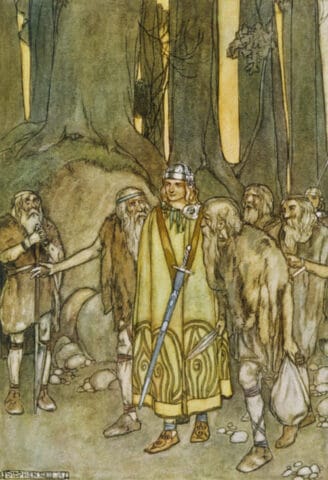
Culhwch and Arthur’s companions reached the lands of Ysbaddaden Bencawr, the Chief Giant, where they encountered the shepherd Custennin. His enormous sheepdog threatened the visitors until Menw subdued it with a spell. Custennin’s wife, who was Culhwch’s aunt, welcomed her nephew but feared for his life. Ysbaddaden had killed twenty-three of her twenty-four sons, and she kept the last hidden in a chest. No previous suitor seeking Olwen had returned alive.
Olwen visited the shepherd’s household every Saturday to wash her hair. At the companions’ request, Custennin’s wife arranged a meeting with her. Olwen appeared wearing flame-red silk and a red-gold collar adorned with precious stones. The tale describes her golden hair and extraordinary beauty, adding that four white trefoils sprang up wherever she walked. This explains her name, interpreted in the story as “white footprint.”
When Culhwch asked Olwen to leave with him, she refused because she had promised not to marry without her father’s consent. Ysbaddaden was destined to die when his daughter married, making him determined to prevent the match. Olwen advised Culhwch to ask her father formally and agree to every demand, warning that any refusal could cost him both his bride and his life.
Read Also:
Branwen, Daughter of Llŷr: The Tragic Mabinogi Tale
The companions entered Ysbaddaden’s fortress after silently killing nine gatekeepers and nine watchdogs. The giant’s eyelids hung so heavily that his servants had to raise them with forks before he could examine his prospective son-in-law. He postponed his answer and hurled a poisoned stone spear at the visitors as they departed. Bedwyr caught it and threw it back, piercing his knee.
The confrontation continued over the next two days. Menw returned the second spear through Ysbaddaden’s chest, while Culhwch hurled the third through his eye. On their fourth visit, the wounded giant finally agreed to name his conditions for the marriage, beginning the series of seemingly impossible tasks Culhwch would have to fulfill.
The Impossible Tasks of Ysbaddaden
Ysbaddaden set Culhwch roughly forty impossible tasks, known in Welsh as anoethau, before he could marry Olwen. Most concerned preparations for the wedding or the giant’s own grooming, but fulfilling them required rare objects, supernatural creatures, and the cooperation of powerful figures who could not easily be persuaded.
The first demand was to clear a wooded hillside, burn the vegetation, plough the land, and produce a harvest within a single day. Only Amaethon son of Dôn could till the soil, Gofannon could prepare the plough’s iron, and special teams of oxen were needed to pull it. For the wedding feast, Ysbaddaden demanded exceptionally sweet honey for brewing bragawd, the magical hamper of Gwyddno Garanhir, Teirtu’s self-playing harp, and Diwrnach’s cauldron from Ireland. He also wanted the Birds of Rhiannon, whose song could wake the dead and lull the living to sleep.
Other conditions concerned the giant’s appearance. He required a tusk from Ysgithyrwyn, Chief of Boars, to shave his beard, and it had to be removed while the animal was alive. The blood of the Black Witch was needed to soften his beard before shaving and had to be kept warm. To comb and trim his hair, Culhwch had to obtain the comb and shears carried between the ears of Twrch Trwyth.
Read Also:
Rhiannon: The Story of a Mysterious Woman in Welsh Mythology
Capturing the enchanted boar presented further difficulties. The hunters needed Drudwyn, a formidable hound that required a special leash, collar, and chain. Only Mabon ap Modron could handle the animal, but he had been abducted as an infant and no one knew where he was. Ysbaddaden also demanded the sword of Gwrnach the Giant, another weapon its owner would never surrender willingly.
The quest for Gwrnach’s sword became one of the first adventures undertaken by Arthur’s companions. Cai gained entry to the giant’s fortress by claiming to be a skilled sword-polisher. After winning Gwrnach’s confidence, he arranged for Bedwyr and Goreu, the surviving son of Custennin, to enter. When the giant entrusted Cai with his sword, Cai used it to behead him. The companions returned to Arthur with the weapon, ready to undertake the search for Mabon.
The Rescue of Mabon ap Modron
Mabon ap Modron had been abducted when he was only three nights old, leaving Arthur’s companions with no obvious place to begin their search.
Arthur first secured the release of Mabon’s cousin, Eidoel son of Aer, who was being held by Gliui. He then sent Eidoel with Cai, Bedwyr, and Gwrhyr Gwalstawd Ieithoedd to search for the missing huntsman. Gwrhyr’s ability to understand animal languages led them to a succession of ancient creatures, each older than the last.
The Blackbird of Cilgwri had lived so long that its beak had worn a smith’s anvil almost to nothing. The Stag of Rhedynfre remembered an oak growing from a sapling into a great tree and eventually decaying. The Owl of Cwm Cawlwyd had witnessed three successive forests, while the Eagle of Gwernabwy had watched a great rock diminish to less than a handbreadth in height. None knew where Mabon was imprisoned.
The eagle, however, remembered a remarkable salmon it had once tried to catch. Instead of becoming prey, the fish dragged the eagle into deep water and nearly drowned it. Believing the salmon might possess greater knowledge, the eagle guided Arthur’s messengers to Llyn Llyw.
Read Also:
Maponos: The Celtic God of Youth and Music
The Salmon of Llyn Llyw told them that it regularly swam upriver to the walls of Caer Loyw (Gloucester), where it had heard terrible lamentations. Carrying Cai and Gwrhyr on its shoulders, the salmon brought them to the prison. Gwrhyr called out and learned that the captive was Mabon himself. When asked whether gold or silver could secure his freedom, Mabon replied that only fighting could release him.
The companions reported their discovery to Arthur, who assembled his warriors and marched against Caer Loyw. During the assault, Cai and Bedwyr rode the salmon to the prison wall. Cai broke through the stonework, carried Mabon out on his back, and continued fighting as Arthur’s forces attacked the fortress. The company returned with Mabon free and able to join the hunt.
Arthur and the Hunt for Twrch Trwyth
The hunt for Twrch Trwyth is the longest and most destructive adventure in Culhwch and Olwen. The enchanted boar, son of Tared Wledig, carries the comb, razor, and shears needed for Ysbaddaden’s wedding preparations. According to Arthur, Twrch Trwyth was once a king whom God transformed into a boar as punishment for his sins.
Arthur first sends Menw son of Teirgwaedd to Ireland to confirm that the objects are still between the boar’s ears. Taking the form of a bird, Menw approaches Twrch Trwyth’s lair and attempts to seize one of the treasures. He manages to take only a bristle before the boar shakes itself, scattering venom that leaves Menw permanently injured.
Arthur then assembles warriors from Britain and territories beyond it and leads them to Ireland. Twrch Trwyth is accompanied by seven young boars. Arthur himself fights for nine days and nights but fails to defeat Twrch Trwyth or overcome his young boars.
He sends Gwrhyr Gwalstawd Ieithoedd, who understands animal languages, to negotiate. Gwrhyr assumes the form of a bird and approaches the boars, but Grugyn Gwrych Ereint, distinguished by his silver bristles, refuses to surrender the treasures. He declares that they will carry their destruction into Arthur’s country.
The boars cross the Irish Sea and land at Porth Clais in Dyfed. Arthur’s warriors pursue them through southern Wales, where Twrch Trwyth repeatedly turns on his attackers, killing numerous men, including Arthur’s son Gwydre. The hunting dogs and warriors gradually overcome several of the younger boars, but Grugyn and Llwydog Gofynniad survive the initial fighting and continue to inflict heavy losses.
Read Also:
The Mabinogion Explained: The Great Stories of Welsh Mythology
Eventually, Grugyn separates from the others and is killed at Garth Grugyn after a fierce battle. Llwydog is slain farther east, having killed several warriors, including two of Arthur’s uncles. Twrch Trwyth continues toward the River Severn without his surviving companions.
Determined to prevent the boar from reaching Cornwall, Arthur gathers his forces at the Severn. His warriors seize Twrch Trwyth by the feet and force him into the water. Mabon ap Modron, riding Gwyn Myngddwn, snatches the razor, while Cyledyr Wyllt takes the shears. The struggle also costs Kacmwri and Osla their lives. Before the hunters can secure the comb, Twrch Trwyth escapes onto dry land and races toward Cornwall.
Arthur’s men finally overtake him in Cornwall, where an even fiercer struggle ends with the recovery of the comb. The boar is driven into the sea and disappears, never to be seen again. Arthur has obtained the three treasures, but the hunt has claimed the lives of many of his warriors.
How Culhwch Finally Won Olwen
After the hunt for Twrch Trwyth, Arthur’s company still needed the blood of the Black Witch, daughter of the White Witch, to soften Ysbaddaden’s beard. Four warriors tried to overcome her in her cave but were driven back. Arthur then attacked from the entrance, striking her with his dagger Carnwennan and cutting her in two. Caw of Prydyn collected her blood.
Culhwch returned to Ysbaddaden’s court with Goreu son of Custennin and the companions carrying the treasures they had obtained. Caw shaved the giant’s beard, removing the skin and flesh down to the bone, along with both ears. When Culhwch asked whether Olwen was now his, Ysbaddaden conceded but told him to thank Arthur, who had made the marriage possible. He admitted that he would never have agreed willingly and declared that the time had come for him to die.
Goreu, whose brothers Ysbaddaden had murdered, seized the giant by his hair, dragged him to a mound, and beheaded him. He displayed the head on a stake and took possession of the fortress and its lands.
That night, Culhwch and Olwen became husband and wife. The tale states that she remained his only wife throughout his life, while Arthur’s warriors returned to their own countries.
What the Tale Reveals About Early Welsh Arthurian Tradition
Culhwch and Olwen portrays Arthur as a ruler whose authority depends on kinship, military leadership, and the loyalty of his companions. He honours his obligation to Culhwch, assembles warriors for dangerous expeditions, and takes part in several adventures himself. Rather than focusing on the achievements of an individual knight, the tale presents Arthur’s court as a powerful company whose members contribute different skills to a common purpose.
The extensive catalogue of Arthur’s followers is one of the tale’s most distinctive features. It combines figures known from other Welsh traditions with obscure characters, humorous names, and possible traces of lost stories. Cai, later known as Sir Kay, is particularly striking. In this account, he can survive nine days and nights underwater without breathing, grow as tall as a forest tree, and generate extraordinary bodily heat. His supernatural abilities contrast with his often quarrelsome portrayal in later French Arthurian romances. Bedwyr and Gwalchmai likewise belong to this Welsh heroic company, although their characters developed differently in subsequent literature.
The narrative also draws on widespread folktale motifs. Culhwch’s jealous stepmother, the giant’s daughter, and the impossible marriage conditions belong to storytelling traditions found beyond Wales. Yet the tale gives these familiar elements a distinctively Welsh character through Arthur’s companions, heroic catalogues, and references to local places and traditions.
Its elaborate speeches, rhythmic lists, and repeated exchanges also suggest a strong connection with oral performance. As Sioned Davies has argued, the tale’s language and structure were particularly suited to being heard aloud. These features help explain how Culhwch and Olwen brings together heroic tradition, supernatural adventure, and the social obligations surrounding Arthur’s court.
Conclusion
Culhwch ultimately wins Olwen, but their marriage comes at a considerable cost. Ysbaddaden meets the death he tried to prevent, Goreu avenges his murdered brothers, and Arthur loses many warriors in fulfilling the giant’s demands. The tale’s happy ending is therefore inseparable from the violence and sacrifices that make it possible.
Beyond its marriage plot, Culhwch and Olwen offers a distinctive vision of Arthur’s world. His power depends not simply on his own strength, but on the loyalty, abilities, and shared obligations of his companions. This combination of kinship, supernatural adventure, and collective heroism gives the story its particular place in medieval Welsh Arthurian literature.
Sources & Primary Texts
This article draws on medieval Welsh manuscripts, scholarly editions, and academic studies of Culhwch ac Olwen. Dates of composition and interpretations of the tale’s literary origins are presented with attention to ongoing scholarly debate.
Primary Texts and Critical Editions
- Bromwich, Rachel, and D. Simon Evans, eds. (1992). Culhwch and Olwen: An Edition and Study of the Oldest Arthurian Tale. University of Wales Press. A scholarly edition with textual commentary and analysis.
- Davies, Sioned, trans. (2007). The Mabinogion. Oxford World’s Classics, Oxford University Press. Modern English translation with introduction and explanatory notes.
- The White Book of Rhydderch. National Library of Wales, Peniarth MS 4. Fourteenth-century manuscript preserving an incomplete version of Culhwch ac Olwen.
- The Red Book of Hergest. Oxford, Jesus College MS 111. Late fourteenth-century Welsh manuscript preserving the complete tale.
Academic Studies
- Rodway, Simon. (2005). “The Date and Authorship of Culhwch ac Olwen: A Reassessment.” Cambrian Medieval Celtic Studies, 49, pp. 21–44. Reexamines the traditional dating of the tale through linguistic evidence.
- Davies, Sioned. (2004). “Performing Culhwch ac Olwen.” In Arthurian Literature XXI: Celtic Arthurian Material, edited by Ceridwen Lloyd-Morgan, pp. 29–52. D. S. Brewer. Examines oral performance and narrative structure.
- Sheehan, Sarah. (2005). “Giants, Boar-hunts, and Barbering: Masculinity in Culhwch ac Olwen.” Arthuriana, 15(3), pp. 3–25. Explores the significance of grooming, heroic masculinity, and the giant’s defeat.
Copyright & Editorial Notice: © 2026 History & Myths. All rights reserved. This article presents an original retelling and historical analysis of Culhwch and Olwen, based on medieval Welsh texts and academic scholarship. The original commentary and presentation are protected by copyright. The underlying traditional narrative remains in the public domain.