Astragalomancy: How Ancient Knucklebone Oracles Worked
Astragalomancy was a form of ancient divination in which people cast animal knucklebones to seek guidance from the gods. In the inscribed oracles of Roman-era southern Asia Minor, five bones were thrown, and their numbered faces determined which of 56 written responses a questioner received. The answers could offer reassurance, warnings, or advice about everyday decisions.
A limestone monument discovered in 2024 at Kibyra, in present-day Turkey, preserves this system in Greek inscriptions. A study published in October 2026 compared its text with similar oracles from other cities, revealing both a shared divination tradition and local differences in how its responses were recorded.
What Is Astragalomancy?
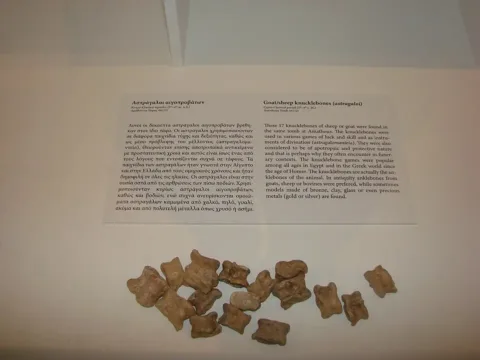
The term astragalomancy comes from the Greek astragalos, meaning ankle bone, and manteia, meaning divination. Despite their English name, “knucklebones” were not finger joints. They were typically ankle bones from sheep or goats, although examples made from bronze and ivory also existed.
Knucklebones served several purposes in the ancient world. They were used in games, deposited as offerings, and sometimes employed in divination. In games, a throw determined the outcome of play. In divination, it was interpreted as a means of consulting the gods.
Archaeologists cannot determine an object’s purpose from its shape alone. Knucklebones found in houses, graves, or sanctuaries do not necessarily indicate divination. Inscribed oracle texts provide stronger evidence because they explicitly connect particular throws with religious responses.
How Did Knucklebone Divination Work?
In Roman-era Asia Minor, people consulted knucklebone oracles by casting five astragaloi. Each bone had four numbered faces, valued at 1, 3, 4, or 6. The resulting combination was matched to an entry inscribed on a stone monument.
Each entry listed the numbers thrown, their total, and the name of a deity, followed by a short verse offering guidance. The combination mattered because different throws could produce the same numerical total.
An oracle from Termessos provides a surviving example. Five ones, totaling five, corresponded to Zeus Olympios. The verse promised favorable results and advised the questioner to honor Aphrodite and Hermes.
The inscriptions supplied a fixed set of responses rather than a newly composed prophecy for each visitor. Whether people read the answers themselves or received help from an attendant remains uncertain.
Why Did the Oracle Have 56 Possible Answers?
Five knucklebones, each with four possible face values, could produce 1,024 different arrangements. But the oracle treated throws containing the same five numbers as one result, regardless of their order. Counting these distinct combinations, including repeated values, gives 56 possible answers.
For example, 1, 1, 3, 4, 6 and 6, 4, 1, 3, 1 led to the same oracle entry. That combination could occur in 60 different arrangements, while five ones could occur in only one.
The 56 answers were therefore not equally likely, even if all four faces had an equal chance of landing upward. Actual knucklebones were also unevenly shaped, making some faces more likely to appear than others.
The Kibyra Oracle: What Archaeologists Discovered
In 2024, archaeologists discovered an inscribed limestone monument at Kibyra, in southwestern Turkey. The surviving block stands 1.24 meters high, with Greek inscriptions on all four sides.
The stone was found reused in a later chapel on the third terrace of the city’s agora. Its original location remains uncertain, and the monument’s upper and lower sections have not been recovered.
A dedicatory inscription records that an unidentified benefactor paid for the oracle monument, a statue of Hermes, and associated architectural features. The statue itself has not been found.
In October 2026, Şenkal Kileci, Nihal Tüner Önen, and Şükrü Özüdoğru published their study in Gephyra. Comparing the inscriptions with knucklebone oracles from Kremna, Termessos, and other Anatolian cities, they identified shared responses alongside differences in wording, grammatical errors, and irregular poetic meter. One oracle passage has no known parallel in the surviving copies.
The Kibyra inscription is particularly valuable because it preserves the numerical casting formulas throughout its surviving sequence. In several comparable monuments, those lines are incomplete or missing, making Kibyra an important source for reconstructing and comparing the regional tradition.
Which Gods Were Associated with Knucklebone Oracles?
The knucklebone oracles of Roman-era Asia Minor associated different throws with Greek gods and divine powers. Each result bore a divine name, followed by a verse offering guidance.
These inscriptions named deities such as Zeus, Apollo, Athena, Aphrodite, and Hermes. They also included personifications such as Tyche, associated with fortune, and the Moirai, who governed fate.
Hermes was particularly relevant to this tradition because of his associations with communication, travel, and commerce. Yet the oracles were not devoted exclusively to him or any other single deity.
The god named above an answer was not necessarily the only one mentioned in its verse. Some responses encouraged the questioner to seek the favor of other gods, reflecting a religious tradition in which several divine powers could influence human affairs.
Read Also
Ancient Greek Oracles and Prophecy: How Delphi Shaped Decisions
Explore how Greek oracles delivered divine guidance and influenced important decisions.
Ancient Greek Religion: Gods, Rituals, and Beliefs Explained
Understand the religious traditions behind Greek worship, offerings, and divination.
Greek Priesthood: Roles and Religious Power in Ancient Greece
Discover the responsibilities of priests and priestesses in Greek religious life.
Where Was Astragalomancy Practiced?
Inscribed knucklebone oracles were concentrated in southern Asia Minor, in present-day Turkey. Dating mainly to the second and early third centuries CE, examples have been found across Pisidia, Pamphylia, Kabalia, southern Phrygia, and Lycia. Alongside Kibyra, cities such as Termessos and Kremna preserve evidence of this regional divination tradition.
Knucklebones themselves had a much wider distribution and a longer history. At Hellenistic Maresha, in present-day Israel, archaeologists recovered more than 600 examples, some of them modified. Researchers have examined their possible uses in gaming and divination.
The Corycian Cave near Delphi yielded approximately 23,000 knucklebones, including thousands that had been altered. Their possible use in divination has attracted scholarly attention, although the precise purpose of these deposits remains uncertain.
What Does the Kibyra Oracle Reveal About Ancient Religion?
The Kibyra oracle offers a glimpse of religion beyond temples, festivals, and public ceremonies. People could seek divine guidance when facing uncertain personal decisions, using a practice that connected a chance throw with a response presented under a god’s name.
The inscriptions offered more than predictions. Their verses could encourage action, recommend caution, or call for the favor of particular gods. Because the responses were not written for specific individuals, the same verse could be interpreted in different circumstances.
The monument also points to the relationship between private religious devotion and communal practice. A benefactor paid for an oracle installation that others could use, making divine consultation part of the city’s religious life.
The surviving inscriptions tell us what guidance was available, but not who consulted the oracle, what questions they asked, or how they acted afterward.
Conclusion
Astragalomancy combined the uncertainty of a throw with the authority of written oracles. The Kibyra monument gives us direct evidence of that practice, showing how divine guidance could be sought through an accessible system of inscribed responses rather than through a newly composed prophecy.
Academic Sources & Further Reading
The following archaeological studies and scholarly publications provide evidence for ancient knucklebone divination, its inscriptions, and its religious context.
- Kileci, Ş., Tüner Önen, N., & Özüdoğru, Ş. (2026).
A New Astragalos Oracle Text from Kibyra: A Comparative Study with Southern Asia Minor Parallels
Gephyra, 31, 257-294.
The primary archaeological publication of the Kibyra inscription, including its discovery context, Greek texts, and comparisons with regional oracles. - Bur, T. (2025).
Technical Divination and Mechanics of Sacred Space
Technologies of the Marvellous in Ancient Greek Religion, pp. 105-124. Cambridge University Press.
Examines astragalomancy as a technical form of divination, including the mathematical and religious significance of knucklebone casting. - Nollé, J. (2007).
Kleinasiatische Losorakel: Astragal- und Alphabetchresmologien der hochkaiserzeitlichen Orakelrenaissance
Vestigia 57. C. H. Beck.
A major scholarly collection and analysis of inscribed lot oracles from Roman Imperial Asia Minor, including astragal and alphabet oracles. - Graf, F. (2005).
Rolling the Dice for an Answer
In Mantikê: Studies in Ancient Divination, pp. 51-97. Brill.
Explores ancient lot divination and the interpretation of results through established collections of oracular responses. - Perry-Gal, L., Stern, I., & Erlich, A. (2022).
Gaming and Divination in the Hellenistic Levant: The Case Study of the Astragalus Assemblage from Maresha, Israel
Levant, 54(1), 65-79.
Analyzes more than 600 archaeological knucklebones from Maresha and investigates their possible uses in gaming and divination.
Copyright & Content Rights
© 2026 History & Myths. All rights reserved.
This article is an original historical and educational work based on archaeological evidence, ancient inscriptions, and published academic research. Historical facts and scholarly interpretations are presented with reference to their respective sources.
Unauthorized reproduction or republication of the original written content is prohibited, except as permitted by applicable copyright law or with prior written permission.
Academic publications, quoted material, and third-party visual content remain subject to their respective copyrights and licenses.