Math fab Mathonwy: Magic and Betrayal in Welsh Mythology
Math fab Mathonwy, the Fourth Branch of the Mabinogi, is a medieval Welsh tale of magic, betrayal, family conflict, and the struggle for power. It begins with Math, the ruler of Gwynedd, and a deception devised by his nephew Gwydion that provokes a war with Pryderi, the ruler of Dyfed.
The consequences of this deception set in motion the story of Arianrhod, her son Lleu Llaw Gyffes, and Blodeuwedd, a woman created from flowers. At the centre of these interconnected events stands Gwydion, whose magic brings destruction to one family while protecting another.
What Is Math fab Mathonwy?
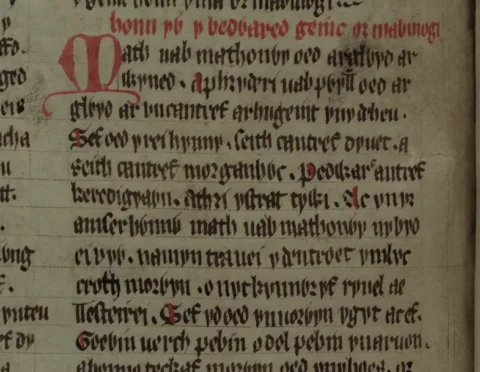
Math fab Mathonwy, meaning “Math, son of Mathonwy,” is the last of the Four Branches of the Mabinogi (Pedeir Keinc y Mabinogi), a collection of interconnected Welsh tales preserved in the fourteenth-century White Book of Rhydderch and Red Book of Hergest. Although the surviving manuscripts are medieval, the precise age of the traditions behind the story remains uncertain.
The narrative is set primarily in Gwynedd, in northern Wales, and Dyfed, in the southwest. It also concludes the story of Pryderi, the only character to appear in all four branches. Despite its title, much of the Fourth Branch follows Gwydion and Lleu rather than Math himself. Its characters are often associated with pre-Christian Celtic mythology, but the surviving text presents them as rulers, magicians, and members of powerful families rather than explicitly identifying them as gods.
Why Did Gwydion Steal Pryderi’s Pigs?
Math could not live unless his feet rested in the lap of a virgin, except when he was at war. Although the position of a royal foot-holder existed in medieval Welsh law, the supernatural condition attached to Math belongs to the tale. His foot-holder was Goewin, the daughter of Pebin.
Gilfaethwy, one of Math’s nephews, desired Goewin. His brother Gwydion devised a plan to draw their uncle away from his court by provoking a war with Pryderi.
Pryderi possessed pigs given to him by Arawn, the ruler of Annwn, the Welsh Otherworld. Disguised as poets, Gwydion and eleven companions visited Pryderi’s court. When Gwydion requested the pigs, Pryderi explained that he was bound by an agreement preventing him from giving them away or selling them until their numbers had doubled.
Gwydion circumvented this restriction by offering an exchange. Using magic, he conjured twelve horses, twelve hunting dogs, and golden shields. Pryderi accepted the bargain, unaware that the magical creations would disappear after a day and a night.
By the time the deception was discovered, Gwydion had returned to Gwynedd with the pigs. Pryderi assembled his forces, compelling Math to leave his court and Goewin behind, exactly as Gwydion had intended.
The Assault on Goewin and the Death of Pryderi
While Math was occupied with the war, Gwydion and Gilfaethwy returned to Caer Dathyl. They dismissed the women attending Goewin, and Gilfaethwy raped her in Math’s own bed.
The fighting between Gwynedd and Dyfed inflicted heavy losses on Pryderi’s forces. To prevent further bloodshed, Pryderi challenged Gwydion to single combat. Gwydion killed him through a combination of strength, courage, magic, and deception. Pryderi’s death brought the conflict to an end, concluding the life of a character whose story had connected all four branches of the Mabinogi.
When Math returned, Goewin told him what had happened and identified both brothers as responsible. Math promised to seek justice for her, married her, and offered her authority over his kingdom. He then turned his attention to punishing his nephews for their actions.
How Math Punished Gwydion and Gilfaethwy
Math struck his nephews with a magic wand, transforming Gwydion into a stag and Gilfaethwy into a hind. He ordered them to live in the wild and produce offspring together. After a year, they returned with a fawn, which Math transformed into a boy named Hydwn.
In the second year, Gwydion became a sow and Gilfaethwy a wild boar. Their offspring received the name Hychdwn. During the third year, Gwydion became a male wolf and Gilfaethwy a she-wolf, producing a third son, Bleidwn.
Math transformed all three offspring into human children and had them baptized. The presence of baptism alongside magical transformations reflects the Christian setting in which the medieval tale was preserved.
After three years of punishment, Math restored the brothers to human form, declaring that they had suffered sufficient humiliation for their offence. He reconciled with them, allowing Gwydion to resume his position at court.
Arianrhod and the Birth of Lleu Llaw Gyffes
Math needed a new foot-holder, and Gwydion recommended his sister Arianrhod, the daughter of Dôn. To test her virginity, Math asked her to step over his magic wand. She immediately gave birth to a boy with golden hair. As she fled in embarrassment, something else fell from her, which Gwydion concealed in a silk cloth and placed inside a chest.
The first child was named Dylan. After his baptism, he entered the sea, where he could swim as naturally as a fish. He was later killed by his uncle Gofannon.
One morning, Gwydion heard a cry from the chest and discovered a baby boy inside. He arranged for the infant to be nursed, and the child grew at an extraordinary rate.
The Welsh text describes what Gwydion initially recovered as pethan, meaning a small thing, without specifying its nature. Although some scholars have suggested that Gwydion was the boy’s father, the narrative never establishes his paternity.
The Three Restrictions Placed on Lleu
When Gwydion brought the boy to Caer Arianrhod, his mother regarded the encounter as a reminder of her humiliation. She imposed a series of restrictions upon him, expressed in the Welsh text through the concept of tynged, a binding fate or condition.
The First Restriction: A Name
Arianrhod declared that the boy would have no name unless she gave him one. Gwydion disguised himself and the child as shoemakers to gain access to her.
When the boy struck a wren with remarkable accuracy, Arianrhod remarked that the fair-haired boy had a skilful hand. Gwydion declared that she had named him Lleu Llaw Gyffes, commonly translated as Lleu of the Skilful Hand.
The Second Restriction: Weapons
Angered by the deception, Arianrhod declared that Lleu would receive no weapons unless she armed him herself.
Gwydion returned with Lleu disguised as young poets. Through magic, he created the illusion of a hostile fleet approaching her fortress. Believing herself under attack, Arianrhod helped arm Lleu, unwittingly fulfilling her own condition.
The Third Restriction: A Wife
Arianrhod imposed a final restriction: Lleu would never have a wife from any race then living on earth. Unlike the previous conditions, this one did not depend on an action she could be tricked into performing.
Gwydion therefore sought Math’s help to create a wife who would fall outside the terms of Arianrhod’s prohibition.
Blodeuwedd: The Woman Created from Flowers
To overcome Arianrhod’s final restriction, Math and Gwydion gathered the blossoms of oak, broom, and meadowsweet. Using their magic, they fashioned a woman of extraordinary beauty, named her Blodeuedd, and arranged her marriage to Lleu.
With the three restrictions overcome, Gwydion approached Math about providing Lleu with land. Math granted him the cantref of Dinoding, a territory in northwestern Wales, where Lleu established his residence at Mur Castell, generally identified with Tomen y Mur.
Although Blodeuedd was created to fulfil Lleu’s need for a wife, the narrative gives no indication that she was consulted about the marriage.
Blodeuwedd’s Betrayal and the Attack on Lleu
While Lleu was visiting Math, Blodeuwedd offered hospitality to Gronw Pebr, the lord of Penllyn, who had been hunting nearby. The two became lovers and plotted to kill Lleu so they could remain together.
Blodeuwedd pretended to worry about Lleu’s safety and asked him how anyone could take his life. Lleu told her that the weapon would have to be a spear made over the course of a year, worked on only during Sunday mass. Even then, he could not be killed indoors or outdoors, on horseback or on foot. He would have to be standing with one foot on the edge of a covered bath and the other on a goat.
Once Gronw had prepared the spear, Blodeuwedd persuaded Lleu to demonstrate these conditions. Gronw emerged from hiding and struck him with the weapon. Rather than dying, Lleu transformed into an eagle and flew away, uttering a terrible cry.
Gronw subsequently took possession of Lleu’s territory.
Read Also:
The Return of Lleu and the Fate of Blodeuwedd
Gwydion searched for Lleu until he reached the house of a swineherd whose sow disappeared each morning. Following the animal, he discovered an eagle perched in an oak tree, shedding pieces of decaying flesh that the sow was feeding upon.
Recognizing Lleu, Gwydion recited three poetic verses (englynion), gradually coaxing the eagle down from the tree. He restored Lleu to human form, although his injuries were so severe that he required a year of treatment before recovering.
When Lleu returned to reclaim his territory, Blodeuedd fled with her attendants. Gwydion caught her and transformed her into an owl, condemning her to avoid daylight and endure the hostility of other birds. The narrative marks this transformation through the change of her name from Blodeuedd to Blodeuwedd.
Gronw agreed to receive a spear throw under the same conditions in which he had attacked Lleu. When his own men refused to take the blow on his behalf, he requested permission to place a stone between himself and Lleu. The spear pierced the stone and killed him.
The tale associates the perforated stone with a local landmark called Llech Gronw. Lleu recovered his territory and eventually became the ruler of Gwynedd, bringing the Fourth Branch to its conclusion.
What Does the Fourth Branch of the Mabinogi Mean?
The Fourth Branch repeatedly connects magic with the exercise of power. Gwydion uses deception to provoke a war and later employs similar methods to secure Lleu’s name and weapons. His devotion to Lleu complicates the moral character of a man whose earlier actions caused considerable suffering.
Arianrhod’s three restrictions can also be understood in terms of medieval Welsh society. A name established personal identity, weapons conferred warrior status, and marriage enabled the formation of a household. By denying Lleu these things, Arianrhod obstructed his path towards social and political independence.
Animal transformations serve different purposes throughout the narrative. For Gwydion and Gilfaethwy, they are temporary punishments; for Lleu, transformation allows him to survive a grave injury; for Blodeuwedd, it imposes permanent exclusion from human society.
The coexistence of supernatural motifs and Christian references makes it difficult to distinguish the tale’s possible pre-Christian inheritance from its medieval literary development.
Conclusion
Math fab Mathonwy brings the Four Branches of the Mabinogi to a close with the establishment of Lleu’s rule over Gwynedd. Its distinctive character lies in the way personal wrongdoing carries consequences across generations, reshaping families and kingdoms. Magic does not resolve every injustice in the tale; it is often the very means through which injustice occurs.
Sources & Primary Texts
- Hughes, Ian (ed.). Math Uab Mathonwy: The Fourth Branch of the Mabinogi. Dublin Institute for Advanced Studies, 2013.
- Davies, Sioned (trans.). The Mabinogion. Oxford University Press, 2007.
- Gruffydd, W. J. Math Vab Mathonwy: An Inquiry into the Origins and Development of the Fourth Branch of the Mabinogi, with the Text and a Translation. 1928.
- Math fab Mathonwy: The Fourth Branch of the Mabinogi. Annotated English translation with textual, linguistic, and historical notes. Mabinogi.net.
- Aberystwyth University. The Four Branches of the Mabinogi: Academic Reading List.
Copyright Notice© 2026 History & Myths. All rights reserved.
This article presents an original retelling and critical analysis of Math fab Mathonwy, based on medieval Welsh texts and scholarly references. The article’s original wording, structure, and analysis are protected by copyright. Unauthorized reproduction or republication is prohibited. Historical source materials and third-party images remain subject to their respective copyright and licensing conditions.