Njord: Norse God of the Sea, Wealth and Seafaring
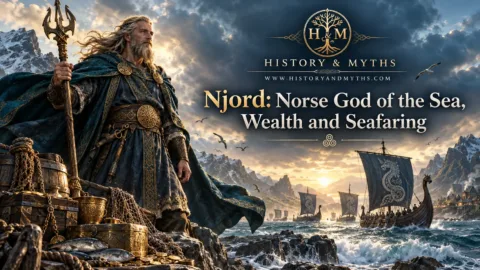
Njord (Old Norse: Njörðr ) was a major Vanir god associated with the sea, favorable winds, seafaring, fishing, and wealth. In Gylfaginning , Snorri Sturluson says that sailors and fishermen could call on him for safe voyages and that he could grant prosperity, land, and possessions.
Njord was not originally one of the Æsir. He came from Vanaheim and was sent to live among them as part of the peace settlement that followed the conflict between the Æsir and the Vanir. He was also the father of Freyr and Freyja.
His surviving myths connect him strongly with the coast. He lives at Nóatún, while his marriage to Skaði fails because she prefers the mountains and he prefers the sea.
Njord is therefore more than a generic sea god. His mythology brings together seafaring, prosperity, divine politics, and the continuing identity of the Vanir within the world of the Æsir.
Who Was Njord?
Njord (Old Norse: Njörðr ) was one of the principal gods of the Vanir, a divine group associated in the surviving Norse sources with prosperity, fertility, and abundance.
After the conflict between the Vanir and the Æsir, Njord was sent to live among the Æsir as part of the peace settlement between the two groups. Although he became part of their divine society, the sources continue to identify him as Vanir by origin.
He was also the father of Freyr and Freyja, two of the most prominent Vanir deities in Norse mythology.
Njord’s importance comes from the unusual position he occupies between the two divine families: Vanir by birth, but closely integrated into the world of the Æsir.
What Was Njord the God Of?
Njord was associated with the sea, favorable winds, seafaring, fishing, and material prosperity. In Gylfaginning , Snorri Sturluson says that he governs the course of the wind, can calm the sea and fire, and should be invoked for voyages and fishing.
He is also described as wealthy and powerful, with the ability to grant land and possessions to those who call on him.
These roles make Njord more than a god of the sea alone. His sphere includes the conditions that made maritime life successful: favorable weather, safe travel, productive fishing, and prosperity.
Was Njord an Aesir or a Vanir?
Njord was a Vanir god, not an Æsir by origin.
Vafþrúðnismál says that he came from Vanaheim and was given to the gods as a hostage. Gylfaginning likewise states that he was raised among the Vanir before being sent to the Æsir as part of the settlement between the two groups.
After the exchange, Njord lived among the Æsir and appeared alongside them in later myths, but the sources continued to preserve his Vanir identity.
Njord and the Aesir-Vanir War
Njord’s importance in the Aesir-Vanir War comes from the peace settlement rather than from the fighting itself.
The surviving sources do not present him as one of the principal combatants. After the conflict, the two divine groups exchanged hostages, and Njord was sent from the Vanir to live among the Æsir. In return, the Æsir sent Hœnir and Mímir to the Vanir.
That exchange made Njord one of the clearest links between the two divine families. His later presence among the Æsir was a direct result of the settlement that ended their conflict.
Where Did Njord Live?
Njord’s home was Nóatún, a divine residence whose name is usually understood as “Ship-Enclosure” or “Ship-Yard.” Both the Poetic Edda and Gylfaginning place him there.
In Grímnismál , Nóatún is listed among the dwellings of the gods and identified as Njord’s hall. Snorri also links him closely with the coast, winds, seafaring, and fishing.
The name and setting of Nóatún fit Njord’s strong association with ships, the sea, and coastal life.
Why Was Njord Associated With Wealth?
Njord’s connection with wealth is explicit in the Prose Edda. In Gylfaginning , Snorri describes him as wealthy and prosperous, with the power to grant land and possessions to those who call on him.
That association fits his maritime role. Ships connected fishing grounds, coastal settlements, trade routes, and overseas exchange, so favorable winds and safe voyages had direct economic value.
Njord’s wealth is best understood through those benefits: successful fishing, secure travel, trade, and the accumulation of land and goods.
Who Was Njord’s Wife?
Njord’s wife was Skaði, the daughter of the jötunn Þjazi. Their marriage began as part of the compensation she received after the gods killed her father.
Skaði was allowed to choose a husband from among the gods, but she could see only their feet. Expecting to select Baldr, she instead chose Njord.
The marriage was therefore the result of a settlement rather than a natural match, and the differences between them soon became impossible to ignore.
Njord and Skaði: Why Their Marriage Failed
Njord and Skaði were poorly matched from the beginning. Skaði belonged to the mountains of Þrymheimr, while Njord preferred the coast and his hall at Nóatún. They tried dividing their time between the two homes, although the surviving versions differ over exactly how long they stayed in each place.
Neither could tolerate the other’s environment. Njord disliked the mountains and the howling of wolves, while Skaði complained that the cries of seabirds disturbed her sleep by the sea. Their complaints are preserved in verse in Gylfaginning .
The arrangement failed, and Skaði returned to Þrymheimr and the mountain life she preferred.
Who Were Njord’s Children?
Njord’s children were Freyr and Freyja, two of the most important Vanir deities in Norse mythology. Skáldskaparmál identifies Freyja as Njord’s daughter and Freyr’s sister, while other sources preserve the same family relationship.
Their mother is unnamed in the surviving sources. In Ynglinga saga, Snorri says that Njord had Freyr and Freyja with his sister while he was still among the Vanir.
The saga presents marriage between close relatives as a custom permitted among the Vanir but not accepted among the Æsir.
Was Njord Worshipped by the Vikings?
There is good evidence that Njord was worshipped in pre-Christian Scandinavia rather than existing only as a figure in medieval literature.
Place-names containing forms of Njord’s name have long been used as evidence for cult activity, especially in Norway. Several occur in coastal areas or near water, which fits his association with seafaring and prosperity. Examples often discussed include Norderhov, Njarðarheimr, and Njarðarland.
Written sources preserve the same association with worship. In Ynglinga saga, Snorri describes Njord as maintaining sacrifices and links him with peace, good seasons, and prosperity. The saga was written long after the Viking Age, so it cannot be treated as a contemporary record of cult practice.
Taken together, the place-name evidence and later literary tradition support genuine worship of Njord in pre-Christian Scandinavia, although the exact form and scale of that cult cannot be reconstructed in detail.
Where Do the Main Sources Describe Njord?
Njord appears in both the Poetic Edda and the Prose Edda, but the surviving references are spread across several texts.
In the Poetic Edda,Vafþrúðnismál preserves his Vanir origin and hostage status, while Grímnismál names Nóatún as his dwelling. Lokasenna adds further references to his family background and place among the gods.
The Prose Edda gives the fullest single portrait of Njord. In Gylfaginning , Snorri describes his powers, wealth, residence, and marriage to Skaði.Skáldskaparmál also preserves important family relationships involving Freyr and Freyja.
No single surviving source gives a complete biography of Njord. His character has to be reconstructed from these separate references.
Njord and Nerthus: Are They Connected?
Njord has often been compared with Nerthus, the Germanic goddess described by Tacitus in Germania in the first century CE.
The connection begins with the names. Njörðr and Nerthus are generally traced to the same Proto-Germanic form, usually reconstructed as Nerþuz, which points to a genuine historical relationship between the two traditions.
What remains uncertain is the nature of that relationship. Tacitus describes Nerthus as female, while Njord appears as male in the Old Norse sources written many centuries later. Scholars have proposed several ways to explain the difference, but no single reconstruction has been accepted.
The linguistic link is strong, but identifying Nerthus and Njord as the same deity goes beyond what the evidence can securely establish.
Njord vs. Aegir: What Is the Difference?
Njord and Aegir are both connected with the sea, but they play very different roles in Norse mythology.
Njord is a Vanir god associated with favorable winds, seafaring, fishing, and wealth. In Gylfaginning , he is a god sailors and fishermen can invoke, giving him a practical and protective role.
Aegir is different. He is usually treated as a jötunn or personification of the sea and is best known as the host who brews ale for the gods. His wife, Rán, is closely associated with those who drown at sea.
Njord is linked with safe travel, successful fishing, and prosperity. Aegir represents the sea more as a mythic being and force in its own right.
What Happened to Njord at Ragnarök?
The surviving sources do not describe Njord dying at Ragnarök.
In Vafþrúðnismál , Vafþrúðnir says that Njord came from Vanaheim as a hostage and that, at the end of the world, he will return to the Vanir. The poem does not place him among the gods who fall in the final battle.
That sets him apart from figures such as Odin, Thor, and Freyr, whose deaths are explicitly tied to Ragnarök. What happens to Njord after his return is not explained.
Conclusion
Njord remained unmistakably Vanir even after becoming part of the Æsir world. His myths connect seafaring, wealth, family, and divine politics without reducing him to a generic sea god.
From Nóatún and his marriage to Skaði to his role in the settlement between the Æsir and Vanir, Njord is best understood as a god whose identity is rooted in coastal life and the prosperity that could come from it.
Academic Sources and Primary Texts
Carolyne Larrington, trans., The Poetic Edda.
Oxford University Press, 2014. A modern scholarly translation containing Vafþrúðnismál, Grímnismál, and Lokasenna, the main poetic sources for Njord’s Vanir origin, Nóatún, family background, and return to the Vanir.
Oxford Academic
Snorri Sturluson, Edda: Prologue and Gylfaginning, ed. Anthony Faulkes.
Viking Society for Northern Research, 2nd ed., 2005. The principal prose source for Njord’s powers over wind and sea, his association with voyages and fishing, his wealth, Nóatún, and his marriage to Skaði.
Viking Society for Northern Research
Snorri Sturluson, Edda: Skáldskaparmál, ed. Anthony Faulkes.
Viking Society for Northern Research, 1998. Important for Njord’s family relationships and the wider mythological context surrounding Freyr, Freyja, and the gods.
Viking Society for Northern Research
Snorri Sturluson, Heimskringla I: The Beginnings to Óláfr Tryggvason, trans. Alison Finlay and Anthony Faulkes.
Viking Society for Northern Research, 2nd ed., 2016. Includes Ynglinga saga, an important source for Njord’s sister-wife tradition, Freyr and Freyja, sacrifice, peace, good seasons, and prosperity.
Viking Society for Northern Research
Tacitus, Germania, Chapter 40.
The earliest surviving literary description of Nerthus and the Germanic cult tradition later compared with Njord. Useful for keeping the Nerthus discussion separate from the much later Old Norse material.
Perseus Digital Library, Tufts University
Stefan Brink, “How Uniform Was the Old Norse Religion?”
In Learning and Understanding in the Old Norse World, Brepols, 2007, pp. 105-136. Important for the study of pre-Christian Scandinavian religion and for place-name evidence connected with Njord and regional cult practice.
University of Aberdeen Research Portal
Stefan Brink, “Nerthus f. > Njǫrðr m.: A Speculative Proposal.”
In Good Thoughts on Folklore and Mythology, 2025, pp. 147-158. A peer-reviewed modern discussion of the linguistic and historical relationship between Nerthus, Niærþer, and Njord, while emphasizing that the reconstruction remains speculative.
University of the Highlands and Islands Research Portal
John Lindow, Norse Mythology: A Guide to the Gods, Heroes, Rituals, and Beliefs.
Oxford University Press, 2002. A major scholarly reference for Norse deities, mythological traditions, ritual context, and the interpretation of figures such as Njord within the wider Norse pantheon.
Oxford Academic