Forseti: The Norse God of Justice and Reconciliation
Forseti was the Norse god of justice and reconciliation, remembered for settling disputes and restoring agreement between opposing parties. The son of Baldr and Nanna, he presided over Glitnir, a hall supported by golden pillars and roofed with silver. In Grímnismál, he is described as bringing conflicts to an end, while Snorri Sturluson’s Prose Edda states that those who brought legal disputes before him departed reconciled.
Despite this reputation, no surviving Norse myth describes Forseti judging a particular case. His historical worship is equally difficult to establish. A possible connection with Fosite, a deity honoured by the Frisians on a sacred island, offers further clues but remains disputed. Forseti’s surviving appearances reveal a divine figure associated with peaceful settlement, while leaving much of his religious importance unknown.
Who Was Forseti in Norse Mythology?
Forseti belonged to the Æsir, the principal group of gods in Norse mythology. In Gylfaginning, Snorri Sturluson identifies his mother, Nanna, as the daughter of Nep. His relationship with Baldr is also preserved in Skáldskaparmál, where “father of Forseti” appears among the poetic descriptions of Baldr. Beyond these family connections, the sources provide no account of Forseti’s birth, marriage, or children.
His name is generally interpreted as “the presiding one” or “chairman,” referring to someone who occupies a leading position in an assembly. The meaning suits his association with settling disputes, but it does not establish that he presided over historical Norse law assemblies or that their proceedings involved his worship.
Glitnir: Forseti’s Hall of Judgment
In Grímnismál, stanza 15, Glitnir is listed as the tenth dwelling of the gods. Its name is commonly translated as “the Shining One.” The poem describes a hall supported by golden pillars and covered by a silver roof, where Forseti spends most of his days settling disputes.
Snorri adds another detail in Gylfaginning, chapter 17: Glitnir’s walls and pillars are made of red gold, while its roof is silver. When he introduces Forseti in chapter 32, he quotes the same stanza from Grímnismál. The descriptions therefore share a poetic source rather than representing entirely independent accounts.
Beyond its materials and purpose, little is known about Glitnir. Neither source describes its interior arrangement, the people who gathered there, or a particular case heard by Forseti. Its reputation as a place of judgment is preserved, but the surviving mythology provides no detailed account of how proceedings took place.
Forseti and the Settlement of Disputes
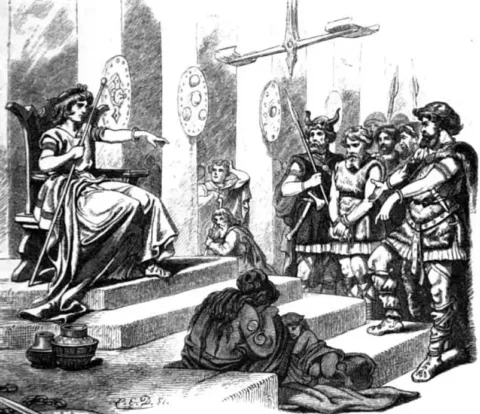
Forseti’s reputation as a judge rests on an unusual detail in Gylfaginning: those who bring difficult legal disputes before him leave reconciled. Snorri calls his seat the finest place of judgment among gods and humans. The emphasis falls on resolving disagreements rather than punishing offenders.
The Old Norse wording is revealing. Snorri uses sakarvandræði for troublesome legal disputes and describes the parties as sáttir, meaning reconciled or in agreement. The account does not explain whether Forseti negotiated settlements, issued binding decisions, or followed particular laws.
His role has invited comparisons with the þing, the assemblies where Scandinavian communities settled legal matters. However, no surviving evidence establishes that Forseti presided over these gatherings or that their participants invoked him. His association with peaceful resolution is well attested in mythology, but the procedures behind his judgments remain unknown.
Forseti also appears at Ægir’s feast in the opening of Skáldskaparmál, seated among twelve Æsir appointed as judges. The passage places him within the divine assembly but gives him no individual judgment or speech.
Fosite and the Sacred Island of Fositesland
An account of the god Fosite survives in Alcuin’s Life of St Willibrord, written around 796 CE. Alcuin describes an island called Fositesland, situated near the boundary between the Frisians and Danes. Its inhabitants revered Fosite, whose sanctuaries stood on the island. Animals grazing there were considered sacred, and water could only be drawn from a spring in complete silence.
According to Alcuin, the missionary Willibrord was driven ashore by a storm. He deliberately violated the island’s religious restrictions by baptizing three people in the sacred spring and ordering cattle slaughtered for food. The inhabitants expected divine punishment, but when none followed, they reported the incident to the Frisian ruler Radbod, who sought to punish the visitors.
Fositesland is commonly identified with Heligoland in the North Sea, although Alcuin does not name that island. His account provides valuable evidence of traditions surrounding Fosite, but it was written from a Christian missionary perspective, decades after the events described. It does not explain the god’s powers or identify him with the Norse Forseti.
Were Forseti and Fosite the Same God?
Forseti and the Frisian god Fosite have often been identified as the same deity because of the resemblance between their names. One theory proposes that an older Frisian name was adapted in Scandinavia as forseti, a familiar word meaning “the presiding one.” The linguistic relationship remains disputed, however, and the two names cannot be securely traced to a common origin.
Their recorded roles also differ. The Norse sources associate Forseti with settling disputes, while the accounts of Fosite describe a sacred island without identifying him as a judge or lawgiver.
A later Frisian legend tells of twelve law-speakers whom Charlemagne sends to sea in a rudderless boat after they fail to recite their laws. A mysterious thirteenth man appears with a golden axe, guides them ashore, creates a spring, and teaches them the law. Some scholars have associated him with Fosite, but the story never names him. Its surviving medieval form also shows Christian influence, making any connection with an earlier pagan deity uncertain.
The identification of Forseti with Fosite is therefore plausible but unproven. The surviving evidence cannot establish whether they were regional forms of one god or distinct deities.
Was Forseti Worshipped by the Norse?
Direct evidence for Forseti’s worship in pre-Christian Scandinavia is scarce. No surviving account describes sacrifices or festivals dedicated to him, and no archaeological site has been securely identified as his sanctuary. One possible trace survives in a Norwegian place name.
The medieval farm name Forsetlund, recorded in Onsø, Østfold, has been reconstructed as Forsetalundr, meaning “Forseti’s grove.” Historian Stefan Brink considers this a plausible reference to the god, particularly because the surrounding district preserves other names associated with pre-Christian religion. If the interpretation is correct, the name suggests a place once connected with his worship, although it reveals nothing about the rituals performed there.
The evidence for the Frisian Fosite is more explicit. Alcuin describes sanctuaries and sacred restrictions on Fositesland, but these cannot automatically be attributed to Forseti because the identification of the two gods remains uncertain. Forseti may have received local worship in Scandinavia, yet its extent and practices cannot be reconstructed from the surviving evidence.
Forseti’s Absence from the Surviving Myths
Although Forseti is identified as Baldr’s son, he plays no recorded part in the story of his father’s death. In Gylfaginning, the gods gather for Baldr’s funeral, and Hermóðr travels to Hel in an attempt to bring him back. Forseti is not mentioned in either episode.
His fate during Ragnarök is equally unknown. Neither Völuspá nor Snorri’s account of the final battle assigns him a role. Baldr is said to return after the destruction of the gods, but the sources reveal nothing about what happens to his son.
This silence does not establish that Forseti lacked other myths. The surviving medieval texts preserve only part of the earlier Norse religious tradition. Stories concerning Forseti may have existed without entering the written record.
Read Also
- Baldr: The Shining God Whose Death Changed the Norse World
, discover the story of Forseti’s father, his tragic death, and his promised return after Ragnarök. - Tyr: The One-Handed Norse God of War and Courage
, explore another Norse deity associated with duty and obligation, whose possible connection with law differs from Forseti’s role in reconciliation. - The Aesir-Vanir War: Why the Norse Gods Fought and Who Won
, examine how conflict between two groups of gods ended through negotiation, peace, and an exchange of hostages.
Conclusion
Forseti occupies a distinctive place among the Norse gods. Rather than appearing in stories of warfare or heroic exploits, he is remembered for resolving disputes and restoring agreement between opposing parties. His hall, Glitnir, reflects this reputation, although no surviving myth describes a judgment he delivered.
The possible connection with the Frisian Fosite suggests a wider religious background, but their identification remains uncertain. Forseti’s role in medieval Norse literature is clear, while the extent of his historical worship and the traditions once associated with him remain largely unknown.
Academic Sources & Primary Texts
This article draws on medieval Old Norse literature, early medieval accounts of Frisian religion, historical place-name research, and modern scholarship. It distinguishes Forseti’s documented role in settling disputes from uncertain claims about his worship and his possible identification with the Frisian god Fosite.
Primary Norse Sources
- The Poetic Edda: A Dual-Language Edition.
Edited and translated by Edward Pettit. Open Book Publishers, 2023.
Grímnismál, stanza 15, describes Forseti’s hall Glitnir, its golden supports and silver roof, and his role in settling disputes. The edition also provides the Old Norse text and scholarly commentary.
Read the Scholarly Edition - Snorri Sturluson. Edda: Prologue and Gylfaginning.
Edited by Anthony Faulkes. Second edition. Viking Society for Northern Research, 2005.
Chapters 17 and 32 describe Glitnir, identify Forseti as the son of Baldr and Nanna, and explain his reputation for reconciling opposing parties.
Academic Edition - Snorri Sturluson. Edda: Skáldskaparmál.
Edited by Anthony Faulkes. Viking Society for Northern Research, 1998.
Includes Forseti among twelve gods occupying the judges’ seats at Ægir’s feast and preserves his name in the poetic descriptions of Baldr.
Academic Edition
Frisian Historical Sources
- Alcuin. Life of St Willibrord.
Written around 796 CE. English translation reproduced by the Internet Medieval Sourcebook, Fordham University.
Chapters 10–11 describe Fositesland, its sacred spring and animals, and Willibrord’s violation of the island’s religious restrictions. The account provides evidence of Fosite’s worship but does not identify him with Forseti.
Read the Primary Source - Nijdam, Han, Jan Hallebeek, and Hylkje de Jong, editors (2023).
Frisian Land Law: A Critical Edition and Translation of the Freeska Landriucht. Brill.
Includes the medieval Frisian tradition of twelve law-speakers, their encounter with a mysterious thirteenth man carrying a golden axe, and the establishment of legal customs. The figure is not explicitly named Fosite or Forseti.
Read the Text and Translation
Modern Academic Scholarship
- Lindow, John (2002).
Norse Mythology: A Guide to the Gods, Heroes, Rituals, and Beliefs. Oxford University Press.
A scholarly reference for Forseti’s parentage, Glitnir, his role in resolving disputes, and the proposed connection with the Frisian Fosite.
Oxford Academic - Simek, Rudolf (1993).
Dictionary of Northern Mythology. Translated by Angela Hall. D. S. Brewer.
A reference work for the historical interpretation of Forseti, Fosite, Glitnir, and related Germanic religious traditions. - Brink, Stefan.
“How Uniform Was the Old Norse Religion?”
Examines regional variation in pre-Christian Scandinavian religion and the evidence of sacred place names, including the possible interpretation of Forsetalundr as a grove associated with Forseti.
Read the Academic Study (PDF)
Research Note: The medieval Norse texts establish Forseti’s association with the peaceful settlement of disputes, but preserve no detailed account of an individual judgment. The identification of Forseti with the Frisian Fosite remains debated. Evidence of Fosite’s worship cannot automatically be treated as evidence of Forseti’s cult in Scandinavia, and the interpretation of Forsetalundr as a sacred place name remains provisional.
Copyright & Content Notice
© 2026 History & Myths. All rights reserved.
The original editorial content of this article is published by History & Myths. Reproduction or redistribution of substantial portions requires permission, except where permitted by applicable copyright law. Brief quotations should include clear attribution and a link to the original article.
Ancient texts, scholarly publications, archaeological objects, and third-party images remain subject to their respective rights and licenses. Image credits and licensing information are provided separately where applicable.