What If Athens Had Lost the Battle of Marathon to Persia?
If Athens had lost the Battle of Marathon in 490 BCE, the immediate consequence would probably have been political crisis at home rather than the conquest of all Greece. The Persian-backed exile Hippias would have been in a far stronger position to return to power, potentially interrupting the young democratic system that had emerged in Athens.
The larger consequences would unfold over the next decade. A politically weakened or Persian-aligned Athens might have given Themistocles less room to shape policy, delayed the city’s naval expansion, and reduced the force that later became central to Greek resistance against Xerxes.
Sparta, Corinth, and other Greek states would still remain independent, so a Persian victory at Marathon would not settle the wider struggle by itself.
The real question is whether Athens would still have become the democratic and naval power that Persia faced when it returned to Greece ten years later.
The Historical Turning Point
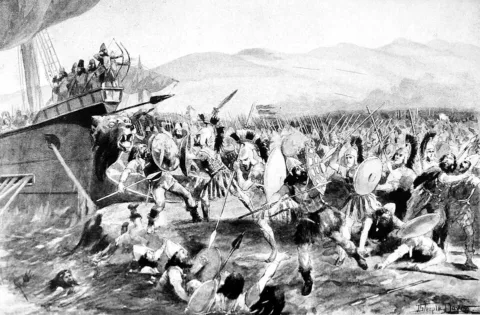
By 490 BCE, Athens had become a target of Persian retaliation after supporting the Ionian Revolt. The Persian expedition crossed the Aegean, captured Eretria, and then landed at Marathon in Attica.
The exiled Athenian tyrant Hippias accompanied the expedition and helped guide the Persians to Marathon. Herodotus presents him as still hoping to recover the power his family had lost, giving the campaign an immediate political dimension for Athens as well as a military one.
Athens marched to Marathon with support from Plataea. Sparta had agreed to send help but arrived only after the battle, leaving the Athenians and Plataeans to face the Persian force without them.
The Athenian line was thinner in the center and stronger on the wings. The Persian center broke through the middle, but the Athenian wings defeated the troops opposite them and then turned inward against the Persian center. That reversal helped decide the battle.
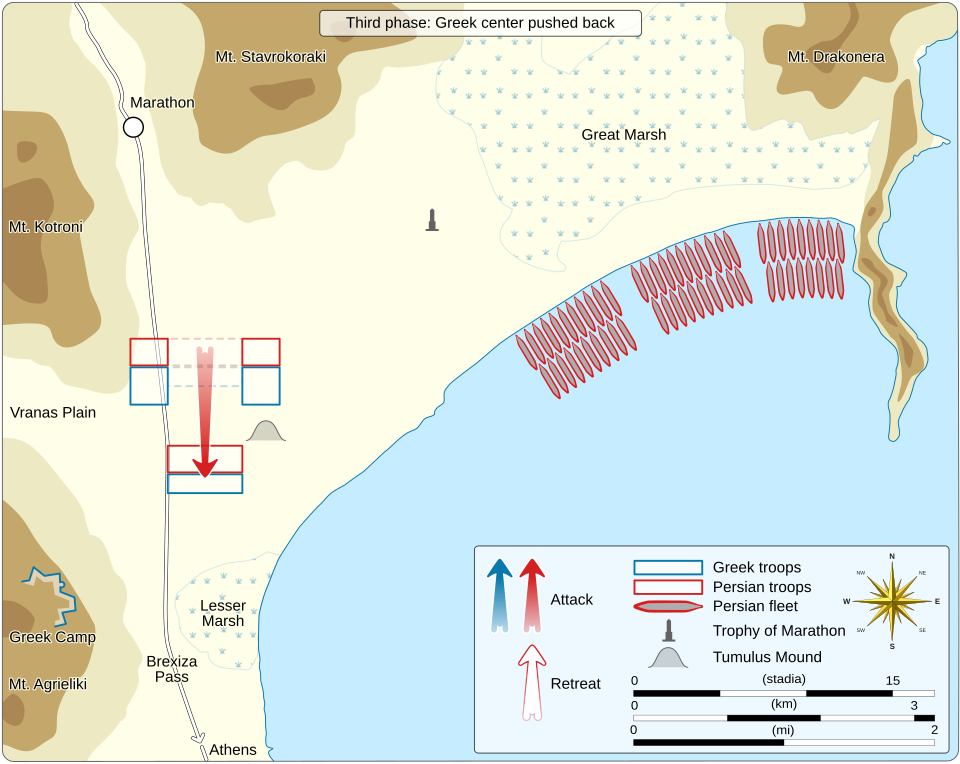
Athens Loses at Marathon
In this timeline, the Athenian center collapses before the wings can complete their maneuver. What begins as a controlled withdrawal turns into disorder, and the Persian army keeps possession of the battlefield.
The Athenians do not need to be annihilated for the result to matter. Enough of the citizen army is killed, scattered, or driven away that Athens loses the organized force that historically returned quickly to defend the city.
Persia now holds the initiative in Attica. Its fleet remains intact, Hippias is still with the expedition, and Athens has to respond to the threat after a battlefield defeat rather than a victory.
The military result therefore creates a political crisis. The next question is not simply whether the Persians can reach Athens, but whether the city can resist pressure for surrender or the restoration of a Persian-backed government.
What Happens to Athens After the Defeat?
A defeat at Marathon would leave Athens with a weakened citizen army while the Persian fleet remained free to move toward the city.
The Persian Fleet Reaches an Exposed Athens
Historically, the Persian fleet sailed around Cape Sounion after the battle and anchored off Phalerum, then Athens’ harbor. The victorious Athenian army marched back quickly enough to reach the city first, and the Persians eventually withdrew.
In this timeline, there is no victorious army returning in good order. Survivors may still reach Athens, and Spartan help is expected, but the city now faces the fleet after losing the main battle in Attica.
That does not make capture certain. It does, however, give Persia far more leverage to demand submission or force a political settlement.
Would Hippias Return to Power?
Hippias had been trying to recover Athens for years. Herodotus records that the Persian satrap Artaphrenes had previously told the Athenians to accept him back if they wanted to remain safe. Athens refused, and Hippias later accompanied the Persian expedition into Attica.
We should not treat his restoration as Persia’s only possible objective. Herodotus says Darius ordered the expedition against Athens and Eretria with instructions to subdue them. But installing Hippias, or another cooperative regime, would offer Persia one way to control Athens without relying on permanent direct occupation.
That arrangement could still face strong resistance. Hippias had been expelled years earlier, and Athens had since developed a broader political system under Cleisthenes.
What Happens to Athenian Democracy?
Cleisthenes’ reforms of 508/507 BCE had reorganized Athens and created the constitutional basis of its democracy. By Marathon, that system was therefore less than two decades old.
A Persian-backed restoration of Hippias could interrupt or restrict those institutions at a formative stage. But it would be too strong to claim that democracy would disappear permanently. Athenian politics could change again through revolt, exile, or a later change of regime.
Defeat at Marathon could therefore break the continuity of early Athenian democracy just as it was becoming established.
That political disruption matters because Athens was about to make decisions that would transform its naval power. Whether the same city could still emerge by 480 BCE is the larger question.
Would Sparta Fight Persia After Marathon?
A Persian victory at Marathon would not remove Sparta from the conflict.
Athens had already asked Sparta for help before the battle. According to Herodotus, the Spartans agreed to send troops but delayed their departure until the full moon. About 2,000 Spartans eventually reached Attica, only to find that the battle was already over.
In the alternate timeline, they might arrive after Athens had been defeated but before the political situation was settled. That would make a Spartan intervention possible, but not inevitable. Persia could avoid a major land battle by pressuring Athens into submission, restoring Hippias, or withdrawing after establishing a friendly government.
Sparta would still remain the strongest independent land power in Greece, and any attempt by Persia to push farther toward the Peloponnese would eventually have to take that into account.
So the most likely immediate result is not a second battle between Persia and Sparta outside Athens. Persia could weaken or dominate Athens without yet conquering the rest of Greece, leaving Sparta as the main obstacle to any wider expansion.
Could Persia Actually Hold Athens?
Winning at Marathon could give Persia strong influence over Athens, but maintaining that control would be more difficult.
Persia already governed Greek cities in Asia Minor through local rulers who depended on imperial support. Before the Ionian Revolt, several Greek tyrants operated within this system, making a restored Hippias, or another cooperative Athenian government, more plausible than direct Persian rule over Attica.
Hippias himself created a problem. By 490 BCE he was already elderly, making it unlikely that a political settlement built around him would remain unchanged for another decade. Herodotus’ account at Marathon clearly presents him as an old man.
After his death, Persia could support another member of the Peisistratid circle or a cooperative Athenian faction. But succession would also give exiles and political rivals an opportunity to challenge the regime.
So Persian influence over Athens after Marathon is plausible. Secure control lasting all the way to 480 BCE is much less certain. Athens might remain within the Persian sphere, revolt, or change governments before Xerxes returned.
Would Themistocles Still Build the Athenian Fleet?
A Persian victory at Marathon would put Athens’ later naval expansion in doubt, but it would not erase the city’s interest in sea power.
Themistocles had already begun looking toward the sea before 490 BCE. Work on Piraeus as a stronger harbor and naval base had started around the time of his archonship in 493/492 BCE, so his naval policy did not simply emerge from victory at Marathon.
The decisive expansion came later. In the 480s, new revenue from the silver mines at Laurium became available. Herodotus says Themistocles persuaded the Athenians to spend the money on ships rather than distribute it among themselves. His immediate argument was the ongoing war with Aegina, not preparation for Xerxes.
That matters because the rivalry with Aegina could still give Athens a reason to build ships even after a defeat at Marathon.
The real uncertainty is political. If Athens were ruled by Hippias or another Persian-backed government, Themistocles might lose influence, face exile, or lack the political support needed to redirect the Laurium revenues toward a large independent fleet.
Athens would not necessarily become a city without naval power. Greek communities within the Persian sphere could still maintain ships and serve imperial campaigns. What becomes much less certain is the rise of the large, independent Athenian fleet that later allowed the city to shape Greek strategy for itself.
The most plausible change is therefore a fleet that is smaller, delayed, politically constrained, or tied more closely to Persian interests.
By 480 BCE, that difference could be decisive. Historically, Athens had become the largest contributor of ships to the Greek resistance against Xerxes. Without the same naval transformation, the next Persian invasion would begin under very different conditions.
Would Xerxes Still Invade Greece in 480 BCE?
A Persian victory at Marathon would not necessarily prevent a later invasion of Greece, but it could change its purpose and strategic setting.
Historically, Darius began preparations for another campaign against Greece after Marathon. He died in 486 BCE, and Xerxes inherited both the empire and those preparations. After suppressing a revolt in Egypt, Xerxes eventually launched the much larger invasion of 480 BCE.
Herodotus presents Xerxes’ campaign as more ambitious than the expedition of 490. Athens remained an important target, but Mardonius urged the king toward the subjugation of Greece more broadly, with the invasion proceeding by both land and sea.
If Athens had already been defeated and brought into the Persian sphere, one major objective would have been achieved before Xerxes came to power. Persia might no longer need to punish Athens or replace its government.
Sparta and other independent Greek states, however, would still remain outside Persian control. A wider campaign against mainland Greece therefore remains plausible, although it would not necessarily follow the same route or strategy as the historical invasion.
The biggest difference would be Athens itself. Instead of forming the core of Greek naval resistance, a Persian-aligned Athens could provide ports, supplies, or ships to the empire, while opposition depended more heavily on Sparta and the Peloponnesian states.
So Xerxes could still invade Greece after a Persian victory at Marathon. What changes is the strategic map he would face: Athens might already be on Persia’s side rather than standing at the center of the resistance.
Explore more alternate turning points in ancient Greek history:
What If the Greeks Had Won at Thermopylae?
What If Sparta Had Destroyed Athens After the Peloponnesian War?
Could the Battle of Salamis Still Happen?
A naval battle in 480 BCE could still happen, but the Battle of Salamis as we know it becomes much less likely.
Historically, Athens supplied the largest single contingent of the Greek fleet. Herodotus lists 180 Athenian ships at Salamis, more than any other Greek state. Although the Spartan Eurybiades commanded the combined fleet, the coalition would have been far smaller without Athens.
The setting also mattered. After Thermopylae fell, the Athenians evacuated Attica and the Greek fleet withdrew to Salamis. Fighting in the narrow straits reduced some of the advantages of the larger Persian fleet and helped produce the Greek victory.
In the alternate timeline, those conditions are harder to reproduce. If Athens remained under Persian influence, its ships might serve Persia or stay out of the resistance. If the city had regained independence but built a smaller fleet, the Greeks could still fight at sea, but with fewer ships.
A naval confrontation around the Saronic Gulf or the approaches to the Peloponnese therefore remains possible. What is much less certain is whether the Greeks could assemble the same force, choose Salamis as the battlefield, and make the narrow straits work in their favor.
The key difference is not simply “no Athens, no Salamis.” It is that the combination of ships, geography, and strategy that produced the historical victory becomes much harder to recreate.
Without a comparable victory at sea, Persia would enter the struggle for southern Greece from a substantially stronger position.
Would Persia Conquer All of Greece?
A Persian victory at Marathon would put the Greeks in a much weaker position, but it would not guarantee the conquest of the entire mainland.
Greece was not a single state that could be defeated by taking Athens. It was a collection of independent cities with different alliances and interests. In 480 BCE, some Greek communities submitted to Xerxes, while others joined a coalition led largely by Sparta on land.
A weaker or Persian-aligned Athens would still change that balance dramatically. The resistance would lose much of the naval strength Athens later supplied, and some states might judge submission safer than joining a smaller coalition.
Persia would also enter any later campaign from a stronger position in the Aegean. Without a comparable Greek victory at Salamis, Persian naval operations could remain effective farther south, increasing pressure on the Peloponnese.
Sparta, however, would still be a serious obstacle. Persian forces would have to operate across a fragmented landscape, maintain long supply lines, and deal with states whose loyalties could shift as the campaign developed.
A victory at Marathon would make Persian domination of Greece more plausible, but not inevitable.
The conflict would still depend on what happened among Sparta, the remaining Greek states, and Persia’s ability to sustain operations in southern Greece.
Most Likely Outcome
The most plausible alternate timeline begins with Athens losing political independence rather than Persia immediately conquering all Greece.
After a victory at Marathon, Persia would have a strong opportunity to pressure Athens into accepting Hippias or another friendly regime. Herodotus places Hippias with the invading force and shows that he still hoped to recover his former rule.
That settlement would not necessarily remain stable until 480 BCE. Athens could revolt, change governments, or recover some independence. What becomes much less likely is that the city follows exactly the same political and naval path as it did historically.
By the time Xerxes returned, Athens might therefore be weaker at sea, politically divided, still within the Persian sphere, or only recently independent.
That would matter most in the next Persian war. Historically, Salamis became a genuine turning point, and Athenian naval power was central to the Greek strategy there.
So the strongest scenario is not “Persia wins Marathon and Greece falls.” It is that Athens reaches 480 BCE as a different state, leaving the Greek resistance weaker and Persia in a substantially better position, without making Persian victory certain.
What Is Highly Unlikely
Some versions of this scenario push the consequences far beyond what the evidence can support.
A Persian victory at Marathon would not mean that Greek philosophy, drama, or science simply disappeared. Athens had not yet become the cultural center associated with the later fifth century BCE, and intellectual life already existed across the wider Greek world, including Ionia and Magna Graecia. Defeat could change where and how Greek culture developed, but it would not erase it.
Claims such as “no Rome,” “no Renaissance,” or “no modern democracy” are even harder to defend. Each depends on centuries of later political, cultural, and military developments that cannot be traced reliably to one battlefield result in 490 BCE.
Academic Sources
This alternate-history scenario is based on the surviving ancient accounts and modern academic scholarship on Marathon, Athenian politics, Persian strategy, Themistocles, and the Battle of Salamis.
- Herodotus, The Histories, Book VI.
Primary account for the Persian expedition of 490 BCE, Hippias at Marathon, the Athenian battle formation, Spartan delay, and the Persian movement toward Athens.
Perseus Digital Library, Tufts University
- Herodotus, The Histories, Book VII, 143–144.
Important evidence for Themistocles, the Laurium silver revenues, the war with Aegina, and the expansion of the Athenian fleet before Xerxes’ invasion.
Perseus Digital Library, Tufts University
- Herodotus, The Histories, Book VIII.
Primary narrative for the Greek naval coalition, Themistocles, the evacuation of Athens, and the Battle of Salamis.
Perseus Digital Library, Tufts University
- Encyclopaedia Iranica, “Greece i. Greco-Persian Political Relations.”
Academic overview of Persian relations with the Greek world, the Ionian Revolt, the expedition of 490 BCE, Marathon, and the wider Persian strategic context.
Encyclopaedia Iranica
- Christopher J. Tuplin, “Salamis.” Encyclopaedia Iranica.
Scholarly discussion of the naval battle of 480 BCE, its surviving sources, strategic setting, and significance within Xerxes’ campaign.
Encyclopaedia Iranica
- Thomas R. Martin, An Overview of Classical Greek History from Mycenae to Alexander.
Academic overview of the Persian invasion and the naval strategy at Salamis, including the importance of geography and the Athenian fleet.
Perseus Digital Library, Tufts University
- The Metropolitan Museum of Art, Greek Art: From Prehistoric to Classical.
Scholarly reference for Cleisthenes’ reforms of 508/507 BCE and the political development of Athens before the Persian Wars.
The Metropolitan Museum of Art