Alvíssmál: How Thor Outwitted a Dwarf in Norse Mythology
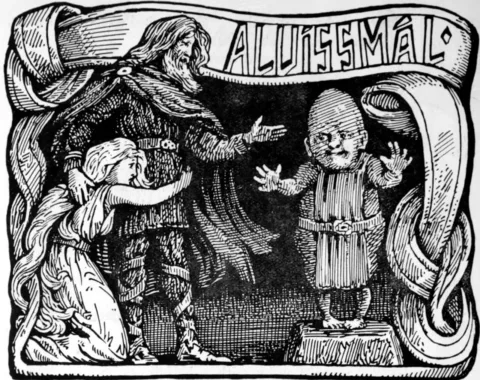
Alvíssmál, meaning “The Sayings of Alvíss,” is an Old Norse poem from the Poetic Edda in which Thor confronts a dwarf who claims that the gods have promised him Thor’s daughter in marriage. Rather than accepting the arrangement, Thor challenges Alvíss to answer questions about the names of things in the different worlds.
Alvíss, whose name means “All-Wise,” answers thirteen questions about the earth, sky, sun, moon, and other familiar things, giving the names used by gods, giants, humans, and other beings. He answers every question, but Thor keeps him talking until sunrise, when the god reveals his deception. The encounter turns Alvíss’s extraordinary knowledge against him while preserving a distinctive collection of names used in Old Norse poetry.
What Is Alvíssmál in Norse Mythology?
Alvíssmál consists of 35 stanzas and survives complete in the Codex Regius (GKS 2365 4to), an Icelandic manuscript copied around 1270, as well as in later paper manuscripts derived from it. It follows Völundarkviða as the final poem in the manuscript’s mythological section, immediately before the heroic poems. Its author is unknown.
The poem is written almost entirely in ljóðaháttr, an Old Norse metre commonly used for dialogue and wisdom poetry. The first eight stanzas establish the dispute between Thor and Alvíss, followed by thirteen exchanges in stanzas 9–34 concerning the names of things across the cosmos. The final stanza concludes the encounter, with its closing lines shifting into galdralag, a related metrical form distinguished by an additional line.
Two stanzas, numbered 20 and 30, also survive in Skáldskaparmál, a section of Snorri Sturluson’s Prose Edda, where they illustrate poetic names for wind and night. These passages appear with textual variations in different manuscripts, providing evidence of the poem’s transmission beyond the surviving text of Codex Regius.
Who Was Alvíss, and Why Did He Seek Thor’s Daughter?
Alvíss describes himself as a dwarf who lives beneath the earth, under the rocks (Alvíssmál, stanza 3). He has come to claim a bride whom the gods supposedly promised him. The poem does not explain why they agreed to the marriage or whether Alvíss offered anything in return.
When Thor encounters him, he mocks the dwarf’s pale appearance, asking whether he has spent the night among the dead and remarking that he resembles a giant. Alvíss does not initially recognise Thor and insists that the gods honour their promise.
Thor replies that he was absent when the agreement was made and that, as the young woman’s father, he alone has the authority to approve her marriage. When Alvíss challenges his right to interfere, Thor identifies himself as Vingþórr and declares that the wedding cannot take place against his will.
The bride never appears or speaks in the poem. She is commonly identified as Þrúð, the daughter of Thor and Sif known from other Old Norse sources, but Alvíssmál does not name her or reveal her wishes.
How Did Thor Turn the Marriage Demand into a Wisdom Contest?
In stanza 8 of Alvíssmál, Thor offers to consent to the marriage if Alvíss can answer everything he wishes to know about the different worlds. The condition gives the dwarf an opportunity to demonstrate the knowledge for which he is named.
Thor begins by asking what the earth is called among different beings. Alvíss supplies six names, attributed to humans, the Æsir, Vanir, giants, elves, and higher divine powers. Thor then moves to other subjects, maintaining the same pattern of questions and answers.
Unlike Odin’s contest with Vafþrúðnir, there is no wager of heads or exchange of questions between the opponents. Alvíss answers every question, but Thor alone controls the conversation. By making his consent depend on the dwarf’s knowledge, Thor keeps him occupied without openly withdrawing the prospect of marriage.
What Were the Thirteen Questions in Alvíssmál?
In stanzas 9–34 of Alvíssmál, Thor asks about thirteen things: earth, sky, moon, sun, clouds, wind, calm weather, sea, fire, woodland, night, grain, and ale. Each answer contains six names attributed to different inhabitants of the mythological world.
Thor begins with the earth, called jörð by humans and fold by the Æsir. The giants call it ígrœn, a name suggesting exceptional greenness, while the elves use gróandi, meaning “growing.” For the sky, the elves have fagrarræfr, “beautiful roof,” and the dwarfs drjúpr salr, “dripping hall.”
The moon is known to the elves as ártali, “year-counter,” while the inhabitants of Hel call it hverfanda hvél, or “turning wheel.” The sun receives the name Dvalins leiki among dwarfs, often translated as “Dvalinn’s plaything,” although its precise meaning is debated. Dvalinn is himself a dwarf known from other Old Norse sources, and the expression has been interpreted as an allusion to the danger of sunlight.
For clouds, the gods use skúrván, suggesting the expectation of rain, while the Vanir call them vindflot, “wind-floating.” Wind itself becomes œpir, “howler,” among giants and dynfari, a noisy traveller, among elves. When Thor asks about calm weather, the Vanir answer vindslót, the ending of wind, while the dwarfs use dags vera, an expression associated with shelter during the day.
The sea is álheimr, “eel-home,” among giants and djúpr marr, “deep sea,” among dwarfs. Fire becomes freki, “greedy,” in the giants’ vocabulary, and forbrennir, “burner-up,” among dwarfs. The gods call woodland vallarfax, “field’s mane,” while the giants use eldi, meaning “firewood.”
Thor’s remaining questions concern night, grain, and ale. Night, introduced through a reference to Nörvi, is called svefngaman, “sleep’s delight,” by elves and draumnjǫrun by dwarfs, a compound associated with dreams. Grain is called bygg, or “barley,” among humans, vaxt, “growth,” among the Vanir, and æti, “food,” among giants. Finally, ale is ǫl among humans, bjórr among the Æsir, veig among the Vanir, and mjǫðr, or “mead,” in Hel.
Although every answer supplies six terms, the groups of beings are not identical throughout the poem. Some names belong to the Vanir or dwarfs, while others are attributed to the inhabitants of Hel, higher divine powers, or Suttungr’s sons.
The Thirteen Things and Their Names in Alvíssmál
Each of Alvíss’s thirteen answers gives six Old Norse names
for the same thing. The table preserves the names and the
beings to whom the poem attributes them.
| Subject | Humans | Gods / Æsir | Other Beings |
|---|---|---|---|
| Earth (10) | jǫrð | fold | Vanir: vegar; Giants: ígrœn; Elves: gróandi; Higher powers: aurr |
| Sky (12) | himinn | hlýrnir | Vanir: vindofnir; Giants: uppheimr; Elves: fagrarræfr; Dwarfs: drjúpr salr |
| Moon (14) | máni | mýlinn | Hel: hverfanda hvél; Giants: skyndir; Dwarfs: skin; Elves: ártali |
| Sun (16) | sól | sunna | Dwarfs: Dvalins leiki; Giants: eygló; Elves: fagrahvél; Sons of the Æsir: alskír |
| Clouds (18) | ský | skúrván | Vanir: vindflot; Giants: úrván; Elves: veðrmegin; Hel: hjálmr huliðs |
| Wind (20) | vindr | váfuðr | Mighty powers: gneggjuðr; Giants: œpir; Elves: dynfari; Hel: hviðuðr |
| Calm (22) | logn | lœgi | Vanir: vindslot; Giants: ofhlý; Elves: dagsefi; Dwarfs: dags vera |
| Sea (24) | sær | sílægja | Vanir: vágr; Giants: álheimr; Elves: lagastafr; Dwarfs: djúpr marr |
| Fire (26) | eldr | funi | Vanir: vágr; Giants: freki; Dwarfs: forbrennir; Hel: hrǫðuðr |
| Woodland (28) | viðr | vallarfax | Heroes / men: hlíðþang; Giants: eldi; Elves: fagrlimi; Vanir: vǫndr |
| Night (30) | nótt | njól | Mighty powers: gríma; Giants: óljós; Elves: svefngaman; Dwarfs: draumnjǫrun |
| Grain (32) | bygg | barr | Vanir: vaxt; Giants: æti; Elves: lagastafr; Hel: hnipinn |
| Ale (34) | ǫl | bjórr | Vanir: veig; Giants: hreinalǫgr; Hel: mjǫðr; Suttungr’s sons: sumbl |
Note: Numbers indicate the stanza containing
each answer. The groups vary between stanzas, and these
names should not be treated as evidence of separate
historical languages. Some readings and spellings are
disputed. The repetition of lagastafr for both
sea and grain may reflect a textual problem.
Source:
Alvíssmál, edited and translated by Edward Pettit (2023)
, stanzas 9–34.
How Did Thor Trick Alvíss at Sunrise?
After Alvíss answers the final question about ale, Thor praises his extraordinary knowledge of ancient lore. He then reveals his deception. In stanza 35, Thor declares that he has tricked the dwarf: dawn has arrived while Alvíss remains above ground, and sunlight is entering the hall.
Alvíss had earlier described his home as lying beneath the earth and stone. Thor’s strategy was to keep him occupied until daylight, rather than defeat him through a question he could not answer. Notably, Thor asks about the names of night but never poses a separate question about day, a detail that may contribute to the poem’s delayed revelation of his plan.
The final stanza does not explicitly describe Alvíss turning to stone. That fate is inferred from the ending and supported by a parallel in Helgakviða Hjörvarðssonar, where the giantess Hrímgerðr is kept talking until sunrise and told that she will stand as stone. In Alvíssmál, the poem ends with Thor’s declaration, leaving the dwarf’s actual transformation undescribed.
What Do the Different Names Reveal About Norse Poetry?
The names in Alvíssmál draw on several forms of Old Norse poetic language. While the terms assigned to humans are generally familiar words, those attributed to supernatural beings often include archaic expressions, poetic synonyms known as heiti, and figurative compounds resembling kennings. The distinction is mainly stylistic, rather than evidence that each group spoke a separate historical language.
In The Languages of Alvíssmál, Lennart Moberg identifies patterns in how these names are distributed. The Æsir tend to use solemn or archaic vocabulary, while the giants often describe things in practical, sometimes unflattering terms. The elves’ expressions more frequently suggest beauty and growth. Moberg also argues that the vocabulary may combine traditional magical or taboo language with words invented by the poet. Its distribution is not systematic enough to reconstruct distinct languages.
Signe Cohen offers a related interpretation of the celestial names, suggesting that the different descriptions of the sky reflect the imagined perspectives of the beings who use them. Their surroundings and characteristics help explain why the same object receives contrasting poetic descriptions.
The arrangement of these names was also shaped by verse structure. Frog’s study of Alvíssmál shows how metre, alliteration, and recurring formulas influenced the selection and placement of words. The resulting patterns reflect both poetic technique and the mythological identities assigned to the speakers.
Read Also
When Was Alvíssmál Composed, and How Reliable Is It?
The composition date of Alvíssmál remains uncertain. Some earlier scholars placed it in the twelfth century, regarding its elaborate poetic vocabulary and carefully structured dialogue as signs of a learned literary composition. Christopher D. Sapp reached a different conclusion in his 2022 study, Dating the Old Norse Poetic Edda. Using a statistical analysis of linguistic features compared with datable skaldic poetry, he assigned Alvíssmál to the tenth century. His findings challenge the traditional late dating, although they cannot establish when the underlying story first emerged.
The poem’s transmission presents another difficulty. Frog’s analysis of its recurring formulas suggests that entire lines could become relatively stable through repeated use, with alliteration, meaning, and syllabic rhythm restricting variation. He describes this process as crystallization, rather than treating oral improvisation and fixed memorisation as the only possibilities. The evidence helps explain the poem’s verbal consistency without settling how it was originally composed.
Alvíssmál also has limits as evidence for pre-Christian religion. Its portrayal of an underground-dwelling dwarf and Thor’s use of daylight draws on mythological traditions, but it does not establish how widely such beliefs were shared or practised. The poem is more securely understood as evidence of how Old Norse poets combined inherited mythology with specialised poetic language.
Conclusion
Alvíssmál presents a contest in which Thor defeats a dwarf whose knowledge is never shown to be lacking. Alvíss answers all thirteen questions, but his confidence keeps him occupied until daylight, allowing Thor to win through deception rather than superior wisdom.
The poem also preserves a remarkable collection of Old Norse poetic names, revealing how familiar elements of the world could be described differently among gods, giants, elves, and other beings.
Academic Sources & Primary Texts
Primary Texts and Editions
- Pettit, Edward, ed. and trans.
The Poetic Edda: A Dual-Language Edition.
Cambridge: Open Book Publishers, 2023.
“Alvíssmál,” 365–384.
Old Norse text and English translation
. - Snorri Sturluson.
Edda: Skáldskaparmál.
Edited by Anthony Faulkes.
London: Viking Society for Northern Research, 1998.
Includes quotations from Alvíssmál.
Scholarly edition
. - Codex Regius of the Poetic Edda
(GKS 2365 4to), c. 1270.
Árni Magnússon Institute for Icelandic Studies.
Manuscript and digital edition information
.
Academic Studies
- McKinnell, John.
“Useless Knowledge? The Paradox of Alvíssmál.”
Saga-Book 41 (2017): 79–96.
Read the study
. - Moberg, Lennart.
“The Languages of Alvíssmál.”
Saga-Book 18 (1973): 299–323.
Read the study
. - Frog.
“Alvíssmál and Orality I: Formula, Alliteration
and Categories of Mythic Being.”
Arkiv för Nordisk Filologi 126 (2011): 17–71.
Academic article
. - Cohen, Signe.
“What Do the Gods Call the Sky?
Naming the Celestial in Old Norse.”
Culture and Cosmos 24, nos. 1–2 (2020): 27–36.
DOI
. - Sapp, Christopher D.
Dating the Old Norse Poetic Edda:
A Multifactorial Analysis of Linguistic Features.
Amsterdam: John Benjamins, 2022.
Academic monograph
.
Copyright & Content Rights
© 2026 History & Myths. All rights reserved.
Original writing, historical analysis, and editorial content by H. Moses.
Ancient texts and academic sources are cited for scholarly reference.
Image credits and licensing information are provided separately.