Where Is Nefertiti’s Tomb? Tutankhamun’s Hidden-Chamber Mystery
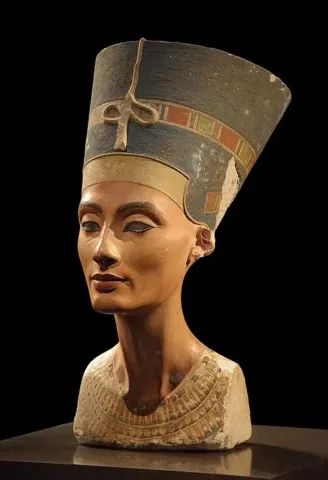
Nefertiti’s tomb has never been securely identified, and no confirmed discovery has yet revealed where the famous Egyptian queen was buried.
Interest in the mystery returned in 2026 after new geophysical surveys around Tutankhamun’s tomb, KV62, detected anomalies that may point to previously unknown structures nearby. The results are intriguing, but they do not prove that hidden chambers exist or that any possible space belongs to Nefertiti.
So where is Nefertiti’s tomb? At present, no one knows. The real question is whether the new evidence around KV62 strengthens an old theory or simply adds another uncertain clue.
Where Is Nefertiti’s Tomb?
No tomb has been securely identified as the burial place of Nefertiti.
Her final years are poorly documented, and the surviving evidence does not reveal where she was buried or whether her body was later moved. Amarna and the Valley of the Kings remain among the main possibilities, but neither has produced a burial that can be securely attributed to her.
That uncertainty is why several theories have survived, including the proposal that her burial may somehow be connected with Tutankhamun’s tomb, KV62.
Why Has Nefertiti’s Burial Never Been Identified?
The main problem is that the final years of Nefertiti’s life are poorly documented. She is securely attested late in Akhenaten’s reign, but the evidence becomes fragmentary just when her death, possible rule and burial would need to be reconstructed.
The Royal Tomb at Amarna included space for another royal burial, including an unfinished suite that has sometimes been associated with Nefertiti. But no burial there has been securely identified as hers, and the tomb was later badly damaged and disturbed.
The collapse of the Amarna court made the picture even less clear. After Akhenaten’s death, the royal family abandoned Akhetaten, and burials or funerary equipment may have been moved, altered or reused during the transition.
That leaves several possibilities: Nefertiti may have been buried at Amarna, transferred elsewhere, or placed in a tomb that has not yet been identified.
The surviving evidence is too incomplete to choose confidently between them, which is why the Valley of the Kings eventually became part of the search.
Why Did Tutankhamun’s Tomb Become Part of the Mystery?
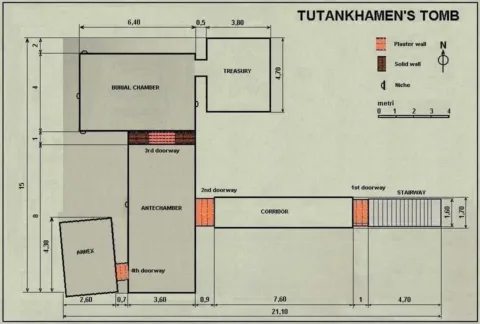
Tutankhamun’s tomb, KV62, became part of the Nefertiti debate because its layout is unusual for a royal burial.
The tomb is much smaller than most royal tombs of the period, and several features suggest that it may have been adapted quickly after Tutankhamun’s unexpected death. That raised an important question: was KV62 originally designed for someone else, or was it only part of a larger burial complex?
Researchers also noticed architectural details and wall features that seemed inconsistent with a simple, self-contained tomb. Those observations encouraged the idea that additional rooms might exist beyond the decorated burial chamber.
Nefertiti entered the discussion because of her close connection to the Amarna royal family and the continued uncertainty surrounding her own burial.
Nicholas Reeves and the 2015 Hidden-Chamber Theory
The modern theory linking Nefertiti to KV62 began with Egyptologist Nicholas Reeves in 2015.
While studying high-resolution scans of Tutankhamun’s burial chamber, Reeves identified lines beneath the painted plaster that he interpreted as possible traces of sealed doorways. He argued that the chamber might not mark the true end of the tomb.
Reeves proposed that Tutankhamun may have been buried in the outer part of an earlier royal tomb, with additional chambers continuing beyond the decorated walls.
He suggested Nefertiti as a possible original owner of that larger complex, partly because of the unusual plan of KV62 and the continued uncertainty surrounding her burial.
At that stage, however, the theory rested on architectural interpretation rather than direct archaeological evidence.
What Did the First Radar Scans Find?
The first radar survey inside KV62 was carried out in late 2015 by Japanese specialist Hirokatsu Watanabe.
His scans appeared to detect changes behind the north and west walls of Tutankhamun’s burial chamber. At the time, the results were interpreted as possible evidence of sealed spaces beyond the visible tomb, giving Reeves’s theory its first geophysical support.
A second radar investigation in 2016 produced a different result. Specialists reviewing those data reported no clear reflections indicating hidden chambers or blocked doorways in the locations proposed by Reeves.
The two surveys therefore left the question unresolved: one appeared to support concealed spaces, while the other found no convincing evidence for them.
Why Did the 2018 Survey Reject Hidden Chambers?
A third radar survey was carried out inside KV62 in February 2018 to resolve the conflicting results of the earlier scans.
The team used three ground-penetrating radar systems operating at different frequencies and collected data at much denser intervals across the tomb walls.
The researchers found no strong radar signature showing the kind of sharp transition expected between natural bedrock and a blocked doorway or artificial wall.
Their conclusion was specific: there was no evidence for hidden chambers immediately adjacent to Tutankhamun’s tomb.
The result weakened the idea that sealed rooms sit directly behind the known burial chamber, but it did not rule out unknown structures elsewhere around KV62.
The Anomalies Detected Around KV62
While the 2018 radar survey found no chamber directly behind Tutankhamun’s burial chamber, another geophysical study examined the ground around KV62 from outside the tomb.
Using electrical resistivity tomography, researchers mapped differences in the subsurface and identified two unusual high-resistivity zones a few metres from the tomb. Such anomalies can sometimes indicate voids or man-made features, but they do not prove either.
Neither anomaly was shown to connect directly with KV62. One lay in a location where recent disturbance seemed unlikely, while the other was closer to an area affected by earlier excavation.
The researchers did not identify either feature as a chamber. Their data showed that something underground differed from the surrounding geology, but not what that feature was.
Those earlier anomalies became relevant again when later surveys detected unusual features in the same wider area.
What Did the New 2026 Survey Find?
In 2026, researchers returned to the area around KV62 using several geophysical methods, including ground-penetrating radar and microgravity, which can detect small differences in underground density.
Their interpretation of the radar data suggests a possible corridor about two metres wide extending away from Tutankhamun’s burial chamber. The suspected passage appears to be filled with debris rather than empty, which may help explain why earlier radar surveys did not detect it clearly.
More than 1,200 microgravity measurements also revealed several low-density features with regular shapes and alignments. Some appear roughly rectangular and parallel to the north wall of KV62.
One of them, Anomaly 7, contains a low-density zone with denser material inside it. Researchers have suggested that it could represent an artificial space containing debris, although the signal is close to the method’s resolution limits.
The surveys therefore identified several features that merit further investigation, but they did not establish what those features actually are.
Does This Mean Hidden Chambers Have Been Found?
No. The 2026 surveys identified geophysical anomalies, not excavated rooms.
Radar, electrical-resistivity measurements and microgravity can detect differences beneath the ground, but they cannot show exactly what caused them. A low-density zone might indicate a void or constructed space, but geology, rubble or earlier disturbance can produce similar signals.
Several of the new features have regular shapes and similar orientations, which makes them worth investigating. But no hidden chamber has been opened, entered or visually confirmed.
For now, the evidence supports further investigation, not the announcement of a newly discovered tomb.
Is There Any Evidence the Chambers Belong to Nefertiti?
Not yet.
The new surveys may strengthen the case that unknown structures exist near KV62, but they do not identify who built them, when they were used, or whether they ever contained a burial.
The connection to Nefertiti still comes from Reeves’s interpretation of the tomb’s architecture and from the unresolved question of her burial. No inscription, funerary object or human remains from the suspected spaces have been found to identify her as their owner.
Even if hidden rooms are eventually confirmed, that would answer only the first question: whether additional spaces exist. Identifying their owner would require separate archaeological evidence.
Read More
What If Tutankhamun Had Lived Longer? Ancient Egypt Alternate History
What If Akhenaten’s Religion Survived? Ancient Egypt Reimagined
Why Do Some Egyptologists Remain Skeptical?
Some Egyptologists and geophysicists remain cautious because the new interpretation still depends on indirect measurements.
One problem is the conflict with earlier surveys. In 2018, a dense radar study found no evidence for chambers immediately beside KV62. The 2026 team argues that earlier surveys may have been searching for a large open void rather than a corridor filled with debris, but that explanation has not yet been physically confirmed.
There is also the question of independent verification. Some of the latest measurements have not been released in enough detail for other specialists to reproduce the analysis or test the proposed shapes, alignments and density changes.
The central issue is whether the new interpretation can be independently tested and eventually confirmed by direct archaeological evidence.
Where Else Could Nefertiti Be Buried?
The Royal Tomb at Amarna remains one of the main alternatives to the KV62 theory.
The tomb was built for Akhenaten and members of his family, and it includes an unfinished suite that may have been intended for another royal burial. Nefertiti has often been suggested as a possible occupant, although nothing found there securely identifies the space as hers.
She may also have been buried elsewhere at Amarna in a tomb that was never completed, later damaged, or has not yet been identified. Much of the royal necropolis remained unfinished when the court abandoned the city.
The Valley of the Kings is another possibility, especially if Nefertiti survived into the transition away from Amarna or if her burial was moved after Akhenaten’s death.
For now, Amarna and the Theban royal necropolis remain the main areas discussed in connection with her missing burial, but neither has produced a tomb that can be securely identified as hers.
What Evidence Would Finally Settle the Question?
Geophysical surveys can show archaeologists where to investigate, but they cannot identify Nefertiti’s tomb on their own. A firm conclusion would require direct archaeological evidence.
The strongest evidence would be a sealed or undisturbed context containing inscriptions, cartouches or funerary objects that clearly name Nefertiti. The position of those objects would also matter, because material moved from another burial could give a false impression.
Human remains could strengthen an identification, especially if they were found in a secure royal context. DNA, age, sex and family relationships might help narrow the possibilities, but they would still need to match the archaeological evidence around them.
Before excavation, researchers may be able to test suspected spaces with more detailed imaging or a carefully placed camera probe to confirm whether a void or corridor actually exists.
Only then could archaeologists move from detecting an anomaly to identifying a burial and its owner.
What We Know, What We Suspect, and What Remains Unknown
Nefertiti’s tomb has not been found, and the new evidence around KV62 does not change that.
The 2026 surveys have identified several unusual features that may represent artificial structures, but their nature has not been confirmed and nothing yet connects them directly with Nefertiti.
For now, the evidence justifies further investigation, not a discovery claim. The mystery will only move beyond hypothesis when archaeologists can examine the suspected spaces and find evidence strong enough to identify what they are and who they belonged to.
Academic & Research Sources
This article draws on peer-reviewed geophysical studies, specialist Egyptological publications, and the latest research report examining possible structures around Tutankhamun’s tomb, KV62.
Geophysical Research on KV62
- Sambuelli, Luigi, Cesare Comina, Gianluca Catanzariti, Filippo Barsuglia, Gianfranco Morelli, and Francesco Porcelli.
“The Third KV62 Radar Scan: Searching for Hidden Chambers Adjacent to Tutankhamun’s Tomb.”
Journal of Cultural Heritage 39 (2019): 288–296.
DOI: 10.1016/j.culher.2019.04.001. - Fischanger, Federico, Gianluca Catanzariti, Cesare Comina, Luigi Sambuelli, Gianfranco Morelli, Filippo Barsuglia, Ahmed Ellaithy, and Francesco Porcelli.
“Geophysical Anomalies Detected by Electrical Resistivity Tomography in the Area Surrounding Tutankhamun’s Tomb.”
Journal of Cultural Heritage 36 (2019): 63–71.
DOI: 10.1016/j.culher.2018.07.011.
Nefertiti and the Hidden-Chamber Hypothesis
- Reeves, Nicholas.
The Burial of Nefertiti?
Amarna Royal Tombs Project, Occasional Paper No. 1, 2015. - Eldamaty, Mamdouh, Abbas Mohamed Abbas, George Ballard, and Nicholas Reeves.
An Archaeo-Geophysical Review and Assessment of the Structure and Morphology of Tutankhamun’s Tomb (KV62): The Burial of Nefertiti? IV.
Amarna Royal Tombs Project, Occasional Paper No. 8, 2026.
Amarna Royal Burial Context
- Martin, Geoffrey Thorndike.
The Royal Tomb at El-‘Amarna II: The Reliefs, Inscriptions, and Architecture.
Archaeological Survey of Egypt, Memoir 39.
London: Egypt Exploration Society, 1989. - Dodson, Aidan.
“The Royal Tomb at El-Amarna Revisited.”
Journal of the Society for the Study of Egyptian Antiquities 45. - Marchant, Jo.
“Exclusive: New Evidence for Hidden Chambers Beyond Tutankhamun’s Tomb.”
Nature 657 (2026): 861–862.
DOI: 10.1038/d41586-026-02621-2.
Copyright Notice
© 2026 History & Myths. All rights reserved.
This article is original editorial content created for HistoryAndMyths.com.
Reproduction, republication or substantial copying of this article, in whole
or in part, is not permitted without prior written permission.