What If Jerusalem Had Survived Nebuchadnezzar II’s Siege?
Jerusalem’s fall to Nebuchadnezzar II in 587/586 BCE was a turning point in the history of Judah. Babylonian forces destroyed the First Temple, ended the kingdom, and carried another major group of Judeans into exile.
During the final siege, however, an Egyptian army advanced into the region and the Babylonians temporarily lifted their blockade. They later returned and captured the city. But what if Egyptian intervention had forced Nebuchadnezzar to abandon the campaign?
Zedekiah might have remained on the throne, the First Temple could have survived, and the deportations that followed Jerusalem’s destruction might never have occurred on the same scale. Judah would still have been a small kingdom caught between Egypt and Babylon, with no guarantee that Nebuchadnezzar would not return.
Even a temporary escape from destruction could have changed far more than Judah’s political future. The survival of Jerusalem, its temple, and its institutions would also have altered the conditions in which Judean religious and cultural traditions developed.
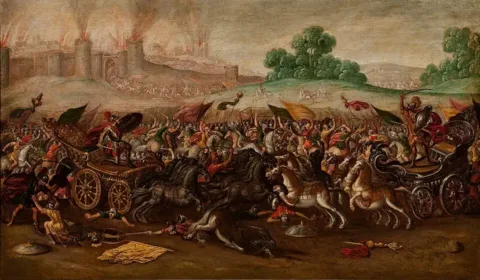
What Actually Happened to Jerusalem in 587/586 BCE?
Jerusalem had already fallen to Babylon once before its final destruction. In 597 BCE, Nebuchadnezzar II captured the city, removed King Jehoiachin, deported members of the royal court and other elites, and placed Zedekiah on the throne as a Babylonian vassal.
Zedekiah later rebelled, hoping Egyptian support could help Judah escape Babylonian control. Nebuchadnezzar responded by besieging Jerusalem again. An Egyptian force entered the region and briefly disrupted the siege, but the Babylonians returned.
After prolonged resistance and severe shortages inside the city, Babylonian forces broke through Jerusalem’s defenses. Zedekiah fled but was captured near Jericho, bringing the Davidic monarchy in Judah to an end.
The Babylonians burned the First Temple, the royal palace, and much of Jerusalem. Another group of Judeans, including members of the elite and skilled population, was deported, while the remaining territory was placed under an appointed governor rather than restored as a kingdom.
This is where the alternate timeline begins: what if the Egyptian intervention had been strong enough to keep Babylon from returning and completing the conquest?
The Point of Divergence: What If Egypt Had Broken the Siege?
The turning point in this scenario comes from a real event. In 588 BCE, an Egyptian army advanced into the region while Babylonian forces were besieging Jerusalem, forcing the Babylonians to interrupt the siege.
Our alternate timeline changes what happened next. Instead of withdrawing, Egypt maintains enough pressure to keep Nebuchadnezzar from returning immediately to Jerusalem.
That would not require an outright Egyptian victory. A costly confrontation, pressure on Babylonian positions along the coast, or the risk of a wider campaign could have made continuing the siege less attractive. Egypt had clear strategic reasons to prevent Babylon from tightening its control over the southern Levant.
Jerusalem survives the crisis, but only because the regional balance has shifted in its favor. Judah remains exposed, and its future now depends on whether Egypt can continue to deter another Babylonian attack.
The Alternate Scenario: Jerusalem Survives the Siege
Egyptian pressure prevents the Babylonian army from returning to Jerusalem in 587/586 BCE. Zedekiah remains on the throne, the First Temple survives, and Judah escapes the destruction that ended the kingdom in actual history.
Jerusalem’s survival does not make Judah powerful. The kingdom becomes increasingly dependent on Egypt while Nebuchadnezzar remains a threat from the east. Its immediate goal is simply to survive long enough for the regional balance to change.
If Judah can avoid another Babylonian attack, Nebuchadnezzar’s death in 562 BCE and the later instability in Babylon give the kingdom a better chance of lasting. By the time Persia emerges as the dominant power, Jerusalem could still be functioning as the political and religious center of a surviving Judean state.
Could Jerusalem Realistically Have Survived?
Yes, at least for a time.
Jerusalem had already endured a long Babylonian siege, and the city did not fall quickly. Its defenses held until shortages and sustained military pressure finally weakened resistance.
The real limitation was not the strength of Jerusalem’s walls, but Judah’s lack of power outside them. The kingdom could not defeat Babylon on its own, so any survival depended on Egypt keeping Nebuchadnezzar occupied elsewhere.
That makes a temporary survival plausible. A permanent victory over Babylon is much harder to imagine, but an interrupted conquest followed by several more years of political survival is a realistic alternate outcome.
What Happens to King Zedekiah?
If Jerusalem survives the siege, Zedekiah probably remains king, at least in the short term.
Historically, his rebellion ended with the fall of Jerusalem. He fled the city, was captured, and lost his throne. In this alternate timeline, that collapse does not happen because Babylon never retakes the city.
His position would still be fragile. Zedekiah had already broken with Babylon, so Nebuchadnezzar would have little reason to trust him again. At the same time, his survival would depend heavily on continued Egyptian support.
Zedekiah could therefore remain on the throne, but as a weakened ruler whose security depended on the balance between Egypt and Babylon.
Does the Kingdom of Judah Survive?
If Jerusalem survives, the kingdom of Judah probably survives with it, though in a weakened state.
Years of war would have damaged the countryside, reduced military strength, and limited Judah’s freedom of action. The kingdom would still be caught between Babylon and Egypt, with little ability to shape regional events on its own.
The most plausible outcome is a small buffer kingdom under strong Egyptian influence. Zedekiah could continue ruling from Jerusalem, while Egypt provided the protection that made Judah’s survival possible.
That would preserve the monarchy, capital, temple, and local institutions, but Judah would remain politically fragile for as long as Babylon retained the power to return.
Would the First Temple Still Be Standing?
If Jerusalem had survived the siege, the First Temple would probably have survived as well, at least in the short term.
Its destruction in 587/586 BCE came with the Babylonian capture and burning of Jerusalem. Without that final conquest, there would be no immediate reason for the temple itself to be destroyed.
Its survival would preserve more than a sacred building. The temple stood at the center of Judah’s religious life and was closely tied to the monarchy, priesthood, and administration of Jerusalem.
The danger would not disappear completely. If Babylon returned and captured the city later, the temple could still be destroyed. But in this alternate timeline, it survives the crisis of 587/586 BCE and continues functioning as the kingdom’s religious center.
What Happens to the Babylonian Exile?
The Babylonian exile would not disappear completely, because deportations had already begun before Jerusalem’s final fall.
After the capture of Jerusalem in 597 BCE, King Jehoiachin, members of the royal court, officials, craftsmen, and other members of Judah’s elite were taken to Babylon. Those communities would still exist in this alternate timeline.
The major difference comes in 587/586 BCE. If Jerusalem is not destroyed, the later deportations associated with the final conquest would either not happen or would be far smaller. More priests, officials, landowners, and skilled workers would remain in Judah, while the monarchy and temple institutions continued functioning in Jerusalem.
That would leave two important Judean centers: Jerusalem under Zedekiah and the earlier exilic community already established in Babylonia.
The exile would remain part of Judah’s history, but without the destruction of Jerusalem and the First Temple, it would not carry the same scale or meaning as the catastrophe that followed in actual history.
Would Babylon Return for Another Campaign?
Probably. A failed siege would not have ended Nebuchadnezzar’s interest in Judah.
Zedekiah had already rebelled against Babylon, and a Jerusalem still aligned with Egypt would remain a strategic problem on the empire’s western frontier.
Nebuchadnezzar might return once the Egyptian threat weakened, perhaps with a larger force or after securing the surrounding region more thoroughly. Another campaign could come within a few years rather than immediately.
Jerusalem’s survival would therefore depend on whether Egypt could continue supporting Judah and whether Babylon had more urgent priorities elsewhere.
Does Judah Become an Egyptian Client State?
Most likely, yes.
If Egyptian intervention saved Jerusalem, Judah would owe its survival to Egypt. That would give Pharaoh Apries considerable influence over Zedekiah’s foreign policy and military choices.
Judah would probably function as a buffer state between Egypt and Babylon. Its location made it useful to Egypt as a barrier against further Babylonian expansion into the southern Levant.
Zedekiah could remain king and retain local authority, but decisions about alliances, tribute, and defense would increasingly depend on Egyptian support.
Judah would still exist as a kingdom, but with much less freedom to act independently.
How Would a Surviving Judah Change the Balance in the Levant?
A surviving Judah would matter less because of its size than because of its location.
Jerusalem stood in a region contested by Babylon and Egypt. A kingdom aligned with Egypt would leave Babylon with a hostile state on its western frontier and could make control of the southern Levant more difficult.
Egypt, meanwhile, would gain influence farther north without having to occupy Judah directly. A friendly kingdom centered on Jerusalem could help protect the approaches to Sinai and preserve Egyptian influence in the region.
Judah would not be powerful enough to reshape the Levant by itself, but its survival would make the frontier between Egypt and Babylon less secure and more difficult for either side to dominate completely.
What Happens When Nebuchadnezzar Dies?
Nebuchadnezzar II died in 562 BCE after more than four decades on the Babylonian throne. If Judah had survived until then, its position could have improved considerably.
Babylon remained powerful, but the succession after Nebuchadnezzar was far less stable. Several rulers followed in quick succession before Nabonidus took the throne in 556 BCE. That instability would likely make another major campaign against Judah less urgent than securing control at the center of the empire.
For Jerusalem, this could be the first real chance to turn temporary survival into something more durable. Zedekiah or his successor might still pay tribute, but Babylon would have less freedom to devote resources to another prolonged siege.
If Judah survived the decades after 587/586 BCE, Nebuchadnezzar’s death could give the kingdom more room to maneuver between Babylon and Egypt.
What Happens When Cyrus Conquers Babylon?
Cyrus the Great captured Babylon in 539 BCE, ending the Neo-Babylonian Empire and replacing Judah’s main eastern threat with a new Persian power.
If Judah had remained under Egyptian influence, it would not necessarily pass into Persian control immediately. Jerusalem might instead find itself between Persia, now dominant in Mesopotamia and much of the Levant, and Egypt to the south.
The balance would become harder to maintain. Persia was expanding westward, and a small kingdom such as Judah would have limited ability to resist once Persian power reached the southern Levant.
By the time Persia moved against Egypt later in the sixth century BCE, Judah would probably have had little choice but to accept Persian supremacy.
In this timeline, Cyrus would still transform Judah’s political world, but not as the ruler who restored Jerusalem after destruction. He would mark the beginning of a new imperial order confronting a kingdom that had never ceased to exist.
How Might Jewish Religion Develop Differently?
The survival of Jerusalem and the First Temple could have changed the conditions in which Judean religion developed.
In actual history, the destruction of the temple and the exile forced Judean communities to preserve their identity without a functioning royal sanctuary in Jerusalem. The catastrophe also shaped later reflection on defeat, exile, covenant, and restoration.
If the temple remained active, religious life would likely continue to center more strongly on Jerusalem, its priesthood, and the monarchy. Developments associated with the exilic and post-exilic periods could still occur, but in a different political and social setting.
The Judeans already living in Babylonia after the deportation of 597 BCE would remain important as well, creating parallel communities in Jerusalem and Mesopotamia rather than a homeland transformed by complete political collapse.
Judaism would not simply disappear from history without the destruction of 587/586 BCE. But its later institutions, priorities, and religious identity could have developed along a noticeably different path.
Would the Hebrew Bible Take the Same Form?
Probably not in exactly the same way.
Many biblical traditions existed before the Babylonian conquest, so the Hebrew Bible did not begin with the exile. But the destruction of Jerusalem, the loss of the monarchy, and life in Babylonia became important settings in which older traditions were preserved, interpreted, and developed.
If Jerusalem and the First Temple had survived, that process would have taken place under different political and religious conditions. Themes of destruction, exile, punishment, restoration, and return might still appear, but they would not carry the same historical weight.
Scribal activity in Judah could also have continued alongside the Judean community already established in Babylonia, allowing both centers to preserve and develop their own traditions.
The Hebrew Bible would still have emerged from a much older body of religious literature, but its final form, emphasis, and arrangement could have developed differently without the catastrophe of 587/586 BCE.
What We Can Say With Confidence, and What Remains Speculation
The historical starting point is clear. Jerusalem was under Babylonian siege, Egypt intervened, the siege was interrupted, and Babylon later returned to capture the city. The First Temple was destroyed, the monarchy ended, and further deportations followed.
That makes a successful Egyptian intervention a reasonable point of divergence. It could have delayed Jerusalem’s fall and allowed Zedekiah’s government to survive for a time.
Beyond that, the uncertainty grows quickly. We cannot know whether Nebuchadnezzar would have returned within months, whether Egypt could have protected Judah for decades, or how long the monarchy might have lasted. The effects on religion, biblical literature, and political identity are even harder to reconstruct because they depend on developments that unfolded over generations.
The most defensible scenario is therefore limited: Jerusalem survives the final siege and Judah avoids immediate destruction. Everything that follows should be treated as a plausible consequence rather than a fixed outcome.
Conclusion
If Jerusalem had survived Nebuchadnezzar II’s final siege, Judah would still have faced powerful enemies and an uncertain future. But the monarchy, the First Temple, and Jerusalem’s institutions could have continued beyond 587/586 BCE.
That survival alone would have changed the political and religious setting in which later Judean history developed. Instead of rebuilding after destruction and exile, Jerusalem might have entered the Persian age as a living center that had never experienced the same collapse.
Academic & Primary Sources
- Babylonian Chronicle, BM 21946.
British Museum. A contemporary Babylonian chronicle covering 605–594 BCE, including Nebuchadnezzar II’s capture of Jerusalem in 597 BCE and the removal of its king. - André Lemaire, “Israel and Judah (c. 931–587 BCE).”
In The Oxford History of the Holy Land, Oxford University Press, 2023. Provides the historical background to Judah, Nebuchadnezzar’s campaigns, the fall of Jerusalem, and the exile of part of the Judean elite. - Oded Lipschits, The Fall and Rise of Jerusalem: Judah under Babylonian Rule.
Eisenbrauns / Penn State University Press, 2005. Major scholarly study of Judah during the Babylonian period, combining biblical texts, archaeology, and Babylonian and Egyptian evidence. - Avraham Faust, Judah in the Neo-Babylonian Period: The Archaeology of Desolation.
Society of Biblical Literature, 2012. Examines the archaeological evidence for the Babylonian destruction of Judah and Jerusalem and the demographic consequences of the conquest. - H. G. M. Williamson, “Babylonian Exile and Restoration (587–325 BCE).”
In The Oxford History of the Holy Land, Oxford University Press, 2023. Covers the Judean exile, the Persian period, return to Jerusalem, and the religious and intellectual importance of the Babylonian community. - C. L. Crouch, “The Historical Contexts of the Books of Jeremiah.”
In The Oxford Handbook of Jeremiah, Oxford University Press, 2021. Examines the political struggle among Judah, Babylonia, and Egypt during the final decades of the kingdom.