Vafþrúðnismál: Odin’s Wisdom Contest in Norse Mythology
Vafþrúðnismál, meaning “The Sayings of Vafþrúðnir,” is an Old Norse poem preserved in the Poetic Edda. It tells of a deadly contest of wisdom between Odin and the giant Vafþrúðnir, who possesses extraordinary knowledge of the world’s past and future. Despite Frigg’s warning, Odin enters the giant’s hall disguised as Gagnráðr. The two eventually wager their heads on the outcome.
Their questions range from the creation of the world from Ymir’s body to the origins of the sun and moon and the events of Ragnarök. Vafþrúðnir foretells Odin’s death at the jaws of Fenrir, but also describes the gods and humans who will survive the destruction of the world.
Odin wins by asking what he whispered into Baldr’s ear before his funeral pyre. Recognising his opponent, Vafþrúðnir admits defeat. The poem never reveals Odin’s words or describes the giant’s death.
What Is Vafþrúðnismál in Norse Mythology?
The anonymous poem consists of 55 stanzas and survives in the Codex Regius (GKS 2365 4to), an Icelandic manuscript dating to around 1270. It follows Völuspá and Hávamál, making it the third poem in the collection. Another manuscript, AM 748 I a 4to, preserves the text from partway through stanza 20 to its conclusion. Snorri Sturluson also quotes several of its verses in the Prose Edda.
Written primarily in ljóðaháttr, a metre commonly used for wisdom poetry, Vafþrúðnismál unfolds almost entirely through dialogue. Its questions and answers bring together traditions about the earliest beings, the structure of the cosmos, and events surrounding Ragnarök.
Neither the poet’s identity nor the date of composition is known. The surviving manuscripts were copied in Christian Iceland, but the poem preserves material associated with pre-Christian Norse mythology. How much of its present form reflects earlier oral traditions, and how much may have changed during transmission, remains debated.
Why Did Odin Challenge Vafþrúðnir?
In the opening stanzas of Vafþrúðnismál, Odin tells Frigg that he intends to visit Vafþrúðnir and test his knowledge of ancient lore against the giant’s wisdom. He speaks of his many journeys and encounters with powerful beings, but remains curious about Vafþrúðnir and the reception awaiting him in his hall.
Frigg tries to dissuade him, declaring that she knows no giant as powerful as Vafþrúðnir. She would rather Odin remain safely among the gods, but he refuses to abandon his plan. Frigg finally wishes him a safe journey and hopes his intelligence will serve him when he faces the giant.
The poem gives Odin no hidden mission or specific prophecy to uncover. His stated purpose is to test the giant’s wisdom, despite the danger Frigg associates with the encounter.
The Wisdom Contest: Gagnráðr and the Giant
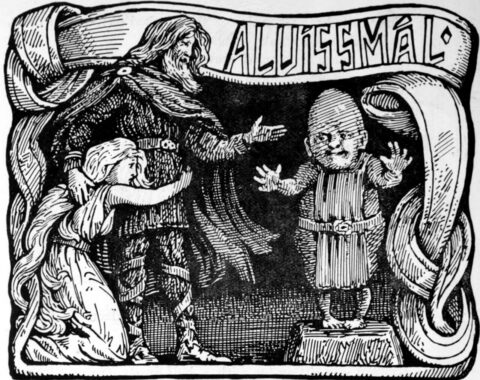
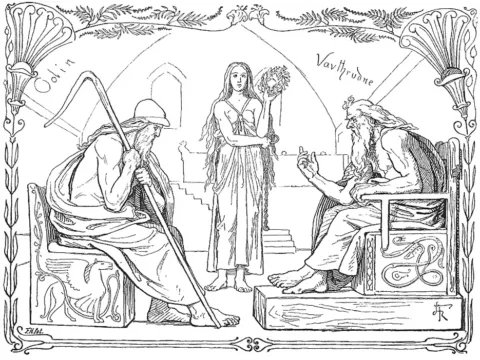
Odin enters Vafþrúðnir’s hall without revealing his identity. When the giant demands to know who has come before him, Odin introduces himself as Gagnráðr, a name often translated as “Good Counsellor,” although its precise meaning is debated. He presents himself as a thirsty traveller seeking hospitality, but Vafþrúðnir warns that he will not leave alive unless he proves the wiser of the two.
The giant offers him a seat, but Odin remains on the hall floor, replying with a proverb about the need for caution when a poor man visits a wealthy host. Vafþrúðnir then tests his knowledge with four questions.
Odin names Skinfaxi, the horse whose shining mane illuminates the world as he draws Day across the sky, and Hrímfaxi, whose dripping bit produces the morning dew as he carries Night. He also identifies Ífing, the river separating the gods from the giants, which never freezes, and Vígríðr, the battlefield where Surtr and the gods will meet at Ragnarök. The poem describes this field as extending a hundred leagues in every direction.
Impressed by the answers, Vafþrúðnir invites Odin to sit beside him. In stanza 19, the giant proposes that they wager their heads on the outcome of their contest of wisdom. Odin then takes over the questioning.
How Was the Norse World Created?
Odin begins by asking where the earth and sky came from. In Vafþrúðnismál, stanza 21, the giant explains that the world was fashioned from the body of Ymir, the primordial frost giant. His flesh became the earth, his bones the mountains, and his skull the sky. The sea was formed from his sveiti, literally “sweat,” although the word is commonly understood here as blood.
The poem describes the materials of creation without explaining how Ymir died. Snorri supplies that account in Gylfaginning, where Odin and his brothers Vili and Vé kill the giant and construct the world from his remains.
Later in the contest, Odin asks about the earliest generations of giants. In stanza 29, Vafþrúðnir names Bergelmir, his father Þrúðgelmir, and his grandfather Aurgelmir, all of whom existed before the earth was formed. Snorri identifies Aurgelmir with Ymir. When questioned about Aurgelmir’s origins, Vafþrúðnir explains that poisonous drops from the primordial rivers Élivágar grew until a giant emerged, from whom the race of giants descended.
Odin then asks how this first giant produced children without a female companion. According to stanza 33, a male and female grew beneath his arm, while one foot joined with the other to produce a six-headed son.
In stanza 35, Vafþrúðnir recalls Bergelmir being placed on a lúðr, a word variously interpreted as a mill-frame, cradle, or vessel. Snorri connects the episode with a flood of blood following Ymir’s death, from which Bergelmir escaped. The poem itself, however, mentions neither the flood nor an escape by boat, leaving the original meaning of the episode uncertain.
The Sun, Moon, Seasons, and the Structure of the Cosmos
In Vafþrúðnismál, stanzas 22–23, Odin asks about the origins of the sun and moon. Vafþrúðnir names Mundilfari as the father of Máni (Moon) and Sól (Sun), who travel across the sky and allow humanity to measure the passing years. The poem gives their parentage, while Snorri’s Gylfaginning provides a fuller account of how the gods assigned them their celestial duties.
The giant next identifies Dellingr as the father of Dagr (Day) and Nörvi as the father of Nótt (Night). In stanza 25, he adds that the gods established the new and waning phases of the moon so people could reckon the years. Timekeeping thus forms part of the divine ordering of the world.
The seasons also have their own ancestry. Vafþrúðnir names Vindsvalr as the father of Winter and Svásuðr as the father of Summer in stanza 27, without explaining how the seasons alternate.
Later, in stanzas 36–37, Odin asks where the invisible wind comes from as it travels over the sea. Vafþrúðnir answers that Hræsvelgr, a giant in the form of an eagle, sits at the edge of heaven. From his wings, the wind spreads across the human world. Snorri preserves the same explanation in Gylfaginning, chapter 18.
What Does Vafþrúðnir Reveal About Ragnarök?
As Odin’s questions turn toward the fate of the gods, Vafþrúðnir reveals what will happen at the end of the present age. In stanza 39, he foretells that Njörðr, who came from Vanaheimr as a hostage among the Æsir, will return to the Vanir at the world’s end. The giant also describes Odin’s einherjar, the fallen warriors who fight one another each day before returning to sit together in peace.
When Odin asks how he knows the secrets of gods and giants, Vafþrúðnir claims in stanza 43 to have travelled through nine worlds, reaching below Niflhel, where people are said to die out of Hel. The passage suggests a deeper realm associated with death, although it provides no clear explanation of what this further death means or how the nine worlds are arranged.
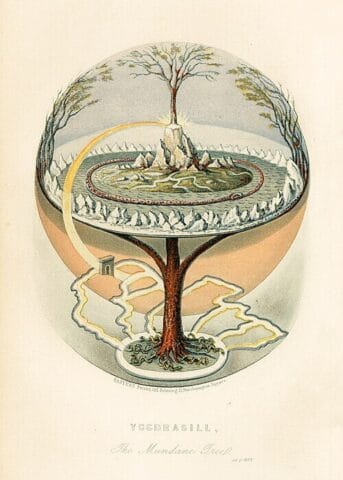
The predictions then turn to those who will survive the world’s destruction. In stanzas 44–45, Vafþrúðnir names Líf and Lífþrasir, two humans who will shelter in Hoddmímir’s wood during Fimbulvetr, the terrible winter preceding Ragnarök. They will live on morning dew, and future generations of humanity will descend from them. The poem does not identify their refuge with Yggdrasil, although that connection has been proposed by later interpreters.
Read Also
The sun will also have a successor. According to stanzas 46–47, Álfröðull, a poetic name for the sun, will bear a daughter before Fenrir devours her. After the gods perish, the daughter will follow her mother’s course across the sky.
In stanzas 50–51, Vafþrúðnir names the gods who will inherit the world after Surtr’s fire has died down. Víðarr and Váli will dwell in the gods’ sacred places, while Móði and Magni, the sons of Thor, will possess Mjölnir. These prophecies describe the continuation of both divine and human life beyond Ragnarök.
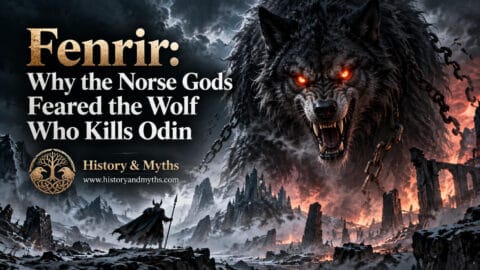
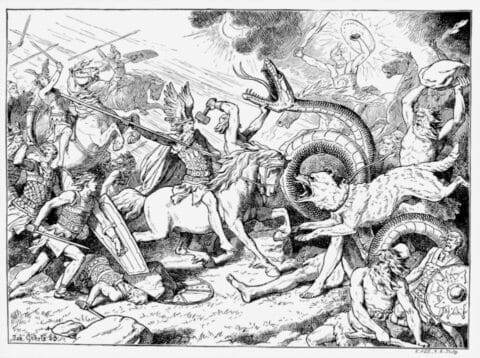
Finally, Odin asks what will cause his own death. Vafþrúðnir answers that a wolf will swallow the Allfather, but Odin’s son Víðarr will avenge him by splitting the creature’s jaws. The wolf is identified as Fenrir in other Norse accounts of Ragnarök.
What Did Odin Whisper in Baldr’s Ear?
In Vafþrúðnismál, stanza 54, Odin ends the contest by asking what he whispered into his son’s ear before the funeral pyre. The poem does not name the son, but the reference is generally understood to concern Baldr, whose funeral is described in other Norse sources.
Vafþrúðnir immediately recognises that his opponent is Odin himself. In stanza 55, he admits that no one else could know what the god had said. Speaking of his own “doomed mouth,” he acknowledges that he has matched his wisdom against Odin’s and lost. His words recall the earlier wager in which both contestants staked their heads.
The poem ends with this admission. It never reveals what Odin whispered to Baldr or describes Vafþrúðnir’s death, despite the fatal stakes of the contest.
Why Does Odin Win the Contest?
Vafþrúðnir answers Odin’s questions about the world’s origins and its destruction without revealing any weakness in his knowledge. Odin defeats him instead with a question about a private act that the giant could not possibly know. His victory depends on an advantage that has little to do with understanding the cosmos.
In his study A Contest of Cosmic Fathers, Ármann Jakobsson interprets the confrontation as a struggle over paternal authority. The giants belong to the ancestral past of the gods, and Vafþrúðnir’s immense age gives him knowledge of that history. Odin’s final question invokes his own son, Baldr, and overturns the older giant’s position as the keeper of ancient wisdom. Jakobsson considers the question unfair, suggesting that Odin’s triumph asserts his authority without necessarily proving that he possesses greater knowledge.
The outcome also carries an irony. Vafþrúðnir has already foretold that a wolf will swallow Odin at Ragnarök. Odin wins the contest, but the knowledge he gains offers no way to escape his own death.
How Reliable Is Vafþrúðnismál as a Source for Norse Mythology?
Vafþrúðnismál preserves important traditions about the origins of the cosmos, the ancestry of supernatural beings, and Ragnarök. Snorri Sturluson quotes several of its verses in the Prose Edda, while Völuspá and Grímnismál contain related mythological material. These parallels help establish connections between the surviving traditions, although they do not always present identical accounts.
Determining how much of the poem reflects pre-Christian beliefs is more difficult. Its surviving manuscripts were copied in Christian Iceland, centuries after some of the traditions they preserve may have originated. Neither the manuscripts nor the similarities with other texts establish precisely when the poem took shape or how its material changed during transmission.
Andrew E. McGillivray examines the poem as both a mythological narrative and a product of its literary and religious environment, considering the possible influence of Christianity alongside inherited Norse traditions. Its cosmological knowledge is presented through a contest between Odin and Vafþrúðnir, rather than as a systematic account of religious belief.
The poem is therefore a valuable witness to Norse mythology as preserved in medieval Iceland, but it cannot establish a uniform set of beliefs shared throughout pre-Christian Scandinavia.
Conclusion
Vafþrúðnismál brings together Norse traditions about the creation of the world, the ancestry of its earliest beings, and the destruction and renewal that follow Ragnarök. Through his answers, Vafþrúðnir demonstrates knowledge extending from the distant past to the fate of the gods themselves.
Odin defeats the giant not by challenging that knowledge, but by asking a question only he can answer. Vafþrúðnir recognises his opponent and concedes defeat, yet his prophecy of Odin’s death remains unchanged. The god wins the contest without gaining the power to escape his own fate.
Academic Sources & Primary Texts
Primary Texts and Manuscripts
- Pettit, Edward, ed. and trans.
The Poetic Edda: A Dual-Language Edition.
Cambridge: Open Book Publishers, 2023.
“Vafþrúðnismál,” 135–164.
Read the critical edition
. - Snorri Sturluson.
Edda: Prologue and Gylfaginning.
Edited by Anthony Faulkes. 2nd ed.
London: Viking Society for Northern Research, 2005.
Scholarly edition
. - Codex Regius of the Poetic Edda
(GKS 2365 4to), c. 1270.
Árni Magnússon Institute for Icelandic Studies.
Manuscript and digital edition
.
Academic Studies
- Jakobsson, Ármann.
“A Contest of Cosmic Fathers: God and Giant in Vafþrúðnismál.”
Neophilologus 92, no. 2 (2008): 263–277.
DOI
. - McGillivray, Andrew E.
Influences of Pre-Christian Mythology and Christianity on Old Norse Poetry: A Narrative Study of Vafþrúðnismál.
Kalamazoo, MI: Medieval Institute Publications, 2018.
Academic publication
.
Copyright & Content Rights
© 2026 History & Myths. All rights reserved.
Original research, analysis, and editorial content by H. Moses.
Ancient texts and historical sources are cited for scholarly reference.
Images are credited separately according to their respective licenses.