Bragi: The Norse God of Poetry and Eloquence
Bragi was the Norse god of poetry and eloquence, celebrated for his command of language rather than his strength in battle. In the Prose Edda, Snorri Sturluson describes him as one of the Æsir, renowned for his wisdom and mastery of verse. He is also the husband of Idunn, the goddess who preserves the apples that keep the gods young.
Bragi appears in several Old Norse texts, exchanging sharp words with Loki in Lokasenna and appearing in poems that portray the reception of fallen kings in Valhalla.
His identity, however, raises an important historical question. An early Scandinavian poet named Bragi Boddason also appears in the surviving record, leading scholars to debate whether the god developed from a celebrated human poet. Although Bragi’s literary role is well established, the origins of his divine identity and the extent of his worship remain uncertain.
Who Was Bragi in Norse Mythology?
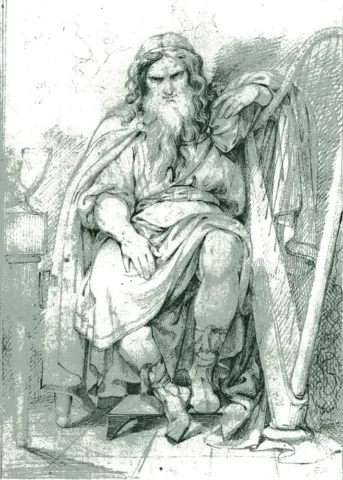
Snorri Sturluson identifies Bragi as a son of Odin in Skáldskaparmál, but gives no account of his birth or names his mother. The same text lists “first maker of poetry” and “long-bearded god” among the expressions used for him. Beyond his long beard, the surviving sources offer little physical description, and no distinctive weapon is associated with him.
In Gylfaginning, Snorri connects Bragi’s name with the Old Norse word bragr, associated with poetry and excellence in speech. He also explains that exceptionally eloquent men and women could be described using terms derived from the god’s name. This reflects Bragi’s reputation as a master of language, although Snorri’s explanation does not establish the historical origin of his name.
Bragi and the Art of Norse Poetry
In Grímnismál, stanza 44, Bragi is named the foremost of skalds, the poets who composed and performed verse in the Norse world.
In Skáldskaparmál, Bragi’s knowledge of poetry takes centre stage when Ægir visits the gods in Asgard. During a feast, Bragi recounts stories about the gods and explains the poetic expressions associated with them. Snorri Sturluson uses their conversation to introduce the techniques of Old Norse skaldic poetry.
Bragi distinguishes poetic language from metre and explains how poets use heiti, alternative poetic names, and kennings, descriptive expressions that replace ordinary words. Poetry, for example, could be called “Odin’s drink,” a reference to the myth of the mead of poetry. Understanding such expressions required familiarity with the stories behind them.
When Ægir asks about poetry’s origins, Bragi tells how the blood of the wise Kvasir was mixed with honey to create the mead that granted poetic inspiration. Odin eventually obtains the drink and brings it to the gods. Bragi is the narrator of this account, not the god who acquires the mead. His role in Skáldskaparmál is to explain the craft of poetry and the mythology that gave its language meaning.
Bragi and Idunn
Idunn, the goddess who guards the apples that restore the gods’ youth, is identified as Bragi’s wife in Gylfaginning. Their marriage also appears in Skáldskaparmál, where “Idunn’s husband” is listed among the poetic descriptions of Bragi, while Idunn can be called “Bragi’s wife.” The sources establish their relationship but say nothing about how they married or whether they had children.
Bragi also recounts the story of Idunn’s abduction by the giant Þjazi. Speaking to Ægir in Skáldskaparmál, he describes how Loki lured her out of Asgard and later rescued her when the gods began to age without her apples. Bragi himself plays no active part in the rescue. Although the story concerns his wife, his role is that of its narrator rather than its hero.
Bragi’s Confrontation with Loki
Bragi’s most heated appearance in Norse mythology occurs in Lokasenna, a poem centred on Loki’s insults during a feast in Ægir’s hall. After being expelled for killing the servant Fimafeng, Loki returns and demands a seat. Bragi refuses him, but Odin allows Loki to stay after he invokes their ancient blood-bond.
Loki then deliberately excludes Bragi when greeting the assembled gods. Bragi offers him a horse, a sword, and a ring if he will stop provoking the gathering. Instead, Loki calls him the least courageous of the gods and elves present. Bragi threatens to take Loki’s head if they meet outside the hall, prompting Loki to mock him as a mere ornament of the benches, brave in words but unwilling to fight.
Idunn intervenes, urging her husband to stop exchanging insults. Loki turns his abuse against her, but she refuses to retaliate and concentrates on calming Bragi. The confrontation ends without a fight. Loki’s accusations reveal how he attacks Bragi’s honour, but they provide no independent evidence that the god was actually a coward.
The Runes on Bragi’s Tongue
In Sigrdrífumál, stanza 16, Bragi appears in a passage describing the mysterious distribution of runes. The valkyrie Sigrdrífa tells the hero Sigurd that runes were carved on Bragi’s tongue, as well as on a bear’s paw, a wolf’s claws, and an eagle’s beak.
The surrounding verses place runes on other objects and beings, including Odin’s spear Gungnir and the horse Sleipnir. They form part of Sigrdrífa’s teachings about runic knowledge and its supernatural uses.
Bragi’s inclusion is particularly fitting for a deity associated with poetry and eloquence. His tongue may symbolize the connection between language and sacred knowledge, but the poem offers no explanation of the image. It does not describe Bragi acquiring magical speech or using the runes to perform a particular feat.
Bragi in Valhalla
Two tenth-century memorial poems place Bragi in Valhalla, Odin’s hall of fallen warriors. In Eiríksmál, composed in honour of King Eiríkr Bloodaxe, Odin prepares the hall for an important arrival. When a tremendous noise approaches, Bragi suggests that Baldr might be returning. Odin corrects him: the newcomer is Eiríkr, and he orders Sigmund and Sinfjötli to welcome the king.
Bragi takes a more active role in Hákonarmál, composed by Eyvindr skáldaspillir after the death of King Hákon the Good. Odin sends Bragi and Hermóðr to greet the fallen ruler. When Hákon expresses concern about Odin’s attitude towards him, Bragi assures him that he will enjoy the peace of the einherjar, share ale with the Æsir, and find eight brothers already in the hall.
These poems portray Bragi as a familiar presence in Odin’s hall and a participant in the ceremonial reception of kings. They do not suggest that he ruled Valhalla or determined which warriors entered it.
Was Bragi Originally a Human Poet?
Bragi shares his name with Bragi Boddason the Old, a Norwegian poet whose surviving work dates to around 850 CE. He is the earliest named skald whose poetry has been preserved in substantial fragments. His best-known composition, Ragnarsdrápa, describes scenes on a decorated shield presented by a patron named Ragnarr. The surviving verses include the attack on King Jörmunrekkr and the legendary conflict involving Hildr. Snorri Sturluson preserved parts of this poem in Skáldskaparmál, several centuries after its composition.
The shared name and connection with poetry have led some scholars to suggest that Bragi Boddason was eventually regarded as a god. The figure named Bragi in the Valhalla poems has also entered this debate, although those poems do not explicitly identify him as the historical Bragi Boddason. John Lindow has argued for a close identification between the two figures, while other scholars remain cautious about their relationship.
No surviving source describes Bragi Boddason becoming divine. Snorri presents Bragi as a god in some passages while separately preserving verses attributed to the historical poet. Whether the divine Bragi originated from his reputation, or whether the two figures had independent origins, remains unresolved.
Was Bragi Worshipped by the Norse?
Despite Bragi’s prominent place in Norse poetry, there is little direct evidence of a cult devoted to him. No securely identified temple, altar, or inscription records offerings made specifically to Bragi. This does not mean he was never worshipped, but the surviving sources cannot establish how people might have honoured him.
One tradition sometimes associated with Bragi is the bragarfull, a ceremonial drinking cup used when making solemn vows. In Ynglinga saga, King Ingjald raises the cup at his father’s memorial feast, swears to expand his kingdom, and then assumes his inherited seat. A similar custom appears in Helgakviða Hjörvarðssonar, where Heðinn makes a troubling vow during a feast.
Although the name bragarfull resembles Bragi’s, scholars generally connect it with the Old Norse word bragr, meaning “foremost” or “chief.” Neither account identifies the ceremony as an offering to the god. The texts document an important tradition of public oath-taking, but they cannot establish a direct connection with Bragi’s worship.
Read Also
- Idunn: The Norse Goddess Who Kept the Gods Young
, discover the story of Bragi’s wife, her life-preserving apples, and her abduction by Þjazi. - Odin: All-Father, Chief of the Norse Gods and God of Wisdom
, explore Odin’s connection with poetic inspiration, the Mead of Poetry, and the pursuit of knowledge. - Loki in Norse Mythology: Trickster, Shapeshifter, Enemy of the Gods
, learn more about the trickster whose insults provoke Bragi during the feast in Lokasenna. - Valhalla in Norse Mythology: Who Goes There and What Happens?
, examine Odin’s hall and the afterlife of fallen warriors, where Bragi appears in royal memorial poetry.
Conclusion
Bragi’s place in Norse mythology reflects the importance of poetry in a culture where stories preserved the deeds and reputations of gods, rulers, and warriors. His appearances in the surviving texts show him explaining poetic language, confronting Loki through words, and welcoming a fallen king to Valhalla.
Much about Bragi remains uncertain, particularly the extent of his worship and his possible connection with the historical poet Bragi Boddason. Yet the surviving accounts consistently associate him with the skill and knowledge of the skald, making him a distinctive figure among the Æsir.
Academic Sources & Primary Texts
This article draws on Old Norse poetry, Snorri Sturluson’s Prose Edda, royal memorial poems, and modern scholarship on skaldic traditions. It distinguishes the medieval portrayal of Bragi from theories concerning the historical poet Bragi Boddason.
Primary Norse Sources
- Snorri Sturluson. Edda: Prologue and Gylfaginning.
Edited by Anthony Faulkes, 2nd ed., Viking Society for Northern Research, 2005.
Chapter 26 identifies Bragi as a god associated with wisdom, eloquence, and poetry, and names Idunn as his wife.
Academic Edition - Snorri Sturluson. Edda: Skáldskaparmál.
Edited by Anthony Faulkes, Viking Society for Northern Research, 1998.
The principal source for Bragi’s role as a narrator, his discussion of kennings and poetic language, and the origin of the Mead of Poetry.
Academic Edition - The Poetic Edda: A Dual-Language Edition.
Edited and translated by Edward Pettit, Open Book Publishers, 2023.
Includes Grímnismál (stanza 44), Lokasenna (Bragi’s confrontation with Loki), Sigrdrífumál (runes on Bragi’s tongue), and Helgakviða Hjörvarðssonar (the ceremonial vow).
Read the Edition - Eiríksmál and Hákonarmál.
Tenth-century memorial poems portraying the arrival of kings in Valhalla. Bragi appears in both accounts, including the welcome given to Hákon the Good.
Heimskringla, Scholarly Translation (PDF) - Snorri Sturluson. Heimskringla: Ynglinga saga.
Translated by Alison Finlay and Anthony Faulkes, Viking Society for Northern Research, 2016.
Chapter 36 describes the ceremonial bragarfull and King Ingjald’s oath. The passage does not identify the ritual as worship of Bragi.
Academic Translation
Academic Studies & Research
- Clunies Ross, Margaret (2005).
A History of Old Norse Poetry and Poetics. D. S. Brewer.
A major scholarly study of Norse poetic composition, skaldic technique, poetic language, and the cultural role of poets.
Book Details, JSTOR - Lindow, John (2002).
Norse Mythology: A Guide to the Gods, Heroes, Rituals, and Beliefs. Oxford University Press.
An academic reference for Bragi’s identity, his appearances in medieval sources, and the relationship between mythological figures and Norse religious traditions.
Oxford Academic - Males, Mikael Meuller (2023).
“The Dating of Bragi’s Poetry.” Medioevo Europeo, 7(2).
Examines the dating of poetry attributed to Bragi Boddason and supports its composition around 850 CE.
Read the Study - Skaldic Poetry of the Scandinavian Middle Ages.
Research database maintained by an international scholarly project.
Provides edited texts, translations, and commentary on poetry attributed to Bragi Boddason, including fragments of Ragnarsdrápa.
Bragi Boddason, Scholarly Database
Research Note: The surviving texts establish Bragi’s association with poetry, his relationship with Idunn, and his appearances in mythological and royal memorial poetry. His possible identification with Bragi Boddason, the development of his divine identity, and the extent of his historical worship remain debated.
Copyright & Content Notice
© 2026 History & Myths. All rights reserved.
The original editorial content of this article is published by History & Myths. Reproduction or redistribution of substantial portions requires permission, except where permitted by applicable copyright law. Brief quotations should include clear attribution and a link to the original article.
Ancient texts, scholarly publications, archaeological objects, and third-party images remain subject to their respective rights and licenses. Image credits and licensing information are provided separately where applicable.