What If Apophis Defeated Sun God Ra? Egyptian Mythology Scenario
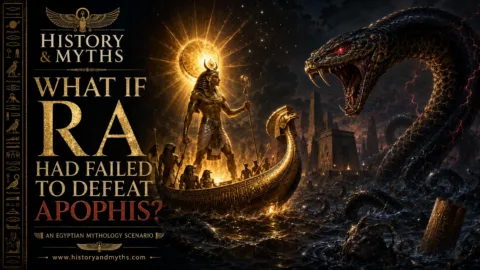
Every night, Ra was believed to cross the Duat in his solar barque while Apophis tried to stop him. Every morning, the rising sun meant that the journey had succeeded and cosmic order had survived another night.
But what if Ra lost once?
If Apophis succeeded in stopping the solar barque before dawn, the immediate consequence would be simple and terrifying: the sun would not rise. In Egyptian belief, however, this would mean far more than darkness. Ra’s nightly journey was part of the cycle that renewed the sun and preserved Ma’at, the ordered structure of the cosmos.
A single defeat could therefore threaten the entire system that kept creation functioning. The real question is not whether Apophis could defeat Ra forever, but whether the Egyptian cosmos could recover after the first morning that never came.
The Nightly Battle That Keeps the World Alive
In Egyptian belief, sunset did not mean that Ra simply disappeared. Each night, the sun god entered the Duat and traveled through its dangerous regions in his solar barque. His goal was to complete the journey, renew himself, and return at dawn.
Apophis, or Apep, was the greatest threat to that cycle. He was not a rival sun god trying to replace Ra, but a force of chaos that sought to stop the solar barque and prevent the ordered world from continuing. Egyptian images show Ra and the gods aboard the barque confronting him directly, including scenes in which Apophis is pierced and subdued.
Ra did not make the journey alone. Other gods and divine beings accompanied the barque, protected it, and helped repel its enemies. Texts from the Book of the Dead also describe sailing with Ra and explicitly refer to repelling Aapep so that the journey can continue.
The important point is that dawn marked more than the beginning of another day. The sun’s return meant that the nightly passage had succeeded and that the cycle of renewal was still intact. Egyptian underworld texts depict the final hours of the night as the moment when the sun approaches rebirth and emerges again at sunrise.
That is why one defeat matters so much in this scenario. If Apophis stops the barque before the journey is completed, the first consequence is not a lost battle. It is a dawn that never arrives.
The Scenario Used in This Article
In this scenario, Ra begins his nightly journey through the Duat as usual,
but for the first time Apophis succeeds in stopping the solar barque before the
cycle is completed.
Everything before that moment remains unchanged. Ra has survived every
previous night, the gods still accompany and defend the barque, and the ordered
cosmos continues to function according to Ma’at.
The only change is the outcome of one battle.
Ra is defeated, but we do not assume that he is killed or permanently
destroyed. Apophis simply prevents the solar journey from reaching its normal
conclusion.
From that point, the question becomes whether the gods can restore the
broken cycle, or whether one failed dawn is enough for cosmic order to begin
falling apart.
The First Morning Without the Sun
The first sign that something had gone wrong would be obvious: dawn would come, but the sun would not.
In Egyptian cosmology, sunrise was the completion of Ra’s passage through the Duat and the beginning of his renewed life in the eastern sky. Underworld texts describe the final hours of night as a movement toward rebirth, with the solar god emerging again at morning.
If Apophis prevented that transition, the failure would be more serious than an unusually long night. The normal cycle of death, regeneration, and return would have been interrupted at the point where renewal was supposed to occur.
For people on earth, the immediate experience would be darkness and uncertainty. Priests could perform rituals, temples could continue their duties, and rulers could still claim to uphold order, but the most visible proof that the cosmos was functioning correctly would be missing.
That is what makes the first failed dawn so important. The world would still exist, at least initially, but one of the central mechanisms that renewed it each day would no longer be working.
What Happens to Ra in the Duat?
The safest assumption is not that Apophis kills Ra, but that he prevents Ra from completing the cycle of renewal.
In the Amduat, Ra’s passage through the Duat is a process of transformation. During the deepest part of the night, the sun god encounters Osiris, and by the final hours he is moving toward rebirth at dawn. The scarab form of the rising sun appears just before sunrise, marking the transition back into the visible world.
If Apophis stops the solar barque before that process is completed, Ra could remain trapped within the Duat in an unfinished state. He would still exist, but the transformation that allows him to return as the morning sun would fail.
That distinction matters. Egyptian sources repeatedly describe the danger of the nightly journey, but they do not give us a canonical account in which Apophis wins and permanently destroys Ra.
So the most defensible scenario is temporary imprisonment or disruption, not immediate divine death. Ra has failed to return, and the rest of the gods now face a problem they were never supposed to face: how to restart a cycle that has already broken once.
Would Ma’at Begin to Collapse?
Yes, but probably not as an instant destruction of the universe.
Ma’at represented more than morality or justice. In Egyptian thought, it was the proper order of the cosmos, the principle that kept gods, kingship, nature, and human society functioning as they should. The Metropolitan Museum describes Maat as the embodiment of cosmic order, truth, and justice.
Apophis represented the opposite force. The British Museum identifies him as the enemy of the sun god and a symbol of the primeval forces of chaos.
That makes Ra’s failure especially serious. If the sun does not return, one of the clearest demonstrations of cosmic order has failed. The regular movement from night to dawn has been broken, and Apophis has proved that the forces of chaos can interrupt a cycle that was supposed to renew itself continuously.
But this does not mean that every part of creation must vanish at once. A more plausible reading is that isfet begins to gain ground. Darkness persists, the normal rhythm of time is disrupted, and the relationship between the divine and human worlds becomes increasingly unstable.
The longer Ra remains unable to complete his journey, the harder it becomes to describe the cosmos as functioning according to Ma’at at all.
Could Seth and the Other Gods Continue the Fight?
Ra’s defeat would not necessarily end the battle.
Seth was one of the gods associated with defending the solar barque, and Egyptian tradition could portray him as a protector of Ra against dangerous forces. The British Museum specifically notes this protective role, while later Egyptian imagery shows Seth attacking Apophis from the barque.
That means a failed night does not require us to assume that every god aboard the barque has been defeated as well. If Ra remains trapped or unable to complete his renewal, Seth and the other divine companions could still attempt to drive Apophis back and reopen the route through the Duat.
Their problem would be greater than simply winning another fight. The normal sequence has already failed. Even if Apophis is eventually subdued, the gods would have to restore Ra’s movement and complete the interrupted process that should have ended at dawn.
So Seth becomes especially important in this scenario. His strength might prevent one victory by Apophis from becoming permanent, but defeating the serpent after sunrise has already failed would only solve half the problem. The gods would still need to restore the solar cycle itself.
What Happens to Osiris, the Duat, and the Dead?
Apophis defeating Ra would not automatically mean that Osiris loses control of the Duat. Osiris has his own role as ruler of the dead, and nothing in the surviving texts suggests that stopping the solar barque would instantly remove him from that position.
The deeper problem is renewal.
In the Amduat, Ra’s nightly journey and the fate of the dead are closely connected. The deceased could travel with the sun god through the Duat, while Ra himself joins with Osiris during the deepest part of the night before moving toward rebirth at dawn.
If that journey is interrupted, the dead may still exist in the underworld, but one of the processes associated with their regeneration has stopped functioning normally. The Duat would no longer be simply a realm through which the sun passes and renews itself. It could become a place where the expected movement toward rebirth has stalled.
This makes Ra’s defeat a crisis for both worlds. The living lose the sunrise, while the dead lose their connection to a solar cycle that helped carry them through darkness toward renewed existence.
Osiris may still rule the Duat, but the relationship between death, regeneration, and sunrise would no longer work as it was supposed to.
What Happens to the Human World Without Dawn?
For humans, the first consequences would be both practical and religious.
The Egyptian day was organized around a regular alternation between daylight and night, with dawn marking the beginning of the daily cycle. More importantly, Ra was believed to bring light, warmth, and life while his repeated journey helped keep the world in Ma’at.
If the expected sunrise never came, ordinary life could continue for a time, but the event would signal something far more serious than prolonged darkness. Temples could still perform rituals, officials could still govern, and the pharaoh could still claim to defend order, yet the most visible confirmation of divine order had failed to appear.
Religiously, that would create an immediate crisis. Egyptians did not treat the sun as a distant object disconnected from the gods. Ra’s movement through the sky and Duat was part of the structure of creation itself.
If darkness continued, the human world would increasingly reflect the cosmic disorder above it. Daily routines, religious observances, and the king’s duty to maintain Ma’at would all continue under one disturbing fact: the gods had failed to restore the sun.
What would not happen, at least immediately, is the Nile suddenly drying up or human civilization vanishing overnight. Those conclusions go beyond the mythology. The first human crisis would be uncertainty, disrupted order, and the realization that the expected dawn might not return.
Could Egyptian Rituals Help Restore Order?
Possibly, but only as part of the wider struggle to restore divine order.
Ancient Egyptians performed rituals specifically aimed at weakening Apophis. The Bremner-Rhind Papyrus preserves the Book of Overthrowing Apep, a ritual text devoted to attacking and symbolically destroying Ra’s enemy. The manuscript belongs to the Ptolemaic Period, but it reflects a broader Egyptian idea that ritual action could support the gods in maintaining cosmic order.
In this scenario, a failed sunrise would make those rituals more urgent than ever. Priests could recite protective texts, curse images of Apophis, and perform acts intended to weaken him while the gods continued their own struggle in the Duat.
But ritual alone would not replace Ra. The purpose of these practices was to assist the defeat of Apophis and protect the solar cycle, not to create a new sun or bypass the gods entirely.
So if Ra were trapped after one lost battle, human ritual might help tip the balance back toward Ma’at. It would be a form of participation in the restoration of order, not a substitute for the divine forces needed to restart the solar journey.
Would Apophis Rule the Cosmos or Destroy Its Order?
Apophis would not become a new ruler of the cosmos in any meaningful Egyptian sense.
He was not a rival creator god with his own system of law, worship, or kingship. His role was fundamentally destructive. Egyptian tradition presents him as the enemy of Ra and as a force associated with chaos, darkness, and the undoing of the ordered world.
That distinction matters. If Apophis defeated Ra, he would not replace Ma’at with a different form of order. He would undermine the conditions that allowed order to exist at all.
The result would therefore be less like a transfer of power and more like the failure of the cosmic structure itself. Ra’s solar cycle would remain broken, the normal boundary between night and day would fail, and isfet would gain ground wherever Ma’at had previously imposed stability.
This also explains why Egyptian rituals focused on destroying or restraining Apophis rather than negotiating with him or incorporating him into divine rule. He represented a threat that had to be overcome, not a power that could govern creation in Ra’s place.
So if Apophis won one decisive night, his victory would not create an “Age of Apophis.” It would begin a struggle over whether the ordered universe could survive at all.
Would Creation Return to Primordial Chaos?
That is one of the most plausible long-term outcomes, but not something the surviving texts describe as an immediate event.
Egyptian creation traditions often begin with the primeval waters of Nun, an undifferentiated state that existed before the ordered world emerged. Creation meant establishing structure, separation, light, and ultimately Ma’at within that earlier condition.
Apophis threatens the opposite process. His victory does not create a rival cosmos. It weakens the boundaries and cycles that keep the existing one ordered.
If Ra remained unable to complete his journey, the danger would therefore grow over time. Night would no longer lead reliably to dawn, solar renewal would fail, and the forces associated with disorder would face less resistance. In that sense, creation could begin moving symbolically back toward the condition from which order first emerged.
But it would be wrong to imagine the world instantly dissolving into the waters of Nun the moment Ra loses. Egyptian sources do not give us that sequence.
The stronger conclusion is gradual cosmic regression: the longer the solar cycle remains broken, the more the ordered world risks losing the distinctions and rhythms that define creation itself.
Could the Sun Ever Rise Again?
Possibly. A failed dawn does not have to mean that the sun is gone forever.
The Egyptian texts describe Ra’s journey as a cycle of danger, renewal, and rebirth. The Amduat shows the sun moving through the final hours of the Duat toward the moment of sunrise, while other texts and rituals focus on restraining Apophis so that the solar barque can continue its passage.
That leaves room for recovery in this scenario. If Seth and the other gods managed to subdue Apophis after the normal moment of dawn had passed, Ra might still be able to complete the interrupted journey and emerge later.
What we cannot know is whether Egyptian cosmology allowed a missed sunrise to be “repaired” in this way. No surviving text gives a canonical account of Ra losing once and then restarting the cycle.
So the strongest conclusion is conditional. If Apophis can be driven back and Ra’s renewal completed, the sun may rise again and Ma’at may be restored. If the interruption becomes permanent, then the crisis moves from a single failed dawn toward a genuine collapse of cosmic order.
What Would Probably Not Happen?
Ra losing one night would not automatically mean that every god dies, the Duat disappears, or creation vanishes in a single instant.
Nor is there good reason to imagine Apophis taking Ra’s throne and ruling the cosmos. His role in Egyptian religion is that of an enemy of the solar god and a force of chaos, not a replacement creator or king with an alternative divine order.
Seth would also not automatically become the new sun god simply because he helped defend the solar barque. His role is protective and martial, not a direct substitute for Ra’s cycle of death and rebirth.
The most defensible scenario is therefore less dramatic but more serious: the machinery of cosmic renewal has failed, while the gods and the ordered world still exist long enough to attempt a recovery.
The danger comes from what happens if that failure continues, not from assuming that one lost battle instantly erases the entire Egyptian universe.
- The Twelve Hours of the Night in the Egyptian Underworld
- The Solar Barque of Ra in Ancient Egypt
- The Night Journey of the Sun God Through the Duat
- Monsters of the Duat in the Egyptian Underworld
- The Duat: Egyptian Underworld and Afterlife
- Ra: The Sun God of Ancient Egypt
- Ma’at in Ancient Egypt: Justice, Truth, and Balance
- Apophis: The Egyptian Serpent of Chaos and Destruction
Most Likely
The most likely result is not the instant destruction of creation, but a broken solar cycle that quickly becomes a crisis of cosmic order.
Ra remains unable to complete his journey, the sun fails to rise, and Apophis gains something he had never achieved before: proof that the nightly renewal of the cosmos can be interrupted. The gods would still exist, Osiris would still rule the Duat, and the human world would not vanish immediately, but the normal rhythm connecting night, rebirth, and dawn would no longer function.
That gives the gods a narrow window to respond. Seth and the other defenders of the solar barque could still fight back, and rituals on earth could continue to support the restoration of order.
If Ra is freed and his renewal completed, Ma’at may recover. If not, the prolonged failure of sunrise would allow isfet to spread until the ordered cosmos itself becomes increasingly unstable.
The most defensible outcome, therefore, is a temporary but extremely dangerous collapse in cosmic renewal, with everything depending on whether Ra’s journey can be restarted.
Plausible but Uncertain
It is plausible that the gods could eventually recover from a single defeat.
Egyptian texts repeatedly present Apophis as an enemy who must be restrained, attacked, and overcome so that the solar journey can continue. The Book of Overthrowing Apep shows that defeating him was imagined as an active, repeated process rather than a one-time event.
That leaves room for a second confrontation after the failed dawn. Seth and the other defenders of the barque might force Apophis back, allowing Ra to resume the interrupted journey and complete his rebirth.
A delayed sunrise is therefore possible within the logic of the scenario, but it is not described in surviving Egyptian texts. We also cannot know whether Ma’at would return immediately once Ra reappeared, or whether one broken cycle would leave lasting consequences for gods, humans, and the dead.
The recovery is plausible. Its timing and cost are not.
Highly Unlikely
It is highly unlikely that Apophis would defeat Ra and then establish a stable new cosmic order of his own.
Nothing in the surviving Egyptian material presents him as a replacement creator, king, or sun god. His role is destructive. He threatens the solar journey, attacks the ordered cosmos, and must repeatedly be restrained so that creation can continue.
It is equally difficult to justify the idea that all other gods would disappear the moment Ra lost one battle. Seth, Osiris, and the other divine beings have roles that do not depend on Ra simply being undefeated at every instant.
A complete and immediate end of existence is also too strong. Egyptian texts emphasize the danger of Apophis and the need to defeat him, but they do not describe a single failed encounter as an instant annihilation of every part of creation.
The least defensible versions of this scenario are therefore the most absolute ones: Apophis becomes the new ruler, every god dies, or the universe vanishes at once.
Final Verdict
If Ra lost to Apophis once, the most plausible consequence would be a failed sunrise and an immediate crisis in the cycle that renewed the Egyptian cosmos.
That does not require Ra to die, the gods to vanish, or creation to end instantly. The stronger interpretation is that the solar journey has been interrupted and Ma’at has suffered a serious breach. The longer Ra remains unable to complete his rebirth, the more room isfet gains to spread through the divine, human, and funerary worlds.
The decisive question would then be whether Seth and the other defenders of the solar barque could force Apophis back and restore Ra’s journey.
If they succeeded, the sun could return and cosmic order might recover, although Egyptian texts do not tell us what a repaired cycle after a failed dawn would look like.
If they failed, one victory by Apophis could become far more than a lost battle. It could mark the beginning of the unraveling of the ordered world itself.
Frequently Asked Questions
What would happen if Apophis defeated Ra?
The most immediate result would be a failed sunrise. In Egyptian cosmology, Ra’s return at dawn was part of the daily renewal of the ordered cosmos, so stopping his journey would create a serious crisis for Ma’at and the solar cycle.
Would Ra die if Apophis defeated him?
Not necessarily. Surviving Egyptian texts do not provide a canonical story in which Apophis permanently kills Ra. A safer interpretation is that Ra could be trapped or prevented from completing his renewal through the Duat.
Would the sun disappear forever?
It is possible that the sun could return if Apophis were eventually driven back and Ra completed the interrupted journey. Egyptian texts describe the solar cycle as repeatedly threatened, but they do not explain what would happen after a failed dawn.
Could Seth defeat Apophis after Ra failed?
Seth was one of the divine defenders associated with protecting Ra’s solar barque from Apophis. That makes a second attempt plausible within the mythology, although no surviving Egyptian source describes Seth restoring the solar cycle after Ra has already failed to rise.
Would Apophis become the new ruler of the gods?
Probably not. Apophis was associated with chaos and the disruption of cosmic order, not with replacing Ra as a creator or king. His victory would more likely weaken the structure of the cosmos than establish a new divine government.
What would happen to Ma’at if Ra lost?
Ma’at would not necessarily vanish instantly, but the failure of sunrise would represent a major breakdown in cosmic order. The longer the solar cycle remained interrupted, the more strongly isfet, or disorder, could dominate the world.
Did ancient Egyptian texts say that Apophis could actually win?
Egyptian texts repeatedly describe the need to defeat, restrain, or destroy Apophis, showing that his threat was taken seriously. However, they do not give a complete canonical account of what would happen if he permanently succeeded.
Sources & Further Reading
This mythological scenario is built from ancient Egyptian religious texts,
archaeological material, museum scholarship, and academic research.
Where the surviving sources do not describe what would happen after an
actual victory by Apophis, the article clearly treats the outcome as
reasoned mythological speculation rather than established Egyptian belief.
British Museum — The Bremner-Rhind Papyrus
Primary Egyptian textual evidence preserving the
Book of Overthrowing Apep, a ritual composition devoted to
attacking and defeating the enemy of Ra.
View the Bremner-Rhind Papyrus
British Museum — Apophis
Museum reference identifying Apophis as the serpent deity of the
underworld, enemy of the sun god, and a symbol of the primeval forces
of chaos.
The Metropolitan Museum of Art — Amduat Papyrus of Henettawy
Archaeological and textual evidence for the twelve-hour journey through
the Duat, Ra’s encounter with Osiris, and the process leading to the
sun’s rebirth in the morning.
The Metropolitan Museum of Art — Divine Egypt: Ruling the Cosmos
Scholarly museum overview explaining how Ra’s recurring birth, daytime
journey, and passage through the underworld preserved cosmic order and
kept the world in Ma’at.
UCL Digital Egypt for Universities — Book of the Dead, Chapter 136
University-based translation and teaching resource containing material
connected with traveling in Ra’s barque and repelling Aapep during the
solar journey.
Read Book of the Dead Chapter 136
De Maré, Charly — “Le combat mythique entre Seth et Apophis”
Academic study of textual and iconographic evidence for the conflict
between Seth and Apophis, including Seth’s positive role as defender of
Ra’s solar barque.
Acta Orientalia Belgica, XXXI, 2018.
Kousoulis, Panagiotis — Ritual of Overthrowing Apophis
Doctoral research examining the apotropaic
Ritual of Overthrowing Apophis and the relationship between
Egyptian ritual practice, magic, religion, and the defense of cosmic
order.
PhD thesis, University of Liverpool.
University of Liverpool Repository
UCL Digital Egypt for Universities — Egyptian Creation Traditions
Academic teaching resource covering Egyptian creation traditions,
including Nun, the primeval watery expanse, and the emergence of the
ordered created world.
Copyright & Use
Written by H. Moses
This article is original content created for
History & Myths
.
Reproduction, republication, or redistribution of the full article without prior permission is not permitted.
Short quotations may be used for educational, academic, or commentary purposes when properly attributed and linked back to
HistoryAndMyths.com