What If Rome Had Won at Teutoburg Forest? Alternate History
In 9 CE, Rome suffered one of the worst defeats in its imperial history when three legions under Publius Quinctilius Varus were destroyed in the Teutoburg Forest by a Germanic coalition led by Arminius.
The defeat did more than cost Rome thousands of soldiers. It caused the collapse of much of Rome’s position east of the Rhine and helped turn the river into the empire’s long-term frontier in the region.
But what if the ambush had failed? If Varus had taken the warnings about Arminius seriously, the Roman army might have entered the battle prepared instead of being trapped in difficult terrain.
A Roman victory would not automatically mean the conquest of all Germania. The more important question is what happens next: does Rome keep its military foothold east of the Rhine, defeat Arminius’s coalition, and continue the effort to bring Germania under permanent Roman control?
If that effort succeeded, the consequences could reach far beyond one battle, reshaping the Roman frontier, the development of Germanic peoples, later migrations, and the political map of Europe.
The Historical Turning Point: Rome’s Disaster in 9 CE
By 9 CE, Rome had spent years campaigning east of the Rhine, but its control over Germania remained incomplete.
Publius Quinctilius Varus marched through the region with three legions, XVII, XVIII, and XIX, while resistance was being organized in secret by Arminius, a Cheruscan noble who had served in the Roman military and held Roman citizenship.
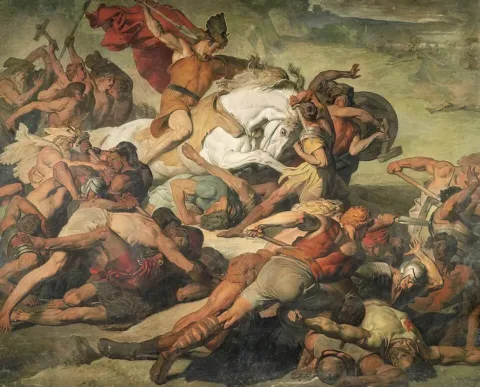
Arminius used that trust to mislead Varus about a local uprising and draw the army into difficult terrain. The Roman column became stretched out, burdened with baggage and civilians, and unable to deploy in the disciplined formations that normally gave the legions their advantage.
Over several days of fighting, the Germanic coalition destroyed most of the Roman force. Varus died, and the numbers XVII, XVIII, and XIX were never used again for Roman legions. Rome’s position east of the Rhine became far harder to maintain.
The disaster did not end Roman military activity in Germania, but it changed the strategic situation. Instead of expanding from an existing foothold, Rome first had to recover from the destruction of an entire field army.
Was Rome Already Conquering Germania Before Teutoburg?
Yes. Rome had been pushing steadily east of the Rhine for years before the disaster in 9 CE.
Roman armies had campaigned deep into Germania under commanders such as Drusus and Tiberius, while forts, roads, and supply networks supported a growing military presence between the Rhine and the Elbe. Rome also relied on alliances with local leaders rather than force alone.
That did not mean Germania had already become a fully established Roman province. Control was uneven, and many communities remained outside direct Roman administration.
Teutoburg therefore did not stop a first attempt at invasion. It disrupted an ongoing process of occupation and consolidation in which Rome had already invested heavily.
Waldgirmes: Evidence That Rome Planned More Than War
One of the clearest signs of Roman ambitions east of the Rhine comes from Waldgirmes, a site in modern Germany that was more than a military camp.
Archaeologists uncovered a planned settlement with streets, timber buildings, a forum, and a central administrative complex. The site also produced fragments of a large gilded equestrian statue, probably of Augustus, pointing to a strong official Roman presence.
Waldgirmes suggests that Rome was planning more than temporary military campaigns. In at least some areas, it was beginning to establish the civilian and administrative infrastructure associated with long-term rule.
Waldgirmes was abandoned around the time of the Teutoburg disaster. In our alternate scenario, a Roman victory gives settlements like it a much better chance of developing into permanent centers of Roman power east of the Rhine.
Alternate-History Scenario: Varus Takes the Warning Seriously
The point of divergence comes before the ambush. Segestes,
a Cheruscan noble hostile to Arminius, warned Varus that a revolt was being
prepared and urged him to arrest the conspirators.
In this scenario, Varus takes the warning seriously.
Arminius is removed from access to Roman planning, reconnaissance is increased,
the marching column is tightened, and the legions move through Germania
expecting an attack rather than assuming the countryside is secure.
The Germanic coalition still strikes, but it loses the surprise that made
the historical ambush so devastating. Roman units have time to form, protect
their baggage, and establish a defensive position. The fighting is costly,
but XVII, XVIII, and XIX survive as organized legions,
and the coalition is defeated.
The victory does not make Germania Roman overnight. More importantly,
Rome keeps its army, its bases east of the Rhine, and the chance
to continue a conquest already underway.
What Happens to Arminius?
A Roman victory would immediately place Arminius in danger.
If his role in the conspiracy were exposed before or during the battle, he could be killed, captured, or forced to flee. Any of those outcomes would weaken the coalition he had helped build among several Germanic groups.
Resistance east of the Rhine would not disappear. Germania was not a single political bloc, and opposition to Roman rule would continue in different forms.
But without Arminius leading a coalition strengthened by a spectacular victory, Rome would face more fragmented opposition. Roman commanders would have greater freedom to isolate hostile groups, reward allies, and restore control without first recovering from a military catastrophe.
What Happens Immediately After a Roman Victory?
The most immediate difference is that Rome does not lose an entire field army in Germania.
In this scenario, Varus survives and the three legions remain intact enough to regroup and continue operations. Roman forts, supply routes, and allied communities east of the Rhine are no longer left exposed by the destruction of XVII, XVIII, and XIX.
Augustus now faces a very different strategic situation. Instead of rebuilding the Rhine frontier after a disaster, Rome can reinforce positions it already holds and continue pressuring hostile groups from a position of strength.
Teutoburg also loses its historical symbolic power. Instead of giving Arminius a famous victory, the failed revolt reinforces the impression that Roman control east of the Rhine can still be defended.
Would Augustus Continue the Conquest of Germania?
A Roman victory would make continued expansion more likely, at least in the short term.
Augustus had already committed years of campaigning east of the Rhine. Without the destruction of Varus’s army, Rome would have stronger reasons to reinforce existing forts, secure river routes, and keep pressure on hostile communities while supporting local allies.
The next step would probably be gradual consolidation rather than an immediate march to the Elbe. Long-term control depended on garrisons, roads, supply networks, taxation, and cooperation with local elites, not simply on winning one battle.
The central question would then become whether Rome could hold and administer Germania at an acceptable cost.
Could Rome Actually Hold Germania?
Winning at Teutoburg would not solve Rome’s hardest problem: holding the territory afterward.
Germania posed serious logistical challenges. Forests, rivers, long supply lines, and dispersed settlements made permanent occupation expensive and difficult to sustain.
Rome could compensate by expanding forts, improving transport routes, and relying on local allies and cooperative elites. Similar methods had helped the empire consolidate control in other difficult regions.
Even then, Roman rule would probably remain uneven. Areas near military bases and major rivers might become stable and increasingly integrated into the empire, while more remote regions remained vulnerable to revolt.
A victory at Teutoburg would make long-term occupation more plausible, but it would not make it easy.
Would the Elbe Replace the Rhine as Rome’s Frontier?
If Roman expansion continued, the Elbe could become a realistic long-term frontier.
Roman armies had already reached the river before 9 CE, and Augustus’s commanders had pushed deep enough into Germania to make an eastern boundary there strategically possible.
But reaching the Elbe was very different from holding it. Rome would first need durable control over the territory between the Rhine and Elbe, along with reliable routes, garrisons, and local cooperation.
An Elbe frontier was therefore possible, but far from guaranteed. It would depend on whether Rome could turn battlefield success into stable administration over the following decades.
How Would Germania Become Romanized?
If Roman control lasted for generations, Romanization would probably spread unevenly rather than transform Germania all at once.
The fastest changes would appear around forts, roads, river crossings, markets, and new towns. Soldiers, merchants, officials, and local elites would introduce Latin, Roman law, coinage, building styles, and new economic networks.
Local leaders who cooperated with Rome could gain citizenship, military roles, or greater access to imperial trade, while Germanic recruits would increasingly serve in the Roman army. Over generations, some communities might become deeply integrated into imperial society.
More remote areas would change more slowly. Germania could develop as a mixed frontier society, with Roman institutions strongest around towns and military centers while local languages, customs, and identities continued alongside them.
What Happens to the Germanic Tribes?
Roman rule would not make the Germanic peoples disappear, but it could change how their political identities developed.
Groups inside Roman territory might be divided between cooperation, service within the empire, and resistance beyond the frontier. That alone could alter the alliances from which later Germanic confederations emerged.
The Franks, Saxons, Alamanni, and other later groups were not fixed nations already waiting in 9 CE. Their identities developed over centuries through changing alliances, migrations, and conflicts.
If Rome controlled more of Germania for generations, some of those confederations might form farther east, emerge under different names, or develop in a political landscape already shaped by centuries of Roman rule.
Would Germanicus Still Fight His German Wars?
Probably not in the same form.
Historically, Germanicus campaigned east of the Rhine between 14 and 16 CE partly to restore Roman prestige after Teutoburg, recover lost standards, and strike at the coalition associated with Arminius.
If Rome had already won in 9 CE, those goals would largely disappear. Germanicus might still serve in Germania, but his campaigns would be more likely to focus on consolidating Roman control, suppressing revolts, and extending the frontier rather than avenging Varus.
Would Rome Still Invade Britain?
Probably, but the timing could change.
Rome did not invade Britain until 43 CE, more than three decades after Teutoburg. If Germania remained an active conquest zone during those years, more troops and resources might stay committed east of the Rhine, making a British invasion less urgent.
If Germania were largely stabilized by the reign of Claudius, however, Britain could still become an attractive target for imperial expansion and political prestige.
A Roman victory at Teutoburg would therefore be more likely to delay or reshape the invasion of Britain than prevent it altogether.
Would the Germanic Migrations Still Happen?
Yes, but probably in a very different form.
The later migrations associated with groups such as the Goths, Vandals, Franks, and Saxons resulted from many pressures, including warfare, political instability, shifting alliances, and later the arrival of the Huns. A Roman victory at Teutoburg would not remove those forces.
What could change is where some of these peoples formed and how they interacted with Rome. If much of western Germania remained inside the empire for generations, later confederations might emerge farther east or develop within a more heavily Romanized political environment.
Large migrations into Roman territory could still occur, but the groups involved, their routes, and the balance of power behind them might look very different.
Would the Western Roman Empire Survive Longer?
Possibly, but controlling Germania would not remove the deeper problems that later weakened the Western Empire.
A larger Roman presence east of the Rhine could provide a broader recruitment base and potentially a wider tax base. At the same time, maintaining forts, armies, and supply networks across Germania would impose substantial costs of its own.
Rome would still face civil wars, succession crises, economic strain, disease, pressure along the Danube, and costly conflicts in the east, especially with Parthia and later Sasanian Persia. Centuries later, the arrival of the Huns could still destabilize much of the European frontier.
A Romanized Germania might make the Western Empire more resilient in the north, but it would not remove the political and military pressures that eventually contributed to its collapse.
Would Germany Ever Exist?
A Roman victory at Teutoburg would not make modern Germany impossible, but it could change the long path that eventually produced it.
The German state emerged many centuries later through developments involving the Frankish world, the Holy Roman Empire, regional states, German-speaking communities, and nineteenth-century unification. None of that was predetermined in 9 CE.
If large parts of Germania became Roman provinces, Central Europe could develop around Roman cities, provincial institutions, and Romanized local elites rather than the later pattern of Germanic kingdoms and confederations.
A German state might still emerge much later, but its borders, language, political traditions, and historical development could be very different from those of modern Germany.
Read Also
What If Hannibal Had Captured Rome After Cannae?
What If Julius Caesar Had Not Been Assassinated? How Rome Changed
Would the English Language Still Exist?
Possibly, though it might develop very differently.
Old English grew from West Germanic dialects brought to Britain after Roman rule ended, especially by Angles, Saxons, and related groups. It later changed further through contact with Norse speakers and Norman French.
A Romanized Germania would not automatically prevent those migrations, especially because some of the peoples involved lived beyond the areas Rome was most likely to control. But centuries of Roman rule could alter the development of Saxon and neighboring communities, their political alliances, and their movements toward Britain.
Germanic settlement could still reshape Britain, but the language that emerged might differ significantly from the English we know today.
Most Likely Outcome
The most likely result of a Roman victory at Teutoburg is the survival of Rome’s position east of the Rhine.
Arminius’s coalition would be weakened, the three legions would remain available, and Roman forts, roads, and allied networks would have more time to develop..
Rome would probably pursue gradual consolidation rather than an immediate conquest of all Germania. If that succeeded, parts of the region could become increasingly integrated into the empire, with the Elbe emerging as a possible long-term frontier.
Plausible but Uncertain
If Roman control lasted for generations, the consequences could reach much further.
A formal province might develop across parts of Germania, Romanization could reshape local societies, and later Germanic confederations and migration routes might emerge differently. Britain could also be invaded later, while the Western Empire might benefit from a different northern frontier.
These outcomes are plausible, but they depend on Rome successfully holding Germania for decades after the battle.
Highly Unlikely
A victory in 9 CE would not instantly turn all of modern Germany into Roman territory or erase Germanic peoples and identities.
Claims that Germany would never exist, English would disappear, or the Roman Empire would survive permanently go much further than the scenario can support. Each depended on political, demographic, and military developments centuries after Teutoburg.
Final Verdict: Rome Wins the Battle, Not the Future
A Roman victory at Teutoburg could preserve the three legions, break Arminius’s coalition, and give Rome the opportunity to continue consolidating its position east of the Rhine.
If that occupation became permanent, the most important long-term result would be a more Romanized Central Europe and a Roman frontier extending deeper into Germania. Everything beyond that, from the Germanic migrations to the future of Germany, English, or the Western Empire, becomes increasingly uncertain the farther we move from 9 CE.
Academic Sources and Further Reading
The historical sections of this article draw on ancient Roman accounts,
modern archaeological research, and current scholarship on Augustan
expansion, the Varian disaster, and Roman rule in Germania.
Primary Sources
Tacitus. Annals, Book 1, especially sections
concerning Segestes, Arminius, the Varian battlefield, and the campaigns
of Germanicus.
Velleius Paterculus. Roman History, Book 2,
117-120. An important early account of Varus, Arminius, Segestes, and the
events leading to the Roman defeat.
Cassius Dio. Roman History, Book 56,
18-24. A later ancient narrative of the Teutoburg campaign and its
consequences.
Modern Academic Scholarship
Reinhard Wolters. “Emergence of the Provinces.”
In The Oxford Handbook of the Archaeology of Roman Germany,
edited by Simon James and Stefan Krmnicek, Oxford University Press,
pp. 28-50. DOI: 10.1093/oxfordhb/9780199665730.013.3.
Günther Moosbauer. “Roman Battlefields in Germany:
Kalkriese and Harzhorn.” In The Oxford Handbook of the Archaeology
of Roman Germany, Oxford University Press, pp. 149-165.
DOI: 10.1093/oxfordhb/9780199665730.013.6.
Daniel Morgan. “The Generalship of P. Quinctilius Varus
in the Clades Variana.” Antichthon, Vol. 53, 2019,
pp. 87-107. DOI: 10.1017/ann.2019.7.
Simon James and Stefan Krmnicek, eds.
The Oxford Handbook of the Archaeology of Roman Germany.
Oxford University Press. A major modern reference for Roman occupation,
frontier archaeology, provincialization, and cultural interaction in Germania.
© 2026 History & Myths. All rights reserved.
This article is original content and may not be copied, republished,
adapted, or redistributed without prior written permission.