How Thor Got Mjölnir: Loki’s Wager and the Six Treasures
Thor received Mjölnir through a contest between two groups of dwarven craftsmen, set in motion when Loki cut off Sif’s hair. To escape Thor’s anger, Loki obtained a golden replacement from the sons of Ivaldi, then wagered his head that the dwarf Sindri could not match their work. Sindri forged Mjölnir, which Odin, Thor, and Freyr judged the greatest of six treasures.
The story appears in Snorri Sturluson’s Skáldskaparmál, where it also explains why Norse poets called gold “Sif’s hair,” how Mjölnir acquired its unusually short handle, and how Loki avoided losing his head.
Loki Cuts Sif’s Hair and Faces Thor’s Anger
Loki cut off all of Sif’s hair as an act of mischief. Snorri Sturluson gives no further reason for targeting Thor’s wife and does not describe her reaction.
When Thor discovered what had happened, he seized Loki and threatened to break every bone in his body. Loki escaped punishment by swearing to obtain new hair for Sif, made from gold but capable of growing like natural hair.
To fulfil his promise, Loki sought out the sons of Ivaldi, a group of dwarven craftsmen. Snorri initially refers to the makers Loki must approach as “black elves” before identifying the sons of Ivaldi as dwarves.
The Sons of Ivaldi and the First Three Treasures
The sons of Ivaldi made Sif new hair from gold. Once placed on her head, it would take root and grow like natural hair, fulfilling Loki’s promise to Thor.
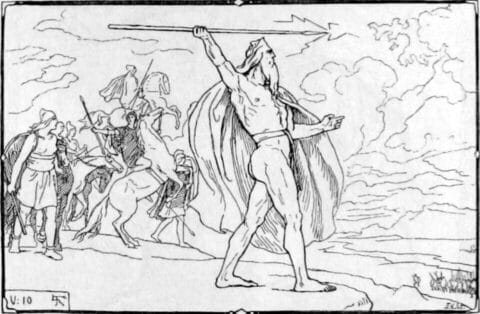
The dwarves also created Gungnir, a spear intended for Odin, and Skíðblaðnir, a ship destined for Freyr.
Gungnir could not be stopped in its thrust. Skíðblaðnir always had a favourable wind whenever its sail was raised, regardless of the direction it travelled. Although the ship could be folded like cloth and carried in a pouch, it was large enough to accommodate all the Æsir, together with their weapons and war gear.
The sons of Ivaldi are also credited with making Skíðblaðnir in Grímnismál, stanza 43 of the Poetic Edda. That poem names the craftsmen but does not recount Loki’s wager.
Loki’s Wager with Brokkr and Sindri
Loki wagered his head with a dwarf named Brokkr, betting that Brokkr’s brother, Sindri, could not produce three treasures equal in value to those made by the sons of Ivaldi.
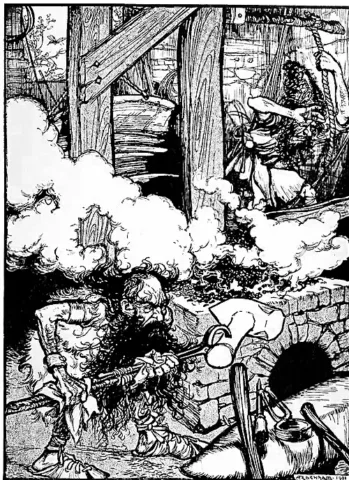
The brothers went to their forge. Sindri handled the metalwork while Brokkr operated the bellows. Sindri instructed him to maintain the airflow until each object was removed from the furnace, since an interruption could spoil the work.
The smith’s name varies between medieval manuscripts of the Prose Edda. Codex Wormianus calls him Eitri, while Sindri appears as a later addition in Codex Regius. Other manuscript versions leave the brothers unnamed. Both names refer to the same craftsman, called Sindri throughout this account.
How the Dwarves Forged Mjölnir
Sindri began by placing a pigskin in the furnace, leaving Brokkr to work the bellows. While the smith was away, a fly landed on Brokkr’s hand and stung him. He endured the sting without stopping, and Sindri returned to remove a boar with a golden mane and bristles.
For the second treasure, Sindri placed gold in the furnace. The fly returned and bit Brokkr’s neck, more painfully than before. Brokkr kept the bellows working, allowing his brother to complete a golden ring called Draupnir.
The final treasure required iron. Sindri warned Brokkr that the work would be spoiled if the airflow stopped.
This time, the fly landed between Brokkr’s eyes and stung his eyelid. Blood ran into his eye, blinding him momentarily. As he reached to brush the insect away, the bellows went slack.
Sindri returned and found that the interruption had nearly ruined his work. He removed a hammer from the furnace, but its handle was shorter than intended. The hammer was Mjölnir.
The first two stings had failed to interrupt Brokkr’s work. Only the third disrupted the forging, leaving the hammer with its one recorded defect.
Modern retellings often identify the fly as Loki in disguise, although Snorri never explicitly reveals its identity.
Sindri handed the three treasures to Brokkr and sent him to Asgard to claim his winnings.
The Six Treasures and the Gods Who Received Them
When Loki and Brokkr presented their treasures, Odin, Thor, and Freyr were chosen to judge the contest.
Loki gave Gungnir to Odin, Sif’s replacement hair to Thor, and Skíðblaðnir to Freyr.
Brokkr presented Odin with Draupnir, a golden ring that produced eight rings of equal weight every ninth night. Freyr received a golden-bristled boar, identified elsewhere in the Prose Edda as Gullinbursti. It could travel through air and water faster than any horse, while its shining mane and bristles provided light even in complete darkness.
Finally, Brokkr gave Mjölnir to Thor. The hammer could deliver powerful blows without failing, never miss its target when thrown, and always return to Thor’s hand. It was also small enough to carry inside his clothing.
The judges declared Mjölnir the finest of the six treasures. Despite its short handle, it offered the gods their strongest defence against the frost giants. Brokkr had won Loki’s wager.
Read Also
Thor: Norse God of Thunder, Mjölnir and Viking-Age Worship
Discover Thor’s role in Norse mythology, his famous hammer, battles with giants, and importance in Viking-Age religion.
Loki in Norse Mythology: Trickster, Shapeshifter, Enemy of the Gods
Explore Loki’s shifting roles as a companion, deceiver, and troublemaker whose actions repeatedly change the fate of the gods.
Idunn: The Norse Goddess Who Kept the Gods Young
Follow another story in which Loki causes a crisis among the gods and must find a way to put things right.
How Loki Lost the Wager but Kept His Head
After Brokkr won the contest, Loki offered to buy back his head, but the dwarf refused.
Loki challenged Brokkr to catch him, then escaped using shoes that allowed him to travel through the air and over water. Brokkr asked Thor for help, and Thor captured Loki and brought him back.
As Brokkr prepared to behead him, Loki argued that the wager entitled the dwarf to his head, but not his neck. Since removing the head would also require cutting through the neck, Brokkr could not claim his prize without violating the agreement.
Instead, Brokkr decided to sew Loki’s mouth shut. He tried to pierce Loki’s lips with a knife, but the blade would not cut. When he called for his brother’s awl, the tool appeared and pierced the lips. Brokkr then stitched them together with a leather thong called Vartari.
The story ends with a reference to the stitched edges being torn. The Old Norse wording leaves it unclear exactly what was torn and by whom, so the account does not establish how long Loki’s mouth remained sewn shut.
Academic Sources & Primary Norse Texts
This article is based primarily on Snorri Sturluson’s account of the dwarven craftsmen and the creation of Mjölnir in Skáldskaparmál. Related passages from the Poetic Edda, critical editions, and modern academic studies provide additional context for the six treasures and their place in Norse mythology.
Primary Sources & Critical Editions
01
Snorri Sturluson, edited by Anthony Faulkes (1998)
Viking Society for Northern Research, University College London. Chapter 35 is the principal surviving account of Sif’s golden hair, Loki’s wager with Brokkr, the forging of Mjölnir, the six treasures, and Loki’s punishment.
02
Snorri Sturluson, translated by Arthur Gilchrist Brodeur (1916)
The Prose Edda: Skáldskaparmál
English translation, chapter 35. Provides the complete narrative of the contest and the descriptions of the treasures, including the short handle of Mjölnir and the dispute over Loki’s head.
03
Snorri Sturluson, edited by Anthony Faulkes (2005)
Edda: Prologue and Gylfaginning
Second edition, Viking Society for Northern Research. Provides additional descriptions of Skíðblaðnir, the golden boar Gullinbursti, and other objects associated with the Norse gods.
04
Henry Adams Bellows, translator (1923)
Stanza 43 credits the sons of Ivaldi with making Skíðblaðnir for Freyr. It offers an additional Old Norse literary reference to the craftsmen without recounting Loki’s wager.
Modern Academic Scholarship
05
John Lindow (2002)
Norse Mythology: A Guide to the Gods, Heroes, Rituals, and Beliefs
Oxford University Press. A major academic reference for Thor, Loki, dwarven craftsmen, divine weapons, and the mythological traditions preserved in Old Norse literature.
06
John Lindow (2021)
Oxford University Press. Examines the surviving mythological sources, their medieval transmission, and the differences between individual Norse traditions.
07
Margaret Clunies Ross (1994)
Prolonged Echoes: Old Norse Myths in Medieval Northern Society, Volume 1: The Myths
Odense University Press. A scholarly study of the social structures, relationships, conflicts, and cultural assumptions represented in Old Norse mythological narratives.
08
Heimir Pálsson, editor, and Anthony Faulkes, translator (2012)
Viking Society for Northern Research. A scholarly edition of the Uppsala manuscript, useful for understanding textual variation within the medieval transmission of Snorri’s Edda.
RESEARCH & SOURCE NOTE
The account of Loki’s wager and the forging of Mjölnir comes primarily from Skáldskaparmál, written down in thirteenth-century Iceland. Other texts preserve related details, but not necessarily the complete story. Manuscript differences, including the names Sindri and Eitri, are treated separately from the narrative itself. The popular identification of the fly as Loki in disguise is not stated explicitly in Snorri’s account.
Copyright & Editorial Notice
© 2026 History & Myths. All rights reserved for the original written content, analysis, and editorial presentation of this article.
This article is an independent educational retelling and examination of the surviving Old Norse account of Mjölnir’s creation. It draws on primary medieval texts and modern academic scholarship while distinguishing documented source details from later interpretations.
The underlying ancient myths and historical facts are not claimed as proprietary material. Modern translations, scholarly editions, and other third-party works remain subject to their respective copyrights and licenses.