Mieza: Was This Where Aristotle Taught Alexander the Great?
Alexander the Great did not receive all of his education at the Macedonian court. According to Plutarch, Philip II brought Aristotle to Macedonia and gave him a place near Mieza where he could teach the young prince. Plutarch calls it the “precinct of the Nymphs” and says that, centuries later, visitors were still shown stone seats and shaded walks associated with Aristotle.
For a long time, that passage was the main clue to the setting of Alexander’s education. Archaeology has since added a much larger picture. At Mieza, near modern Naousa in northern Greece, excavations have revealed a major fourth-century gymnasium with exercise grounds, colonnades, dining rooms, and spaces used for instruction and communal life. Its date, scale, and apparent connection with the Macedonian court have strengthened the case that it formed part of the environment in which Alexander was educated.
The evidence, however, does not identify Aristotle’s exact classroom or connect any surviving object directly to Alexander. The real question is how closely the archaeological remains at Mieza match the place remembered by the ancient sources.
What Plutarch Actually Says About Aristotle at Mieza
The fullest surviving ancient account comes from Plutarch’s Life of Alexander. He says that Philip II wanted a teacher of exceptional standing for his son and summoned Aristotle to Macedonia.
For the place of instruction, Plutarch is unusually specific: Philip assigned Aristotle and Alexander the “precinct of the Nymphs near Mieza.” He adds that the stone seats and shaded walks connected with Aristotle could still be seen in his own day. This passage is the foundation for the long-standing association between Mieza and Alexander’s education.
Plutarch is also useful because he tells us something about the purpose of that education. Aristotle taught Alexander ethics and politics and introduced him to more advanced forms of learning. The details of those subjects belong later in the article, but the passage makes clear that this was not simply elementary tutoring.
There is an important limitation. Plutarch wrote roughly four centuries after Alexander’s youth. His biography is an essential ancient source, but it is not a contemporary record of what happened at Mieza.
He also never says that Aristotle taught inside a building called the Royal Gymnasium. His description gives us a place, Mieza, and a sacred precinct associated with the Nymphs, but not the layout of the educational complex.
That leaves archaeology with the key problem: what fourth-century setting existed at Mieza that could match the educational environment described in the literary tradition?
The Nymphaeum and the Problem of Aristotle’s “School”
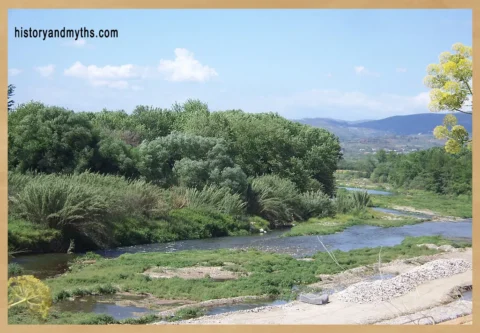
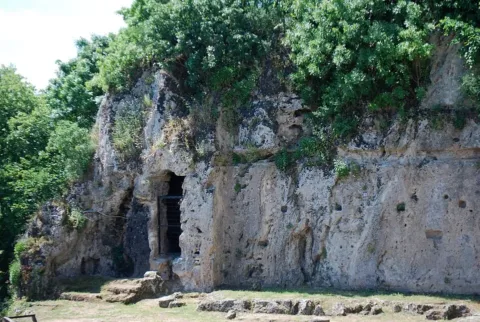
For decades, the place most closely identified with Aristotle’s school was the Nymphaeum at Isvoria, west of ancient Mieza. The setting fits Plutarch’s description unusually well. Three natural caves stand beside springs and dense vegetation, while an abandoned limestone quarry was transformed into a sanctuary of the Nymphs during the fourth century BC. An L-shaped portico, about 80 square metres in area, was later built in front of the caves.
When archaeologist Fotis Petsas excavated the site in the 1960s, he identified it with the place described by Plutarch and interpreted the portico as a setting for Aristotle’s lessons. The connection was reasonable: Plutarch places Alexander’s education in a precinct of the Nymphs near Mieza, and the landscape at Isvoria closely matches that description.
The problem is scale. The Nymphaeum contains a sanctuary and a modest portico, but not the facilities expected for the sustained education and training of a group of royal and aristocratic youths. There is no palaestra, stadium, large exercise portico, or substantial complex of teaching and communal spaces. Archaeologist Angeliki Kottaridi has therefore argued that the Nymphaeum should not be treated as the entire educational institution.
That does not remove it from the story. It remains a fourth-century sanctuary of the Nymphs in the landscape associated with Aristotle at Mieza and may have formed part of the setting remembered by Plutarch. The larger institutional setting appears to have been nearby.
The Royal Gymnasium of Mieza
Northeast of Mieza’s ancient theatre lies a much larger complex that is now identified as a gymnasium dating to the reign of Philip II. Earlier interpretations had proposed an agora or a sanctuary of Asclepius, but later research changed that picture.
The scale is striking. The gymnasium covered roughly 3.5 hectares, of which only about 0.6 hectares have been excavated. Along its northern side ran a covered Doric portico nearly 200 metres long, identified as a xystos, with a palaestra of about 4,000 square metres nearby.
The complex was also more elaborate than a simple athletic facility. Eleven rooms along the palaestra have been identified as banqueting halls, and other parts of the site were associated with instruction and communal activity. Limestone masonry, marble thresholds, pebble floors, and painted plaster closely resemble features found in the royal palace at Aigai, pointing to a connection with the Macedonian court.
This combination of date, scale, architecture, and function is why the Royal Gymnasium has become central to the study of Alexander’s education at Mieza. It provides the kind of institution that the smaller Nymphaeum alone could not.
What the 2024–2026 Excavations Have Revealed
Excavations begun in 2024 have clarified how the eastern side of the Mieza complex was used. The most important development is the identification of a Didaskaleion, a teaching area beside the palaestra. Rooms interpreted as lecture spaces include stone benches built along their walls, providing direct archaeological evidence that formal instruction took place within the gymnasium.
The excavations have also produced four writing styluses, along with pottery, coins, and architectural material. The styluses are a small but useful detail: they show that writing formed part of activity at the site, although none can be connected to Aristotle, Alexander, or any named student.
In 2026, work in the Didaskaleion uncovered a three-part suite covering more than 160 square metres. A central vestibule opened into two andrones, or formal dining rooms, with mosaic floors and raised platforms for couches. Each could accommodate ten couches, showing that communal dining was built into the life of the institution.
The significance of the recent excavations is therefore not that a previously unknown gymnasium suddenly appeared. The complex was already known. What has become clearer is its educational character: Mieza contained spaces specifically suited to teaching as well as training and communal life.
Was This Really the School of Aristotle and Alexander?
No inscription has been found saying that Aristotle taught Alexander inside the Royal Gymnasium. The identification rests instead on several independent pieces of evidence that converge on the same place.
The chronology fits: the complex belongs to the reign of Philip II, when Aristotle was brought to Macedonia to educate Alexander. The location fits as well. Plutarch names Mieza, while archaeology has uncovered there both the sanctuary landscape associated with the Nymphs and a large gymnasium equipped for the education and training of elite youths.
Its apparent connection with the Macedonian court strengthens the case further. The scale and quality of the complex, together with the teaching spaces revealed by recent excavation, make it a strong candidate for the institution in which Alexander and other young nobles were educated.
But the distinction between identification and proof remains important. No surviving inscription names Aristotle in the gymnasium, no room can be demonstrated to have been his classroom, and no object from the site can be assigned personally to Alexander.
The Royal Gymnasium is therefore best understood as the strongest archaeological candidate for the institutional setting of Alexander’s education at Mieza. The evidence supports the identification as a whole, even though it cannot yet connect Aristotle or Alexander to a specific room within the complex.
Read Also
- Greek Philosophy: How Socrates, Plato, and Aristotle Changed Thinking
- How Greek Students Learned in Ancient Greece Step by Step
- What If Alexander the Great Had Lived 20 Years Longer?
What Education at Mieza May Have Looked Like
Mieza was not a school in the modern sense. The Royal Gymnasium brought together different parts of elite Macedonian education: intellectual instruction, physical training, communal life, and preparation for the responsibilities expected of young men close to the royal court.
Teaching did not have to remain inside a fixed classroom. The Didaskaleion shows that the complex included dedicated spaces for instruction, while its porticoes and other shared areas could also support discussion and study.
Physical training was built into the institution. The palaestra and nearly 200-metre xystos provided space for regular exercise, an important part of the education of young Macedonian aristocrats whose future roles were closely tied to military and court service.
Communal dining formed another part of that environment. The andrones show that students were not simply trained as individuals. They also learned within a social setting shaped by hierarchy, shared meals, and the relationships of the Macedonian elite.
What archaeology cannot give us is Alexander’s personal schedule. We do not know how long he spent with Aristotle each day, where particular subjects were taught, or how every part of the complex was used during his years at Mieza. What the site does reveal is the kind of institution in which his education took place.
What Did Aristotle Actually Teach Alexander?
The exact curriculum Aristotle gave Alexander has not survived. Ancient sources identify some areas of study, but not enough to reconstruct a complete syllabus.
Plutarch is clearest about ethics and politics. He also says Aristotle introduced Alexander to more advanced teachings intended for students prepared for deeper philosophical study. Plutarch refers to these as acroamatic or epoptic teachings, but he does not explain exactly what Alexander studied under those headings.
Literature was another important part of Alexander’s education. Plutarch says Aristotle encouraged his interest in Homer and that Alexander particularly valued the Iliad. He also preserves the tradition that Aristotle prepared a corrected or annotated copy of the poem for him, which Alexander later kept during his campaigns.
Modern accounts often extend Alexander’s curriculum to subjects such as medicine, zoology, geography, rhetoric, logic, and natural science. Those fields belonged to Aristotle’s intellectual world, and some may have formed part of Alexander’s education. The surviving evidence, however, does not allow us to treat Aristotle’s entire range of interests as Alexander’s personal syllabus.
Plutarch later describes Alexander as interested in medicine, reading, and philosophy, but those later interests cannot be traced securely to individual lessons at Mieza.
What can be said with more confidence is that Philip II did not bring Aristotle to Macedonia simply to provide basic tutoring. Alexander was being educated as a future king, and the subjects most clearly attested, ethics, politics, literature, and advanced philosophical discussion, were suited to shaping judgment as well as knowledge.
Who Studied With Alexander at Mieza?
Alexander was not educated entirely alone. Modern scholarship describes him studying at Mieza with a group of young Macedonian Companions, away from their families and the court at Pella. These were members of the aristocratic world in which Alexander would later build his military and political career.
What we do not have is a reliable class list. Ancient sources do not name every young noble who studied under Aristotle at Mieza, which makes many of the familiar modern lists more confident than the evidence allows.
Hephaestion is often placed among Alexander’s fellow students because he was close to Alexander from an early age and belonged to the same courtly generation. But no major surviving ancient source explicitly states that Hephaestion attended Aristotle’s lessons at Mieza. His presence is plausible rather than demonstrated.
The same caution applies to other famous Macedonians later associated with Alexander. Some may well have shared this period of education, but being part of Alexander’s later circle is not proof that they studied under Aristotle.
What can be said securely is that Alexander’s education took place within a group of elite Macedonian youths, not as a private intellectual retreat between one prince and one philosopher. The exact membership of that group remains uncertain.
What We Know, What We Infer, and What We Still Do Not Know
By this point, the evidence can be separated fairly clearly.
What We Know
Plutarch places Aristotle and Alexander at Mieza, in a precinct of the Nymphs provided by Philip II. Archaeology also confirms that Mieza contained a large fourth-century gymnasium with facilities for training, instruction, and communal life.
What the Evidence Strongly Suggests
The Royal Gymnasium is the strongest known candidate for the institution connected with Alexander’s education. Its date, location, scale, and function all fit the historical setting. The nearby Nymphaeum may have formed part of the same wider landscape described by Plutarch.
What We Still Cannot Prove
No inscription identifies a room as Aristotle’s classroom, and no object from the site can be securely linked to Alexander. We also cannot reconstruct his daily routine, identify every student who studied there, or determine exactly how the Nymphaeum and gymnasium were used together.
The case for Mieza therefore rests on several lines of evidence that reinforce one another, not on a single decisive discovery.
Conclusion
Mieza gives us something rare: a place where an ancient account of Alexander’s education can be tested against a real fourth-century landscape.
Plutarch preserves the tradition that Aristotle taught Alexander there. Archaeology has now revealed a royal-scale gymnasium that fits the time, setting, and educational world of Philip II’s court. The connection is strong, even if no single room or object can yet be tied directly to Aristotle or Alexander.
Future excavations may clarify that relationship further. For now, Mieza offers the best archaeological setting we have for understanding where Alexander was educated before he became king.
Academic & Primary Sources
- Plutarch, Life of Alexander, Chapter 7.
Primary ancient source for Philip II’s appointment of Aristotle, the “precinct of the Nymphs near Mieza,” and Plutarch’s account of Alexander’s education in ethics, politics, and advanced philosophical teachings.
Perseus Digital Library, Tufts University
- Daniel Ogden, “Alexander’s Birth and Childhood.”
In The Cambridge Companion to Alexander the Great, Cambridge University Press, 2024. Reviews the surviving evidence for Alexander’s early life and education, including the problems involved in separating historical material from later tradition.
Cambridge University Press
- Thomas R. Martin and Christopher W. Blackwell, Alexander the Great: The Story of an Ancient Life.
Cambridge University Press, 2012. Provides a modern scholarly reconstruction of Alexander’s youth and describes his period of study with Aristotle and a group of Macedonian Companions at Mieza.
Cambridge University Press
- Angeliki Kottaridi, study of the Royal Gymnasium at Mieza.
Archaeological analysis arguing that the monumental gymnasium northeast of the theatre, rather than the Nymphaeum alone, provides the most plausible institutional setting for the education of Alexander and other Macedonian elites.
Research profile and papers, Hellenic Ministry of Culture
- Hellenic Ministry of Culture, Mieza excavation program.
Official archaeological source for the recent excavation of the gymnasium and Didaskaleion, including teaching rooms, stone benches, dining spaces, mosaics, and other finds from the 2024–2026 campaigns.
Hellenic Ministry of Culture