Matres and Matronae: Celtic Mother Goddesses in Roman Europe
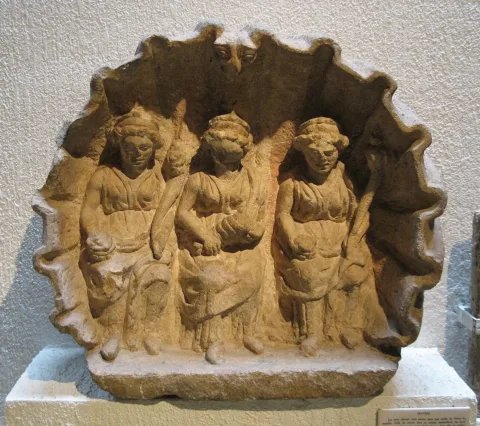
Across Roman Gaul, the Rhineland, and Britain, people worshipped divine mothers known as the Matres and Matronae. These were not simply three goddesses with a shared identity or mythology. Inscriptions reveal numerous local groups, often distinguished by names associated with particular places or communities. Their surviving monuments frequently depict three seated women holding baskets of fruit, bread, or other offerings.
The Matres and Matronae are commonly associated with motherhood, fertility, abundance, and protection, although their precise roles varied and cannot always be established. Their worship developed within the religious landscape of the Roman Empire, where Celtic, Germanic, and Roman traditions interacted. Unlike many better-known ancient deities, they left no surviving body of mythology. Most of what we know comes from votive inscriptions, altars, and sculptures, which reveal both the widespread importance of these mother goddesses and the distinctive local identities behind their names.
Who Were the Matres and Matronae?
Most surviving evidence for the Matres and Matronae dates to the second and third centuries CE, when worshippers across the northwestern Roman provinces erected inscribed altars and reliefs in their honour. These monuments often record the fulfilment of religious vows, sometimes identifying both the dedicant and the particular group of goddesses addressed.
Despite their maternal titles, worship of these deities was not confined to women or domestic life. Their devotees included men and women, civilians, soldiers, and military officials. Some made dedications on behalf of their families, while others honoured the goddesses through the established religious practices of Roman provincial society. Latin inscriptions and conventional votive formulas could therefore accompany the worship of deities whose names and associations remained distinctly local.
Matres, Matrae, and Matronae: Names and Differences
The names Matres and Matronae come from related Latin terms. Matres means “mothers,” while Matronae means “matrons,” traditionally married women of recognized social standing. A third form, Matrae, occurs chiefly in inscriptions from southern Gaul. Because votive dedications address the goddesses directly, these names frequently appear in the dative plural: Matribus, Matronis, and Matrabus, respectively.
Their use varied geographically. Matronae was particularly common in northern Italy and the Lower Rhine, especially in the territory of the Ubii. Matres was widespread in Britain and Gaul, while Matrae was concentrated in southern Gaul. The distinction was not absolute. An inscription from Bonn (CIL XIII 8021) addresses the Matribus sive Matronis Aufaniabus domesticis. The word sive, meaning “or,” shows that the dedicant treated Matres and Matronae as interchangeable titles for these particular goddesses.
Indigenous languages also shaped their names. A dedication from Glanum in southern Gaul reads Matrebo Glaneikabo, meaning “to the Mothers of Glanum.” Although written in Greek letters, the inscription is Gaulish. Its dative plural ending -bo differs from the Latin -bus, providing direct evidence of mother-goddess worship expressed in a local Celtic language.
Were the Matres and Matronae Celtic or Germanic?
The Matres and Matronae cannot be classified as exclusively Celtic or Germanic. Their worship developed across communities with different linguistic and cultural backgrounds, particularly in the Rhineland, where indigenous traditions interacted under Roman rule.
The Ubii, a people generally classified as Germanic, provide a revealing example. Their territory along the Lower Rhine has yielded numerous dedications containing both Celtic and Germanic elements. The name Matronae Bergniahenae, for instance, has been interpreted as combining the Celtic root bergo- (“mountain”) with the Germanic suffix -iahenae. Similar linguistic combinations occur in other divine epithets, although some roots are shared by both languages and cannot be assigned securely to either. Such names reveal cultural contact without necessarily establishing the ethnic identity of the worshippers or the origins of the goddesses themselves.
Roman influence shaped how these cults were recorded and practised. Latin inscriptions, stone altars, and conventional votive formulas accompanied the worship of deities bearing indigenous names. The surviving evidence thus documents local religious traditions operating within Roman provincial society, but it does not establish whether all the mother-goddess cults descended from a common pre-Roman tradition.
Where Were the Mother Goddesses Worshipped?
The largest concentration of Matronae dedications comes from the Lower Rhine, particularly around Cologne, Bonn, and the Eifel region of modern Germany. The Roman province of Germania Inferior was a major centre of their worship, with hundreds of inscribed monuments and several excavated sanctuaries. Many belonged to the former territory of the Ubii, although the cult extended into neighbouring regions.
In Gaul, the Matres are attested across several provinces, from the Mediterranean south to northern Gaul. Inscriptions from Nîmes and Glanum provide important evidence from Gallia Narbonensis. Dedications also survive in northern Italy, while more scattered examples occur in Hispania and Rome.
Roman Britain preserves substantial evidence from both military and civilian communities. Along the northern frontier, altars dedicated to the Mothers have been discovered at Vindolanda, Carrawburgh, and other forts near Hadrian’s Wall. Farther south, London has yielded an inscribed dedication, while sculptures and an altar associated with the mother goddesses were found at Cirencester.
A particularly revealing altar from York (RIB 653) honours the African, Italian, and Gallic Mothers. Its dedicator, Marcus Minucius Audens, was a soldier and gubernator (pilot) of the Sixth Legion Victrix. The inscription demonstrates how deities associated with different regions could receive worship far from those regions, particularly within the mobile communities of the Roman army.
The geographical record remains uneven. Areas with numerous surviving altars reveal important centres of worship, but their concentration cannot establish how widely the goddesses were honoured in places where fewer monuments survive.
Local Names and Epithets of the Matres and Matronae
Many dedications to the Matres and Matronae include epithets identifying particular groups of goddesses. Some names refer to settlements or communities, others suggest a connection with the home, and several remain difficult to interpret linguistically.
In the Rhineland, the Matronae Aufaniae received numerous dedications at Bonn and Nettersheim, while the Matronae Vacallinehae were especially prominent at the sanctuary of Pesch. Both groups had established centres of worship, but the precise meanings of their names remain disputed. Their inscriptions provide clearer evidence of local religious importance than the competing interpretations of their epithets.
Other names are easier to understand. A Gaulish inscription from Nîmes addresses the Matrebo Namausikabo, meaning “to the Mothers of Nemausus,” linking the goddesses directly to the settlement. The Matres Domesticae, or Mothers of the Home, are attested in Britain and Germany. At Catterick, Julius Victor dedicated an altar to them and recorded the fulfilment of his vow (RIB 3210).
A dedication from Binchester preserves another distinctive title. Pomponius Donatus, a military official serving the provincial governor, honoured Jupiter and the Matribus Ollototis sive Transmarinis (RIB 1030). The Latin sive, meaning “or,” identifies the Ollototae with the Mothers from overseas. The inscription establishes this association but does not specify where the goddesses were believed to have originated.
The Triple Images and Symbols of the Mother Goddesses
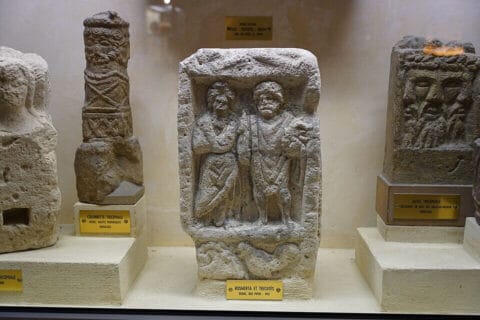
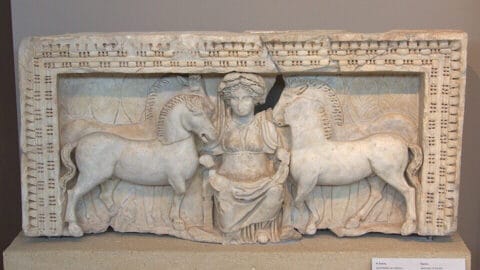
The most recognizable representations of the Matres and Matronae show three women seated side by side, sometimes within an architectural niche. In Rhineland reliefs, the two outer figures commonly wear large, rounded headdresses associated with the traditional dress of Ubian women, while the central figure has uncovered, flowing hair. This difference has been interpreted as a distinction in marital status, although the sculptures do not establish what the arrangement was intended to signify.
The goddesses frequently hold baskets of fruit, loaves of bread, ears of grain, or cornucopias, imagery associated with nourishment and abundance. Some representations emphasize motherhood more directly. A limestone relief from Cirencester shows three seated Matres, one holding a swaddled infant, while other examples depict women nursing children. Regional artistic traditions also differed: the distinctive Ubian headdresses of Rhineland monuments do not appear in the surviving British representations.
Groups of three were common but not universal. A third-century limestone relief from Roman London depicts four seated mother goddesses holding, from left to right, bread and fruit, a nursing infant, a dog, and a basket of fruit. The sculpture was later reused in London’s riverside wall during the 270s or 280s CE. Individual goddesses, pairs, and larger groups are also attested, demonstrating that the triple arrangement was not the only accepted form of representation.
Worship, Votive Altars, and Sacred Sites
Worship of the Matres and Matronae is documented through inscribed altars, votive monuments, and excavated sanctuaries. Dedications commonly recorded the worshipper’s name, the goddesses addressed, and the fulfilment of a vow. The Latin formula votum solvit libens merito (VSLM) indicated that a vow had been willingly and deservedly fulfilled. At Ribchester in Roman Britain, an altar dedicated to the Mothers records a vow made by a woman named Marulla (RIB 3183).
Several sanctuaries have been excavated in the Rhineland. At Nettersheim, the sanctuary of the Matronae Aufaniae occupied a walled enclosure containing three buildings. Votive monuments stood around the main temple, including one dedicated by Marcus Pettronius Patroclus, a beneficiarius serving on the provincial governor’s staff. Excavations also uncovered ash-filled pits from an earlier phase, indicating that offerings had been burned at the site before the stone temples were built. At Pesch, the sanctuary of the Matronae Vacallinehae yielded numerous votive inscriptions and evidence of successive building phases. Bonn was another major centre of Aufaniae worship, although the location of its principal sanctuary remains unidentified.
Some dedications record the construction of religious buildings. At Dover, Olus Cornelius Candidus, a strator consularis attached to the governor’s staff, stated that he had built a shrine for the Matres Italicae (RIB 3031). Such inscriptions document acts of devotion, while archaeological remains provide additional evidence of offerings and sacred spaces. The precise ceremonies performed at individual sanctuaries, however, are only partly recoverable.
What Did the Matres and Matronae Represent?
Motherhood, fertility, and abundance were central associations of the Matres and Matronae. Their maternal titles and depictions of nursing women or infants suggest a concern with childbirth and the care of children. Fruit, grain, and other offerings evoke nourishment and prosperity, although these images alone cannot establish the specific powers attributed to each group.
Votive inscriptions provide more direct evidence of their protective role. At Catterick, a dedication to the Matres Domesticae includes the phrase pro se et suis, meaning “on behalf of himself and his family” (RIB 3210). Another from Binchester uses pro salute sua et suorum, explicitly invoking the welfare of the worshipper and his household (RIB 1030). These formulas show that devotees sought the goddesses’ favour for their families, not merely for matters of childbirth or fertility.
Some representations suggest an additional association with fate. Reliefs depicting a swaddled infant alongside scales and an open scroll have been interpreted as combining the Matres or Matronae with the Roman Parcae, goddesses who governed human destiny. The scroll may represent the recording of a child’s fate, while the scales evoke its determination. This interpretation reflects a particular fusion of provincial and Roman religious imagery rather than an established function of every mother-goddess cult.
Read Also
Were the Matres and Matronae the Celtic Triple Goddess?
The Matres and Matronae are sometimes linked to the Triple Goddess of modern Paganism, represented by the Maiden, Mother, and Crone. In this model, a single goddess embodies three stages of a woman’s life, often associated with the phases of the moon. The concept was popularized during the twentieth century, particularly through Robert Graves’s The White Goddess (1948), and later influenced Wicca and other modern Pagan traditions.
Ancient evidence does not support identifying the Matres and Matronae with this model. No surviving inscription assigns them the roles of Maiden, Mother, and Crone. In Rhineland sculptures, the contrast between the uncovered hair of the central figure and the headdresses of her companions may indicate differences in marital status, but it does not establish three successive stages of life.
The inscriptions also identify distinct local groups rather than three aspects of a universal deity. Although triple representations were common in ancient Celtic religious imagery, interpreting the Matres and Matronae through the modern Maiden, Mother, and Crone framework goes beyond what the historical evidence can demonstrate.
Conclusion
The Matres and Matronae are known chiefly through the people who honoured them. Their altars reveal where worshippers made dedications, which goddesses they invoked, and sometimes whose welfare they sought. Local epithets and regional differences in sculpture show that these divine mothers did not possess a single, fixed identity across Roman Europe.
What the monuments rarely reveal is how devotees understood the goddesses’ individual characters or explained their powers through stories. Their religious significance is therefore best understood through the surviving evidence of local worship, rather than attempts to reconstruct a shared mythology.
Academic Sources & Primary Texts
Academic Studies
- Rives, James. “Deae Matres.” Oxford Classical Dictionary. Oxford University Press, 2015.
Oxford Academic. - Spickermann, Wolfgang. “Nouvelles réflexions relatives à la genèse et aux vecteurs du culte matronal dans la région du Rhin Inférieur.” Cahiers du Centre Gustave Glotz 13 (2002): 141–167.
Read study. - Vágási, Tünde. “Did Address Influence Whether Gods Answered Prayers? Preliminary Overview of Vulgar Latin Names of Deities in the Roman Empire.” Acta Antiqua 62, no. 4 (2022): 447–460. Published online 2023.
Read study. - Grüll, Tibor. “‘The Book of Fate’: A Distinctive Representation of Matronae/Parcae and the Spread of Literacy in the Northern Provinces of the Roman Empire.” Religion in the Roman Empire 7, no. 3 (2021): 403–429. Published 2022.
Read study. - Hutton, Ronald. The Triumph of the Moon: A History of Modern Pagan Witchcraft. Oxford: Oxford University Press, 1999.
Oxford Academic.
Primary Inscriptions & Archaeological Evidence
- Roman Inscriptions of Britain, RIB 653. Dedication to the African, Italian, and Gallic Mother Goddesses, York.
View inscription. - Roman Inscriptions of Britain, RIB 1030. Dedication to Jupiter and the Matres Ollototae sive Transmarinae, Binchester.
View inscription. - Roman Inscriptions of Britain, RIB 3210. Altar dedicated to the Matres Domesticae, Catterick.
View inscription. - Roman Inscriptions of Britain, RIB 3031. Altar recording the construction of a shrine to the Matres Italicae, Dover.
View inscription. - Recueil des inscriptions gauloises, RIG G-64. Gaulish dedication to the Mothers of Glanum. University of Cambridge, Department of Anglo-Saxon, Norse and Celtic.
Inscription and translation. - London Museum. Relief of Four Mother Goddesses, Roman London, third century CE. Collection no. 77.58.
Museum record. - Archäologischer Landschaftspark Nettersheim. Das Matronenheiligtum. Archaeological evidence for the sanctuary of the Matronae Aufaniae.
Archaeological site record.
Copyright & Content Notice
© 2026 History & Myths. All rights reserved.
Original article written by H. Moses. Historical interpretations are based on the academic studies, inscriptions, and archaeological evidence cited above. Ancient texts and artifacts are not claimed as original copyrighted material. Images remain subject to their respective licenses and attribution requirements. Unauthorized reproduction of the original article text is prohibited.