Belenus: The Celtic God Linked to Apollo and Healing
Belenus, also known as Belenos or Belinus, was a Celtic god worshipped in parts of the Roman world, particularly in Noricum and the northern Italian city of Aquileia. Roman inscriptions identify him with Apollo, while the historian Herodian describes him as a divine protector of Aquileia during its siege in AD 238. Unlike many figures known through surviving mythological narratives, Belenus is documented primarily through inscriptions, religious dedications, and accounts written by Roman authors.
Belenus is commonly described as a god of sunlight and healing, but the historical evidence is more complicated. His identification with Apollo is firmly established, and dedications associated with springs and nymphs suggest a connection with water. Whether he was primarily a solar deity remains uncertain, while the often-repeated association with the Irish festival Beltane lacks direct historical confirmation.
Who Was Belenus in Celtic Religion?
Belenus belonged to the religious traditions of the Celtic-speaking communities of continental Europe. His worship was especially prominent among the Norici of the eastern Alps and in the northern Adriatic region, where local religious practices continued under Roman rule.
His importance in Noricum is particularly clear from the writings of Tertullian, a Christian author of the late second and early third centuries AD. In Apologeticum 24.7, Tertullian names Belenus as the god of the Norici, placing him alongside deities associated with Syria, Arabia, and other regions of the Roman Empire. He mentions Belenus again in Ad Nationes 2.8. Although Tertullian was criticizing pagan religion rather than documenting its practices, his references show that Belenus was widely recognized as a deity associated with the Norican people.
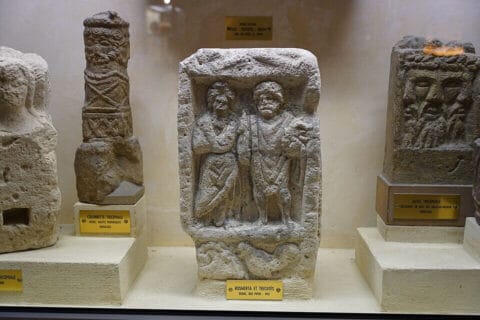
The archaeological evidence gives a different perspective. Inscriptions and remains of sanctuaries show that Belenus received formal dedications and possessed established places of worship. His cult was therefore part of religious life in communities that combined local traditions with Roman institutions. What these records rarely reveal is how worshippers understood his character or what stories they told about him.
The Name Belenus: Meaning and Variations
The god’s name survives in several forms, including Belenus, Belenos, Belinus, and Belinos. These are not necessarily names of different deities. The variations reflect differences in language, pronunciation, and the ways Celtic names were recorded in Latin inscriptions. Belinus was particularly common in Noricum, while both Belinus and Belenus appear at Aquileia. Related forms also appear in Celtic inscriptions and coin legends, although these attestations do not always establish whether the name refers to the deity himself.
The meaning of Belenus remains disputed. A traditional interpretation connects the name with an Indo-European root associated with brightness, producing the familiar translation “the Shining One.” This explanation contributed to his identification as a solar deity. Linguist Xavier Delamarre, however, has connected the name with the Gaulish element belo-, meaning “strong” or “powerful.”
Patrizia de Bernardo Stempel has proposed another derivation, linking the name to an Indo-European root associated with springs. Her interpretation is particularly relevant because inscriptions also connect Belenus with water. Yet neither the traditional explanation nor the alternative derivations have settled the question. The name alone cannot establish whether his worshippers primarily regarded him as a god of sunlight, strength, or sacred waters.
Why Was Belenus Identified with Apollo?
When Roman religious practices spread through Celtic-speaking regions, local gods were sometimes identified with Roman deities whose attributes appeared similar. Scholars call this process interpretatio Romana. It did not necessarily mean that the two gods were identical in every respect. A local deity could acquire a Roman name while retaining an established identity and following.
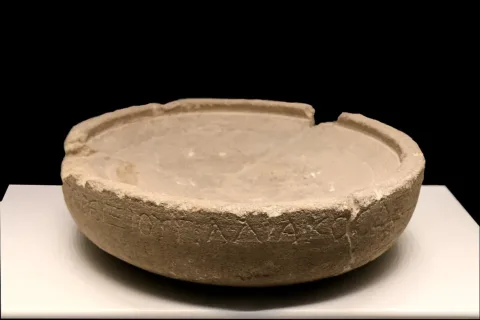
Belenus provides a well-documented example. Several Latin inscriptions from Aquileia address him as Apollo Belenus, combining the Roman god’s name with the Celtic one. A second-century dedication, catalogued as CIL V 8212, was commissioned by a freedman who held a civic religious office in Aquileia. Its surviving inscription identifies the recipient as Apollo Belenus, although the opening letters of Apollo’s name have been restored by editors. Such dedications show that the combined name was used in actual worship, rather than being merely a comparison made by Roman writers.
Why worshippers considered the two gods comparable is less certain. In De Bello Gallico 6.17, Julius Caesar describes Apollo as the deity who drove diseases away among the Gauls. He does not name Belenus, however, and his account cannot establish which local gods he had in mind. The identification with Apollo may reflect overlapping religious functions, but the inscriptions themselves do not explain precisely which attributes worshippers associated with Belenus. The continued use of his Celtic name suggests that his local identity remained important even within a Roman religious setting.
Was Belenus a God of the Sun?
Belenus is frequently described as a Celtic sun god, but the surviving evidence does not establish that solar worship was his principal function. The identification rests largely on interpretations of his name and his association with Apollo, rather than on an ancient account explicitly describing him as ruler of the sun.
In some Greek and Roman traditions, Apollo was identified with Helios, the sun god.
Yet a Celtic deity identified with Apollo did not necessarily share every aspect of the Roman god’s character. The surviving dedications to Belenus establish his worship, but they do not clearly explain whether his followers associated him with sunlight, the movement of the sun, or the changing seasons.
The broader evidence for sun worship among the Celts is also difficult to interpret. Classical scholar Andreas Hofeneder, in his study Vestiges of Sun Worship among the Celts (2010), concludes that the limited and ambiguous sources make Celtic religious conceptions of the sun difficult to reconstruct. Belenus may have possessed solar associations, but describing him definitively as a sun god goes beyond what the available evidence can demonstrate.
Belenus, Healing, and Sacred Springs
Belenus is often described as a healing god, but some of the clearest evidence for this interpretation comes from his association with water. Two inscriptions from Aquileia refer to Fons B(eleni), understood as the “spring of Belenus.” One was discovered in the Beligna district, while the other was formerly kept at Monastero. Both originals are now lost, leaving scholars dependent on earlier transcriptions. Another dedication associates Belenus with the Nymphs, divine figures commonly linked to springs and other natural waters.
The local landscape adds weight to this evidence. Mineral and sulphurous waters are documented around Aquileia, particularly near Beligna. Archaeologist Annalisa Giovannini has examined whether these natural resources might help explain the prominence of Belenus’s worship in the area. The possibility of a sacred spring with healing associations is significant, although its precise location and the rituals performed there remain uncertain.
The healing interpretation also draws support from Belenus’s identification with Apollo, but the inscriptions require caution. Historian Marjeta Šašel Kos noted that no dedications explicitly made pro salute, meaning “for health,” had been identified in the evidence she reviewed. A proposed association with Valetudo, the Roman personification of health, is also uncertain because the relevant inscription has competing readings. Healing was therefore a plausible aspect of Belenus’s religious character, even though surviving sources do not describe specific cures or medical ceremonies performed in his name.
The Worship of Belenus at Aquileia and Beyond
Aquileia was one of the principal centres of Belenus’s worship during the Roman period. Numerous inscriptions from the city and its surroundings record dedications made by individuals and local officials. Some address him as Belenus Augustus, reflecting his place within the religious life of a Roman municipality. His cult also attracted imperial recognition: an inscription from Aquileia, partly reconstructed by scholars, records a dedication to Apollo Belenus by the emperors Diocletian and Maximian in the late third century AD.
Evidence for an established sanctuary survives at Iulium Carnicum, modern Zuglio in northeastern Italy. An inscription dating to the second half of the first century BC records that two local officials, Publius Erbonius Princeps and Sextus Votticius Argentillus, paid to restore the temple of Belinus. Both men were freedmen serving as magistri vici, officials of the settlement. They also provided five gilded decorative shields and two statues. The inscription, catalogued as CIL V 1829, shows that Belenus had an organized cult supported by local civic authorities before the height of the Roman Empire.
Across the eastern Alps, dedications to Belinus were concentrated around Magdalensberg and Virunum in Noricum. An altar bearing his name was also discovered at Celeia, modern Celje in Slovenia. At Santicum, near present-day Villach in Austria, a fragmentary inscription has been interpreted as referring to a temple of Belinus.
These finds indicate that his worship extended beyond individual household offerings to established religious sites.
Further evidence comes from Concordia and Altinum in northeastern Italy, while scattered attestations have also been identified in Gaul, the western Alps, and Celtiberia. At Concordia, a small bronze statue of a youthful figure, now lost, reportedly carried a dedication to Belenus on its thigh. The distribution of these finds suggests that his cult spread through communities connected by Alpine trade and travel routes. Whether it first gained prominence in Noricum or around Aquileia, however, remains disputed.
Belenus and the Siege of Aquileia in AD 238
In AD 238, the Roman emperor Maximinus Thrax marched into northern Italy amid a struggle for control of the empire. Aquileia, whose inhabitants supported the Roman Senate against him, closed its gates and prepared to resist. When Maximinus attempted to persuade the citizens to surrender, Crispinus, one of the city’s defenders, urged them to stand firm. Their resistance became the setting for a remarkable account of Belenus’s role as Aquileia’s divine protector.
The historian Herodian, writing in the third century, reports that local diviners interpreted omens and oracles as promises of victory from the city’s patron deity. He calls the god Belis, generally identified with Belenus, and notes that the inhabitants worshipped him with particular devotion and associated him with Apollo. According to Herodian, some soldiers in Maximinus’s army even claimed to have seen the god’s image appearing in the sky and fighting on behalf of Aquileia.
Herodian did not accept these reports without question. He suggested that the soldiers might have invented the story to explain why their much larger army had failed to overcome the city’s defenders. The later Historia Augusta, in its account of Maximinus, explicitly names Belenus as the god whose prophecy foretold the emperor’s defeat. It likewise reports that soldiers attributed their failure to Apollo’s intervention rather than to the defenders themselves.
Aquileia ultimately survived the siege. As supplies dwindled and resentment spread through the besieging army, Maximinus and his son were killed by their own soldiers. The surviving accounts do not establish that Belenus intervened in the fighting, but they provide unusually direct evidence of his importance to the city’s religious identity. During a major political and military crisis, his protection was invoked not simply for individual worshippers, but for Aquileia itself.
Was Belenus Connected to Beltane?
Belenus is frequently linked to Beltane, the Gaelic festival traditionally marking the beginning of summer around May 1. The association comes partly from the resemblance between their names and the festival’s use of fire. Yet no surviving ancient source identifies Beltane as a celebration dedicated to Belenus.
One of the earliest written accounts of Beltane appears in Sanas Cormaic (Cormac’s Glossary), an early medieval Irish text. It describes a custom in which druids lit two fires and drove cattle between them to protect the animals from disease. Some versions of the glossary also explain the festival’s name through a deity called Bel. However, this medieval explanation does not establish that Bel was the same god as Belenus, whose worship is documented principally in continental Europe during the Roman period.
The proposed connection has nevertheless influenced modern interpretations of Celtic religion. Scholars have suggested possible linguistic links between the names, but their origins remain disputed. Historian Marjeta Šašel Kos specifically cautions that the association between Belenus and Beltane is not documented in the surviving sources.
What Survives of Belenus’s Myths and Later Traditions?
No surviving ancient myth describes Belenus’s birth, family, or adventures. References to him concern his worship and the communities associated with his cult rather than a continuous mythological narrative. One revealing testimony comes from the fourth-century poet Ausonius. In Commemoratio Professorum Burdigalensium, he describes the rhetorician Attius Patera as a man whose family was said to descend from druids connected with a temple of Belenus. Ausonius qualifies the claim with the words “if report does not lie,” suggesting that he was repeating a family tradition rather than documenting religious practices he had witnessed.
A much later belief was recorded in the Tolmin region of present-day Slovenia. In 1882, historian Simon Rutar reported that local people spoke of sveti Belin, or “holy Belin,” as a powerful healer whose mysterious “key” could cure blindness. Rutar identified this figure with the ancient Belinus worshipped around Aquileia. The tradition is striking because it preserves a similar name and an association with healing in a region close to one of Belenus’s principal centres of worship.
Historian Marjeta Šašel Kos has suggested that the belief might reflect a survival of Belenus’s cult, transformed through centuries of religious change and contact with Slavic traditions. Such continuity remains a hypothesis, however. The surviving records do not trace an uninterrupted connection between Roman worshippers and the nineteenth-century inhabitants of Tolmin. The account of holy Belin is valuable evidence of later folklore, but it cannot establish what stories ancient devotees told about Belenus.
Academic Sources & Primary Texts
Ancient Texts & Archaeological Evidence
- Tertullian. Apologeticum 24.8 and Ad Nationes 2.8.5.Apologeticum, Latin Text |
Ad Nationes, Book II.Early Christian references identifying Belenus as a deity associated with the Norici. - Julius Caesar. Commentarii de Bello Gallico 6.17.Latin Text and English Translation.Caesar’s description of Apollo as a deity who averts disease among the Gauls. Belenus is not named in this passage.
- Herodian. History of the Roman Empire 8.3.7–9.English Translation, Livius.Account of the siege of Aquileia in AD 238 and reports that the city’s patron deity protected its defenders.
- Historia Augusta. “The Two Maximini,” 22.Latin Text and English Translation.A later account explicitly naming Belenus in connection with a prophecy concerning Maximinus’s defeat.
- Ausonius. Commemoratio Professorum Burdigalensium 4.7–14.
Critical Latin Text.
Fourth-century testimony concerning Attius Patera, his alleged druidic ancestry, and a temple of Belenus.
- Corpus Inscriptionum Latinarum (CIL), V 8212 and V 1829.CIL V 8212, Apollo Belenus at Aquileia |
CIL V 1829, Temple of Belinus at Iulium Carnicum.Epigraphic evidence for the identification with Apollo and the restoration of a sanctuary dedicated to Belinus.
Academic Studies
- Haeussler, Ralph. “Belenus.” In The Encyclopedia of Ancient History, edited by Roger S. Bagnall et al. Wiley-Blackwell, 2012.Scholarly reference on the god’s identity, name variants, and geographical distribution.
- Šašel Kos, Marjeta. “Belenus, Cybele, and Attis: Echoes of Their Cults through the Centuries.” Studia Mythologica Slavica 25 (2022): 227–243.Evidence for Belenus’s worship in the Alpine and Adriatic regions and the possible survival of related traditions.
- Šašel Kos, Marjeta. “Belin.” Studia Mythologica Slavica 4 (2001): 9–16.Discussion of Belenus, sacred springs, disputed interpretations of his functions, and later folklore from the Tolmin region.
- de Cazanove, Olivier. “Apollo nelle Gallie: uno e multiplo.” In Sacrum facere: Apollo, politeismi a confronto, 131–162. Trieste: EUT Edizioni Università di Trieste, 2025.Recent archaeological analysis of Apollo’s identification with local Celtic deities, including Belenus.
- Hofeneder, Andreas. “Vestiges of Sun Worship among the Celts.” In Sun Worship in the Civilisations of the World, edited by Albert J. Gail, 85–107. Prague, 2010.Critical assessment of the limited evidence for solar worship in Celtic religions.
- Hutton, Ronald. “Beltane.” In The Stations of the Sun: A History of the Ritual Year in Britain, 218–225. Oxford: Oxford University Press, 1996.Historical examination of Beltane, its medieval Irish sources, and the interpretation of its seasonal customs.
Copyright & Usage
© 2026 History & Myths. All rights reserved.
Original article written by H. Moses for History & Myths. Unauthorized reproduction or republication of the original text is prohibited. Brief quotations with appropriate attribution and a link to the original article are welcome. Ancient texts, scholarly translations, archaeological photographs, and other third-party materials remain subject to their respective copyright terms and licenses.