Hel: The Norse Ruler of the Dead and Her Underworld
In Norse mythology, Hel is the daughter of Loki and Angrboða and the ruler of a realm that shares her name. According to Snorri Sturluson’s Prose Edda, Odin sent her to Niflheim and gave her authority over those who came to her after death, particularly people who died from sickness or old age. Unlike Valhalla, her realm was not reserved for fallen warriors, but neither was it simply a place of punishment.
Hel’s authority becomes especially important in the story of Baldr. After his death, the gods send Hermóðr to negotiate his return. Hel agrees to release him only if every living and lifeless thing in the world weeps for him. When that condition fails, Baldr remains among the dead.
The name Hel could also designate the realm of the dead, and the poems do not always make clear which meaning is intended. Snorri’s detailed portrait preserves one influential account of Hel, but it cannot be treated as a complete record of how pre-Christian Scandinavians understood death and the afterlife.
Who Was Hel in Norse Mythology?
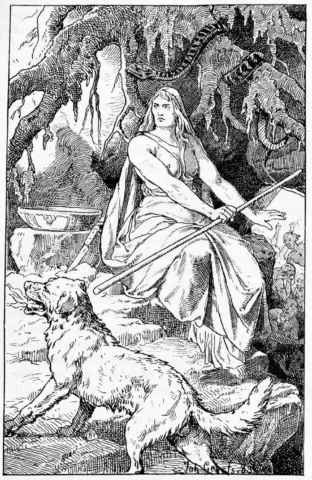
In Gylfaginning, chapter 34, Snorri Sturluson identifies Hel as the daughter of Loki and the giantess Angrboða. She was raised in Jötunheimr alongside her brothers Fenrir, the monstrous wolf, and Jörmungandr, the serpent that encircles the world. Hel was not one of the Æsir. Through her parents and siblings, she belonged to a family whose members were feared by the gods because of prophecies concerning the harm they would cause.
Hel’s identity as Loki’s daughter also appears in Ynglingatal, a skaldic poem traditionally attributed to the ninth-century poet Þjóðólfr of Hvin. In its account of King Dyggvi’s death, Hel is called Loka mær (Loki’s daughter) and jódís Ulfs ok Narfa (sister of the wolf and Narfi). The wolf is understood to be Fenrir, while Narfi, another son of Loki, is her half-brother according to Snorri’s genealogy. The poem portrays Hel as a female figure who claims the dead king.
Although the composition and dating of Ynglingatal remain debated, its references to Hel are significant. They preserve a poetic portrayal of her as Loki’s daughter, distinct from the more elaborate account in Snorri’s Prose Edda. They do not, however, establish how widely the details of her ancestry were known or understood in pre-Christian Scandinavia.
Hel and Helheim: The Ruler and the Realm
In Old Norse literature, Hel can refer to the female ruler of the dead or to the realm bearing her name. The meaning depends on the context. Someone described as going to Hel may simply be entering the world of the dead, without encountering its ruler. Old Norse hel and English hell descend from a common Germanic root associated with concealment, although their religious meanings developed differently.
The name Helheim (Old Norse Helheimr), meaning “Hel’s realm,” is widely used in modern accounts, while Eddic poetry generally uses Hel. In Grímnismál, stanza 31, Hel is said to dwell beneath one of Yggdrasil’s three roots. Baldrs draumar describes Odin riding downward toward Niflhel, passing a hound that emerges from Hel. Snorri’s account of Hermóðr’s journey likewise places the road to the dead through dark valleys, leading downward and northward. These descriptions do not establish a single, consistent geography of the underworld.
Niflhel and Niflheim: Were They the Same Place?
Niflhel, often translated as “Misty Hel,” appears in Vafþrúðnismál, stanza 43. The giant Vafþrúðnir claims to have travelled through nine worlds and refers to a region below Niflhel, where people die out of Hel. The passage suggests a deeper level of the underworld, although its precise nature remains unclear.
Niflheim has a different role in Snorri’s cosmology. In Gylfaginning, chapters 4–5, it is a primordial region of cold, associated with the spring Hvergelmir and the formation of the world. Later, in chapter 34, Odin sends Hel there, connecting this ancient realm with the destination of the dead.
The texts do not explain whether Niflhel and Niflheim were originally understood as separate places or different descriptions of the same region. Their relationship is partly a matter of interpretation, rather than a geographical distinction consistently maintained across the surviving sources.
Why Did Odin Give Hel Authority Over the Dead?
In Gylfaginning, chapter 34, the gods learned from prophecies that Loki’s three children would bring them harm. Odin ordered them taken from Jötunheimr. He cast Jörmungandr into the surrounding ocean, sent Hel to Niflheim, and kept Fenrir among the Æsir until the wolf was eventually bound.
Hel’s removal came with a grant of authority. Snorri states that Odin gave her power over nine worlds and the responsibility of assigning dwellings to those sent to her after death, specifically people who died from illness or old age. Although the reference to nine worlds suggests extensive authority, the duty described concerns the reception of the dead, not the government of the living or the gods themselves.
Snorri does not explain why Odin entrusted this responsibility to someone whose family he feared. His account establishes Hel as a ruler appointed by Odin rather than one who seized control of the underworld.
What Did Hel Look Like?
In Gylfaginning, chapter 34, Snorri Sturluson describes Hel as half blá, a word that can mean dark blue or blue-black, and half the natural colour of human skin. He also characterises her expression as downcast and fierce.
The contrast between her two halves has been interpreted as a representation of life and death, although Snorri offers no such explanation. Modern illustrations often depict Hel as half woman and half skeleton, but the original description mentions neither exposed bones nor a skeletal body.
Her dwelling is equally unsettling. Hel’s hall, Éljúðnir, stands behind exceptionally high walls and large gates. Its furnishings have names associated with deprivation and suffering: her dish is Hungr (Hunger), her knife Sultr (Famine), and her bed Kör (Sickbed). Her servants, Ganglati and Ganglöt, bear names suggesting slowness or inactivity.
These details give Hel’s household its grim character, but no comparably detailed description of her appearance or dwelling survives in the older Eddic poems.
What Was Hel’s Power Over the Dead?
Hel’s authority extended over those who entered her realm, but the sources do not portray her as determining when people died. Snorri gives her responsibility for the dead without describing her as a judge who weighed their deeds or decided their punishment. Her role was therefore distinct from that of a deity who controlled human lifespans or administered moral justice.
The Eddic poem Baldrs draumar, stanzas 6–7, offers a different glimpse of the underworld. Odin learns that benches decorated with rings, a platform adorned with gold, and mead have been prepared for Baldr’s arrival. The poem does not attribute these preparations directly to Hel, but the scene suggests an honoured reception rather than imprisonment or torment.
The clearest demonstration of Hel’s authority comes in Snorri’s account of Baldr, where the gods must seek her permission to bring him back from the dead.
Hel and Baldr: Why Could the Gods Not Bring Him Back?
After Baldr’s death, Frigg sought someone willing to travel to Hel and offer a ransom for his return. In Gylfaginning, chapter 49, Hermóðr undertook the journey on Odin’s eight-legged horse, Sleipnir.
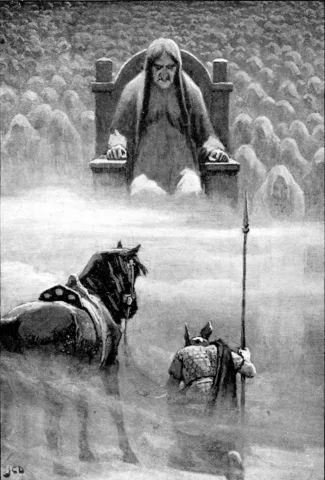
He rode for nine nights through dark valleys before reaching the river Gjöll. Móðguðr, the guardian of its bridge, confirmed that Baldr had already crossed and directed Hermóðr farther north and downward. At Hel’s gates, Sleipnir leapt over the barrier, allowing Hermóðr to reach the hall where Baldr sat in the seat of honour.
After spending the night there, Hermóðr asked Hel to let Baldr return to Asgard, describing the grief his death had caused among the Æsir. Hel replied that Baldr’s reputation for being universally loved must be tested. Every living and lifeless thing in the world would have to weep for him. If even one refused or objected, he would remain with her.
Before Hermóðr departed, Baldr entrusted him with the ring Draupnir to return to Odin, while Nanna sent gifts to Frigg and Fulla. Hermóðr then carried Hel’s terms back to Asgard.
The gods sent messengers throughout the world, and humans, animals, trees, stones, earth, and metals all wept for Baldr. On their return, however, the messengers encountered a giantess named Þökk sitting in a cave. She refused to mourn, declaring that Baldr had brought her no happiness and that Hel should keep him. Snorri adds that people believed Þökk was Loki in disguise, presenting the identification as a supposition rather than an established fact.
Because Hel’s condition was not fulfilled, Baldr remained among the dead. The episode shows the Æsir seeking her consent rather than simply overruling her authority. Although older poems such as Baldrs draumar connect Baldr’s fate with the underworld, the detailed negotiation with Hel survives in Snorri’s Prose Edda.
Hel, Valhalla, and the Norse Afterlife
Hel was one of several destinations associated with the dead in Norse mythology. Odin’s hall, Valhalla (Valhöll), received warriors chosen from those killed in battle. Yet Grímnismál, stanza 14, states that Freyja chose half of the slain for her realm of Fólkvangr, while Odin received the other half. Death in battle did not necessarily mean entering Valhalla.
Other traditions connected the dead with the sea or particular places in the landscape. In Sonatorrek, a poem attributed to the tenth-century skald Egill Skallagrímsson, the grieving father blames the sea goddess Rán for taking his drowned son. Eyrbyggja saga preserves a belief that Þórólfr Mostrarskegg and his relatives would enter the mountain Helgafell after death. These accounts suggest that ideas about the afterlife varied across Norse traditions.
Hel should not be equated with the Christian Hell. In Gylfaginning, chapter 3, Snorri describes wicked people passing through Hel to Niflhel, but elsewhere he associates Hel with those who died from sickness or old age. Baldr also enters her realm without being portrayed as a sinner undergoing punishment. The sources therefore do not support a universal division between a heavenly reward for warriors and eternal torment for everyone else.
Read Also
Hel in Ragnarök and the Return of Baldr
Unlike her brothers Fenrir and Jörmungandr, Hel has no recorded role in the fighting at Ragnarök. In Gylfaginning, chapter 51, Snorri describes Loki arriving at the battlefield accompanied by Heljarsinnar, the people of Hel. He does not say that Hel herself joins them or commands their forces.
Her realm appears again when the world is renewed. In Völuspá, stanza 62, Baldr returns and dwells alongside Höðr, the brother who killed him, in Hroptr’s victory dwellings, Hroptr being another name for Odin. Snorri adds in Gylfaginning, chapter 53, that both brothers emerge from Hel and join the surviving gods at Iðavöllr, where Asgard once stood.
Baldr’s return takes place only after Ragnarök, but neither account explains whether Hel permits his departure or whether the renewal of the world changes the conditions governing the dead. The sources are equally silent about Hel’s own fate. They do not describe her death or survival, or whether she continues to rule the underworld.
Was Hel Worshipped in Pre-Christian Scandinavia?
Although Hel appears in Norse poetry and Snorri’s Prose Edda, there is no secure evidence of a cult dedicated to her in pre-Christian Scandinavia. No known inscription, identifiable sanctuary, or archaeological offering can be confidently attributed to her worship.
Place names provide evidence for the historical worship of gods such as Odin, Thor, and Freyr, but no comparable evidence has been established for Hel. The name itself presents a difficulty: hel could refer to the realm of the dead as well as its ruler, so its appearance in a place name would not necessarily indicate devotion to a goddess.
Funeral customs and beliefs about the dead cannot be treated as evidence of rituals dedicated specifically to Hel. Nor does the absence of identifiable cult sites prove that she was never honoured. Religious practices varied across Scandinavia, and much of their evidence has not survived. Hel’s place in Norse mythology is therefore better documented than her role in historical worship.
Conclusion
Hel appears in Old Norse literature both as a female figure who claims the dead and as the name of the realm they enter. Snorri presents a fuller account of her identity and authority, most clearly demonstrated when the gods must seek her consent to bring Baldr back from the dead.
Yet her prominence in mythology does not establish that she received organised worship in pre-Christian Scandinavia. The poetic evidence suggests that Hel’s identity as Loki’s daughter was not confined to Snorri’s mythological account, although the dating and transmission of that evidence remain debated.
Academic Sources & Primary Texts
Primary Texts
- Snorri Sturluson. Edda: Prologue and Gylfaginning. Edited by Anthony Faulkes. 2nd ed. London: Viking Society for Northern Research, 2005. Chapters 3–5, 34, 49, 51, and 53.
Academic edition. - Pettit, Edward, ed. and trans. The Poetic Edda: A Dual-Language Edition. Cambridge: Open Book Publishers, 2023. See Grímnismál, Vafþrúðnismál, Baldrs draumar, and Völuspá.
Open-access edition. - Snorri Sturluson. Heimskringla, Volume I: The Beginnings to Óláfr Tryggvason. Translated by Alison Finlay and Anthony Faulkes. 2nd ed. London: Viking Society for Northern Research, 2016. Ynglinga saga, including the verses of Ynglingatal concerning King Dyggvi.
Read edition. - Eyrbyggja saga. Translated by William Morris and Eiríkr Magnússon as The Saga of the Ere-Dwellers, 1892. See the passages concerning Helgafell and beliefs about the dead.
Read translation.
Academic Studies
- Abram, Christopher. “Hel in Early Norse Poetry.” Viking and Medieval Scandinavia 2 (2006): 1–29.
DOI. - Abram, Christopher. Representations of the Pagan Afterlife in Medieval Scandinavian Literature. PhD diss., University of Cambridge, 2003.
University repository. - Lindow, John. Murder and Vengeance among the Gods: Baldr in Scandinavian Mythology. Folklore Fellows’ Communications 262. Helsinki: Academia Scientiarum Fennica, 1997.
Publisher record. - Lindow, John. Old Norse Mythology. Oxford: Oxford University Press, 2021.
Oxford Academic. - Brink, Stefan. “How Uniform Was the Old Norse Religion?” In Learning and Understanding in the Old Norse World, edited by Judy Quinn, Kate Heslop, and Tarrin Wills, 105–136. Turnhout: Brepols, 2007.
Academic paper (PDF).